
In the field of precision machinery, the RV reducer plays a critical role due to its compact design, high transmission ratio, and excellent load-bearing capacity. As a key component in industrial robots, CNC machine tools, and medical devices, the performance and longevity of the RV reducer are paramount. Among its internal components, the rotating arm bearing, which connects the cycloid gear and the crankshaft, is particularly vital. This bearing transmits torque and withstands complex dynamic loads, making it a potential weak point. Therefore, a detailed analysis of the forces acting on this bearing and the resulting contact stresses is essential for optimizing the RV reducer’s design and ensuring its reliability. In this article, we will explore the transmission principles of the RV reducer, conduct a comprehensive force analysis on the rotating arm bearing, and calculate the contact stresses under various operational loads using theoretical and finite element methods. Our focus will be on understanding how the forces vary with the crankshaft angle and how these variations impact stress distribution, ultimately providing insights for engineering applications.
The RV reducer, short for Rotate Vector reducer, is a two-stage planetary gear system that combines an involute gear train with a cycloidal drive. This unique configuration allows for a high reduction ratio in a compact form factor. The first stage involves an involute sun gear driving multiple planetary gears, which are mounted on crankshafts. The second stage utilizes a cycloid gear and a fixed pin gear arrangement, where the cycloid gear engages with the pins to produce the desired output motion. The crankshafts, equipped with rotating arm bearings, serve as the interface between the planetary gears and the cycloid gears, transmitting motion and torque. The overall transmission ratio can be expressed as a function of the gear teeth counts. For instance, if we denote the number of teeth on the sun gear as \(z_s\), on the planetary gears as \(z_p\), on the cycloid gear as \(z_c\), and on the pin gear as \(z_{pin}\), the total reduction ratio \(i\) of the RV reducer can be derived as follows:
$$i = 1 + \frac{z_{pin}}{z_c} \cdot \frac{z_s}{z_p}$$
This formula highlights the efficiency of the RV reducer in achieving high ratios. To better understand the mechanical parameters involved, we summarize the key specifications for a typical RV reducer model, such as the RV-110E, in the table below. This model is commonly used in robotics and has an额定 output torque of 1078 N·m and a maximum torque capacity of 2.5 times the额定 value.
| Parameter | Symbol | Value |
|---|---|---|
| Reduction Ratio | \(i\) | 111 |
| Rated Output Torque | \(M_c\) | 1078 N·m |
| Maximum Torque | \(M_{max}\) | 2695 N·m |
| Output Speed | \(n\) | 15 rpm |
| Number of Crankshafts | \(N\) | 3 |
| Number of Cycloid Gears | \(N_c\) | 2 |
| Number of Pin Teeth | \(z_{pin}\) | Typically 40-50 |
| Number of Cycloid Teeth | \(z_c\) | Typically one less than pin teeth |
The transmission principle of the RV reducer can be visualized through a schematic diagram, which illustrates how power flows from the input shaft to the output via the interacting components. In this mechanism, the sun gear rotates and drives the planetary gears, causing them to revolve around the central axis while also rotating on their own axes. This motion is transferred to the crankshafts, which in turn drive the cycloid gears through the rotating arm bearings. The cycloid gears engage with the fixed pin gear, generating an output rotation through the planetary carrier. This complex interaction results in high torque transmission with minimal backlash, making the RV reducer ideal for precision applications. To aid in understanding, we insert an image that depicts the internal structure of an RV reducer, highlighting the arrangement of gears and bearings.
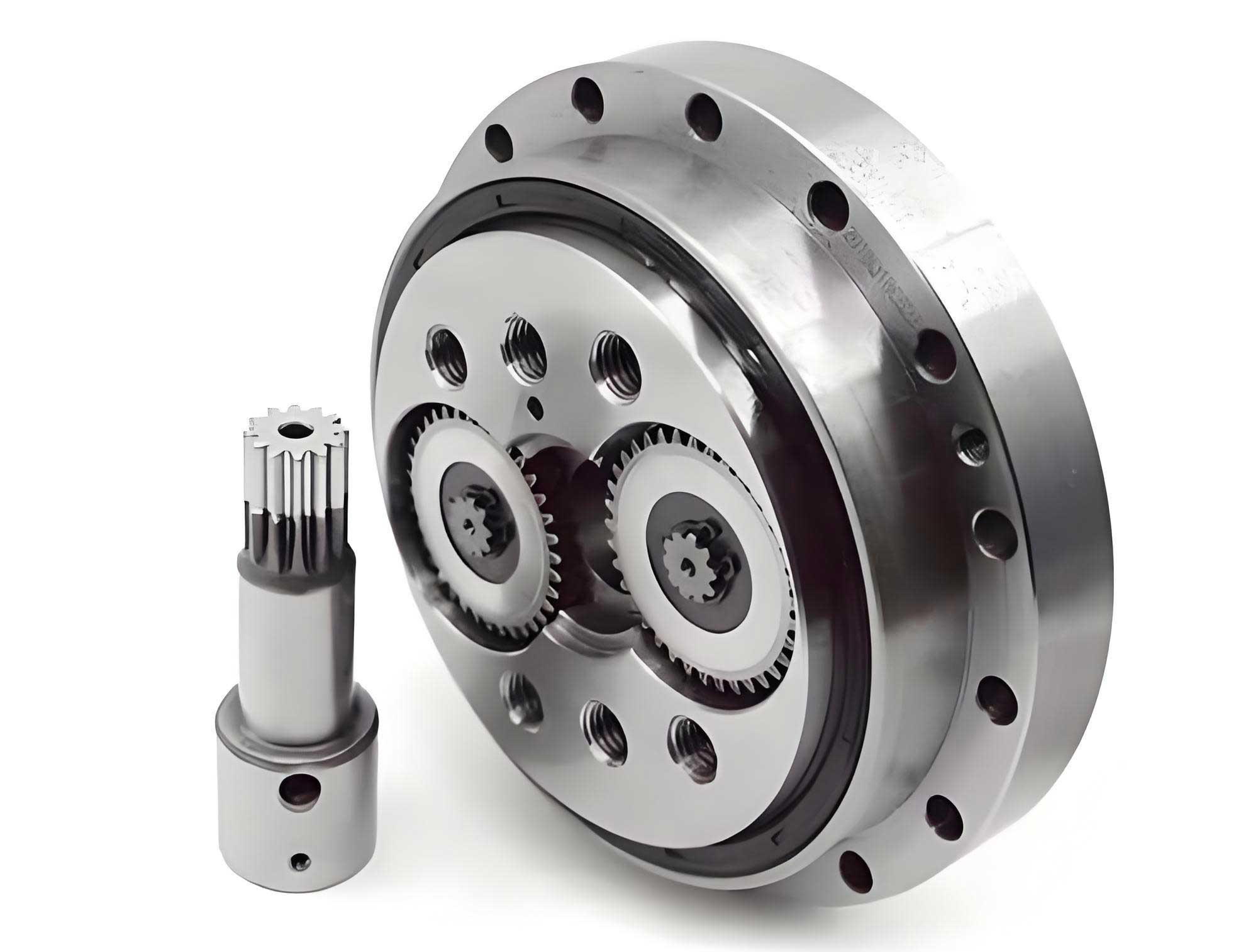
Moving to the force analysis of the rotating arm bearing, we focus on the interaction between the cycloid gear and the crankshaft. The bearing in question is often designed as a needle roller bearing, where the inner race is formed by the crankshaft journal, and the outer race is formed by the bore of the cycloid gear. This integration helps reduce the overall size of the RV reducer but increases the complexity of load distribution. The forces acting on the cycloid gear arise from two primary sources: the engagement with the pin gear and the interaction with the crankshaft via the bearing. To simplify the analysis, we apply a coordinate transformation by imposing a reverse rotation on the entire system equal to the output speed. This allows us to treat the cycloid gear as having only a公转 motion around the center, facilitating the calculation of forces. In this reference frame, the pin gear rotates, and the cycloid gear experiences forces from the pins. The resultant force from the pin gear on the cycloid gear, denoted as \(F_p\), can be decomposed into tangential and radial components, \(F_{pt}\) and \(F_{pr}\), respectively. These components depend on the output torque and geometric parameters of the RV reducer.
Let \(M_c\) be the load torque on the RV reducer, \(r_c\) the average radius of the cycloid gear tooth profile, \(z_{pin}\) the number of pin teeth, \(k_1\) the shortening coefficient (a design parameter for cycloid profiles), \(r_p\) the pitch circle radius of the pin gear, and \(z_c\) the number of cycloid gear teeth. The tangential component \(F_{pt}\) and radial component \(F_{pr}\) are given by:
$$F_{pt} = \frac{M_c}{r_c \cdot z_{pin}}$$
$$F_{pr} = F_{pt} \cdot \tan(\alpha)$$
where \(\alpha\) is the pressure angle, which can be derived from the geometry of the cycloid engagement. For a standard cycloid drive, the relationship can be simplified using the design parameters. Alternatively, based on the provided material, the forces can be expressed as:
$$F_{pt} = \frac{M_c}{r_c \cdot z_{pin}} \cdot k_1$$
$$F_{pr} = \frac{M_c}{r_p} \cdot \frac{z_c}{z_{pin}}$$
These equations highlight how the load torque directly influences the pin gear forces. Next, we consider the forces from the rotating arm bearing on the cycloid gear. These forces, denoted as \(R_i\) for the i-th crankshaft (with i=1,2,3 for a three-crankshaft RV reducer), can be decomposed into three components: \(R_{i1}\), \(R_{i2}\), and \(R_{i3}\). Here, \(R_{i1}\) is a constant force that balances the moment generated by \(F_{pt}\) about the cycloid gear center, \(R_{i2}\) balances the tangential force \(F_{pt}\) itself, and \(R_{i3}\) balances the radial force \(F_{pr}\). Notably, \(R_{i1}\) remains fixed in magnitude and direction relative to the crankshaft, while \(R_{i2}\) and \(R_{i3}\) rotate with the crankshaft, changing direction periodically. Thus, the total bearing force \(R_i\) is the vector sum of a fixed load and two rotating loads.
To quantify these forces, we establish a local coordinate system on each crankshaft, with the x-axis tangent to the crank throw and the y-axis perpendicular to it. The components of \(R_i\) in this system can be derived as follows. Let \(\theta\) be the rotation angle of the crankshaft, measured from a reference position. Then, the fixed component \(R_{i1}\) has a magnitude proportional to the load torque, while the rotating components \(R_{i2}\) and \(R_{i3}\) vary sinusoidally with \(\theta\). The expressions are:
$$R_{i1} = \frac{M_c}{N \cdot r_c} \cdot C_1$$
$$R_{i2} = \frac{M_c}{N \cdot r_p} \cdot \sin(\theta) \cdot C_2$$
$$R_{i3} = \frac{M_c}{N \cdot r_p} \cdot \cos(\theta) \cdot C_3$$
where \(C_1\), \(C_2\), and \(C_3\) are constants derived from the gear geometry and transmission ratio. For the RV-110E model, with parameters such as \(z_{pin} = 40\), \(z_c = 39\), \(r_c = 85 \text{ mm}\), and \(r_p = 100 \text{ mm}\), we can compute these constants. The total force \(R_i\) is then:
$$R_i = \sqrt{(R_{i1} + R_{i2})^2 + R_{i3}^2}$$
This force varies with \(\theta\), and its magnitude cycles between a maximum and minimum value. Using MATLAB or similar tools, we can simulate this variation over one full rotation of the crankshaft. For the RV-110E under额定 load, the maximum force on a single bearing is approximately 7600 N, and the minimum is around 276 N. Under maximum load (2.5 times rated), the forces scale proportionally, reaching up to 19000 N. The table below summarizes the force characteristics for different load conditions, emphasizing the周期性 nature of the loading in the RV reducer.
| Load Condition | Maximum Force (N) | Minimum Force (N) | Variation Pattern |
|---|---|---|---|
| Rated Torque (1078 N·m) | 7600 | 276 | Periodic with crankshaft angle |
| Maximum Torque (2695 N·m) | 19000 | 690 | Periodic with crankshaft angle |
The periodic variation in bearing force is crucial for fatigue analysis, as it leads to alternating stresses that can affect the lifespan of the RV reducer. To visualize this, we plot the force components and the resultant over one rotation. The curves show sinusoidal patterns for the rotating components and a constant offset from the fixed component, resulting in a resultant force that fluctuates between the extremes. This dynamic loading necessitates a detailed stress analysis to ensure the bearing can withstand operational conditions.
Proceeding to stress calculation, we employ finite element analysis (FEA) to determine the contact stresses in the rotating arm bearing under the maximum force condition. The bearing configuration in the RV reducer typically uses needle rollers, with the crankshaft journal as the inner race and the cycloid gear bore as the outer race. The materials are selected for high strength and wear resistance: the crankshaft (inner race) is made of 18CrNiMnMoA steel with an elastic modulus of \(2.12 \times 10^{11} \text{ Pa}\), the rollers are GCr15 bearing steel with a modulus of \(2.19 \times 10^{11} \text{ Pa}\), and the cycloid gear (outer race) is 20CrMo steel with a modulus of \(2.1 \times 10^{11} \text{ Pa}\). All materials have a Poisson’s ratio of 0.3. The key design parameters for the bearing are listed in the table below, which includes dimensions relevant to the RV-110E model.
| Parameter | Value |
|---|---|
| Number of Rollers | 20 |
| Roller Diameter | 6 mm |
| Inner Race Diameter | 30 mm |
| Outer Race Diameter | 42 mm |
| Bearing Width | 20 mm |
For the FEA, we simplify the model to focus on the contact regions between the rollers and the races. Since the bearing is subjected to a radial load, we assume a planar stress state and model a cross-section. The mesh is refined in the contact areas, with element sizes less than 0.01 mm to capture stress gradients accurately. Contact pairs are defined between the roller surfaces and the race surfaces, using a asymmetric contact formulation with the Lagrange multiplier method. Constraints are applied by fixing the outer race exterior, and the maximum force of 19000 N (for maximum load) is applied to the inner race as a pressure load. The solution is computed using elastic theory, though we note that plastic deformation may occur in practice.
The results from the FEA reveal that the maximum contact stress occurs at the interface between the lowermost roller and the inner race, where the load is concentrated. The stress distribution shows a Hertzian contact pattern, with high stresses localized in small areas. The calculated maximum stress is approximately 1569 MPa for the inner race and 1524 MPa for the roller. These values exceed the yield strength of the materials (typically around 1000 MPa for such steels), indicating that elastic analysis alone may overestimate stresses. In reality, the bearing components undergo plastic deformation at contact points, which redistributes stresses and prevents failure. This is acceptable in bearing design, especially when considering factors like surface hardening and lubrication. The stress results are summarized below for both rated and maximum loads, demonstrating how stress scales with force in the RV reducer.
| Load Condition | Maximum Stress on Inner Race (MPa) | Maximum Stress on Roller (MPa) |
|---|---|---|
| Rated Torque | 627.6 | 609.6 |
| Maximum Torque | 1569 | 1524 |
The high stresses underscore the importance of proper bearing selection and design modifications, such as profile crowning on the rollers to reduce edge stresses. Additionally, the periodic force variation implies that fatigue life calculations should account for stress cycles. Using the Palmgren-Miner rule or similar methods, the bearing life can be estimated based on the stress amplitudes and material endurance limits. For the RV reducer, ensuring adequate bearing life is critical for overall reliability, as bearing failure can lead to catastrophic breakdowns in applications like industrial robots.
In conclusion, our analysis of the rotating arm bearing in the RV reducer has provided detailed insights into the force dynamics and stress characteristics. The bearing experiences a complex load that varies periodically with the crankshaft angle, comprising both fixed and rotating components. This variation is directly proportional to the output torque, with forces ranging from a few hundred to thousands of Newtons under different operating conditions. The subsequent stress calculations via finite element analysis reveal that contact stresses can exceed material yield limits, but practical designs accommodate this through plasticity and surface treatments. These findings emphasize the need for careful bearing design and optimization in RV reducers to enhance durability and performance. Future work could explore advanced materials, lubrication effects, or dynamic modeling to further improve the lifespan of these critical components. Ultimately, understanding the mechanical behavior of the rotating arm bearing contributes to the development of more robust and efficient RV reducers for high-precision applications.
Throughout this discussion, we have repeatedly highlighted the role of the RV reducer in modern machinery, underscoring its significance in robotics and automation. The force and stress analyses presented here serve as a foundation for engineers aiming to optimize RV reducer designs, ensuring they meet the demanding requirements of industrial use. By integrating theoretical formulas, computational simulations, and practical considerations, we can advance the state of the art in减速器 technology, paving the way for more reliable and compact systems. The RV reducer, with its unique传动原理, continues to be a focal point in mechanical engineering research, and studies like this one help unlock its full potential.