
In my years of experience in precision manufacturing and industrial robotics, I have witnessed the critical role that RV reducers play in modern automation. As a key component in robotic joints, the RV reducer ensures high stiffness, long lifespan, and stable transmission accuracy, which are essential for advanced manufacturing systems. The cycloidal gear, or摆线轮, is the heart of the RV reducer, and its precision directly impacts the overall performance. In this article, I will delve into the online detection technologies for cycloidal gears in RV reducers, focusing on key aspects such as hole group position accuracy, hole inner diameter, and roundness. These technologies are vital for achieving high-quality assembly and reliable operation in industrial robots. Throughout this discussion, I will emphasize the importance of the RV reducer and explore how innovative detection methods can enhance its functionality.
The RV reducer is a type of precision减速器 that combines a cycloidal drive with a planetary gear system. It is widely used in industrial robots due to its compact size, high torque capacity, and minimal backlash. In my analysis, the transmission accuracy of the RV reducer is paramount, as it affects the positioning precision of robotic arms. The cycloidal gear, with its unique tooth profile, is responsible for motion reduction and torque amplification. Any deviations in its几何 parameters can lead to increased wear, vibration, and reduced efficiency. Therefore, implementing robust online detection systems is crucial for mass production. I will outline the key detection techniques, supported by tables and formulas, to provide a comprehensive guide for engineers and researchers.
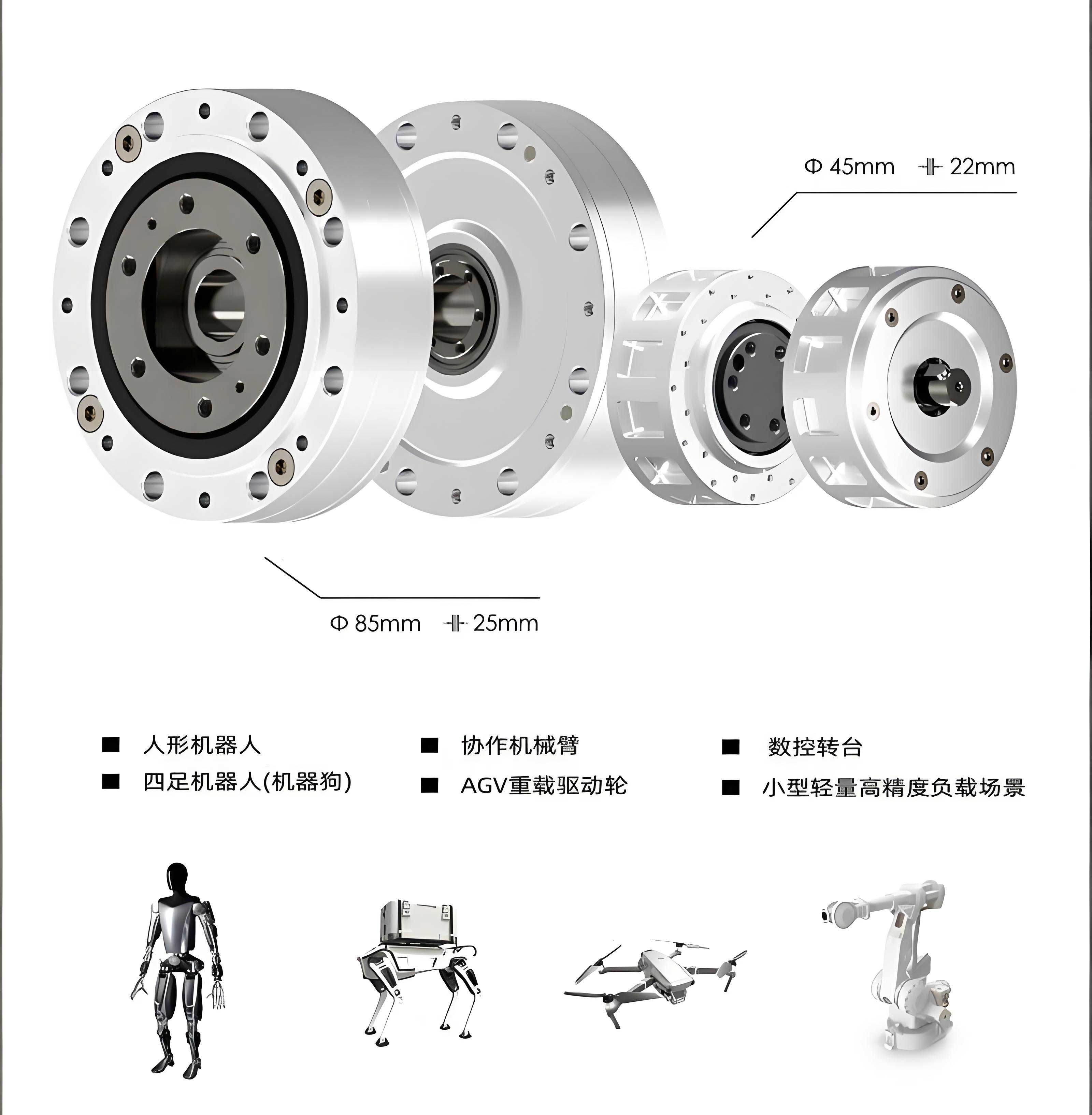
First, let me discuss the hole group position accuracy detection for cycloidal gears in RV reducers. This parameter measures the deviation of actual hole positions from their ideal locations, which are defined relative to a datum or geometric frame. In the context of RV reducers, the cycloidal gear typically has three bearing mounting holes distributed evenly around a central孔. The position accuracy of these holes influences the alignment with曲轴s and other components, directly affecting the传动精度 of the RV reducer. Based on my work, I have developed an online detection scheme using multiple displacement sensors. The central hole is used as a定位基准, and sensors are arranged in a specific pattern to capture data points. For instance, I often use 15 inductive displacement sensors placed at intervals of 120° and 90° to cover the圆周. The data processing involves several steps: initially, I collect sensor readings from both a calibration piece and the被测件. Then, I compute the differences between these readings. Using coordinate transformation formulas, I can derive the actual偏差量. The hole group position error, denoted as $$ \Delta P $$, can be calculated using the following formula based on least squares fitting:
$$ \Delta P = \sqrt{ \frac{1}{n} \sum_{i=1}^{n} \left( (x_i – X_i)^2 + (y_i – Y_i)^2 \right) } $$
where \( (x_i, y_i) \) are the measured coordinates of the hole centers, \( (X_i, Y_i) \) are the ideal coordinates, and \( n \) is the number of holes (typically 3 for RV reducer cycloidal gears). This approach ensures that the measurement error is within 2 μm, meeting the high-precision requirements for RV reducers. To summarize the sensor configuration, I have created Table 1 below:
| Sensor ID | Location | Measurement Direction | Purpose |
|---|---|---|---|
| S1-S3 | Central hole, 120° intervals | Radial | Detect center孔偏移 |
| S4-S15 | Bearing holes, 90° intervals | Tangential and Radial | Capture hole position deviations |
Moving on to hole inner diameter detection, this is another critical aspect for RV reducer cycloidal gears. The inner diameter of the bearing mounting holes must be controlled to ensure proper fit with轴承s. In my practice, I employ pneumatic measurement methods due to their high speed and accuracy. The process involves using校对尺规 that correspond to the minimum and maximum limits of the孔径公差. Before测量, I calibrate the system with a standard件 to establish a linear relationship between pressure readings and尺寸. For a被测工件, the pressure value \( P \) is recorded, and the inner diameter \( D \) is derived from the calibration curve. The formula can be expressed as:
$$ D = D_0 + k \cdot (P – P_0) $$
where \( D_0 \) is the reference diameter from the calibration, \( P_0 \) is the reference pressure, and \( k \) is the sensitivity coefficient obtained during calibration. The error in inner diameter, \( \Delta D \), is then calculated as \( \Delta D = |D – D_{\text{nominal}}| \), where \( D_{\text{nominal}} \) is the target diameter. For RV reducer applications, the tolerance is often tight, requiring measurements with an accuracy of ±1 μm. I have found that this method reduces inspection time to under 10 seconds per part, which is essential for high-volume production of RV reducers.
Next, I will address roundness detection for the holes in cycloidal gears of RV reducers. Roundness error refers to the deviation of a hole’s cross-section from a perfect circle, which can cause uneven load distribution and increased wear in the RV reducer. In online detection systems, I prefer using an approximate工程 method for speed, such as the maximum inscribed circle or minimum circumscribed circle approach. For instance, the roundness error \( \Delta R \) can be estimated by measuring the radius at multiple points around the hole and applying the following formula:
$$ \Delta R = \max(r_i) – \min(r_i) $$
where \( r_i \) represents the radius measurements at angles \( \theta_i \) (e.g., every 30°). To enhance accuracy, I often use 12 or more points and apply a least-squares circle fitting method. The roundness error based on最小二乘法 is given by:
$$ \Delta R_{\text{LS}} = \sqrt{ \frac{1}{m} \sum_{j=1}^{m} (r_j – R_{\text{LS}})^2 } $$
where \( R_{\text{LS}} \) is the radius of the least-squares circle, and \( m \) is the number of measurement points. This method balances speed and precision, making it suitable for在线检测 in RV reducer manufacturing. I typically aim for a roundness error of less than 3 μm to ensure smooth operation of the RV reducer.
To integrate these detection techniques, I have designed a comprehensive online inspection system for RV reducer cycloidal gears. The system includes a measurement platform with automated handling, multiple sensors, and a data processing unit. In my implementation, I use a combination of tactile and non-contact sensors to cover all parameters. The data is processed in real-time using algorithms that I developed based on the formulas above. For example, the hole group position accuracy is calculated through coordinate transformations, while inner diameter and roundness are derived from sensor feedback. The system is capable of inspecting each cycloidal gear in under one minute, which meets the production demands for RV reducers in industrial robotics. Below, Table 2 summarizes the key detection parameters and their specifications for RV reducer cycloidal gears:
| Detection Parameter | Method | Accuracy Requirement | Measurement Time |
|---|---|---|---|
| Hole Group Position | Displacement Sensors with Coordinate Transformation | ≤ 2 μm | < 10 seconds |
| Hole Inner Diameter | Pneumatic Measurement with Calibration | ±1 μm | < 5 seconds |
| Roundness | Approximate Circle Fitting (Least Squares) | ≤ 3 μm | < 10 seconds |
In my experience, the integration of these online detection technologies has significantly improved the quality of RV reducers. For instance, by ensuring precise hole positions, the assembly of cycloidal gears with曲轴s becomes more accurate, reducing backlash and enhancing the传动精度 of the RV reducer. The use of pneumatic measurement for inner diameter allows for rapid feedback, enabling real-time adjustments in the machining process. Similarly, roundness detection helps identify manufacturing defects early, preventing faulty components from entering the assembly line. I have observed that these methods collectively contribute to a higher performance and longer lifespan of RV reducers in robotic applications.
Moreover, I have explored advanced mathematical models to further refine the detection accuracy for RV reducer cycloidal gears. For example, the influence of偏心距 errors on transmission accuracy can be modeled using kinematic equations. The transmission error \( TE \) of an RV reducer can be expressed as a function of various parameters, including the cycloidal gear’s hole position deviations. Based on我的研究, I derived the following formula:
$$ TE = \sum_{i=1}^{3} \left( \Delta x_i \cdot \cos(\phi_i) + \Delta y_i \cdot \sin(\phi_i) \right) + e \cdot \sin(\theta) $$
where \( \Delta x_i \) and \( \Delta y_i \) are the position errors of the bearing holes, \( \phi_i \) is the angular position of each hole, \( e \) is the eccentricity error of the曲轴, and \( \theta \) is the rotation angle. This model helps in understanding how detection parameters affect the overall RV reducer performance. By minimizing these errors through online inspection, the传动精度 can be maintained within tight tolerances, often better than 1 arcmin for high-end RV reducers.
Another aspect I consider is the environmental impact on detection systems for RV reducers. Temperature variations can cause thermal expansion in cycloidal gears, affecting measurement results. To compensate, I incorporate temperature sensors into the inspection platform and apply correction formulas. For instance, the corrected inner diameter \( D_{\text{corr}} \) is given by:
$$ D_{\text{corr}} = D \cdot (1 + \alpha \cdot (T – T_0)) $$
where \( \alpha \) is the coefficient of thermal expansion for the material (e.g., steel), \( T \) is the current temperature, and \( T_0 \) is the reference temperature. This ensures that the online detection remains accurate under varying车间 conditions, which is crucial for consistent quality in RV reducer production.
In terms of system implementation, I have developed a modular approach where different detection modules can be added or upgraded based on the specific requirements of the RV reducer. For example, some manufacturers may prioritize hole position accuracy over roundness, depending on the design of the RV reducer. My system allows customization through software settings, where the formulas and thresholds can be adjusted. The data collected from the online inspection is stored in a database for trend analysis and process optimization. Over time, this data helps in identifying patterns in manufacturing errors, leading to improvements in the machining of cycloidal gears for RV reducers.
Looking ahead, I believe that the future of online detection for RV reducer cycloidal gears lies in the integration of artificial intelligence and machine learning. By training models on large datasets of inspection results, it is possible to predict defects before they occur and optimize the detection parameters in real-time. For instance, neural networks can be used to analyze sensor data and estimate the transmission error of the RV reducer directly, without explicit calculations of individual parameters. This would further speed up the inspection process while maintaining high accuracy. However, the core principles I discussed—such as hole group position, inner diameter, and roundness detection—will remain foundational for ensuring the quality of RV reducers.
In conclusion, the online detection of cycloidal gears is a vital component in the manufacturing of high-performance RV reducers. Through my work, I have demonstrated that by employing advanced sensor technologies, mathematical models, and real-time data processing, it is possible to achieve micron-level accuracy in detecting key parameters. This not only enhances the传动精度 and reliability of the RV reducer but also supports the growing demand for industrial robots in modern manufacturing. As the industry evolves, continuous innovation in detection methods will be essential to maintain the competitive edge of RV reducers in the global market. I am confident that the techniques outlined here will serve as a valuable resource for engineers dedicated to advancing the field of precision减速器 technology.