
In the realm of mechanical power transmission, spur gears remain a fundamental component due to their simplicity and efficiency. The accurate prediction of their contact behavior, especially under high-load conditions, is paramount for reliable design and longevity. A critical factor influencing this behavior is the actual topography of the tooth surface, which is inherently shaped by the manufacturing process. Traditional simulation methods often rely on idealized geometric models, which, while computationally efficient, fail to capture the nuanced surface features imparted by real machining operations, such as the characteristic cutter marks or “milling passes.” These micro-scale features can act as stress concentrators, initiating localized contact stresses that may lead to premature pitting and eventual gear failure. Therefore, generating a virtual model that closely replicates the surface produced by physical machining is crucial for conducting meaningful and predictive finite element analysis (FEA).
This article details a methodology developed for the high-fidelity virtual simulation of the gear shaping process for spur gears. The core objective is to transcend the limitations of purely theoretical tooth profiles by digitally replicating the precise kinematics and parameters of the physical shaping operation. The process is implemented within the CATIA V5 environment, leveraging its robust modeling, assembly, and automation capabilities. Subsequently, the accuracy of the virtually machined tooth surface is rigorously quantified. Finally, the functional significance of the simulated surface features is validated through a comparative finite element analysis against a geometrically perfect, reconstructed model, demonstrating the critical importance of manufacturing-accurate models in stress prediction.
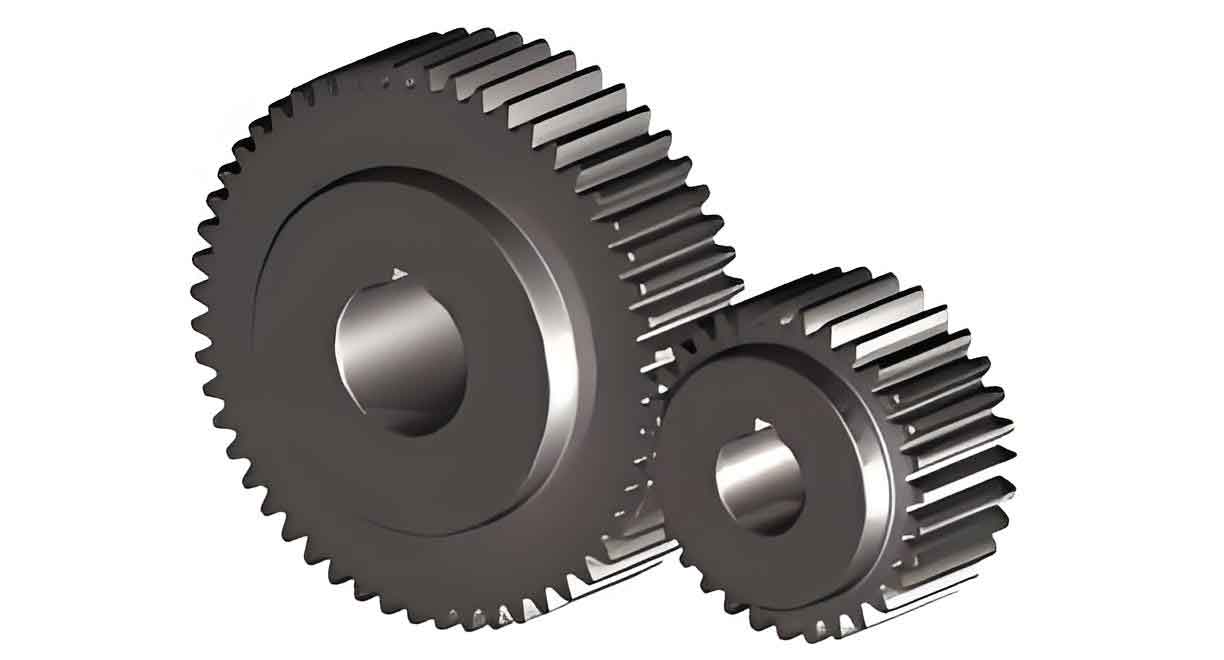
High-Precision Virtual Shaping of Spur Gears in CATIA
The gear shaping process is essentially a discontinuous form generation based on the principle of conjugate action, simulating the meshing of a pair of spur gears. One gear, the cutter, is given appropriate cutting angles (rake and relief), while the other represents the blank. Our virtual methodology meticulously replicates this interaction within a digital space.
Principles and Kinematics of Shaping
The primary motion in shaping is the high-speed reciprocating stroke of the cutter along the axis of the gear blank. The generating motion, which produces the involute profile, is the rolling action without slip between the pitch circles of the cutter and the blank. This is mathematically defined by the constant angular velocities of the cutter (ω₀) and the blank (ω₁), related by their tooth numbers (z₀, z₁):
$$
\frac{\omega_1}{\omega_0} = \frac{z_0}{z_1}
$$
During each stroke, the cutter tooth occupies a successive position relative to the blank (Positions I, II, III, IV…). The envelope of all these consecutive positions forms the complete involute tooth profile on the spur gear. In the virtual domain, this is achieved by iteratively positioning the cutter model and performing Boolean subtraction operations from the blank model.
Modeling of Cutter and Gear Blank
To balance computational demand with accuracy, a simplified yet precise cutter model is employed. A high-detail 3D model of the shaping cutter, incorporating corrected tooth profile angles to compensate for rake angle effects, is first created. Its cutting edge profile is then projected onto a plane and extruded to form the solid tool body used for Boolean operations. Key parameters for the shaping cutter and the target spur gear are summarized below:
| Component | Parameter | Symbol | Value | Unit |
|---|---|---|---|---|
| Shaping Cutter | Module | m | 2 | mm |
| Number of Teeth | z₀ | 38 | – | |
| Rake Angle | α | 5 | ° | |
| Relief Angle | β | 6 | ° | |
| Addendum Coefficient | ha0* | 1.25 | – | |
| Tip Radius | rtip | 0.15 | mm | |
| Spur Gear (Target) | Module | m | 2 | mm |
| Number of Teeth | z₁ | 20 | – | |
| Pressure Angle | φ | 20 | ° | |
| Face Width | b | 20 | mm | |
| Addendum Coefficient | ha1* | 1.0 | – |
The gear blank is modeled as a simple cylinder with a diameter equal to the gear’s addendum diameter. The virtual machining aims to carve out the tooth spaces from this blank to produce the final spur gear.
Simulation Workflow and Automation via VBA
The simulation follows a structured, automated loop to replicate the intermittent cutting action. The process is controlled via CATIA’s VBA (Visual Basic for Applications) environment to ensure precision and repeatability.
- Initialization: The cutter and blank models are assembled at the standard center distance for the pair of spur gears.
- Positioning and Cutting Loop: A core loop is executed where for each increment
i:- The cutter is rotated by an angular step Δθ (circumferential feed) about its own axis.
- The blank is simultaneously rotated by a corresponding angle Δθ’ = Δθ * (z₀/z₁) about its axis to maintain pure rolling at the pitch circles.
- A Boolean subtraction of the cutter from the blank is performed, representing one cutting stroke.
- Memory Management: To prevent excessive memory load from accumulating Boolean operation history, the partially machined blank is periodically extracted, and its relative position to the cutter is saved. A new assembly is then created from these saved states to continue the process.
- Termination: The loop continues until the tool has traversed the entire circumference of the blank, resulting in a fully formed spur gear model with visible, simulated milling passes.
The total number of cutting steps (N) and thus the density of milling passes on the final spur gear tooth flank is governed by the chosen angular feed increment Δθ:
$$
N = \frac{\pi m z_1}{\Delta \theta}
$$
Smaller Δθ values result in a higher number of cutting steps, producing a finer, more accurate envelope that better approximates a true involute. The following table and figure illustrate the impact of this key simulation parameter on the visual fidelity of the generated spur gears.
| Circumferential Feed Δθ (mm) | Approx. Angular Step | Number of Cutting Steps (N) | Resulting Surface Texture |
|---|---|---|---|
| 0.4 | Larger | Lower | Coarse, visibly segmented milling passes. |
| 0.2 | Medium | Medium | Fine, smooth milling passes; representative of finishing cuts. |
| 0.1 | Smaller | Higher | Very fine, near-continuous surface; high computational cost. |
Quantitative Accuracy Assessment of the Simulated Spur Gear Tooth Flank
Verifying the geometric accuracy of the virtually machined spur gear is essential. Since the simulation occurs in an ideal environment (no machine tool errors, deflections, etc.), the primary deviation stems from the discrete nature of the envelope process. The assessment focuses on the points lying on the simulated milling passes, as these represent the actual cut surface.
Methodology for Error Measurement
A theoretical, perfect involute curve for the spur gear is generated using the standard parametric equations, where \( r_b \) is the base radius and \( u \) is the involute roll angle:
$$
x = r_b (\sin u – u \cos u) \\
y = r_b (\cos u + u \sin u)
$$
This ideal curve is imported into the CATIA assembly containing the simulated spur gear. It is positioned in the mid-plane of the gear and aligned so that it intersects the pitch circle at the theoretical pitch point. For each intersection point where a milling pass meets the gear’s transverse plane, the normal distance from that point to the theoretical involute curve is measured. This normal distance represents the local profile form error at that specific point on the spur gear’s tooth flank.
Analysis of Error Distribution and Influence of Δθ
The collected error data is plotted against the roll distance from the pitch point (positive towards the addendum, negative towards the dedendum). Analysis of these plots for simulations with different Δθ values reveals consistent trends:
- Error Pattern: The error is minimal near the pitch point and increases towards both the tooth tip and root. This manifests as slight undercutting (root) and tip relief (tip) in the simulated spur gear, which is a direct consequence of the cutter profile correction applied to compensate for its rake angle. This correlation confirms that the virtual process correctly replicates a real physical effect.
- Convergence with Finer Feed: As the circumferential feed Δθ decreases (from 0.4 mm to 0.1 mm), the magnitude of the error generally decreases, and the error curve becomes smoother, indicating convergence towards the theoretical profile.
- Practical Validation: The error reduction between Δθ = 0.2 mm and Δθ = 0.1 mm is marginal. The significant gain in accuracy occurs when moving from a coarse feed (0.4 mm) to a medium feed (0.2 mm). This finding aligns with standard industrial practice, where a feed of 0.2 mm is commonly specified for the finishing cut in actual spur gear shaping operations, validating the practical relevance of the simulation parameters.
The following table summarizes the maximum observed profile error for different simulation settings, highlighting the trade-off between precision and computational effort for these spur gears.
| Simulation ID | Circumferential Feed Δθ (mm) | Max Error at Tip (μm) | Max Error at Root (μm) | Relative Computational Cost |
|---|---|---|---|---|
| Sim_01 | 0.4 | ~45 | ~38 | Low |
| Sim_02 | 0.2 | ~22 | ~18 | Medium |
| Sim_03 | 0.1 | ~20 | ~16 | High |
Finite Element Analysis: Significance of Simulated Surface Topography
To evaluate the engineering significance of the virtually machined surface features on spur gears, a comparative finite element analysis was conducted. The spur gear model generated with a Δθ of 0.4 mm (exhibiting clear milling passes) was selected for comparison against a “perfect” model.
Model Preparation for FEA
1. Virtual Shaping Model: This model retains all the milling pass features from the CATIA simulation.
2. Reconstructed Model: The same virtual model was processed using a B-spline surface fitting technique. This operation creates a perfectly smooth tooth flank, effectively erasing all milling pass information, resulting in an idealized geometric model of the spur gear.
Both models were discretized using high-precision meshing in HyperMesh. Special attention was paid to the contact regions. For the virtual shaping model, the mesh was refined along the paths of the milling passes to ensure nodes were located at these potential stress concentrators. The material properties for 40Cr steel were assigned: Elastic Modulus E = 211 GPa, Poisson’s ratio ν = 0.277. A friction coefficient of 0.1 was defined for tooth contact.
Analysis Setup and Comparative Results
A single-tooth, 3D static contact analysis was set up in Abaqus. The driving gear was subjected to a smooth ramp of rotational displacement, while the driven gear (the analyzed spur gear) had a constant resisting torque of 25 N·m applied. The primary output of interest was the maximum contact stress (Hertzian pressure) on the tooth flanks during the meshing cycle.
The results demonstrated a profound difference between the two models:
- Reconstructed (Smooth) Model: Exhibited a relatively smooth, periodic variation of maximum contact stress during meshing. The peak stress observed was approximately 716 MPa, located in the region of single-tooth contact near the pitch line, which is a typical and expected result for spur gears.
- Virtual Shaping Model: Showed a significant periodic fluctuation superimposed on the expected stress curve. The maximum contact stress peaked at approximately 868 MPa, representing an increase of about 21% over the smooth model. This peak consistently occurred when the contact zone traversed a milling pass line. The stress variation relative to the smooth model’s baseline ranged from -30% to +40% throughout the engagement cycle.
| Spur Gear Model Type | Key Feature | Peak Contact Stress (MPa) | Stress Fluctuation vs. Smooth Model | Probable Failure Initiation Site |
|---|---|---|---|---|
| Reconstructed (Ideal) | Smooth Involute Flank | ~716 | Baseline (None) | Subsurface, near pitch line |
| Virtual Shaping (Simulated) | With Milling Passes | ~868 | -30% to +40% | Surface, along milling pass lines |
The formula for contact stress, while complex in 3D, is rooted in Hertzian theory. The local curvature, significantly altered by the milling pass, is a direct input. The local principal curvature \( \kappa_{local} \) at a point on a milling pass can be expressed as the sum of the ideal involute curvature \( \kappa_{involute} \) and a perturbation \( \delta \kappa \) caused by the pass geometry:
$$
\kappa_{local} = \kappa_{involute} + \delta \kappa
$$
This altered curvature feeds into the contact stress calculation, leading to the observed fluctuations. This comparative analysis conclusively proves that the microscopic topography, accurately captured by the virtual shaping process, is not a negligible detail. It fundamentally alters the contact stress field in spur gears. The milling passes act as persistent stress risers, providing precise locations for the initiation of pitting and wear, which aligns with empirical observations of gear failure modes. An analysis based solely on a perfectly smooth model would significantly underestimate the risk and mispredict the location of initial surface damage in real spur gears.
Conclusion
This work has presented and validated a comprehensive methodology for the high-precision virtual machining and analysis of spur gears. By implementing a kinematics-accurate simulation of the gear shaping process within CATIA V5 and automating it via VBA, we successfully generated digital models of spur gears that incorporate the authentic surface topography—namely, the milling passes—resulting from discrete cutting actions. The geometric accuracy of these models was verified against theoretical involutes, showing error patterns consistent with actual cutter physics and converging with industry-standard finishing feeds.
The core contribution, however, lies in the finite element validation. The comparative stress analysis between the virtually machined spur gear model and its geometrically perfect, smoothed counterpart delivered a critical insight: the manufacturing-induced surface features have a decisive impact on contact mechanics. The simulated milling passes caused substantial fluctuations (from -30% to +40%) and a significant peak increase (~21%) in contact stress. This confirms that these micro-features are primary candidates for stress concentration and the initiation of contact fatigue failures like pitting.
Therefore, for high-fidelity durability analysis and predictive design of spur gears, especially for high-performance applications, moving beyond idealized geometry is essential. The proposed virtual shaping method provides a viable and effective pathway to generate manufacturing-realistic models. This approach is not limited to shaping but can be conceptually extended to other gear generation processes like hobbing or grinding for spur and helical gears, offering a versatile framework for enhancing the reliability of gear design through simulation.