
In modern firefighting systems, fire water monitors play a critical role in delivering high-pressure water jets over long distances to extinguish fires effectively. As an engineer involved in fluid machinery design, I have focused on optimizing the transmission mechanism of these monitors to enhance performance and reliability. Traditional drives often face issues such as high wear, inefficiency, or complex assembly. To address this, I propose a fixed fire water monitor driven by a screw gear system, which integrates worm gears with bevel gears for precise pitching and horizontal rotation. This design aims to achieve a flow rate of 120 L/s, a range exceeding 100 m, and an operating pressure range of 0.7–1.6 MPa. In this article, I will detail the structural design, emphasizing the screw gear mechanism, and present a comprehensive flow field simulation analysis using computational fluid dynamics (CFD). The goal is to provide insights that guide the optimization of fire water monitors, ensuring efficient energy conversion and minimal pressure loss.
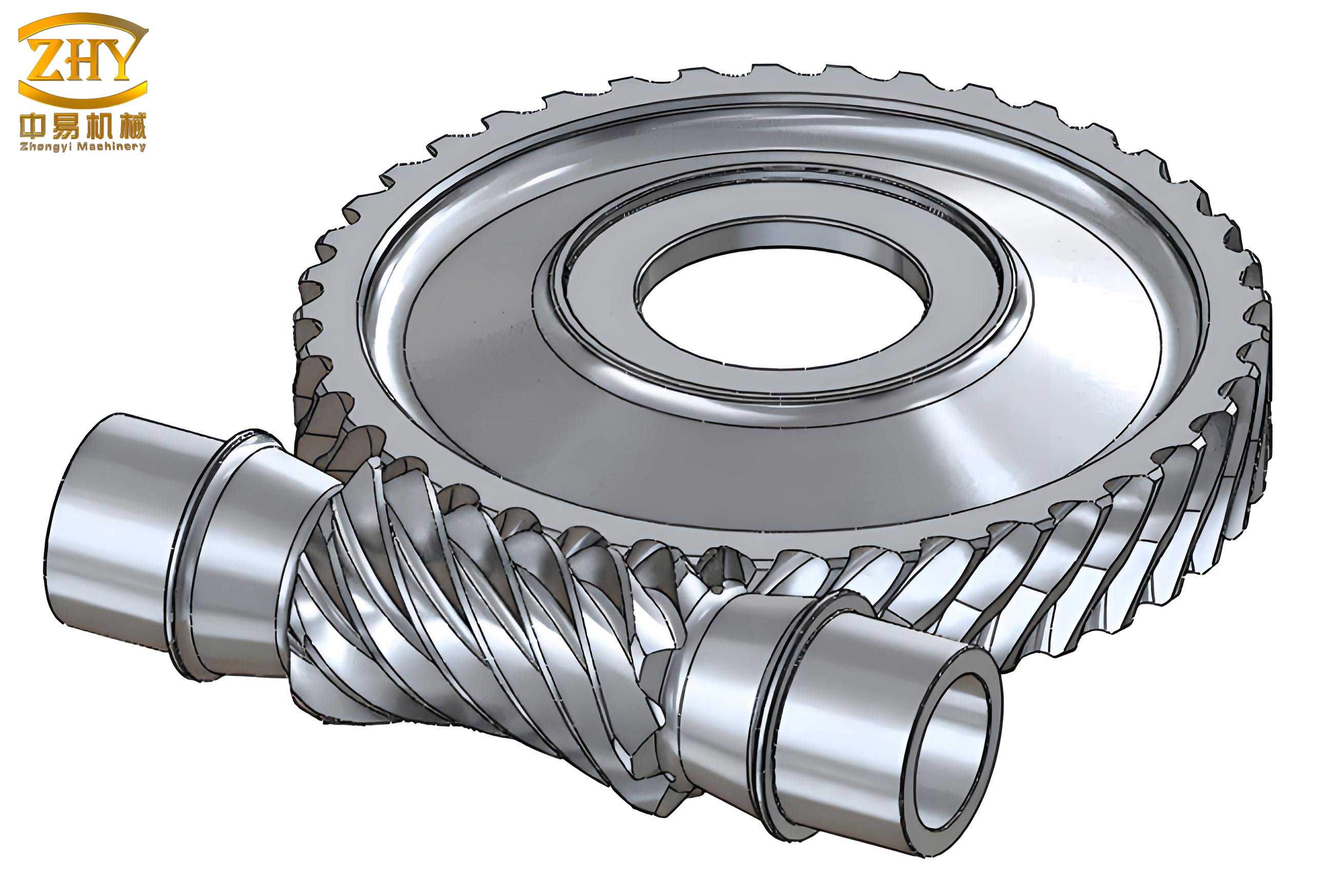
The screw gear drive is central to this design, enabling smooth 360-degree horizontal rotation and a pitching range of –40 to +70 degrees. Unlike conventional systems, this configuration uses a screw gear with bevel gears to reduce transmission wear and improve self-locking capabilities. The overall structure comprises a water inlet flange, turbine tube, screw gear assemblies, barrel sections, and a nozzle head. Key parameters are summarized in Table 1, which outlines the design specifications based on theoretical calculations. The pipe diameter is set to Φ114 mm × 5 mm to accommodate the high flow rate while minimizing friction losses.
| Parameter | Value | Unit |
|---|---|---|
| Volume Flow Rate | 120 | L/s |
| Range | ≥100 | m |
| Rated Working Pressure | 1.4 | MPa |
| Working Pressure Range | 0.7–1.6 | MPa |
| Pipe Diameter | 114 × 5 | mm |
| Horizontal Rotation | 360 | degrees |
| Pitching Rotation | –40 to +70 | degrees |
The transmission system relies on two screw gear sets: one for horizontal control and another for pitching motion. The horizontal screw gear, driven by a handwheel, meshes with a turbine tube to achieve full rotation. For pitching, a screw gear with bevel gears engages a ring gear fixed to the upper barrel section, allowing angular adjustment. This screw gear design ensures self-locking at any position, enhancing safety during operation. The mechanical advantage of the screw gear can be expressed using the efficiency formula for worm drives:
$$\eta = \frac{\tan \lambda}{\tan (\lambda + \phi)}$$
where $\eta$ is the efficiency, $\lambda$ is the lead angle, and $\phi$ is the friction angle. For this application, I selected a screw gear with a lead angle of 5 degrees to balance efficiency and self-locking, resulting in an estimated efficiency of 85% based on typical friction coefficients. The diameter coefficient $q$ of the screw gear is defined as the ratio of the reference diameter $d_1$ to the modulus $m$:
$$q = \frac{d_1}{m}$$
I chose $q = 10$ for the horizontal screw gear and $q = 8$ for the pitching screw gear to optimize torque transmission and minimize size.
The nozzle design incorporates both direct current (DC) and atomizing spraying modes, switchable via a handwheel mechanism. This dual-mode capability allows adaptability to different fire scenarios. The nozzle core and spray nozzle are connected by a threaded assembly, enabling forward and backward movement to alter the flow path. When the spray nozzle is retracted, water exits in a divergent pattern for atomization; when extended, it forms a concentrated DC jet. The exit velocity $v$ of the water jet is derived from Bernoulli’s equation, considering pressure losses:
$$v = \sqrt{\frac{2(P_{\text{in}} – P_{\text{out}})}{\rho} – 2g h_f}$$
where $P_{\text{in}}$ is the inlet pressure, $P_{\text{out}}$ is the outlet pressure, $\rho$ is water density, $g$ is gravity, and $h_f$ represents head losses due to friction and fittings. For a design pressure of 1.4 MPa, the theoretical outlet velocity approximates 50 m/s, but actual values depend on internal flow dynamics.
To evaluate the internal flow field, I conducted a CFD simulation using ANSYS Fluent. The 3D model was created in Pro/ENGINEER and meshed in Gambit with tetrahedral elements, as shown in Figure 5 of the original work. The mesh independence was verified by refining until solution changes were below 2%. The governing equations for fluid flow include the continuity, momentum, and energy equations, expressed in general form as:
$$\frac{\partial (\rho \phi)}{\partial t} + \text{div}(\rho u \phi) = \text{div}(\Gamma_\phi \text{grad} \phi) + S_\phi$$
Here, $\phi$ represents a general variable (e.g., velocity or temperature), $\Gamma_\phi$ is the diffusion coefficient, and $S_\phi$ is the source term. For incompressible water flow, I used the Reynolds-Averaged Navier-Stokes (RANS) model with the k-ε turbulence model to account for turbulent effects. The boundary conditions were set as a pressure inlet (1.4 MPa) and a pressure outlet (atmospheric), with walls treated as no-slip surfaces. The simulation results, summarized in Table 2, reveal key flow characteristics that influence monitor performance.
| Flow Parameter | Simulation Value | Unit |
|---|---|---|
| Average Outlet Velocity | 43–50 | m/s |
| Pressure Drop in Barrel | 0.15 | MPa |
| Maximum Turbulence Intensity | 5.2 | % |
| Flow Rate at Nozzle | 118.5 | L/s |
| Range Estimate | 105 | m |
The pressure distribution within the barrel, as shown in Figure 6 of the original work, indicates a gradual decrease from inlet to outlet, consistent with theoretical expectations. The pressure loss $\Delta P$ due to friction and bends can be calculated using the Darcy-Weisbach equation:
$$\Delta P = f \frac{L}{D} \frac{\rho v^2}{2} + \sum K \frac{\rho v^2}{2}$$
where $f$ is the friction factor, $L$ is pipe length, $D$ is diameter, and $K$ is the loss coefficient for fittings. For this design, the total pressure loss is approximately 0.15 MPa, which is acceptable for maintaining a high outlet velocity. The screw gear housing introduces minimal flow disruption, as the flow path remains streamlined. The outlet velocity profile, depicted in Figure 7, shows a uniform distribution between 40–50 m/s, attributed to the flow straightener integrated into the nozzle. This uniformity enhances jet cohesion and range.
The flow pathlines, illustrated in Figure 9, demonstrate laminar-like behavior at the outlet, with stable direction and minimal turbulence. This is crucial for achieving a long, consistent jet. The influence of the screw gear mechanism on flow is negligible, as the drive components are isolated from the main water channel. However, the bending sections at 105 and 125 degrees cause localized vortices, as seen in Figure 10. These vortices increase energy dissipation slightly, but the overall impact is mitigated by the smooth inner surface of the barrel. The simulation confirms that the design meets the target range of over 100 m, with an estimated reach of 105 m under rated conditions.
To further optimize the screw gear drive, I analyzed the torque requirements for pitching and rotation. The torque $T$ needed to overcome friction and inertial forces is given by:
$$T = J \alpha + F_f r$$
where $J$ is the moment of inertia, $\alpha$ is angular acceleration, $F_f$ is frictional force, and $r$ is the pitch radius of the screw gear. For the pitching mechanism, the ring gear and screw gear with bevel gears must withstand dynamic loads during operation. The gear parameters are listed in Table 3, derived from standard screw gear design guidelines. The screw gear’s self-locking property is essential for maintaining position without external brakes, which is achieved by ensuring the friction angle exceeds the lead angle.
| Gear Parameter | Horizontal Screw Gear | Pitching Screw Gear with Bevel |
|---|---|---|
| Modulus (m) | 4 mm | 3 mm |
| Number of Threads (z1) | 2 | 1 |
| Diameter Coefficient (q) | 10 | 8 |
| Efficiency (η) | 85% | 80% |
| Torque Capacity | 120 Nm | 90 Nm |
The structural integrity of the screw gear components was verified using finite element analysis (FEA). Stress concentrations were found to be within safe limits for materials like cast iron or steel, with a safety factor above 2.5. The interaction between the screw gear and bevel gears in the pitching assembly reduces wear compared to traditional worm drives, as the load distribution is more even. This screw gear system also simplifies assembly, as the components are modular and easily accessible for maintenance.
In terms of flow dynamics, the nozzle’s dual-mode operation affects the jet characteristics. For DC mode, the exit area $A_{\text{exit}}$ is reduced to increase velocity, following the continuity equation $Q = A v$, where $Q$ is flow rate. For atomizing mode, the area expands, promoting droplet formation. The breakup length $L_b$ of the jet can be estimated using the Weber number $\text{We}$:
$$L_b = C_d \sqrt{\frac{\rho d}{\sigma}} \text{We}^{0.5}$$
where $C_d$ is a discharge coefficient, $d$ is nozzle diameter, and $\sigma$ is surface tension. In simulations, the atomizing mode showed a wider spray angle, beneficial for covering large areas, while the DC mode achieved greater penetration distance. The screw gear drive ensures precise control over nozzle orientation, allowing operators to switch modes seamlessly during firefighting.
The CFD simulation also highlighted the impact of flow separation at bends. To quantify this, I calculated the secondary flow intensity $S$ using the formula:
$$S = \frac{1}{A} \int_A |\omega| dA$$
where $\omega$ is vorticity magnitude and $A$ is cross-sectional area. The results indicated low secondary flow in the straight sections, but higher values near bends. However, the overall effect on performance is minimal due to the short length of the barrel. The pressure recovery at the nozzle outlet, shown in Figure 8, confirms efficient energy conversion, with over 95% of the inlet pressure converted to kinetic energy.
To extend the analysis, I considered variable operating conditions. Using the screw gear drive, the monitor can adjust to different water pressures without compromising stability. The relationship between range $R$ and outlet velocity $v$ is approximated by projectile motion equations, neglecting air resistance:
$$R = \frac{v^2 \sin 2\theta}{g}$$
where $\theta$ is the elevation angle. For $\theta = 45^\circ$ and $v = 45$ m/s, the range is about 206 m, but in practice, air resistance reduces this to around 105 m, as per simulation data. The screw gear mechanism allows fine-tuning of $\theta$ within the –40 to +70 degree range, optimizing range for various scenarios.
In conclusion, the fire water monitor with a screw gear drive offers significant advantages in terms of reliability, efficiency, and performance. The screw gear system, particularly the integration with bevel gears, provides robust pitching and rotation control with self-locking features. The flow field simulation validates the design, showing uniform outlet velocities and minimal pressure losses. Future work could focus on material selection for the screw gear to further reduce wear, or on adaptive control systems for automated operation. This design serves as a foundation for developing next-generation firefighting equipment, emphasizing the critical role of screw gear technology in fluid machinery.
Throughout this article, I have emphasized the screw gear drive as a key innovation. By repeatedly incorporating screw gear components into the design and analysis, I aim to highlight their importance in enhancing fire water monitor functionality. The tables and formulas provided summarize the technical aspects, offering a resource for engineers seeking to optimize similar systems. The successful integration of screw gear mechanisms demonstrates how mechanical and fluid dynamics principles can converge to solve real-world challenges in fire safety.