
The transmission of power in heavy-duty industrial machinery, particularly within the demanding environment of mining operations, relies heavily on robust and reliable gear systems. Among these, spur gears remain a fundamental choice due to their straightforward design, ease of manufacturing, and efficient power transfer capabilities. The operational integrity of mining equipment, such as conveyors, crushers, and especially reducers, is directly linked to the performance and longevity of these spur gears. Failure modes like pitting, scuffing, and most critically, tooth bending fracture, are primarily governed by the complex and dynamically fluctuating states of contact stress and root bending stress experienced during meshing. Traditional design methodologies often rely on simplified static strength checks, such as Hertzian contact theory for surface stresses and the 30° tangent or cantilever plate methods for bending stresses. While these methods provide a foundational assessment, they fall short of capturing the transient, dynamic nature of the stress fields that develop as gear teeth engage and disengage throughout the rotation cycle. This gap necessitates a more sophisticated approach to accurately predict stress histories, optimize design parameters, and enhance the reliability of spur gears in critical applications.
This article presents a comprehensive methodology that integrates parametric computer-aided design (CAD) with advanced dynamic nonlinear finite element analysis (FEA) to investigate the strength characteristics of spur gears. The core objective is to move beyond static approximations and simulate the real-world dynamic loading conditions within a gear pair. We employ a two-stage process: first, the rapid generation of precise three-dimensional gear models using parametric modeling techniques; second, the execution of an explicit dynamic analysis coupled with sub-modeling technology to obtain high-fidelity, time-resolved data on contact and bending stresses. This integrated approach not only improves the accuracy and efficiency of stress calculation but also establishes a framework for the parametric and series-based design optimization of spur gears.
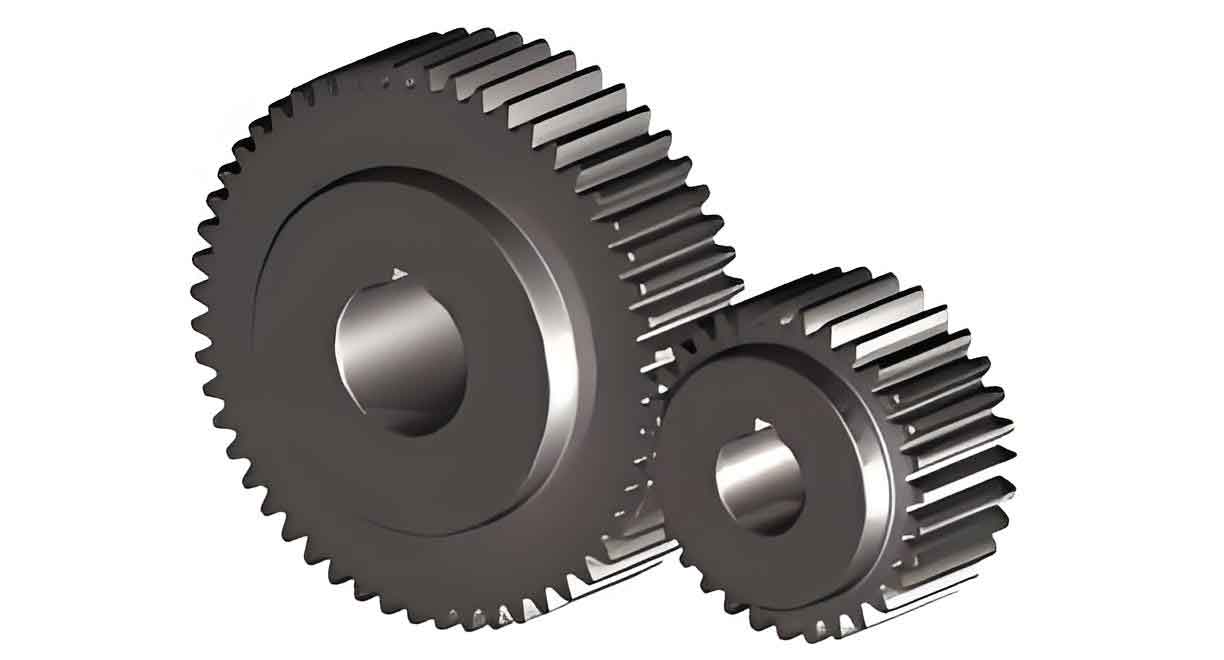
Fundamentals of Spur Gear Geometry and Parametric Modeling
The geometry of a standard involute spur gear is defined by a relatively small set of key parameters. This characteristic makes it an ideal candidate for parametric modeling, where a single, intelligent model can be regenerated automatically by modifying its driving dimensions and parameters. The primary design parameters for a spur gear include:
- Module (m): A fundamental parameter defining the tooth size.
- Number of Teeth (z): Determines the gear’s diameter and the transmission ratio.
- Pressure Angle (α): Typically 20° or 14.5°, affecting the tooth shape and force transmission.
- Face Width (b): The axial length of the gear teeth.
- Addendum Coefficient (ha*): Usually 1 for standard full-depth teeth.
- Dedendum Coefficient (c*): Dictates the clearance, often 0.25.
- Profile Shift Coefficient (x): Allows for modification of the tooth profile to avoid undercut or adjust center distance.
From these independent parameters, all other critical geometric dimensions can be derived. The following equations govern the standard spur gear geometry:
Addendum: $$h_a = m(h_a^* + x)$$
Dedendum: $$h_f = m(h_a^* + c^* – x)$$
Pitch Diameter: $$d = m z$$
Tip Diameter: $$d_a = d + 2h_a$$
Base Diameter: $$d_b = d \cos \alpha$$
Root Diameter: $$d_f = d – 2h_f$$
The heart of the involute tooth profile is mathematically defined by a parametric equation. In a Cartesian coordinate system with the origin at the gear center, the coordinates of points on the involute curve are given as a function of an involute roll angle (θ), which itself is a function of a parameter t ranging from 0 to 1. The equations are:
$$\theta = 45t \quad \text{(a scaling factor for the sweep angle)}$$
$$s = \frac{\theta \pi}{180} \quad \text{(angle in radians)}$$
$$x = r_b (\cos \theta + s \sin \theta)$$
$$y = r_b (\sin \theta – s \cos \theta)$$
$$z = 0$$
where $r_b$ is the base circle radius, $r_b = d_b / 2$. Using a CAD platform like Creo Parametric or similar, these equations can be implemented as “Relations” or “Parameters.” The designer inputs the basic parameters (m, z, α, b, x), and the software automatically calculates all derived dimensions, generates the precise involute curve, and completes the solid model of the spur gear. This parametric model serves as the foundational digital twin for all subsequent analysis. A pair of spur gears, such as a pinion and a wheel for a mining reducer, can be modeled and assembled with appropriate constraints (e.g., pin joints) in the CAD environment before being exported in a neutral format (like STEP) for finite element analysis.
| Parameter | Symbol | Pinion (Driver) | Gear (Driven) |
|---|---|---|---|
| Number of Teeth | z | 25 | 80 |
| Module | m (mm) | 5 | |
| Pressure Angle | α (deg) | 20 | |
| Face Width | b (mm) | 50 | |
| Addendum Coefficient | ha* | 1.0 | |
| Dedendum Coefficient | c* | 0.25 | |
| Profile Shift Coefficient | x | To be determined based on design | To be determined based on design |
| Pitch Diameter | d (mm) | 125 | 400 |
| Transmission Ratio | i | 3.2 | |
Finite Element Methodology for Dynamic Gear Analysis
To accurately capture the dynamic contact phenomena between meshing spur gears, a nonlinear transient finite element analysis is required. The explicit dynamics solver (such as ABAQUS/Explicit) is particularly well-suited for this task as it efficiently handles complex contact conditions with large rotations and deformations. The analysis setup involves several critical steps:
Material Properties and Load Case
A common high-strength material for mining equipment gears, such as 40Cr alloy steel, is selected. Its properties are assigned to the pinion and gear models:
| Property | Value |
|---|---|
| Young’s Modulus (E) | 206 GPa |
| Poisson’s Ratio (ν) | 0.3 |
| Density (ρ) | 7.85 × 10⁻⁹ tonne/mm³ (7,850 kg/m³) |
The operational conditions for the mining reducer spur gears are defined. The pinion is the driver, receiving rotational motion, and the gear is the driven component, resisting an output torque. For instance:
- Input Power (P): 27.7 kW
- Pinion Rotational Speed (n): 311 rpm
- Output Torque on Gear (T): 820 N·m
The angular velocity for the pinion is $\omega = \frac{2 \pi n}{60} \approx 32.55$ rad/s.
Constraints, Coupling, and Contact Definition
Reference points (RP) are created at the center of each spur gear. These points are kinematically coupled to the inner bore surface of their respective gears using a rigid body or distributing coupling constraint, ensuring the gear body moves as a single entity with the RP. Boundary conditions are applied to these RPs:
- Pinion RP: All translational degrees of freedom (U1=U2=U3=0) and two rotational degrees (UR1=UR2=0) are constrained. The driving rotational velocity is applied about its axis (UR3 = ω).
- Gear RP: Similarly, all translational and two rotational degrees are constrained. The resisting output torque (T) is applied about its axis.
The contact interaction between the spur gear teeth is the most crucial part of the setup. A general, surface-to-surface contact pair is defined. The finer-meshed, potentially stiffer pinion tooth flank is typically assigned as the master surface, and the gear tooth flank as the slave surface. A penalty-based friction formulation with a small coefficient (e.g., 0.05-0.1) is often used. The explicit solver dynamically enforces this contact condition, allowing teeth to separate and re-engage naturally.
Sub-modeling and Meshing Strategy
Analyzing a full 360-degree spur gear model with a mesh fine enough to resolve contact stresses is computationally prohibitive. The sub-modeling technique provides an elegant solution. A global, coarse-mesh model of the full gear pair can be run first to obtain the overall dynamic response and boundary displacements. However, for a self-contained analysis, a strategic segment model is often sufficient. A sector containing 3-5 teeth from each spur gear is modeled. This “sub-model” captures multiple states of single and double tooth contact as the gears rotate.
Within this segment, the mesh is highly refined, especially in the potential contact regions and at the tooth fillets where bending stresses concentrate. Second-order reduced-integration hexahedral elements (e.g., C3D10M in ABAQUS) are preferred for their accuracy in contact and bending problems. The final mesh for the critical region is significantly finer than what would be possible in a full-gear model, enabling detailed stress resolution without excessive computational cost.
| Analysis Component | Settings / Technique |
|---|---|
| Solver Type | Explicit Dynamics (ABAQUS/Explicit, LS-DYNA) |
| Model Geometry | 5-Tooth Segment (Sub-model) |
| Element Type | C3D10M (10-Node Modified Tetrahedron) or C3D8R (8-Node Hexahedron) |
| Contact Algorithm | Surface-to-Surface, Penalty Friction (µ ≈ 0.08) |
| Load Application | Rotational Velocity on Pinion RP, Torque on Gear RP |
| Output | Time-history of Stress Components, Contact Pressure, Tooth Load |
Dynamic Analysis of Contact Stresses in Spur Gears
The explicit dynamic FEA simulates the complete meshing cycle of the spur gear pair. The output provides a time-series visualization and data for the von Mises stress or, more specifically, the contact pressure. The analysis reveals the highly dynamic nature of the contact stress field:
- Load Sharing and Stress Fluctuation: The contact stress oscillates in a characteristic pattern corresponding to the alternation between single-pair and double-pair contact inherent to spur gears with a contact ratio between 1 and 2. When two pairs of teeth share the load (double-pair contact zone), the contact stress on each engaged tooth is relatively lower and stable. As one pair approaches the end of its contact path, the entire load is transferred to the remaining single pair. This transition causes a sharp increase in the contact stress on that single tooth.
- Location of Maximum Contact Stress: The simulation consistently shows that the peak contact stress does not occur at the initial point of contact (tip of the driven gear) or the lowest point of contact. Instead, it is typically observed near the pitch point region during the single-pair contact phase. This aligns with theoretical expectations, as the relative radius of curvature is smaller away from the pitch line, and friction forces change direction at the pitch point, influencing the subsurface shear stress.
- Stress History Plot: A plot of contact stress (or flank pressure) versus time (or pinion rotation angle) clearly shows the periodic peaks corresponding to the single-pair contact zones and the troughs corresponding to the double-pair contact zones. The magnitude of these peaks from the FEA provides the dynamic maximum contact stress ($\sigma_{H,dyn}^{FEA}$). For the example mining spur gears, this value was found to be approximately 579.4 MPa.
The dynamic finite element analysis of these spur gears provides a crucial insight: the traditional static analysis smoothens out these fluctuations, whereas the dynamic model captures the impulsive loading events that can accelerate fatigue damage initiation.
Dynamic Analysis of Bending Stresses in Spur Gears
Alongside contact fatigue, tooth bending fracture is a primary failure mode. The dynamic FEA allows for the direct extraction of tensile stress at the tooth root fillet—the critical location for bending fatigue. The analysis of root bending stress reveals its own distinct dynamic signature:
- Variation During Mesh Cycle: As a tooth enters the mesh, the point of load application moves from the tip towards the root. The bending moment arm decreases, but the lever arm for the bending stress at the root also changes. The bending stress typically increases from the initial contact point, reaches a maximum, and then decreases as the load moves towards the pitch line and beyond. The maximum root bending stress in spur gears often occurs when the load is applied at the highest point of single-tooth contact (HPSTC).
- Dynamic Amplification: The transition from double-pair to single-pair contact not only affects contact stress but also causes a step increase in the load borne by an individual tooth. This sudden load application can induce dynamic effects, leading to a bending stress peak that may exceed the value calculated from a static load distribution analysis.
- Stress History Plot: A plot of the maximum principal stress (tensile stress) at the tooth root fillet versus time shows a series of pulses, one per tooth engagement. Each pulse rises as the tooth takes load, peaks near the HPSTC position, and falls as the load is shared or removed. The highest of these peaks from the FEA gives the dynamic maximum bending stress ($\sigma_{F,dyn}^{FEA}$). For the subject spur gears, this was found to be around 242.1 MPa.
This dynamic bending stress history is invaluable for performing a more accurate fatigue life prediction using stress-life (S-N) or fracture mechanics approaches, as it accounts for the actual stress amplitude and mean stress experienced by the gear tooth.
Comparison with Classical Theoretical Calculations
To validate the FEA approach and contextualize its results, it is essential to compare them with established theoretical calculation methods. These classical methods, while static and based on simplified models, form the backbone of standard gear design codes (like AGMA, ISO, or DIN).
Contact Stress (Hertzian Theory)
The theoretical contact stress for spur gears is based on the Hertzian contact stress formula for parallel cylinders, modified with several application factors. The fundamental formula is:
$$\sigma_H = Z_\epsilon Z_H Z_E \sqrt{\frac{(\mu + 1) K F_t}{\mu b d}}$$
Where:
- $Z_\epsilon$: Contact ratio factor (accounts for load sharing between tooth pairs).
- $Z_H$: Zone factor (accounts for the geometry at the pitch point, transforming tangential load to normal load and considering curvature).
- $Z_E$: Elastic coefficient (material property: $Z_E = \sqrt{\frac{1}{\pi\left(\frac{1-\nu_1^2}{E_1} + \frac{1-\nu_2^2}{E_2}\right)}}$).
- $\mu$: Gear ratio ($z_2 / z_1$).
- $K$: Application factor ($K = K_A K_V K_{H\beta} K_{H\alpha}$).
- $K_A$: Application factor (external conditions).
- $K_V$: Dynamic factor (internal vibrations).
- $K_{H\beta}$: Face load factor (load distribution across face width).
- $K_{H\alpha}$: Transverse load factor (load distribution between teeth).
- $F_t$: Nominal tangential load at the reference circle, $F_t = \frac{2T}{d}$.
- $b$: Face width.
- $d$: Pitch diameter of the pinion.
For our example spur gears, with calculated factors ($K \approx 1.54$, $Z_\epsilon \approx 0.93$, $Z_H \approx 2.5$, $Z_E \approx 189.8 \sqrt{N/mm^2}$, $F_t \approx 15081 N$), the theoretical static contact stress is:
$$\sigma_{H,theo} \approx 647.5 \text{ MPa}$$
The FEA result (579.4 MPa) is about 10-11% lower. This difference can be attributed to several factors: the classical formula assumes load is applied at the highest point of single-tooth contact, considers simplified geometry, and uses empirical factors to approximate dynamic and distribution effects. The FEA dynamically simulates the actual load sharing, contact path, and local deformations, often yielding a slightly less conservative but more physically accurate stress estimate. This comparison validates the FEA model’s correctness while highlighting that the classical Hertzian approach tends to be conservative for these spur gears.
Bending Stress (Lewis/ISO Formula)
The theoretical root bending stress is often calculated using a formula derived from the cantilever beam model (Lewis formula), enhanced with application factors and a geometry factor:
$$\sigma_F = \frac{F_t}{b m_n} K_A K_V K_{F\beta} K_{F\alpha} \, Y_F Y_S$$
Where:
- $m_n$: Normal module.
- $K_{F\beta}$: Face load factor for bending.
- $K_{F\alpha}$: Transverse load factor for bending.
- $Y_F$: Tooth form factor (accounts for tooth geometry and stress concentration at the root).
- $Y_S$: Stress correction factor (further refines the stress concentration effect).
Often, a combined geometry factor $Y_J = Y_F Y_S$ is used. For the example spur gears, with appropriate factors ($Y_J \approx 0.404$, $K \approx 1.52$), the theoretical bending stress is:
$$\sigma_{F,theo} \approx 227.7 \text{ MPa}$$
The FEA result (242.1 MPa) is about 6% higher. This discrepancy is common and often stems from the precise modeling of the root fillet. The theoretical factor $Y_F$ or $Y_J$ is based on standardized, parameterized fillet shapes. In the FEA, the exact fillet geometry from the CAD model is meshed, which may have a slightly different stress concentration factor. The FEA also captures the dynamic load peak during single-pair contact more directly. Again, the close agreement validates the FEA model, showing it provides a plausible and detailed stress picture.
| Stress Type | Theoretical (Static) Calculation | Dynamic FEA Result | Deviation | Comment |
|---|---|---|---|---|
| Maximum Contact Stress | 647.5 MPa | 579.4 MPa | FEA ~10.5% lower | Classical method is conservative; FEA captures dynamic load sharing. |
| Maximum Root Bending Stress | 227.7 MPa | 242.1 MPa | FEA ~6.3% higher | FEA captures precise fillet geometry and dynamic load peaks. |
Implications for Design and Optimization of Spur Gears
The integrated parametric and dynamic FEA methodology provides a powerful tool not just for analysis, but for the proactive design and optimization of spur gears. The insights gained enable several advanced engineering activities:
1. Parametric Sensitivity Studies: Since the gear model is parametric, designers can easily investigate the influence of key parameters on dynamic stresses. For example:
- Module (m): Increasing the module generally decreases bending stress (due to a thicker tooth) but may increase contact stress (due to a larger radius of curvature). An optimal balance can be sought.
- Pressure Angle (α): A larger pressure angle (e.g., 25°) increases the tooth thickness at the root (reducing bending stress) and the radius of curvature at the flank (reducing contact stress), but it also increases separating forces and bearing loads.
- Profile Shift (x): Applying positive profile shift to the pinion can strengthen its thinner teeth against bending, while adjusting the contact ratio and sliding velocities.
A series of automated FEA runs, driven by changing CAD parameters, can map the stress landscape, guiding the selection of the most robust design for a given set of constraints.
2. Identification of Critical Load Instants: The dynamic analysis pinpoints the exact rotational positions (e.g., HPSTC for bending, pitch point single-pair contact for pitting) where stresses peak. This information is critical for fatigue analysis, as these instants define the maximum stress amplitude and mean stress used in fatigue life calculations (e.g., using a modified Goodman diagram). The formula for safety factor $S$ against bending fatigue can be expressed as:
$$\frac{1}{S} = \frac{\sigma_{F,eq}}{\sigma_{FP}} = \frac{\sigma_{F,a} + \psi \sigma_{F,m}}{\sigma_{F,\lim} Y_{NT} / (Y_{\delta relT} Y_R)}}$$
where $\sigma_{F,a}$ and $\sigma_{F,m}$ are the stress amplitude and mean stress derived from the FEA dynamic history, $\sigma_{F,\lim}$ is the material endurance limit, and $Y_{NT}, Y_{\delta relT}, Y_R$ are life, relative sensitivity, and roughness factors, respectively. $\psi$ is the mean stress sensitivity factor.
3. Foundation for Micro-Geometry Optimization (Profile Modification): The observed dynamic stress fluctuations are partly caused by the abrupt change in load when teeth engage and disengage. This leads to vibrations and noise. The FEA results provide a quantitative basis for designing profile modifications—such as tip relief, root relief, or lead crowning. By slightly altering the tooth profile (parametrically in the CAD model), subsequent FEA runs can evaluate the effectiveness of these modifications in smoothing the load transition, reducing dynamic factors ($K_V$, $K_{F\alpha}$, $K_{H\alpha}$), and consequently lowering peak dynamic stresses. The goal is to shift the designer’s focus from just achieving static strength to optimizing dynamic performance.
Conclusion
The analysis of spur gears for demanding applications like mining machinery requires a paradigm shift from traditional static calculations to dynamic, simulation-driven design. The methodology presented herein—combining parametric CAD modeling with explicit dynamic finite element analysis and sub-modeling—provides a robust and efficient framework for this purpose. It enables the accurate prediction of time-varying contact and bending stresses, capturing the essential dynamics of the meshing process that are missed by conventional methods.
Key findings for the analyzed mining reducer spur gears include: the maximum contact stress occurs in the single-pair contact region near the pitch circle, and the maximum bending stress occurs when the load is applied at the highest point of single-tooth contact. The dynamic finite element results showed close yet insightful agreement with classical theoretical calculations, validating the model while revealing the conservative nature of the Hertzian contact formula and the sensitivity of bending stress to root fillet geometry.
Ultimately, this integrated approach transforms spur gear design from a sequential, factor-based process into a holistic, iterative optimization loop. Designers can rapidly explore the parameter space, assess the dynamic implications of micro-geometry changes, and predict fatigue life with greater confidence. This leads to the development of spur gears that are not only strong enough but are also optimized for smooth operation, reduced noise, and extended service life—critical advantages for the reliability and productivity of mining equipment.