
In the transmission systems of vehicles and industrial machinery operating under low-speed, high-torque conditions, the longevity and reliability of gear components are paramount. A primary failure mode affecting these components is adhesive wear on the tooth surfaces of spur gears. This form of wear, resulting from the relative sliding and contact pressure between meshing teeth, progressively alters the original tooth profile. Such changes can lead to degraded transmission accuracy, increased vibration and noise, and ultimately, catastrophic system failure if left unchecked. While experimental studies provide valuable insights, they are often costly, time-consuming, and lack generalizability across different gear parameters and operating conditions. Therefore, developing accurate theoretical models to predict the evolution of tooth surface wear in spur gears is essential for proactive maintenance and lifecycle prediction.
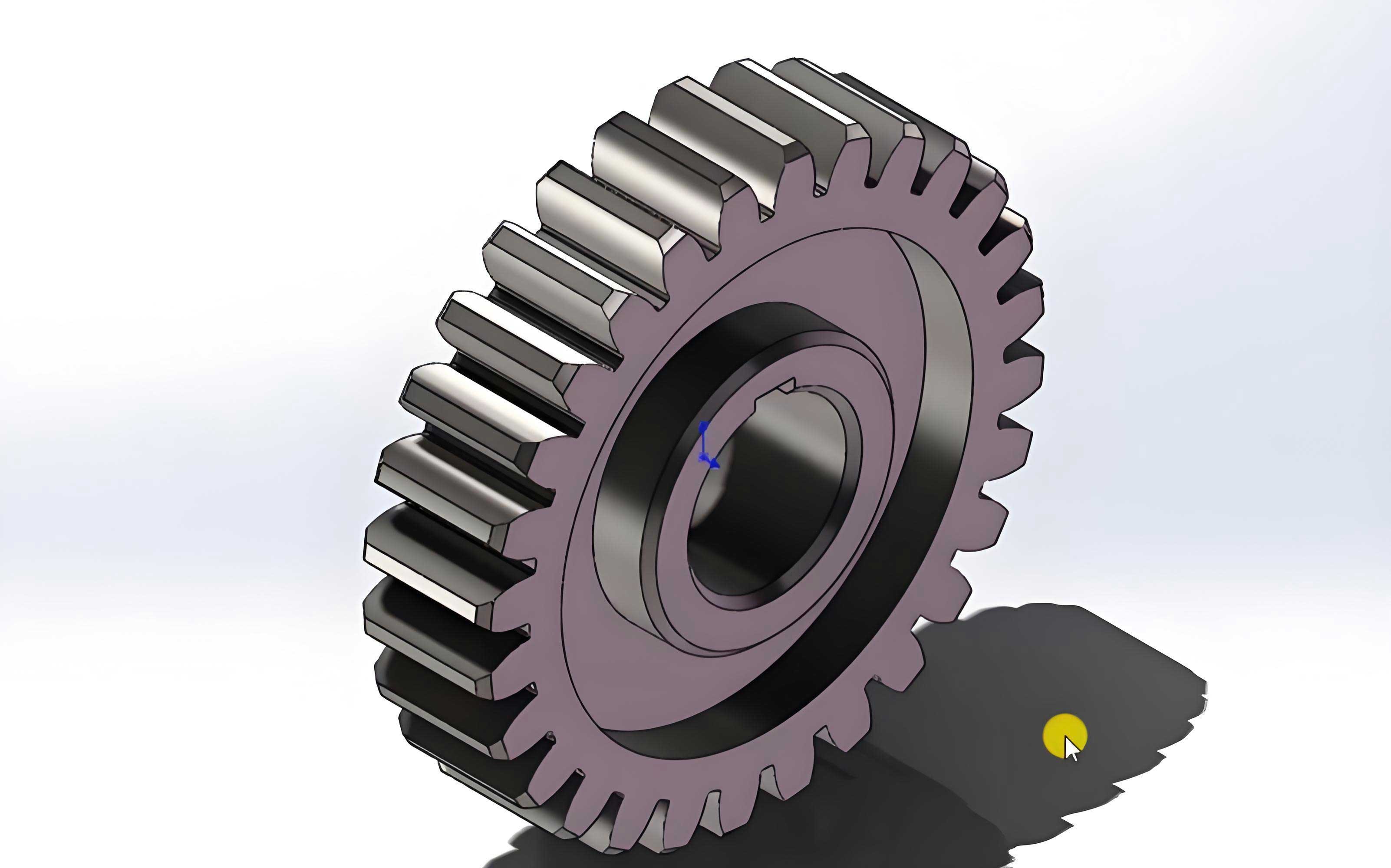
The fundamental challenge in modeling wear for spur gears lies in capturing the complex interaction between the changing tooth surface geometry and the resulting load distribution. As wear removes material from the tooth flanks, the load is redistributed among the contacting teeth, which in turn alters the local contact conditions and subsequent wear rates. This paper presents a comprehensive methodology for calculating adhesive wear on the tooth surfaces of involute cylindrical spur gears under low-speed, boundary lubrication conditions. The model integrates a load-sharing model that explicitly accounts for the coupling between wear depth and load distribution with the well-established Archard wear formula. Furthermore, a dynamic wear factor is incorporated to reflect the influence of lubrication regimes, which is crucial for accurate prediction in mixed or boundary-lubricated spur gear contacts typical of low-speed operation.
1. Theoretical Framework for Wear Calculation
The prediction of adhesive wear in spur gears is built upon two core theoretical pillars: a model for determining how the total transmitted load is shared among the contacting teeth, and a model for calculating the material removal rate at any point on the tooth surface.
1.1 Load Distribution Model Considering Tooth Surface Wear
Involute spur gears experience alternating single-tooth and double-tooth contact regions along the path of action. During double-tooth contact, the total load is shared between two pairs of teeth. A common simplification is to assume equal load sharing, but this becomes inaccurate as wear modifies the tooth profiles. To address this, a quasi-static model is employed where the gears are considered rigid bodies capable of elastic deformation at the contact points.
The compatibility condition for two pairs of teeth in contact, accounting for their individual wear depths, is given by:
$$ \delta_1 – \delta_2 = \tilde{E}_h = h_{w2}^{(2)} + h_{w1}^{(1)} – h_{w2}^{(1)} – h_{w1}^{(2)} $$
where \( \delta_i \) is the deformation of tooth pair \( i \), and \( h_{w}^{(j)} \) is the wear depth on the specified gear (\(j=1\) for pinion, \(j=2\) for gear) at the contact point of pair \( i \). \( \tilde{E}_h \) is thus a function of the accumulated wear on all contacting surfaces.
The equilibrium condition requires that the sum of the individual tooth pair forces equals the total normal load \( F \):
$$ F = F_1 + F_2 = k_1 \delta_1 + k_2 \delta_2 $$
The mesh stiffness \( k_i \) for each pair is a function of the gear rotation angle \( \theta \) and is calculated using the potential energy method, considering bending, shear, axial compression, and fillet foundation deflections of the spur gear teeth. It is defined as:
$$ k_i = k_i(\theta, \delta_i) = \begin{cases} k_i(\theta), & \delta_i > 0 \\ 0, & \delta_i = 0 \end{cases} $$
Solving these equations yields the Load Sharing Factor (LSF) for each contacting tooth pair, which evolves with wear:
$$ LSF_1 = \frac{F_1}{F} = \frac{k_1}{k_1 + k_2} \left(1 + \frac{k_2 \tilde{E}_h}{F}\right) $$
$$ LSF_2 = \frac{F_2}{F} = \frac{k_2}{k_1 + k_2} \left(1 – \frac{k_1 \tilde{E}_h}{F}\right) $$
This model captures the critical feedback loop: wear changes the profile, which changes the load sharing, which subsequently changes the local wear rate.
1.2 Wear Model Based on Archard’s Equation
The fundamental model for calculating adhesive wear depth is the Archard wear equation. For a specific point \( P \) on the tooth surface of a spur gear, the incremental wear depth \( dh \) over an incremental sliding distance \( ds \) is:
$$ \frac{dh}{ds} = k p $$
Here, \( p \) is the Hertzian contact pressure at point \( P \), and \( k \) is the dimensional wear coefficient. Integrating over the total sliding distance \( s_P \) for one engagement cycle gives the wear depth per cycle:
$$ \Delta h_{wP} = \int_0^{s_P} k_w \, p_P \, ds_P $$
where \( k_w \) is the dimensionless wear factor, related to \( k \) by \( k = k_w / H \) with \( H \) being material hardness. In a discrete simulation framework, the accumulated wear depth after \( N \) cycles is updated as:
$$ h_{wP}^{(N+1)} = h_{wP}^{(N)} + \Delta h_{wP}^{(N)} $$
To apply this, the contact pressure \( p_P \) and sliding distance \( s_P \) must be determined at every mesh position along the path of action for the spur gears.
1.2.1 Contact Pressure Calculation
The contact between two spur gear teeth is modeled as an equivalent contact between two cylinders. The radii of these cylinders are equal to the radii of curvature of the involute profiles at the contact point \( P \):
$$ \rho_1 = \frac{d_{01}}{2} \sin \alpha_0 + y, \quad \rho_2 = \frac{d_{02}}{2} \sin \alpha_0 – y $$
where \( d_{0i} \) is the standard pitch diameter, \( \alpha_0 \) is the pressure angle, and \( y \) is the distance from the pitch point. The equivalent radius of curvature \( \rho \) is:
$$ \frac{1}{\rho} = \frac{1}{\rho_1} + \frac{1}{\rho_2} $$
According to Hertzian contact theory, the semi-half width \( a_H \) of the contact patch and the pressure distribution \( p_P(y_i) \) across it for a given tooth pair load \( F_P \) are:
$$ a_H = \sqrt{\frac{4 F_P \rho}{\pi b E^*}} $$
$$ p_P(y_i) = \frac{2 F_P}{\pi b a_H^2} \sqrt{a_H^2 – y_i^2} $$
where \( b \) is the face width, \( y_i \) is the coordinate across the face width (\( -a_H \leq y_i \leq a_H \)), and \( E^* \) is the equivalent Young’s modulus:
$$ \frac{1}{E^*} = \frac{1-\nu_1^2}{E_1} + \frac{1-\nu_2^2}{E_2} $$
1.2.2 Sliding Distance Calculation
The relative sliding distance between the contacting surfaces on the pinion and gear is crucial for wear calculation. The sliding distances for points on the pinion (\( s_{P1} \)) and gear (\( s_{P2} \)) tooth profiles are:
$$ s_{P1} = 2 a_H \left( \frac{U_1 – U_2}{U_1} \right), \quad s_{P2} = 2 a_H \left( \frac{U_2 – U_1}{U_2} \right) $$
where \( U_1 \) and \( U_2 \) are the tangential velocities at the contact point for the pinion and gear, respectively:
$$ U_1 = \omega_1 \left( \frac{d_{01}}{2} \sin \alpha_0 + y \right), \quad U_2 = \omega_2 \left( \frac{d_{02}}{2} \sin \alpha_0 – y \right) $$
1.3 Dynamic Wear Factor Model
The wear factor \( k_w \) is not a constant but depends heavily on the lubrication condition. Under low-speed conditions common for many spur gear applications, the oil film thickness is often minimal, leading to boundary or mixed lubrication where wear is significant. The specific film thickness \( \lambda \) is defined as the ratio of the minimum elastohydrodynamic lubrication (EHL) film thickness \( h_{min} \) to the composite surface roughness \( R_{q} \):
$$ \lambda = \frac{h_{min}}{R_{q}} $$
A dynamic wear factor model that transitions with \( \lambda \) is used:
$$ k_w =
\begin{cases}
k_{w0}, & \lambda < 0.5 \quad \text{(Boundary Lubrication)} \\[6pt]
\dfrac{2k_{w0}(4-\lambda)}{7}, & 0.5 \leq \lambda \leq 4 \quad \text{(Mixed Lubrication)} \\[6pt]
0, & \lambda > 4 \quad \text{(Full-Film EHL Lubrication)}
\end{cases} $$
The base wear factor \( k_{w0} \) for boundary lubrication is itself a function of operating conditions. An empirical relationship derived from statistical analysis of gear test data is used:
$$ k_{w0} = 3.981 \times 10^{29} \, L_w^{1.219} \, G_w^{-7.377} \, S_w^{1.589} \, E’ $$
where \( L_w \), \( G_w \), and \( S_w \) are the dimensionless load, material, and roughness parameters, respectively, and \( E’ = 2E^* \). The minimum film thickness \( h_{min} \) is calculated using a well-established EHL formula:
$$ h_{min} = 3.63 \, \rho \, U_w^{0.68} \, G_w^{0.49} \, L_w^{-0.073} \, (1 – e^{-0.68 \kappa}) $$
For spur gears, the ellipticity ratio \( \kappa \) is large and the term \( (1 – e^{-0.68 \kappa}) \approx 1 \). The dimensionless parameters are:
$$ U_w = \frac{\eta_0 \bar{u}}{E’ \rho}, \quad G_w = \alpha E’, \quad L_w = \frac{F_P}{b E’ \rho} $$
where \( \eta_0 \) is the ambient viscosity, \( \bar{u} = (U_1+U_2)/2 \) is the rolling velocity, and \( \alpha \) is the pressure-viscosity coefficient. Under very low speeds, \( h_{min} \) becomes negligible, confirming the boundary lubrication assumption for low-speed spur gear analysis.
2. Simulation Methodology and Model Validation
2.1 Simulation Algorithm
The calculation of wear evolution for spur gears follows an iterative numerical procedure:
- Initialization: Define spur gear geometry, material properties, operating conditions (torque, speed), and initial surface roughness.
- Load Distribution Cycle: For a given wear depth profile \( h_w^{(N)}(y) \):
- Calculate the unloaded static transmission error \( \tilde{E}_h \) for all potential contact points.
- Determine the mesh stiffness \( k_i(\theta) \) and contact points along the line of action.
- Solve the load-sharing equations to obtain \( F_P(\theta) \) for each contacting tooth pair.
- Wear Calculation Cycle: For each discrete point on the tooth profile:
- Compute local contact geometry (curvature radii \( \rho_1, \rho_2 \)), load \( F_P \), and Hertzian pressure \( p_P \).
- Calculate the sliding velocities \( U_1, U_2 \) and the sliding distance \( s_P \).
- Determine the lubrication condition (\( h_{min}, \lambda \)) and the dynamic wear factor \( k_w \).
- Compute the incremental wear depth \( \Delta h_{wP}^{(N)} = k_w \, p_P \, s_P \).
- Update and Iterate: Update the total wear depth profile: \( h_w^{(N+1)} = h_w^{(N)} + \Delta h_{w}^{(N)} \). Return to Step 2 for the next simulation cycle (\( N+1 \)).
2.2 Model Validation Against Experimental Data
To validate the proposed model for spur gears, its predictions were compared against published experimental wear data. The geometric and operational parameters from the referenced experiment are used as input for the simulation.
| Parameter | Symbol | Value |
|---|---|---|
| Number of Teeth (Pinion/Gear) | \( z_1 / z_2 \) | 16 / 24 |
| Module | \( m \) | 4.5 mm |
| Pressure Angle | \( \alpha_0 \) | 20° |
| Face Width | \( b \) | 14 mm |
| Young’s Modulus | \( E \) | 2.1×10¹¹ Pa |
| Poisson’s Ratio | \( \nu \) | 0.3 |
| Pinion Speed | \( n_1 \) | 100 rpm |
| Pinion Torque | \( T_1 \) | 302 N·m |
| Surface Roughness, Rq | \( R_q \) | 0.3 µm |
| Lubricant Pressure-Viscosity Coefficient | \( \alpha \) | 2.6×10⁻⁸ m²/N |
The simulation results for the maximum wear depth at the pinion root are plotted against the number of operating cycles and compared with the experimental measurements. The experimental data shows some scatter between two adjacent teeth, attributable to manufacturing and assembly errors not modeled in the simulation. In the initial running-in phase, the experimental wear rate is slightly higher, likely due to the absence of lubricant additives in the test. As the cycles progress, the simulated wear evolution trend converges closely with the experimental data, confirming the validity and accuracy of the proposed model for predicting adhesive wear in spur gears.
3. Analysis of Wear Evolution in Spur Gears
Using the validated model, a detailed analysis of the wear process in the example spur gear pair is conducted. The results reveal the complex interplay between load sharing, contact conditions, and wear evolution.
3.1 Evolution of Load Sharing and Wear Factor
The model’s key advantage is its ability to track how wear changes the load distribution. The figure below conceptually illustrates the change in Load Sharing Factor (LSF) for the first contacting tooth pair over many cycles. Initially, the load is shared according to the ideal geometry. As wear progresses, particularly in regions of high initial contact, the load distribution shifts. For the pinion, the load near the root in the double-contact zone decreases, while it increases for the adjacent double-contact zone closer to the pitch point. The opposite trend occurs for the gear. This redistribution directly impacts the local wear factor \( k_w \).
The wear factor varies significantly along the path of action. It is generally higher near the pinion root due to higher sliding and potentially more severe boundary lubrication conditions. A sharp increase in \( k_w \) is observed at the transition from double-tooth to single-tooth contact because the entire load is suddenly borne by a single tooth pair, increasing contact pressure. As wear accumulates, \( k_w \) evolves: it decreases in initially high-wear regions (like the pinion root) as load shifts away, and increases at the double/single contact transition zones due to the load redistribution described above. This dynamic coupling is critical for accurate long-term wear prediction in spur gears.
3.2 Wear Depth Distribution and Evolution
The simulated wear depth profiles for both the pinion and gear after a significant number of cycles provide clear insights into the wear mechanisms of spur gears.
| Location on Tooth Profile | Wear Depth | Primary Reason |
|---|---|---|
| Pinion Root Region | Maximum | High sliding ratio, high contact pressure, and high dynamic wear factor under boundary lubrication. |
| Gear Tip Region | Maximum (for the gear) | Similar reasons as pinion root: high sliding and pressure at the start of engagement. |
| Pitch Point Region | Nearly Zero | Pure rolling motion (zero sliding velocity), leading to minimal adhesive wear. |
| Transition between Double and Single Tooth Contact | Abrupt Change/Step | Sudden change in load per tooth pair (load sharing factor discontinuity) causes a step change in contact pressure and wear rate. |
The wear is most severe at the pinion root (or correspondingly at the gear tip). This is a critical finding for design and maintenance, as the pinion, with fewer teeth, typically experiences more cycles and is often the limiting component. The characteristic “step” in the wear profile at the transition points is a direct consequence of the discontinuous change in the load per tooth and is a signature of wear in spur gears operating under load.
3.3 Parametric Study: Influence of Key Factors
The model allows for investigating the influence of various parameters on the wear of spur gears. Two major factors are examined:
1. Applied Load (Torque): The relationship between contact pressure \( p \) and load \( F \) in Hertzian contact is non-linear (\( p \propto \sqrt{F} \)). Furthermore, the dimensionless load parameter \( L_w \) in the wear factor equation \( k_{w0} \propto L_w^{1.219} \) shows a strong positive correlation. Therefore, increasing the transmitted torque in spur gears leads to a more than proportional increase in wear depth per cycle, significantly accelerating failure.
2. Lubrication Condition (Surface Roughness & Viscosity): The lubrication condition, primarily governed by the specific film thickness \( \lambda \), drastically affects the dynamic wear factor \( k_w \). For example, improving surface finish (reducing \( R_q \)) increases \( \lambda \), potentially moving the contact from boundary (\( k_w = k_{w0} \)) into the mixed regime where \( k_w \) is lower. Similarly, using a higher viscosity oil increases \( h_{min} \) and \( \lambda \), reducing the wear rate. This highlights the importance of proper lubrication and surface treatment for enhancing the wear life of low-speed spur gears.
4. Conclusion
This paper has presented a comprehensive and validated methodology for calculating adhesive wear on the tooth surfaces of involute spur gears under low-speed operating conditions. The model’s core strength lies in the integration of a dynamic load-sharing model, which accounts for the coupling between evolving wear profiles and load distribution among spur gear teeth, with a physics-based Archard wear model employing a dynamic wear factor sensitive to the lubrication regime.
The key conclusions from the analysis are:
- The developed model accurately predicts the evolution of wear depth in spur gears, as validated against experimental data. It captures the non-linear relationship between applied load and wear rate.
- Wear significantly alters the load distribution in the double-tooth contact regions of spur gears. This redistribution must be modeled to predict long-term wear progression accurately.
- The most severe wear in a reducing spur gear pair occurs at the root of the pinion and the tip of the gear. The pitch point region experiences negligible adhesive wear due to pure rolling.
- Characteristic abrupt changes (steps) in the wear profile occur at the transitions between single and double tooth contact zones in spur gears, caused by the sudden change in load per tooth pair.
- Operating parameters such as load and lubrication condition (via surface roughness and oil viscosity) have a profound and non-linear impact on the wear rate of spur gears.
This computational framework provides a valuable theoretical tool for engineers to predict the wear life of spur gear transmissions, optimize gear design parameters, select appropriate materials and lubricants, and plan maintenance schedules, thereby improving the reliability and durability of systems employing spur gears under demanding low-speed conditions.