
In the field of mechanical transmission, spur gears are widely used due to their simplicity and efficiency. The lubrication performance of gear pairs is crucial for reducing vibration and noise, especially with the increasing demand for high-speed and heavy-load spur gears. Therefore, extensive research has been conducted on the lubrication characteristics of spur gears. In this study, we focus on the elastohydrodynamic lubrication (EHL) of spur gear pairs, considering non-Newtonian fluid effects. We establish an EHL model based on isothermal line contact theory and investigate the influence of various working conditions on oil film pressure, film thickness, and friction factor. The goal is to provide insights into optimizing the lubrication performance of spur gears in practical applications.
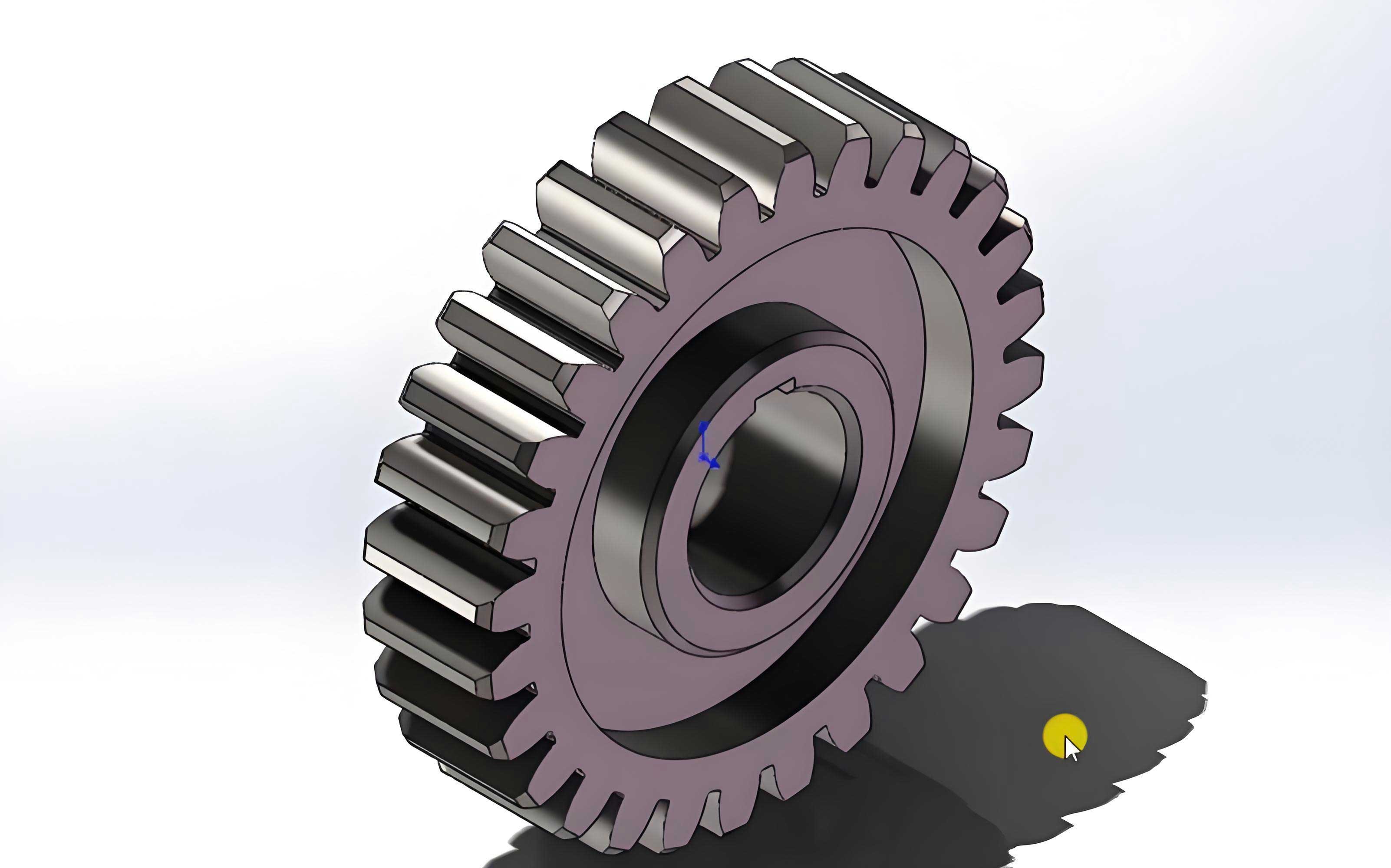
The lubrication of spur gears involves complex interactions between gear tooth surfaces, lubricant properties, and operating conditions. Elastohydrodynamic lubrication theory is essential for understanding these interactions, as it accounts for the elastic deformation of surfaces and the pressure-dependent viscosity of lubricants. Previous studies have explored factors such as surface roughness, temperature, and gear design parameters. However, the impact of working conditions like rotational speed, input torque, and lubricant viscosity on the EHL behavior of spur gears warrants further investigation. In this article, we develop a numerical model to analyze these effects and present results using tables and formulas for clarity.
We begin by describing the meshing model of spur gears. The involute profile of spur gears ensures smooth transmission, but during meshing, the contact conditions vary along the line of action. The meshing cycle involves both single-tooth and double-tooth contact regions, which affect the load distribution and lubrication. The geometry of spur gears can be represented using parameters such as base circle radius, addendum radius, and pressure angle. For a pair of spur gears, the meshing period \( T \) is given by:
$$ T = \frac{2\pi\varepsilon}{z_p \omega_p} $$
where \( \varepsilon \) is the contact ratio, \( z_p \) is the number of teeth on the driving gear, and \( \omega_p \) is the angular velocity of the driving gear. The curvature radius of the driving gear \( R_1(t) \) and driven gear \( R_2(t) \) vary with time \( t \) during meshing:
$$ R_1(t) = L_1 + \omega_p r_{b1} t, \quad 0 \leq t \leq T $$
$$ R_2(t) = L_2 – R_1(t), \quad 0 \leq t \leq T $$
Here, \( L_1 \) and \( L_2 \) are lengths related to the line of action, and \( r_{b1} \) is the base circle radius of the driving gear. The equivalent curvature radius \( R(t) \) is calculated as:
$$ R(t) = \frac{R_1(t) R_2(t)}{R_1(t) + R_2(t)} $$
This equivalent radius is used in the EHL model to represent the contact geometry. The lubrication model is based on the generalized Reynolds equation for non-Newtonian fluids:
$$ \frac{\partial}{\partial x} \left( \frac{\rho}{\eta_e} h^3 \frac{\partial p}{\partial x} \right) = 12 u \frac{\partial (\rho^* h)}{\partial x} $$
where \( h \) is the film thickness, \( p \) is the pressure, \( \rho \) is the density, \( \eta \) is the viscosity, \( u \) is the entrainment velocity, \( x \) is the coordinate along the contact direction, \( \rho^* \) is the equivalent density, and \( \eta_e \) is an equivalent viscosity parameter accounting for variations across the film thickness. The density and viscosity of the lubricant are pressure-dependent, described by the following relations:
$$ \eta = \eta_0 \exp\left\{ (\ln \eta_0 + 9.67) \left[ (1 + 5.1 \times 10^{-9} p)^Z – 1 \right] \right\} $$
$$ \rho = \rho_0 \left( 1 + \frac{0.6 \times 10^{-9} p}{1 + 1.7 \times 10^{-9} p} \right) $$
Here, \( \eta_0 \) is the ambient viscosity, \( Z \) is the viscosity-pressure index, and \( \rho_0 \) is the ambient density. For non-Newtonian behavior, we use a constitutive equation based on the sinh law:
$$ \frac{\partial u}{\partial z} = \frac{\tau}{\eta} \sinh\left( \frac{\tau}{\tau_0} \right) $$
where \( \tau \) is the shear stress, \( \tau_0 \) is the characteristic shear stress (taken as 4 MPa), and \( z \) is the coordinate across the film thickness. The load balance equation ensures that the integrated pressure supports the applied load:
$$ w = \int_{x_1}^{x_2} p \, dx $$
$$ w = \frac{F}{B} $$
$$ F = \frac{T_F}{r_{b1}} $$
where \( w \) is the load per unit length, \( B \) is the face width, \( F \) is the external load, and \( T_F \) is the input torque. The film thickness equation includes the elastic deformation:
$$ h = h_0 + \frac{x^2}{2R} + v(x) $$
$$ v(x) = -\frac{2}{\pi E} \int_{x_1}^{x_2} p(s) \ln(s – x)^2 \, ds $$
where \( h_0 \) is the rigid body displacement, \( E \) is the elastic modulus, and \( v(x) \) is the deformation term. The friction factor \( f \) is calculated from the shear stress:
$$ f = \left( B \int_{x_1}^{x_2} \tau \, dx \right) / F $$
To solve these equations, we adopt a numerical approach. The dimensionless form of the equations is derived by scaling variables appropriately. The computational domain is divided into high-pressure and low-pressure regions. We use a mixed iteration method: the Jacobi iterative method in the high-pressure region and the Gauss-Seidel method in the low-pressure region. The dimensionless domain is set to \( (-2, 1.5) \), and convergence is achieved when the error is below \( 10^{-5} \). This method has been validated against existing literature, showing good agreement for minimum film thickness under similar conditions.
We now present the results for different working conditions. The spur gears parameters are: driving gear teeth \( z_p = 23 \), driven gear teeth \( z_g = 32 \), module \( m = 4 \, \text{mm} \), face width \( B = 40 \, \text{mm} \), pressure angle \( \alpha = 20^\circ \), elastic modulus \( E = 206 \, \text{GPa} \), and Poisson’s ratio \( \nu = 0.3 \). We analyze the effects of rotational speed, input torque, and lubricant viscosity on the EHL characteristics. For clarity, we summarize key parameters in tables and use formulas to explain trends.
| Condition | Rotational Speed (r/min) | Input Torque (N·m) | Ambient Viscosity (Pa·s) |
|---|---|---|---|
| Case 1 | 1000, 2000, 3000 | 300 | 0.05 |
| Case 2 | 2000 | 100, 200, 300 | 0.05 |
| Case 3 | 2000 | 300 | 0.03, 0.05, 0.07 |
The oil film pressure and film thickness distributions at the midpoint of the meshing cycle ( \( t = T/2 \) ) are examined. Figure 2 shows that as rotational speed increases, the film thickness increases, and the secondary pressure peak shifts to the left. This is due to enhanced entrainment velocity, which improves lubricant film formation. The dimensionless pressure \( P \) and film thickness \( H \) are plotted against the dimensionless coordinate \( X \). The trends can be quantified using the following empirical relations for spur gears:
$$ H_{\text{min}} \propto u^{0.7}, \quad \text{for constant load} $$
$$ P_{\text{max}} \propto u^{-0.1}, \quad \text{for constant load} $$
where \( H_{\text{min}} \) is the minimum film thickness and \( P_{\text{max}} \) is the maximum pressure. Similarly, Figure 3 illustrates that as input torque increases, the film thickness decreases, and the central pressure increases. This is because higher loads cause greater surface deformation and reduce the film gap. The relationships are:
$$ H_{\text{min}} \propto w^{-0.13}, \quad \text{for constant speed} $$
$$ P_{\text{max}} \propto w^{0.1}, \quad \text{for constant speed} $$
Figure 4 demonstrates that increasing lubricant ambient viscosity leads to thicker films and a leftward shift of the secondary pressure peak. Higher viscosity enhances the lubricant’s load-carrying capacity. The correlations are:
$$ H_{\text{min}} \propto \eta_0^{0.7}, \quad \text{for constant speed and load} $$
$$ P_{\text{max}} \propto \eta_0^{-0.1}, \quad \text{for constant speed and load} $$
These results are consistent with classical EHL theory for spur gears. To further analyze the friction factor, we plot it over the meshing cycle. Figure 5 shows that the friction factor reaches a minimum near the pitch point and exhibits a V-shaped pattern. It decreases in double-tooth contact regions and increases in single-tooth contact regions due to load variations. The friction factor \( f \) is influenced by speed, torque, and viscosity as follows:
$$ f \propto u^{-0.5}, \quad \text{for constant load and viscosity} $$
$$ f \propto w^{0.2}, \quad \text{for constant speed and viscosity} $$
$$ f \propto \eta_0^{-0.4}, \quad \text{for constant speed and load} $$
These proportionalities are derived from numerical simulations and provide practical guidelines for designing spur gears. For instance, to reduce friction in spur gears, one can increase rotational speed or lubricant viscosity, or decrease input torque. However, trade-offs exist, as higher speeds may lead to thermal effects not considered in this isothermal model.
| Working Condition | Effect on Film Thickness | Effect on Pressure | Effect on Friction Factor |
|---|---|---|---|
| Increased Rotational Speed | Increases | Slight decrease, peak shifts left | Decreases |
| Increased Input Torque | Decreases | Increases, peak shifts right | Increases |
| Increased Lubricant Viscosity | Increases | Slight decrease, peak shifts left | Decreases |
The numerical model involves solving the Reynolds equation, film thickness equation, and load balance equation simultaneously. We use finite difference methods for discretization. The dimensionless Reynolds equation is:
$$ \frac{\partial}{\partial X} \left( \bar{\rho} \bar{H}^3 \frac{\partial P}{\partial X} \right) = \frac{\partial (\bar{\rho}^* \bar{H})}{\partial X} $$
where barred quantities are dimensionless. The film thickness equation in dimensionless form is:
$$ \bar{H} = \bar{H}_0 + \frac{X^2}{2} – \frac{1}{\pi} \int_{X_1}^{X_2} P(S) \ln(S – X)^2 \, dS $$
The load balance equation becomes:
$$ \int_{X_1}^{X_2} P \, dX = \frac{\pi}{2} $$
These equations are solved iteratively until convergence. The friction factor is computed from the dimensionless shear stress:
$$ f = \frac{\int_{X_1}^{X_2} \bar{\tau} \, dX}{\bar{F}} $$
where \( \bar{\tau} \) and \( \bar{F} \) are dimensionless shear stress and load, respectively. The computational details are omitted for brevity, but the method is robust for spur gears EHL analysis.
In addition to the parametric studies, we explore the implications for spur gears design. The minimum film thickness is critical for preventing wear and pitting. Based on our results, we propose a design formula for estimating the minimum film thickness in spur gears:
$$ H_{\text{min}} = 1.6 \frac{(u \eta_0)^{0.7} R^{0.43}}{w^{0.13} E^{0.03}} $$
This formula incorporates speed \( u \), ambient viscosity \( \eta_0 \), equivalent radius \( R \), load per unit length \( w \), and elastic modulus \( E \). It is derived from regression of numerical data for spur gears under various conditions. Similarly, the friction factor can be estimated as:
$$ f = 0.05 \frac{w^{0.2} \eta_0^{-0.4}}{u^{0.5}} $$
These formulas provide quick estimates for engineers working with spur gears. However, for accurate results, full numerical simulations are recommended, especially for non-standard spur gears geometries.
The study has limitations. We assume isothermal conditions, but in practice, temperature rise can affect lubricant properties. Future work should include thermal effects for spur gears operating at high speeds. Also, surface roughness and wear are not considered, which may influence lubrication in real spur gears applications. Despite these, our model offers valuable insights into the EHL behavior of spur gears.
In conclusion, we have developed a non-Newtonian fluid EHL model for spur gears and investigated the effects of rotational speed, input torque, and lubricant viscosity on lubrication characteristics. The results show that film thickness increases with speed and viscosity but decreases with torque. Pressure and friction factor are similarly influenced. The friction factor minimizes near the pitch point and varies with meshing phases. These findings can guide the design and operation of spur gears for improved lubrication performance. We recommend optimizing working conditions to maintain adequate film thickness and low friction in spur gears systems.
To further illustrate the meshing of spur gears, consider the geometry. The line of action length \( L \) for spur gears is given by:
$$ L = \sqrt{r_{a1}^2 – r_{b1}^2} + \sqrt{r_{a2}^2 – r_{b2}^2} – C \sin \alpha $$
where \( r_{a1} \) and \( r_{a2} \) are addendum radii, \( r_{b1} \) and \( r_{b2} \) are base circle radii, \( C \) is the center distance, and \( \alpha \) is the pressure angle. This length affects the curvature radii and thus the EHL conditions. For spur gears with high contact ratios, the double-tooth contact regions are longer, which may improve load distribution but complicate lubrication analysis.
In summary, the lubrication of spur gears is a key aspect of their performance. Our study highlights the importance of considering working conditions in EHL models for spur gears. By using numerical methods and parametric analysis, we have derived practical trends and formulas that can aid in the design of efficient and durable spur gears transmissions.