
The operational reliability, safety, and longevity of mining machinery are paramount, given the extreme and unforgiving environments in which they operate. As a critical component within these systems, gears are subjected to immense stress, cyclical loading, and abrasive conditions. Statistical analyses consistently identify gear failure as a primary cause of downtime in mining equipment. Common failure modes include wear, surface fatigue (pitting and spalling), plastic deformation, and fracture. Consequently, the performance of mining machinery is intrinsically linked to the performance of its gears. Enhancing the comprehensive properties of these gears is not merely an improvement but a necessity for efficient and reliable operation. While significant research has been dedicated to gear materials and design, the domain of efficient and precise heat treatment for mining gears remains an area ripe for innovation. Conventional heat treatment methods, such as carburizing and induction hardening, though effective, can introduce significant heat treatment defects including excessive distortion, inconsistent case depth, and high residual tensile stresses. These defects ultimately compromise gear life. This article explores the application of laser heat treatment as a superior alternative, focusing on process parameter optimization to maximize gear performance while minimizing the occurrence of detrimental heat treatment defects.
The fundamental advantage of laser heat treatment lies in its precision and rapid thermal cycle. A high-energy-density laser beam is scanned across the gear tooth surface, causing rapid austenitization of a thin surface layer. Subsequent self-quenching, due to rapid heat conduction into the cold bulk material, results in a transformation to a hard martensitic microstructure. This process offers several key benefits over traditional methods: minimal distortion, precise control over hardened zone geometry, and the generation of beneficial residual compressive stresses. The core relationship governing the energy input is the energy density, \(E_d\):
$$E_d = \frac{P}{v \cdot d}$$
where \(P\) is the laser power (W), \(v\) is the scanning speed (mm/s), and \(d\) is the beam diameter (mm). This parameter is crucial; an incorrect \(E_d\) is the direct cause of several laser-specific heat treatment defects. Insufficient \(E_d\) leads to inadequate austenitization, resulting in low hardness and shallow case depth—a clear performance defect. Excessive \(E_d\) can cause surface melting, grain coarsening, and excessive thermal stress leading to cracking or severe distortion.
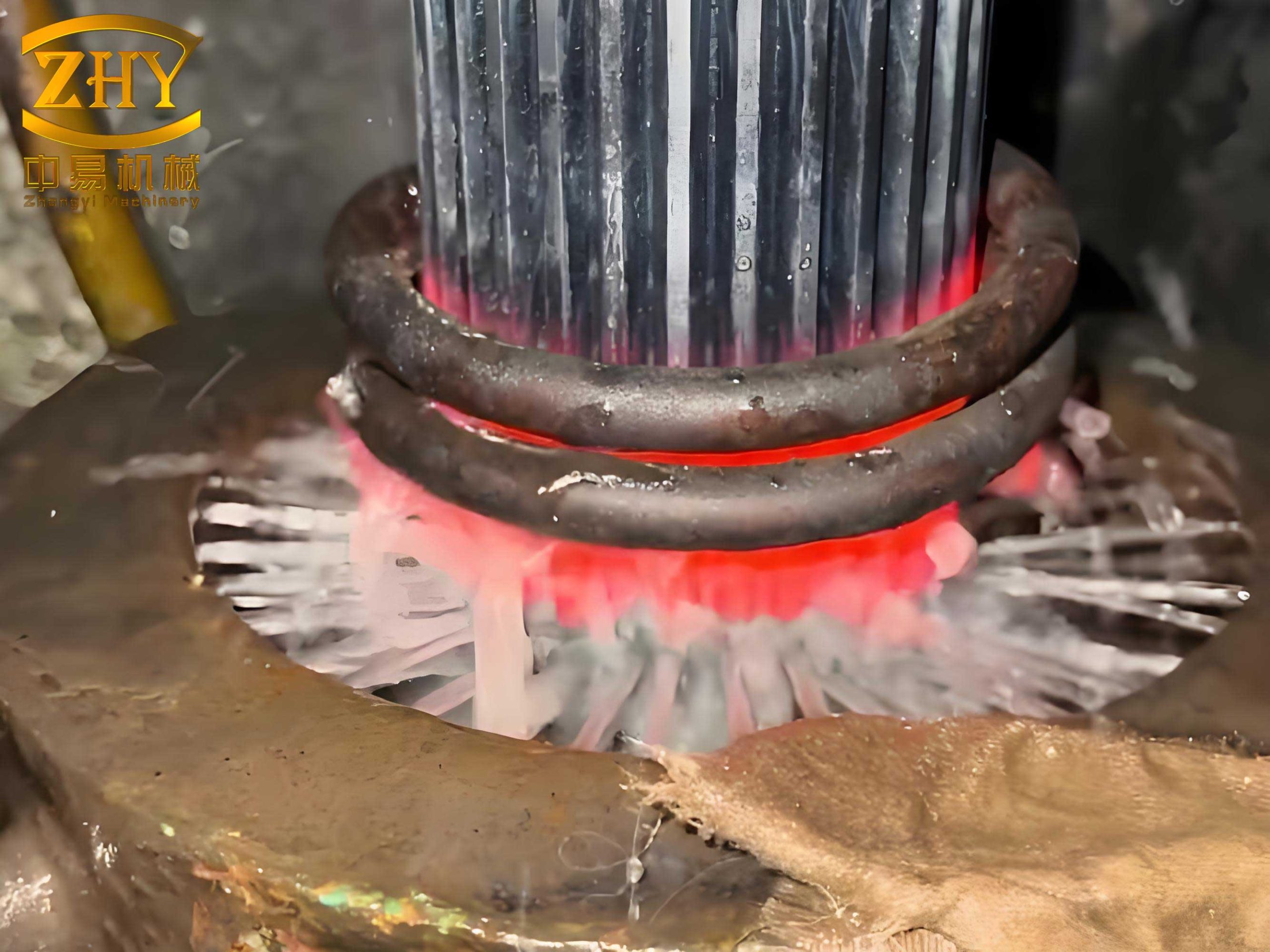
The study referenced in the source material utilized 20CrNi2Mo steel, a common alloy for high-strength gears, with a chemical composition typical for such applications. The laser heat treatment was performed using an axial tooth-by-tooth scanning strategy, varying laser power and scanning speed while keeping the beam spot size constant. The evaluation of the process’s success and the avoidance of heat treatment defects was based on four critical metrics: hardness profile, distortion, residual stress state, and wear resistance.
Theoretical Foundations: Linking Process Parameters to Microstructure and Stress
The final properties of the laser-hardened gear are a direct consequence of the thermal cycle induced. The temperature field, \(T(x,y,z,t)\), during laser heating can be modeled using the heat conduction equation with a moving source:
$$\rho C_p \frac{\partial T}{\partial t} = \nabla \cdot (k \nabla T) + Q_{laser}$$
where \(\rho\) is density, \(C_p\) is specific heat, \(k\) is thermal conductivity, and \(Q_{laser}\) is the heat input from the laser. The peak temperature and cooling rate determine the phase transformation. The hardening depth, \(\delta\), is empirically related to the process parameters. A simplified model often takes the form:
$$\delta \propto \frac{P}{\sqrt{v \cdot \kappa}}$$
where \(\kappa\) is the thermal diffusivity. The hardness, \(H\), is primarily a function of the martensite content and its fineness, which is governed by the prior austenite grain size and the cooling rate, \(\dot{T}\):
$$H = H_0 + K_H \cdot (\dot{T})^{n}$$
where \(H_0\) and \(K_H\) are material constants. High cooling rates promote fine martensite and high hardness, but excessively high rates can increase the risk of quenching cracks—a severe heat treatment defect.
Perhaps the most critical outcome for fatigue resistance is the residual stress profile. The rapid heating and cooling create a complex stress state. The total residual stress, \(\sigma_{res}\), is a superposition of thermal stress (\(\sigma_{th}\)) and transformation stress (\(\sigma_{tr}\)):
$$\sigma_{res} = \sigma_{th} + \sigma_{tr}$$
Thermal stress arises from constrained thermal contraction during cooling, while transformation stress results from the volumetric expansion associated with the austenite-to-martensite transformation. The martensite transformation start temperature, \(M_s\), plays a key role. When transformation occurs at lower temperatures, the yield strength of the material is higher, allowing for the generation of higher magnitude residual compressive stresses. A key objective is to maximize this beneficial compressive stress while avoiding tensile stresses that can initiate fatigue cracks, a common failure linked to residual stress defects from poor heat treatment.
Experimental Results and Parametric Analysis: The Path to Avoiding Defects
The experimental work systematically varied laser power and scanning speed. The results are summarized in the following comprehensive tables, which illustrate the non-monotonic relationship between input parameters and output performance—a hallmark of processes where an optimum exists to avoid heat treatment defects.
| Sample ID | Laser Power (kW) | Scan Speed (mm/min) | Avg. Surface Hardness (HV) | Max. Hardening Depth (mm) | Wear Volume (10⁻³ mm³) |
|---|---|---|---|---|---|
| 1 | 2.3 | 120 | 795 | 1.05 | 73 |
| 2 | 2.7 | 120 | 825 | 1.55 | 21 |
| 3 | 3.1 | 120 | 805 | 1.25 | 48 |
| 4 | 2.7 | 90 | 810 | 1.40 | 58 |
| 5 | 2.7 | 150 | 815 | 1.20 | 38 |
Table 1: Effect of Laser Heat Treatment Parameters on Hardness and Wear Properties.
| Sample ID | Laser Power (kW) | Scan Speed (mm/min) | Profile Error (µm) | Lead Error (µm) | Pitch Error (µm) | Avg. Residual Stress (MPa) |
|---|---|---|---|---|---|---|
| 1 | 2.3 | 120 | 76.4 | 2.1 | 36.4 | -520 |
| 2 | 2.7 | 120 | 78.5 | 2.3 | 38.2 | -680 |
| 3 | 3.1 | 120 | 89.2 | 3.8 | 47.7 | -480 |
| 4 | 2.7 | 90 | 87.6 | 3.6 | 46.3 | -550 |
| 5 | 2.7 | 150 | 78.3 | 2.2 | 37.9 | -600 |
Table 2: Effect of Laser Heat Treatment Parameters on Dimensional Accuracy and Residual Stress.
The data reveals clear optimal zones. At a constant scan speed of 120 mm/min, increasing laser power from 2.3 kW to 3.1 kW causes hardness, case depth, and compressive residual stress to first increase to a maximum at 2.7 kW and then decrease. Distortion metrics show a slight initial increase followed by a sharp rise at the highest power. Wear resistance (inversely related to wear volume) follows the same trend, peaking at 2.7 kW. This indicates that 2.3 kW represents an under-treated condition (a heat treatment defect of insufficient energy), while 3.1 kW represents an over-treated condition (a heat treatment defect of excessive energy leading to potential grain growth and higher distortion).
Similarly, at a constant power of 2.7 kW, increasing scan speed from 90 to 150 mm/min produces an optimum at 120 mm/min for most properties. A slow speed (90 mm/min) delivers excessive energy per unit area, increasing heat input and thermal diffusion time. This leads to a broader heat-affected zone, greater thermal stress, and consequently, higher distortion—a primary heat treatment defect laser processing aims to minimize. It can also cause tempering of previously hardened zones if overlapping is used. A high speed (150 mm/min) provides insufficient interaction time for complete austenitization, leading to lower case depth and sub-optimal hardness, another form of performance defect.
The wear behavior is a direct consequence of the microstructure and residual stress. The optimal sample (2.7 kW, 120 mm/min) possesses the highest surface hardness, a sufficiently deep hardened case to support the surface, and the highest magnitude of residual compressive stress. This combination effectively resists abrasive and adhesive wear mechanisms. The high compressive stress also suppresses crack initiation and propagation under contact fatigue conditions. Samples with process-induced defects, such as lower hardness or reduced compressive stress, exhibited significantly higher wear volumes and more severe surface damage characterized by plowing, spalling, and deep grooves.
Comprehensive Discussion: Parameter Optimization Strategy for Defect Prevention
Optimizing laser heat treatment for mining gears is a multi-objective task aimed at preventing a spectrum of heat treatment defects. The goal is to find the parameter window (P, v) that simultaneously:
- Maximizes surface hardness and case depth for wear and contact fatigue resistance.
- Generates high, stable residual compressive stresses in the surface layer.
- Minimizes geometric distortion to maintain gear accuracy and reduce post-processing.
- Avoids surface melting, cracking, or excessive tempering.
A systematic approach can be derived. First, the required case depth, \(\delta_{req}\), is determined based on the gear loading (e.g., using Hertzian contact stress calculations). This depth must be less than the critical depth to avoid through-hardening a tooth, which could lead to brittle fracture. Using the relationship \(\delta \propto P / \sqrt{v}\), a family of (P, v) curves satisfying the depth requirement can be plotted.
Next, the constraint of avoiding surface melting sets an upper limit for energy density. The melting threshold energy density, \(E_{d,melt}\), is material-dependent. The process must satisfy:
$$E_d = \frac{P}{v \cdot d} < E_{d,melt}$$
Furthermore, to ensure complete austenitization without excessive grain growth, the peak temperature, \(T_{peak}\), must lie within a window:
$$A_{c3} + \Delta T_{min} \leq T_{peak} \leq A_{c3} + \Delta T_{max}$$
where \(A_{c3}\) is the austenitization temperature and \(\Delta T\) is a safety margin. \(T_{peak}\) can be estimated from thermal models. The cooling rate, \(\dot{T}\), must also be high enough to form martensite but not so high as to cause cracking. For a given material, there is a critical cracking cooling rate, \(\dot{T}_{crit}\).
The experimental data suggests that the optimal parameters often lie where the thermal gradient is steep enough for rapid quenching but where the total heat input is controlled to limit distortion. The residual stress, \(\sigma_{res}\), is not maximized at the maximum hardness condition but at a condition where the transformation stress component is optimized. This often occurs at a slightly lower cooling rate than that which yields maximum hardness, allowing more transformation plasticity to occur, thereby increasing compressive stress without inducing tensile defects.
For the specific case of 20CrNi2Mo steel and the described setup, the intersection of these constraints yields the optimal parameters: Laser Power \(P^* = 2.7 \text{ kW}\) and Scan Speed \(v^* = 120 \text{ mm/min}\). This parameter set successfully avoids the common heat treatment defects associated with both under- and over-processing.
Beyond Single Parameters: Advanced Considerations for Industrial Application
While power and speed are primary, other factors are critical for industrial-scale implementation and further defect prevention:
- Beam Geometry and Homogenization: A rectangular or defocused line beam is often preferred for gear teeth over a Gaussian spot to ensure uniform heating across the tooth width. Inhomogeneous energy distribution is a major source of inconsistent hardness and soft spots—a severe defect.
- Preheating and Post-Heating: For high-carbon or alloy steels prone to cracking, a low-power preheat scan can reduce thermal shock. A post-heat tempering scan can reduce brittleness without significantly lowering hardness, mitigating the defect of excessive martensite brittleness.
- Overlap Strategy: For scanning multiple tracks (e.g., on a wide face), overlap must be controlled. Excessive overlap leads to tempering of the previous track (a softening defect), while insufficient overlap creates a soft zone (defect). The overlap ratio, \(O_r\), must be optimized.
- Surface Condition: Absorptivity of the laser beam is highly dependent on surface finish and coating. An uncontrolled surface can lead to erratic energy absorption, causing localized defects like burning or incomplete hardening. The use of controlled absorptive coatings is standard practice.
Conclusion and Outlook
Laser heat treatment presents a technologically advanced solution for enhancing the performance of mining machinery gears. Its principal advantage is the precise delivery of energy, enabling the creation of superior surface properties—high hardness, deep case, and beneficial compressive stresses—while inherently minimizing the heat treatment defects of distortion and part warpage that plague conventional methods. The experimental and theoretical analysis demonstrates that the process is governed by the fundamental energy density parameter \(E_d = P/(v \cdot d)\). Both under- and over-application of this energy lead to distinct defects: insufficient hardness and shallow case versus excessive distortion, grain growth, and potential melting.
The optimization path is not singular but multi-dimensional, balancing mechanical performance against geometric integrity. For the studied 20CrNi2Mo gear, the optimal parameters of 2.7 kW laser power and 120 mm/min scan speed were identified. This parameter set successfully navigates the narrow window between the defects of insufficient transformation and excessive thermal damage. Future work should integrate real-time monitoring systems (e.g., pyrometry, spectroscopy) with closed-loop control to dynamically adjust parameters, ensuring consistency and further eliminating heat treatment defects across large production batches. The integration of laser heat treatment into the digital manufacturing chain, combined with predictive modeling of microstructure and stress, represents the future for producing ultra-reliable, high-performance gears capable of withstanding the extreme demands of the mining industry.