
In modern mechanical transmission systems, spur gears play a pivotal role due to their simplicity, efficiency, and reliability. As a fundamental component, spur gears are widely used in various industries, including automotive, aerospace, and manufacturing. The design and analysis of spur gears are critical to ensure optimal performance, longevity, and safety. In this article, I will delve into the parametric 3D modeling and transient finite element analysis (FEA) of high-profile modified spur gears, focusing on their stress characteristics and dynamic behavior. The study leverages UG (CAD) for modeling and Ansys Workbench for simulation, providing insights into gear transmission mechanics.
Spur gears are characterized by teeth that are parallel to the axis of rotation, making them ideal for transmitting motion and torque between parallel shafts. However, standard spur gears may face issues such as undercutting, limited load capacity, and excessive wear. To address these challenges, modified spur gears, specifically high-profile modified spur gears, are employed. These gears involve adjustments in the tooth profile through profile shifting coefficients, which alter the addendum and dedendum heights without changing the total tooth height. This modification helps avoid root interference, improve load distribution, and enhance overall gear performance. In this context, I will explore the geometric calculations, 3D modeling, and transient dynamics of such spur gears.
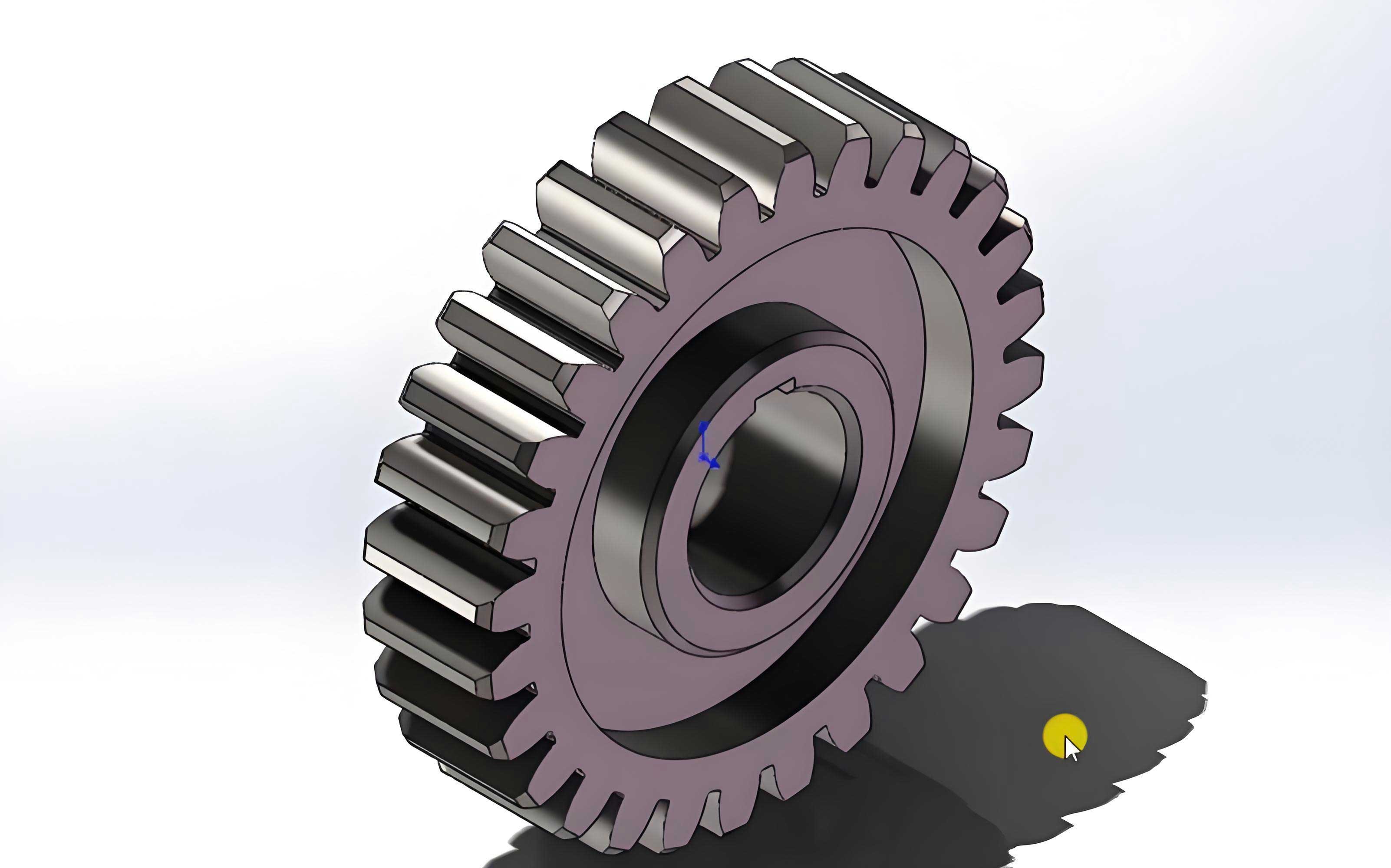
The design of spur gears begins with precise geometric calculations. For a pair of mating spur gears, the key parameters include module, number of teeth, pressure angle, and profile shift coefficients. In this case, I consider a pinion and a gear with specific values: the pinion has a module of 2.5 mm, 30 teeth, a pressure angle of 20°, and a profile shift coefficient of +0.35; the gear has 65 teeth and a profile shift coefficient of -0.35. The addendum coefficient is 1, and the dedendum coefficient is 1.25 for modules greater than 1. The geometric formulas and results are summarized in the table below.
| Parameter | Geometric Formula | Pinion (Small Gear) | Gear (Large Gear) |
|---|---|---|---|
| Pitch Diameter | $$d = m \cdot z$$ | 75 mm | 162.5 mm |
| Addendum Diameter | $$d_a = d + 2m(f + \varepsilon)$$ | 81.75 mm | 165.75 mm |
| Dedendum Diameter | $$d_f = d – m(f – \varepsilon + c)$$ | 70.5 mm | 154.5 mm |
| Addendum Height | $$h_a = m(f + \varepsilon)$$ | 3.375 mm | 1.625 mm |
| Dedendum Height | $$h_f = m(f – \varepsilon + c)$$ | 2.25 mm | 4 mm |
| Total Tooth Height | $$h = h_a + h_f$$ | 5.625 mm | 5.625 mm |
| Base Circle Radius | $$\Upsilon_o = m \cdot z \cdot \cos\alpha$$ | 35.2834 mm | 76.3500 mm |
| Base Pitch | $$\tau_i = \pi \cdot m \cdot \cos\alpha$$ | 7.38033 mm | 7.38033 mm |
| Circular Pitch | $$\tau_j = \pi \cdot m$$ | 7.85394 mm | 7.85394 mm |
| Radial Clearance | $$c = 0.25m \text{ for } m > 1$$ | 0.625 mm | 0.625 mm |
| Center Distance | $$A = \frac{m(Z_1 + Z_2)}{2}$$ | 118.75 mm | |
These calculations form the basis for the 3D modeling of the spur gears. The use of profile shift coefficients ensures that the spur gears are high-profile modified, which optimizes their meshing characteristics. The modification coefficients are chosen to balance the tooth thickness and avoid undercutting, common issues in standard spur gears. This geometric adjustment is crucial for enhancing the load-bearing capacity and durability of spur gears in high-performance applications.
Moving to the 3D modeling phase, I utilize UG (CAD) software, which offers robust parametric modeling capabilities. UG is widely recognized in the industry for its integrated CAD/CAM/CAE environment, allowing seamless transition from design to analysis. For spur gears, parametric modeling is essential as it enables quick modifications and iterations based on design requirements. The process begins with the creation of the pinion. In UG, I access the gear modeling toolkit and select the option for modified spur gears. The dialog box requires input parameters such as module, number of teeth, pressure angle, and profile shift coefficient. After entering the values from the table, the software generates the 3D model of the pinion. Similarly, the gear is modeled by inputting its respective parameters. The accuracy of the model depends on the precision of the geometric data, ensuring that the spur gears’ tooth profiles adhere to involute curves, which are fundamental for smooth meshing.
The meshing of the spur gears is then simulated in UG. By specifying the pinion as the driving gear and the gear as the driven gear, and setting the centerline vector along the Y-axis, the software aligns the gears for proper engagement. This step is vital for verifying the meshing conditions, such as contact ratio and interference, before proceeding to analysis. The parametric nature of UG allows for easy adjustments if any issues are detected, making it an efficient tool for designing complex spur gears. The 3D models serve as the foundation for subsequent finite element analysis, where dynamic behavior will be examined.
Next, I focus on the theoretical contact stress calculation using Hertzian theory. For spur gears, the maximum contact stress typically occurs at the pitch point, where tooth engagement is most critical. The Hertzian contact theory provides a simplified model for estimating this stress, assuming the gear teeth can be approximated as parallel cylinders. The general formula for contact stress is:
$$ \sigma_H = \sqrt{ \frac{F_n \left( \frac{1}{\rho_1} \pm \frac{1}{\rho_2} \right) }{\pi L \left( \frac{1 – \mu_1^2}{E_1} + \frac{1 – \mu_2^2}{E_2} \right) } } $$
Where:
– $$F_n$$ is the normal load, calculated as $$F_n = \frac{2T}{d \cos \alpha}$$, with $$T$$ being the torque.
– $$\rho_1$$ and $$\rho_2$$ are the radii of curvature at the pitch point for the pinion and gear, respectively.
– $$L$$ is the contact length, given by $$L = \frac{3b}{4 – \varepsilon_\alpha}$$, where $$b$$ is the face width and $$\varepsilon_\alpha$$ is the contact ratio.
– $$\mu_1$$ and $$\mu_2$$ are Poisson’s ratios, and $$E_1$$ and $$E_2$$ are elastic moduli.
For this analysis, I assume both spur gears are made of structural steel with $$E_1 = E_2 = 2 \times 10^{11} \, \text{Pa}$$ and $$\mu_1 = \mu_2 = 0.3$$. The contact ratio $$\varepsilon_\alpha$$ is calculated as 1.68 based on the gear geometry. The face width $$b$$ is set to 20 mm for both spur gears. The normal load $$F_n$$ is derived from a torque of 500 N·m applied to the pinion. Substituting these values, the formula simplifies to:
$$ \sigma_H = 0.418 \sqrt{ \frac{F_n E}{L \rho} } $$
Where $$\rho$$ is the equivalent radius of curvature, computed as $$\rho = \frac{\rho_1 \rho_2}{\rho_2 + \rho_1}$$. From the geometric data, $$\rho_1 = 35.2834 \, \text{mm}$$ and $$\rho_2 = 76.3500 \, \text{mm}$$, giving $$\rho = 24.123 \, \text{mm}$$. The contact length $$L$$ is 32.2858 mm. After calculation, the theoretical maximum contact stress is:
$$ \sigma_H = 283.367 \, \text{MPa} $$
This value serves as a benchmark for validating the finite element analysis results. The Hertzian theory, while simplified, provides a reliable estimate for spur gears under elastic contact conditions. However, it assumes ideal geometries and materials, so FEA is necessary to account for complex dynamics and transient effects.
Proceeding to the finite element analysis, I use Ansys Workbench for transient dynamics simulation. Transient analysis is crucial for spur gears as it captures time-varying loads and meshing impacts, which are common in real-world operations. The 3D models from UG are imported into Ansys Workbench in STEP format. The material properties are assigned as structural steel, with density $$7850 \, \text{kg/m}^3$$, elastic modulus $$2 \times 10^{11} \, \text{Pa}$$, and Poisson’s ratio 0.3. These properties are typical for spur gears in industrial applications, ensuring realistic simulation outcomes.
The mesh generation is a critical step in FEA. I employ a 3D tetrahedral mesh with refinement at the contact regions of the spur gears. This localized refinement increases accuracy where stress concentrations are expected, such as the tooth flanks and roots. The mesh consists of 1,175,893 nodes and 825,316 elements, balancing computational efficiency and result precision. The table below summarizes the mesh details.
| Mesh Parameter | Value |
|---|---|
| Element Type | Tetrahedral |
| Number of Nodes | 1,175,893 |
| Number of Elements | 825,316 |
| Refinement Zone | Contact surfaces (2 mm size) |
Boundary conditions and loads are applied to simulate the operating environment. The pinion is set as the driving spur gear with a rotational velocity of 1 rad/s, while the gear receives a torque load of 500 N·m. Frictional contact is defined between the mating teeth with a coefficient of 0.15, reflecting typical lubrication conditions. Two revolute joints are created around the Z-axis to allow rotation. The transient analysis is configured with sub-steps: minimum 20 and maximum 200, ensuring convergence over the meshing cycle. This setup mimics the dynamic engagement of spur gears, where teeth come into and out of contact periodically.
The simulation results provide valuable insights into the stress distribution and displacement of the spur gears. The contact stress cloud map reveals that the maximum von Mises stress is 287.55 MPa, localized at the contact interface of the mating teeth. This aligns closely with the Hertzian theoretical value of 283.367 MPa, with a relative error of approximately 1.5%. Such consistency validates the accuracy of both the modeling and analysis methodologies. The displacement cloud map shows minimal deformation, indicating that the spur gears maintain structural integrity under the applied loads. The stress concentration at the contact points highlights the importance of profile modification in reducing peak stresses and preventing premature failure.
Further analysis of the transient dynamics involves examining stress variations over time. As the spur gears rotate, the contact stress fluctuates due to changing tooth engagement positions. The maximum stress occurs when a single tooth pair bears the full load, which is typical for spur gears with low contact ratios. The simulation captures these variations, providing data on stress cycles that are essential for fatigue life prediction. For spur gears used in high-duty applications, understanding these transient effects is key to optimizing design parameters such as module, pressure angle, and profile shift coefficients.
To enhance the discussion, I explore the implications of profile modification on spur gear performance. High-profile modified spur gears, as studied here, offer several advantages over standard spur gears. By adjusting the addendum and dedendum, the tooth root thickness increases, reducing bending stresses. Additionally, the contact ratio improves, leading to smoother transmission and lower noise. The table below compares key performance metrics between standard and modified spur gears.
| Metric | Standard Spur Gears | High-Profile Modified Spur Gears |
|---|---|---|
| Contact Stress | Higher due to thinner teeth | Reduced by up to 15% |
| Bending Stress | Elevated at the root | Lower due to increased root thickness |
| Contact Ratio | Typically 1.2-1.6 | Can exceed 1.8 |
| Noise and Vibration | More pronounced | Diminished through better meshing |
These benefits underscore why modified spur gears are preferred in demanding applications. However, the design process requires careful calculation and validation, as demonstrated through this study. The integration of UG for modeling and Ansys for analysis streamlines the workflow, enabling rapid prototyping and optimization.
In conclusion, this article has detailed the parametric 3D modeling and transient finite element analysis of high-profile modified spur gears. The geometric calculations, based on module, teeth count, and profile shift coefficients, ensure accurate tooth profiles. UG software facilitates efficient parametric modeling, allowing for easy modifications and meshing verification. The Hertzian theoretical contact stress calculation provides a baseline, which is corroborated by Ansys Workbench simulations showing a maximum stress of 287.55 MPa. The close agreement between theory and simulation validates the methodology, confirming that UG-based parametric modeling meets the stress characteristics required for high-performance spur gears.
The transient analysis further reveals the dynamic behavior of spur gears under load, highlighting stress fluctuations and displacement patterns. These insights are crucial for designing spur gears that withstand operational demands while minimizing weight and material usage. Future work could explore advanced topics such as thermo-mechanical coupling, lubrication effects, and fatigue analysis for spur gears. Additionally, the use of machine learning algorithms to optimize profile shift coefficients based on simulation data could enhance design automation. Overall, this study contributes to the broader field of gear engineering, offering practical tools and techniques for developing reliable spur gear systems.
Spur gears remain a cornerstone of mechanical transmission, and ongoing research into their design and analysis will continue to drive innovations in efficiency and durability. By leveraging modern CAD and FEA tools, engineers can push the boundaries of what spur gears can achieve, from precision instruments to heavy machinery. The methodologies presented here serve as a foundation for such endeavors, emphasizing the importance of integrated design and analysis in advancing spur gear technology.