
The control of vibration and noise constitutes a critical research frontier in gear transmission systems, directly influencing performance, reliability, and acoustic signature. For spur gears, the primary excitation source is the periodic fluctuation in the mesh stiffness as the number of tooth pairs in contact changes. This Time-Varying Mesh Stiffness (TVMS) is an inherent characteristic of the gear pair geometry, leading to dynamic forces and undesired vibration responses. Traditional methods for mitigating these vibrations include increasing the contact ratio, applying profile modifications, using profile shifts, or incorporating damping elements. This article explores a novel approach focused on the deliberate manipulation of the meshing phase between multiple, axially-staggered gear segments, termed the Staggered Tooth Phase Tuning Method.
The fundamental concept involves splitting a single gear of width \(b\) into \(n\) segments, each with a width of \(b/n\). These segments are then assembled on a common shaft but are rotationally offset from one another by a specific angle. This creates multiple, parallel meshing paths between the driving and driven gears, each with a controlled phase difference in their engagement sequences. Crucially, this modification does not alter the overall transmission ratio. The angular offset between adjacent segments is defined as the Staggered Phase Angle, \(\phi\). For a system with two meshing paths (a 2-segment gear, or 2nd-order tuning), the relationship between the normalized Staggered Phase \(p\) and the physical angle \(\phi\) is given by:
$$ p = \frac{\phi}{2\pi / z} $$
where \(z\) is the number of teeth on the driving spur gear. Due to the cyclic nature of gear meshing, the effective staggered phase angle is always modulo one tooth pitch angle: \(\phi = \mod(\phi_0, \frac{2\pi}{z})\).
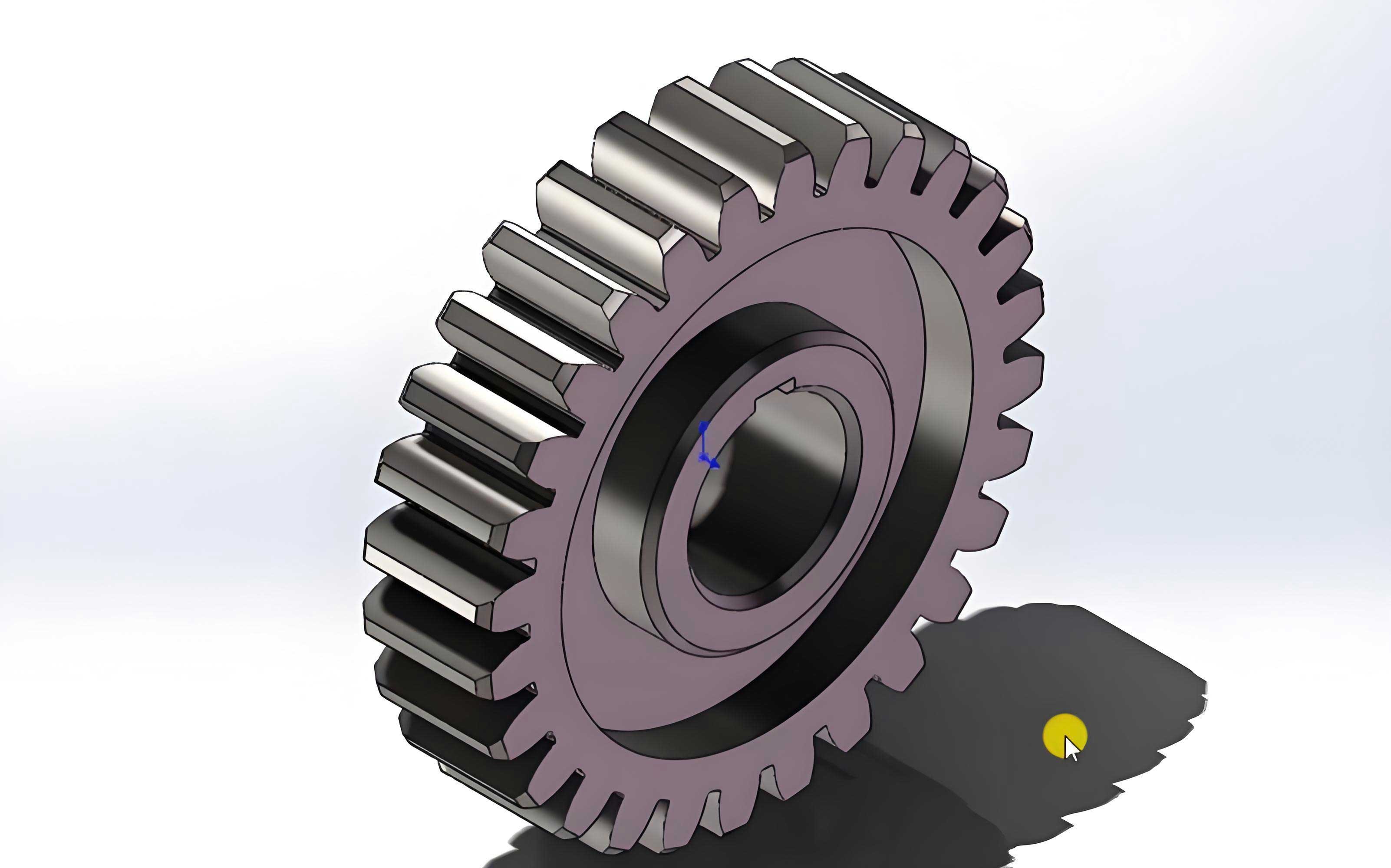
For a standard spur gear pair with a contact ratio between 1 and 2, the meshing cycle alternates periodically between single-tooth and double-tooth contact zones. When using a phase-tuned gear pair with two segments (A1 and A2), the key principle is that the corresponding teeth on each segment do not enter the active meshing zone simultaneously. By tuning the staggered phase \(p\), it is possible to arrange the system so that when segment A1 is in its single-tooth contact zone, segment A2 is in its double-tooth contact zone, and vice versa. This effectively smoothens the transition in the total contact length across the entire gear width, as illustrated in the following table summarizing the possible states:
| Meshing State of Segment A1 | Meshing State of Segment A2 | Total Number of Contacting Tooth Pairs | Total Effective Contact Length (for width b/segment) |
|---|---|---|---|
| Single-Tooth Contact | Single-Tooth Contact | 2 | 2b |
| Single-Tooth Contact | Double-Tooth Contact | 3 | 3b |
| Double-Tooth Contact | Single-Tooth Contact | 3 | 3b |
| Double-Tooth Contact | Double-Tooth Contact | 4 | 4b |
Consequently, unlike a standard spur gear where the total contact length oscillates sharply between \(2b\) and \(4b\), a phase-tuned gear’s contact length varies between \(2b\), \(3b\), and \(4b\), resulting in a reduced amplitude of fluctuation in the overall mesh stiffness.
The theoretical foundation for the vibration reduction effect lies in the analytical formulation of the TVMS for the phase-tuned gear system. For a standard gear mesh, the TVMS, \(k(t)\), can be expressed as the sum of its average value, \(\bar{k}\), and a periodic variation, \(\Delta k(t)\):
$$ k(t) = \bar{k} + \Delta k(t) $$
For a 2-segment phase-tuned gear, we consider two meshing paths with stiffness functions \(k^{(1)}(t)\) and \(k^{(2)}(t)\), having initial meshing phases \(p^{(1)}\) and \(p^{(2)}\), respectively. The equivalent mesh stiffness for the entire tuned gear pair, \(k_d(t)\), is the average of the two paths:
$$ k_d(t) = \frac{1}{2} \left[ k^{(1)}(t) + k^{(2)}(t) \right] = \bar{k} + \frac{1}{2} \left[ \Delta k_{p^{(1)}}(t) + \Delta k_{p^{(2)}}(t) \right] $$
Letting \(p^{(1)} = 0\) and \(p^{(2)} = p\), and expressing the variation \(\Delta k(t)\) for a standard spur gear as a Fourier series, the amplitude of the \(n\)-th harmonic of the combined stiffness variation, \(J_n\), becomes the critical parameter. After derivation, it is found to be:
$$ J_n = | 2 Q_z \cos(n\pi p) | $$
where
$$ Q_z = \frac{2(k_{\text{min}} – k_{\text{max}})}{n\pi} \sin(n\pi\alpha_1) $$
Here, \(\alpha_1\) is the fractional part of the contact ratio (\(\varepsilon_0 – 1\)), and \(k_{\text{min}}\) and \(k_{\text{max}}\) are the minimum and maximum stiffness values in a single mesh cycle. The factor \(|\cos(n\pi p)|\) shows that the amplitude of the \(n\)-th harmonic of the mesh stiffness fluctuation can be attenuated or even nullified by choosing an appropriate staggered phase \(p\). For instance, if the base contact ratio \(\varepsilon_0 \approx 1.66\), then \(\alpha_1 \approx 2/3\). In this case, the 3rd harmonic (\(n=3\)) can be minimized by choosing \(p = 1/6\) or \(p = 1/2\), since \(\cos(3\pi \cdot 1/6) = \cos(\pi/2) = 0\). This analytical insight guides the optimal design of spur gears for minimal stiffness excitation.
To validate the theoretical model, an experimental study was designed using a parallel-shaft spur gear test rig. The test gears were designed to allow for the physical implementation of different staggered phases. The driving pinion and driven gear both had 36 teeth, resulting in a tooth pitch angle of \(10^\circ\). Using a spline connection with 30 teeth on the hub, different staggered phases were achieved by rotating one gear segment relative to the other by specific numbers of spline teeth.
| Spline Teeth Offset | Relative Rotation | Staggered Phase Angle, \(\phi\) | Normalized Staggered Phase, \(p\) |
|---|---|---|---|
| 0 | 0° | 0° | 0 |
| 1 | 12° | 2° | 0.2 |
| 2 | 24° | 4° | 0.4 |
The experiments were conducted on a back-to-back test rig powered by a servo motor and loaded by a magnetic powder brake. Vibration displacement and acceleration were measured on both the input and output shafts in orthogonal directions using eddy current sensors and tri-axial accelerometers, respectively. Tests were performed at a constant input speed of 500 rpm under various load torques, with key vibration metrics (RMS and frequency spectra) analyzed for the three staggered phase configurations: \(p = 0\) (baseline), \(p = 0.2\), and \(p = 0.4\).
The experimental results conclusively demonstrated the vibration attenuation effect of the staggered phase method. The following table summarizes the reduction in vibration displacement Root Mean Square (RMS) at the input shaft under a 20 N·m load:
| Staggered Phase (\(p\)) | RMS Value (\(\mu m\)) | Reduction vs. \(p=0\) |
|---|---|---|
| 0 (Baseline) | 23.0 | – |
| 0.2 | 11.8 | 48.7% |
| 0.4 | 10.1 | 56.1% |
Frequency domain analysis revealed that the shaft rotational frequency (\(f_z\)) and its harmonics were the dominant components. The amplitude at \(f_z\) was reduced from 28.9 \(\mu m\) for \(p=0\) to 15.1 \(\mu m\) and 12.6 \(\mu m\) for \(p=0.2\) and \(p=0.4\), respectively, representing reductions of 47.8% and 56.4%.
Similarly, vibration acceleration RMS showed significant improvement. The results for the input shaft under the same operating condition are presented below:
| Staggered Phase (\(p\)) | RMS Value (\(m/s^2\)) | Reduction vs. \(p=0\) |
|---|---|---|
| 0 (Baseline) | 6.89 | – |
| 0.2 | 5.17 | 24.9% |
| 0.4 | 4.22 | 38.8% |
The frequency spectra of acceleration were dominated by the gear mesh frequency (\(f_m\)) and its harmonics. For both non-zero staggered phases, the amplitudes at these key frequencies were consistently lower than those for the baseline spur gear configuration (\(p=0\)).
A comprehensive study across varying load torques further confirmed the robustness of the method. The trend of vibration reduction for \(p=0.2\) and \(p=0.4\) compared to \(p=0\) was consistent at all tested loads. The following formulas summarize the average reduction in vibration acceleration RMS across the load range, comparing experimental and simulation results for the input shaft:
$$ \text{Experiment, } p=0.2: \quad \text{Avg. Reduction} \approx 15.9\% $$
$$ \text{Simulation, } p=0.2: \quad \text{Avg. Reduction} \approx 19.4\% $$
$$ \text{Experiment, } p=0.4: \quad \text{Avg. Reduction} \approx 28.6\% $$
$$ \text{Simulation, } p=0.4: \quad \text{Avg. Reduction} \approx 32.3\% $$
The close agreement between the experimental trends and the simulation predictions validates the theoretical model of the staggered phase tuning method. The slightly higher vibration levels in experiments can be attributed to practical factors such as manufacturing tolerances, assembly errors, shaft misalignment, and bearing clearance, which are not fully captured in the idealized simulation model.
In conclusion, the Staggered Tooth Phase Tuning method presents a novel and effective approach for passive vibration control in spur gear transmissions. The core of the method lies in modifying the periodic excitation source—the Time-Varying Mesh Stiffness—by creating multiple, phase-shifted meshing paths. Analytical derivation shows that the amplitude of the TVMS harmonics can be directly controlled by the normalized staggered phase \(p\), which is linked to the gear’s contact ratio. For a given spur gear pair, an optimal \(p\) exists that minimizes the stiffness fluctuation. Experimental investigations on a parallel-shaft gear test rig provide strong empirical evidence for the vibration attenuation effect, demonstrating significant reductions in both displacement and acceleration RMS values across different operating loads. The consistency between theoretical predictions and experimental trends confirms the viability of this method as a valuable design tool for enhancing the dynamic performance and reducing the noise of gear transmission systems employing spur gears.