
In the field of automotive engineering, the transmission system is a critical assembly responsible for transferring power from the engine to the driving wheels. Within this system, gear shafts serve as the fundamental structural elements upon which gears, bearings, and other components are mounted. The dynamic performance of these gear shafts directly influences the overall noise, vibration, and harshness (NVH) characteristics and the operational lifespan of the transmission. As powertrains evolve towards higher power density and efficiency, the demands on these components intensify, making their design optimization paramount. This article details a comprehensive methodology I employed for the modal analysis and subsequent shape optimization of an automotive transmission input gear shaft, utilizing an integrated Computer-Aided Design (CAD) and Computer-Aided Engineering (CAE) approach.
The core challenge stems from the complex vibratory environment inside a transmission. Gear shafts are subjected to both internal excitations, such as time-varying mesh stiffness and transmission errors from gear pairs, and external excitations from engine torque fluctuations and road inputs. When the frequency of any of these excitations coincides with or approaches a natural frequency of the shaft, resonance occurs. This phenomenon leads to amplified vibrational amplitudes, which not only radiate objectionable noise but also induce high dynamic stresses that can precipitate premature fatigue failure. Therefore, a fundamental design objective is to strategically elevate the lower-order natural frequencies of critical gear shafts beyond the dominant excitation frequency ranges encountered during operation.
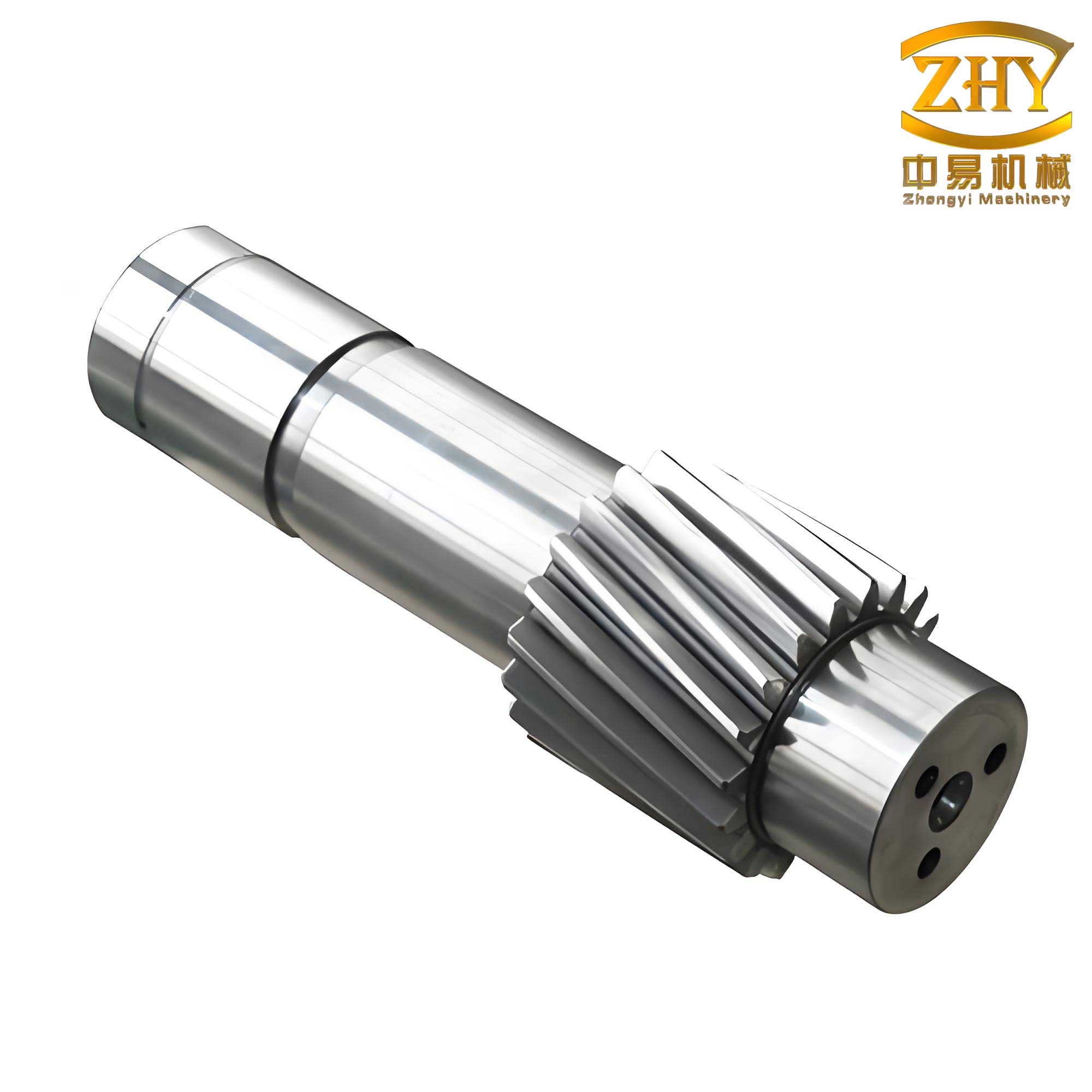
To address this, I initiated the process with a detailed modal analysis. Modal analysis is a numerical technique used to determine the inherent vibration characteristics—natural frequencies and corresponding mode shapes—of a structure. For a linear elastic system, the undamped free-vibration behavior is governed by the following equation of motion derived from finite element theory:
$$ \mathbf{M}\{\ddot{x}\} + \mathbf{K}\{x\} = \{0\} $$
Here, $\mathbf{M}$ is the global mass matrix, $\mathbf{K}$ is the global stiffness matrix, $\{x\}$ is the displacement vector, and $\{\ddot{x}\}$ is the acceleration vector. Assuming a harmonic solution of the form $\{x\} = \{\phi\} e^{i \omega t}$, the equation reduces to the generalized eigenvalue problem:
$$ (\mathbf{K} – \omega^2 \mathbf{M}) \{\phi\} = \{0\} $$
Solving this eigenvalue problem yields the natural frequencies $\omega_i$ (where $i = 1, 2, 3, …$) and the associated mode shapes $\{\phi_i\}$ of the structure. For practical engineering purposes, the lower-order modes are most critical, as they are typically easier to excite and contribute more significantly to the dynamic response.
My analysis focused on an input gear shaft from a passenger vehicle transmission. The three-dimensional geometry was first created using a parametric CAD modeler. Parametric modeling is crucial as it allows design variables, such as shaft diameters, to be defined symbolically. This enables automatic geometry updates during an optimization loop. The key geometric features were two journal diameters, labeled $d_1$ and $d_2$, which are common locations for bearing support. The initial design dimensions were set at $d_1 = 27$ mm and $d_2 = 17$ mm.
This CAD model was then imported into a high-fidelity finite element analysis (FEA) software. The material was defined as standard alloy steel with a Young’s Modulus of 210 GPa, a Poisson’s ratio of 0.3, and a density of $7850\ kg/m^3$. The geometry was discretized using a mesh of second-order tetrahedral (solid) elements, ensuring accurate stress and deformation calculation. The boundary conditions simulated the shaft’s mounting in the transmission: both ends of the shaft were constrained in all translational and rotational degrees of freedom except for rotation about the shaft’s longitudinal axis, reflecting its function as a rotating component.
The modal analysis was executed to extract the first six natural frequencies and their corresponding mode shapes. The results are summarized in the table below.
| Mode Order | Natural Frequency (Hz) | Primary Mode Shape Description |
|---|---|---|
| 1 | 801.6 | First bending (in one plane) |
| 2 | 801.8 | First bending (in orthogonal plane) |
| 3 | 2301.3 | Second bending |
| 4 | 2578.8 | First torsional |
| 5 | 2625.5 | Coupled bending/torsion |
| 6 | 4840.7 | Third bending / Complex shape |
The visualization of the mode shapes was particularly informative. It clearly showed that the maximum displacements in the lower-order bending modes occurred near the smaller journal sections ($d_2$) and along the spans between supports. This indicated that these sections were the most flexible and thus key to controlling the global stiffness and natural frequencies of the gear shafts. This insight directly informed the choice of design variables for optimization.
To systematically improve the design, I formulated an optimization problem. The goal was to shift the first six natural frequencies higher to create a margin from potential excitation frequencies. A single objective function $F$ was constructed as a weighted sum of these frequencies to prevent “mode switching,” where the order of modes changes during optimization, which can destabilize the process.
$$ F = \sum_{i=1}^{6} w_i \cdot f_i $$
$$ w = [0.3,\ 0.3,\ 0.1,\ 0.1,\ 0.1,\ 0.1]^T $$
The weights $w_i$ were assigned higher values to the first two modes due to their primary influence on response. The design variables were the two journal diameters: $X = [d_1, d_2]^T$. Practical manufacturing and assembly constraints were imposed as bounds on these variables. The complete optimization model is defined below.
| Component | Definition |
|---|---|
| Objective | Maximize $F(X) = 0.3f_1 + 0.3f_2 + 0.1f_3 + 0.1f_4 + 0.1f_5 + 0.1f_6$ |
| Design Variables | $d_1$, $d_2$ (Journal Diameters) |
| Constraints | $25.0 \text{ mm} \leq d_1 \leq 32.0 \text{ mm}$ $15.0 \text{ mm} \leq d_2 \leq 20.0 \text{ mm}$ |
The execution of this optimization required a seamless integration of the CAD and CAE tools. I implemented an automation platform that orchestrated the entire workflow without manual intervention. The platform consisted of four main components: the CAD software (Pro/E) for parametric geometry, the CAE solver (Abaqus) for modal analysis, a Calculator for evaluating the objective function, and an Optimizer driver.
The process began with a parametrized CAD script (a “journal file”). The Optimizer, starting with initial guesses for $d_1$ and $d_2$, passed these values to the CAD component, which regenerated the 3D model of the gear shaft. This updated geometry was automatically exported in a neutral format (IGES) to the CAE component. Here, a Python script controlled the entire FEA process: importing the geometry, assigning materials, meshing, applying boundary conditions, submitting the modal analysis job, and extracting the resulting first six natural frequencies from the report file. These frequencies were passed to the Calculator, which computed the objective function value $F$. This value was fed back to the Optimizer, which then used an algorithm to decide on a new set of design variables, closing the loop.
For the optimization algorithm, I selected the Adaptive Simulated Annealing (ASA) method. Simulated Annealing mimics the physical process of annealing in metallurgy, where a material is heated and slowly cooled to reduce defects. The algorithm allows for occasional acceptance of worse designs (uphill moves) with a certain probability to escape local minima (or maxima, in our case). The ASA variant improves upon classic SA by adaptively tuning its parameters (like the “temperature” cooling schedule) during the search, leading to more robust and efficient convergence to a near-global optimum, which is essential for nonlinear problems involving complex CAE simulations.
The integrated system was set to run until convergence. The convergence criterion was based on the change in the objective function and design variables between successive iterations. The optimization history, showing the progression of the design variables and the objective function, is charted below. The system converged after 107 iterative evaluations of the FEA model.
| Iteration Cycle | Design Variable $d_1$ (mm) | Design Variable $d_2$ (mm) | Objective Function $F$ (Hz) |
|---|---|---|---|
| 0 (Initial) | 27.000 | 17.000 | 1754.6 |
| 20 | 29.541 | 18.227 | 1892.3 |
| 40 | 31.112 | 19.005 | 1945.8 |
| 60 | 31.758 | 19.431 | 1960.1 |
| 80 | 31.899 | 19.587 | 1966.0 |
| 100 | 31.923 | 19.618 | 1967.0 |
| 107 (Optimal) | 31.925 | 19.624 | 1967.1 |
The final optimized design yielded journal diameters of $d_1 = 31.93$ mm and $d_2 = 19.62$ mm, effectively pushing against the upper bounds of the defined constraints. This result is physically intuitive: increasing the diameter of the slender sections ($d_2$) and the primary journals ($d_1$) significantly increases the shaft’s bending and torsional stiffness ($I$ and $J$), which is proportional to the fourth power of the diameter for circular sections ($I \propto d^4$). The impact on the natural frequencies was substantial, as shown in the comparative table below.
| Mode Order | Initial Freq. (Hz) | Optimized Freq. (Hz) | Percentage Increase |
|---|---|---|---|
| 1 | 801.6 | 973.3 | +21.4% |
| 2 | 801.8 | 1043.7 | +30.2% |
| 3 | 2301.3 | 2576.8 | +12.0% |
| 4 | 2578.8 | 3044.2 | +18.0% |
| 5 | 2625.5 | 3167.4 | +20.6% |
| 6 | 4840.7 | 5107.2 | +5.5% |
The overall objective function increased by 12.1%, from 1754.6 Hz to 1967.1 Hz. Most importantly, the first two natural frequencies, which are most susceptible to low-frequency engine orders and gear mesh harmonics, were raised by over 20%. This creates a significantly larger safety margin against resonance within the typical operating speed range of the transmission. The optimization of these gear shafts directly contributes to reduced vibrational energy being transmitted to the housing and ultimately lowers radiated noise.
In conclusion, the methodology presented herein demonstrates a powerful and automated framework for the dynamic design enhancement of transmission gear shafts. By integrating parametric CAD modeling, high-fidelity finite element modal analysis, and advanced optimization algorithms within a single platform, I successfully achieved a targeted improvement in the lower-order natural frequencies of a critical component. The process efficiently navigated the design space, arriving at an optimized geometry that maximizes frequency separation from excitation sources while adhering to spatial constraints. This approach not only improves product performance and durability by mitigating resonance risks but also drastically reduces the time and manual effort associated with traditional trial-and-error design cycles. It provides a robust, systematic template for the NVH-focused design of rotating gear shafts and similar structural elements across the automotive and mechanical engineering industries.