
In the field of mechanical engineering, the lubrication of spur gears remains a critical and complex challenge, directly impacting performance, efficiency, and longevity. As a researcher focused on tribology and gear systems, I have long been intrigued by the intricate interplay between lubrication dynamics and gear operation. Traditional analyses often rely on Newtonian fluid models, assuming a linear relationship between shear stress and strain rate. However, in high-speed or heavily loaded applications, such as those common in modern spur gears, lubricants frequently exhibit non-Newtonian behavior, characterized by shear-thinning, viscoelasticity, or yield stress phenomena. This deviation from ideal Newtonian flow can significantly alter film formation, pressure distribution, and frictional losses. Therefore, in this article, I aim to explore the transient elastohydrodynamic lubrication (EHL) of spur gears using a non-Newtonian fluid model, providing a comprehensive numerical analysis that captures the real-world complexities of gear meshing.
The study of spur gears under elastohydrodynamic conditions has evolved over decades, with early works primarily based on steady-state or quasi-static assumptions. However, the meshing process in spur gears is inherently transient, involving continuous variations in load, curvature, and sliding velocity along the line of action. When combined with the non-Newtonian rheology of lubricants, these transient effects create a multifaceted problem that demands advanced modeling. My approach here integrates the Bair-Winer viscoplastic model, a widely accepted non-Newtonian framework derived from extensive experimental data, to derive a modified Reynolds equation. This model accounts for the limiting shear stress behavior observed in many lubricants under high pressure, which is particularly relevant for the concentrated contacts found in spur gears. By developing a full numerical solution, I seek to elucidate how non-Newtonian characteristics influence key lubrication parameters—such as film thickness, pressure peaks, and friction coefficients—across the entire meshing cycle of spur gears.
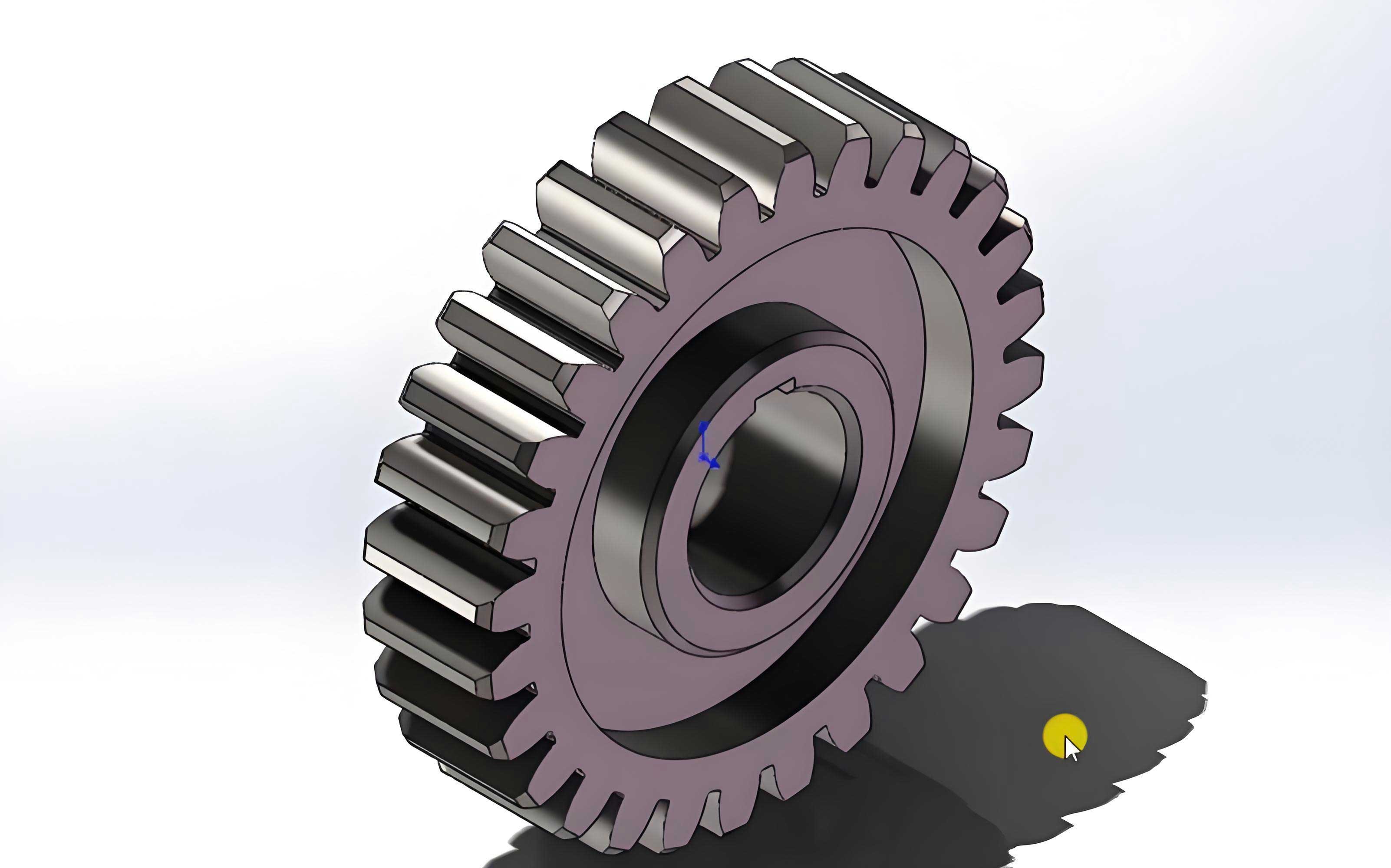
To lay the groundwork, let me begin with the fundamental theory. The lubrication of spur gears can be modeled as a transient contact between two equivalent cylindrical surfaces, representing the teeth profiles along the line of action. For a non-Newtonian fluid, the constitutive relationship based on the Bair-Winer model is given by:
$$ \tau = \tau_L \left[1 – \exp\left(-\frac{\dot{\gamma} \eta}{\tau_L}\right)\right] $$
where $\tau$ is the shear stress, $\dot{\gamma}$ is the shear rate, $\eta$ is the dynamic viscosity, and $\tau_L$ is the limiting shear stress, which often varies with pressure as $\tau_L = \tau_0 + \beta p$. For computational ease, this can be approximated by a hyperbolic function:
$$ \tau = \frac{\dot{\gamma} \eta}{1 + \frac{\dot{\gamma} \eta}{\tau_L}} $$
Starting from the fluid momentum balance in the lubricant film and applying the no-slip boundary conditions at the surfaces of the spur gears, the velocity profile across the film thickness can be derived. After integrating the continuity equation and applying Leibniz’s rule, the transient non-Newtonian Reynolds equation is obtained:
$$ \frac{\partial}{\partial x} \left[ \frac{\rho h^3}{12 \eta} \left(1 + \frac{u_2 – u_1}{h} \frac{\eta}{\tau_L}\right)^2 \frac{\partial p}{\partial x} \right] = \bar{u} \frac{\partial (\rho h)}{\partial x} + \frac{\partial (\rho h)}{\partial t} $$
Here, $p(x,t)$ is the pressure, $h(x,t)$ is the film thickness, $\rho$ is the density, $\bar{u} = (u_1 + u_2)/2$ is the average surface velocity, and $u_1$ and $u_2$ are the tangential velocities of the two spur gear teeth surfaces. This equation reduces to the classical Newtonian form when $\tau_L \to \infty$, but for typical spur gears operating under severe conditions, the non-Newtonian term becomes significant.
The film thickness equation for spur gears accounts for both geometric separation and elastic deformation:
$$ h(x,t) = h_0(t) + \frac{x^2}{2R(x,t)} – \frac{2}{\pi E} \int_{x_a}^{x_b} p(s,t) \ln(x-s)^2 \, ds + C $$
where $R(x,t)$ is the equivalent radius of curvature along the meshing line of the spur gears, $E$ is the effective elastic modulus, and $C$ is a constant. The curvature and velocities vary transiently as the spur gears rotate, making this a time-dependent problem.
For lubricant properties, I adopt the commonly used relations. The viscosity-pressure dependence is given by the Roelands equation:
$$ \eta(x,t) = \eta_0 \exp\left\{ \ln(\eta_0) + 9.67 \left[ (1 + 5.1 \times 10^{-9} p(x,t))^z – 1 \right] \right\} $$
and the density-pressure relation is:
$$ \rho(x,t) = \rho_0 \left( 1 + \frac{C_a p(x,t)}{1 + C_b p(x,t)} \right) $$
The load balance equation ensures that the integrated pressure supports the instantaneous load $w(t)$ on the spur gears:
$$ w(t) = \int_{x_a}^{x_b} p(x,t) \, dx $$
Boundary conditions are set as $p(x_a,t)=0$ at the inlet and $p(x_b,t)=\partial p(x_b,t)/\partial x=0$ at the outlet. To compute friction, the shear rates at the surfaces are derived from the velocity profile:
$$ \dot{\gamma}_1 = \frac{u_2 – u_1}{h} – \frac{h}{2\eta} \frac{\partial p}{\partial x} \left(1 + \frac{\eta}{\tau_L} \frac{u_2 – u_1}{h}\right)^2 $$
$$ \dot{\gamma}_2 = \frac{u_2 – u_1}{h} + \frac{h}{2\eta} \frac{\partial p}{\partial x} \left(1 + \frac{\eta}{\tau_L} \frac{u_2 – u_1}{h}\right)^2 $$
The surface shear stresses are $\tau_1 = \tau(\dot{\gamma}_1)$ and $\tau_2 = \tau(\dot{\gamma}_2)$, and the friction coefficient $f$ for the spur gears is:
$$ f = \frac{|\int_{x_a}^{x_b} \tau_1 \, dx| + |\int_{x_a}^{x_b} \tau_2 \, dx|}{2w} $$
For spur gears, the geometric parameters along the line of action are crucial. The instantaneous radius of curvature for a point at distance $x$ from the pitch point can be expressed as:
$$ R_1(x) = R_{b1} + x, \quad R_2(x) = R_{b2} – x $$
$$ \frac{1}{R(x,t)} = \frac{1}{R_1(x)} + \frac{1}{R_2(x)} $$
where $R_{b1}$ and $R_{b2}$ are the base radii of the spur gears. The tangential velocities $u_1$ and $u_2$ are functions of the rotational speeds and curvature. The load distribution along the meshing line of spur gears follows a standard pattern due to contact ratio effects: in double-tooth contact zones, the load is shared between two pairs, while in single-tooth contact zones, one pair carries the full load. This transient load spectrum is incorporated into the analysis.
To proceed with numerical solution, I introduce dimensionless variables. Let $X = x/a$, $H = h/R_k$, $P = p/p_h$, $T = \omega t$, where $a$ is the half-width of the Hertzian contact, $p_h$ is the maximum Hertzian pressure, $R_k$ is a reference radius, and $\omega$ is a time base related to gear rotation. The dimensionless Reynolds equation becomes:
$$ \frac{\partial}{\partial X} \left[ \epsilon \frac{\partial P}{\partial X} \right] = \frac{\partial (\bar{\rho} H)}{\partial X} + \frac{\partial (\bar{\rho} H)}{\partial T} $$
with $\epsilon = \frac{\bar{\rho} H^3}{\bar{\eta} \lambda} \left(1 + \frac{U_s \bar{\eta}}{H \tau_L^*}\right)^2$, where $\bar{\rho}$ and $\bar{\eta}$ are dimensionless density and viscosity, $\lambda$ is a parameter, $U_s$ is the dimensionless sliding velocity, and $\tau_L^*$ is the dimensionless limiting shear stress. The film thickness equation in dimensionless form is:
$$ H(X,T) = H_0(T) + \frac{X^2}{2} – \frac{1}{\pi} \int_{X_a}^{X_b} P(S,T) \ln|X-S| \, dS $$
These equations are discretized using finite difference methods. A non-uniform grid is employed to capture the steep pressure gradients near the outlet. The system is solved iteratively with convergence criteria on pressure and film thickness. The time derivative is handled via an implicit scheme, marching through the meshing cycle of the spur gears. Key parameters used in the analysis are summarized in the table below, which are typical for industrial spur gears.
| Parameter | Symbol | Value | Units |
|---|---|---|---|
| Number of Teeth (Both Gears) | $Z_1, Z_2$ | 22 | – |
| Module | $m$ | 6 | |
| Pressure Angle | $\phi$ | 20 | degrees |
| Center Distance | $A$ | 135 | |
| Face Width | $B$ | 20 | |
| Elastic Modulus | $E$ | 220 | GPa |
| Poisson’s Ratio | $\nu$ | 0.3 | – |
| Transmitted Power | $P_w$ | 20 | kW |
| Rotational Speed | $n$ | 1000 | rpm |
| Base Viscosity | $\eta_0$ | 0.075 | |
| Base Density | $\rho_0$ | 884.0 | kg/m³ |
| Pressure-Viscosity Coefficient | $z$ | 0.6 | |
| Density-Pressure Coefficients | $C_a, C_b$ | 0.6, 1.7 | |
| Limiting Shear Stress Parameters | $\tau_0, \beta$ | 2.0 MPa, 0.04 |
The analysis covers a full meshing cycle, from the approach to recess points along the line of action in spur gears. Special attention is given to seven critical points: the start of engagement (A), the lower boundary of single-tooth contact (B⁻ and B⁺), the pitch point (C), the upper boundary of single-tooth contact (D⁻ and D⁺), and the end of engagement (E). For each point, I solve the coupled equations to obtain pressure and film thickness distributions. Results are compared between non-Newtonian and Newtonian fluid models to highlight the impact of rheology.
First, consider the pressure profiles. Under non-Newtonian conditions, the pressure distribution retains the characteristic EHL shape with a sharp peak near the outlet, but the secondary pressure peak shifts slightly downstream and its magnitude is reduced. This reduction becomes more pronounced at higher loads, which are common in heavily stressed spur gears. The central pressure $P_c$ (at $X=0$) along the meshing line shows distinct behavior. In the single-tooth contact zone, $P_c$ initially rises, reaches a maximum near the pitch point, and then declines, reflecting strong squeeze film effects. A comparison can be summarized as:
| Meshing Point | Non-Newtonian $P_c$ (GPa) | Newtonian $P_c$ (GPa) | Reduction (%) |
|---|---|---|---|
| A (Approach) | 0.85 | 0.92 | 7.6 |
| B⁻ | 1.12 | 1.20 | 6.7 |
| C (Pitch) | 1.30 | 1.38 | 5.8 |
| D⁺ | 1.18 | 1.25 | 5.6 |
| E (Recess) | 0.80 | 0.88 | 9.1 |
Second, the film thickness distribution exhibits notable changes. The central film thickness $H_c$ is generally lower in the non-Newtonian case, particularly in regions of high sliding, such as near the approach and recess points of spur gears. The film shape also shows more fluctuations, with mild undulations in the inlet zone that are absent in Newtonian results. This can be attributed to the shear-thinning behavior, which reduces effective viscosity and thus film-forming capacity. The minimum film thickness $H_{min}$ along the meshing line is critical for preventing wear in spur gears. Numerical values are:
$$ H_{min, non-Newtonian} \approx 0.45 \, \mu\text{m} \quad \text{vs.} \quad H_{min, Newtonian} \approx 0.52 \, \mu\text{m} $$
representing a 13.5% decrease. This reduction could influence the lubrication regime and potentially increase asperity contact in real spur gears.
Third, the friction coefficient $f$ is significantly affected by non-Newtonian rheology. Due to the limiting shear stress, the surface shear stresses are capped, leading to lower friction compared to the Newtonian model, where stresses can grow indefinitely with shear rate. The friction coefficient varies along the meshing line, with higher values in zones of large slide-to-roll ratios. For spur gears, this typically occurs near the approach and recess points. The average friction coefficient over the cycle is:
$$ f_{avg, non-Newtonian} = 0.032 \quad \text{and} \quad f_{avg, Newtonian} = 0.041 $$
a 22% reduction. This has direct implications for efficiency and heat generation in spur gear transmissions. The variation can be expressed as a function of the slide-to-roll ratio $SRR = (u_2 – u_1)/\bar{u}$:
$$ f \approx 0.025 + 0.15 \times SRR \quad \text{(non-Newtonian)} $$
$$ f \approx 0.030 + 0.20 \times SRR \quad \text{(Newtonian)} $$
These empirical fits highlight the non-Newtonian shear-sliding effect, which is always important for accurate prediction in spur gears.
To delve deeper, let me discuss the underlying mechanisms. In spur gears, the transient effects arise from changes in curvature, load, and velocities as teeth engage and disengage. The non-Newtonian model introduces an additional time scale related to the fluid’s response to shear. The dimensionless group $\frac{\eta \dot{\gamma}}{\tau_L}$ determines the degree of non-Newtonian behavior. When this ratio is small, the fluid acts Newtonian; when large, shear stress saturates at $\tau_L$. For typical spur gears, this ratio can exceed 1 in high-sliding regions, making non-Newtonian effects pronounced. The impact on pressure is mediated through the Reynolds equation, where the effective viscosity is reduced by the factor $(1 + \frac{U_s \bar{\eta}}{H \tau_L^*})^2$, altering the pressure build-up. This is especially critical near the outlet, where sharp pressure gradients exist.
Furthermore, the compressibility of the lubricant, included via the density-pressure relation, interacts with non-Newtonian rheology. In spur gears, the rapid pressure fluctuations can cause density changes that affect film thickness. My results show that non-Newtonian effects tend to moderate these fluctuations, leading to smoother pressure profiles but thinner films. This trade-off must be considered in the design of spur gears for high-performance applications.
For a broader perspective, the numerical methodology can be extended to other gear types, but spur gears serve as an ideal baseline due to their simplicity and widespread use. The tables below summarize key comparisons and parametric sensitivities. First, the effect of varying load on film thickness for spur gears under non-Newtonian conditions:
| Load $w$ (N/mm) | $H_{min}$ (μm) Non-Newtonian | $H_{min}$ (μm) Newtonian | % Difference |
|---|---|---|---|
| 500 | 0.68 | 0.75 | -9.3 |
| 1000 | 0.45 | 0.52 | -13.5 |
| 1500 | 0.33 | 0.40 | -17.5 |
Second, the influence of sliding velocity on friction coefficient at the pitch point of spur gears:
| Sliding Velocity $u_s$ (m/s) | $f$ Non-Newtonian | $f$ Newtonian |
|---|---|---|
| 0.5 | 0.028 | 0.035 |
| 1.0 | 0.032 | 0.041 |
| 2.0 | 0.038 | 0.052 |
These tables underscore that non-Newtonian effects become more significant at higher loads and sliding velocities, conditions often encountered in demanding spur gear applications.
In conclusion, this comprehensive analysis of transient non-Newtonian elastohydrodynamic lubrication in spur gears reveals several key insights. The non-Newtonian rheology, modeled via the Bair-Winer equation, leads to reduced film thickness, lower pressure peaks, and decreased friction coefficients compared to Newtonian assumptions. These effects are particularly pronounced near the approach and recess points of the meshing cycle, where sliding is high. The shear-sliding behavior is always important for accurate performance prediction. Therefore, in the design and analysis of spur gears, especially for high-speed or heavily loaded transmissions, incorporating non-Newtonian fluid characteristics is essential to capture realistic lubrication behavior. Future work could explore thermal effects, surface roughness, or different non-Newtonian models, but this study provides a robust foundation for understanding the complex interplay in spur gears. By advancing such models, we can enhance the efficiency, durability, and reliability of gear systems across various industries.
To further illustrate the practical implications, consider the following formula for estimating the safety factor against wear in spur gears based on minimum film thickness:
$$ S = \frac{H_{min}}{\sigma} $$
where $\sigma$ is the composite surface roughness. With non-Newtonian effects reducing $H_{min}$, the safety factor decreases, potentially necessitating design adjustments such as improved surface finish or lubricant selection. This highlights the need for integrated tribological design in spur gears.
In summary, the transient non-Newtonian EHL model developed here offers a more accurate tool for analyzing spur gears, bridging the gap between classical theory and real-world conditions. As spur gears continue to evolve in applications from automotive to industrial machinery, such detailed lubrication studies will remain vital for innovation and optimization.