
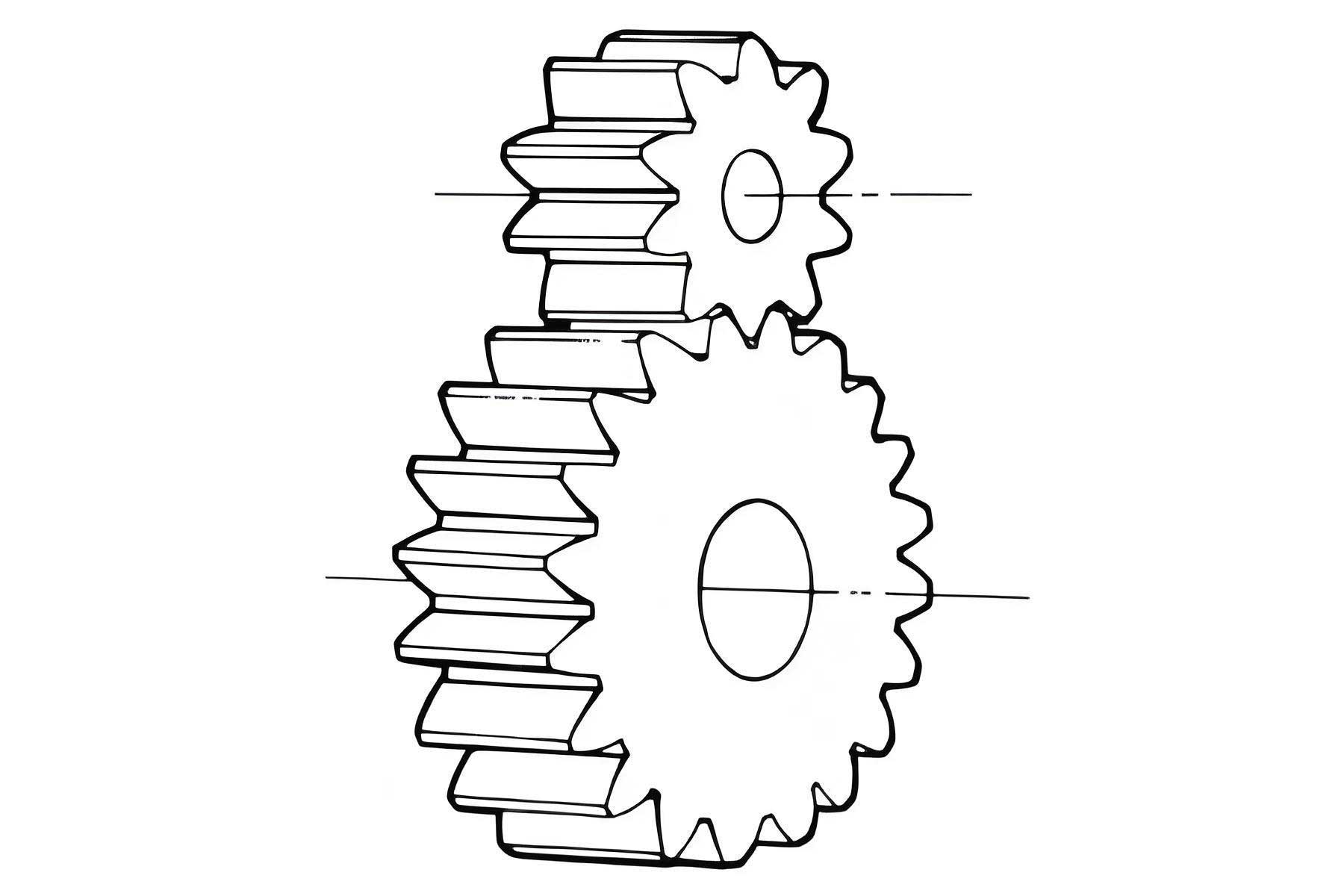
The reliable and efficient operation of mechanical power transmission systems is a cornerstone of modern engineering. Among these systems, the spur gear drive remains one of the most prevalent and critical components. Its performance and longevity are intrinsically linked to the lubrication conditions prevailing in the highly stressed contact zones between meshing teeth. This contact is characterized by extreme pressures, significant sliding and rolling velocities, and transient operating conditions, making classical hydrodynamic lubrication theories inadequate. A realistic analysis must therefore consider the elastic deformation of the contacting surfaces, the dramatic pressure-viscosity and thermal effects on the lubricant, and the time-varying nature of the gear meshing process. This article presents a detailed, first-person perspective on the modeling and analysis of transient thermal elastohydrodynamic lubrication (TEHL) for spur gear pairs, with a specific focus on the non-Newtonian behavior of lubricants, employing advanced numerical techniques for a complete solution.
The fundamental challenge in spur gear lubrication analysis stems from the dynamic nature of the meshing process. As a pair of teeth engage, travel through the line of action, and disengage, three key parameters undergo continuous and significant change: the normal load acting on the tooth pair, the entrainment velocity at the contact point, and the equivalent radius of curvature. These transients elevate the problem beyond steady-state or quasi-static EHL analyses. Early investigations, such as those by Vichard (1971), provided foundational insights using simplified methods. Subsequent work by Wang and Cheng (1981) incorporated dynamic loads and surface temperatures but neglected full transient effects. Hua and Khonsari (1995) advanced the field by solving the transient isothermal EHL problem for gears. Recent studies have successfully solved the transient TEHL problem. However, a critical aspect often simplified is the rheology of the lubricant. Most practical gear oils exhibit shear-thinning behavior under the high shear rates encountered in EHL contacts, deviating from Newtonian fluid assumptions. This non-Newtonian characteristic directly influences friction, film thickness, and temperature rise. Therefore, a comprehensive model for spur gear TEHL must integrate transient effects, thermal phenomena, surface elasticity, and non-Newtonian fluid rheology. This article synthesizes these aspects, detailing the governing equations, the sophisticated numerical strategy based on the multigrid method, and a discussion of the resulting pressure, film thickness, temperature, and friction characteristics along the entire path of contact.
Theoretical Foundation: Governing Equations for Gear TEHL
The analysis of a transient, thermal, non-Newtonian EHL contact in a spur gear pair is governed by a tightly coupled set of differential and integral equations. These equations describe the formation of pressure within the lubricant film, the resulting elastic deformation of the gear teeth, the conservation of energy, and the force balance.
1. The Generalized Reynolds Equation
The cornerstone of the lubrication analysis is the Reynolds equation, modified to account for lubricant compressibility, viscosity variation across the film, and non-Newtonian behavior. For a line contact under transient conditions, the form used is derived from the concept of “equivalent viscosity.” The governing equation is:
$$ \frac{\partial}{\partial x} \left[ \left( \frac{\rho}{\eta} \right)_e h^3 \frac{\partial p}{\partial x} \right] = 12 \bar{u} \frac{\partial}{\partial x}(\rho^* h) + 12 \frac{\partial}{\partial t}(\rho_e h) $$
where \( p(x,t) \) is the hydrodynamic pressure, \( h(x,t) \) is the film thickness, and \( \bar{u} = (u_1 + u_2)/2 \) is the entrainment velocity (with \( u_1 \) and \( u_2 \) being the surface velocities of the pinion and gear, respectively). The terms \( \rho^* \), \( \rho_e \), and \( (\rho/\eta)_e \) are equivalent quantities integrated across the film thickness to account for the variation of density \( \rho \) and viscosity \( \eta \) with pressure and temperature. The rightmost term, \( \partial(\rho_e h)/\partial t \), is the crucial transient term capturing the time-dependent squeeze film effect. The boundary conditions are:
$$ p(x_{in}, t) = p(x_{out}, t) = 0, \quad p(x,t) \ge 0 \ \text{for} \ x_{in} < x < x_{out} $$
where \( x_{in} \) and \( x_{out} \) define the computational domain’s inlet and outlet boundaries.
2. Film Thickness Equation
The film thickness separates the two elastically deformed surfaces. It comprises a geometric gap, a parabolic term representing the initial contact geometry, and the elastic deformation caused by the pressure distribution:
$$ h(x,t) = h_0(t) + \frac{x^2}{2R(t)} – \frac{2}{\pi E’} \int_{x_{in}}^{x_{out}} p(s,t) \ln|x-s| \, ds $$
Here, \( h_0(t) \) is the central offset (rigid body separation), \( R(t) \) is the time-varying equivalent radius of curvature at the contact point, and \( E’ \) is the effective elastic modulus. For two cylinders (representing gear teeth profiles at the contact point), \( 1/R = 1/R_1 + 1/R_2 \) and \( 2/E’ = (1-\nu_1^2)/E_1 + (1-\nu_2^2)/E_2 \), where \( R_i \), \( E_i \), and \( \nu_i \) are the radius, Young’s modulus, and Poisson’s ratio of surface \( i \). In a spur gear mesh, \( R(t) \) changes continuously from a small value at the start of engagement to a large value at the pitch point and back to a small value at the end of engagement.
3. Non-Newtonian Constitutive Relation
To model the shear-thinning behavior of typical lubricants, the Ree-Eyring fluid model is often employed. The relationship between shear stress \( \tau \) and shear rate \( \dot{\gamma} \) is given by:
$$ \dot{\gamma} = \frac{\tau_0}{\eta} \sinh\left(\frac{\tau}{\tau_0}\right) $$
where \( \tau_0 \) is the characteristic shear stress. For integration into the Reynolds equation framework, an equivalent viscosity \( \eta^* \) is defined such that the Newtonian shear stress expression \( \tau = \eta^* \dot{\gamma} \) holds. This leads to:
$$ \frac{1}{\eta^*} = \frac{1}{\eta} \cdot \frac{\sinh(\tau / \tau_0)}{(\tau / \tau_0)} $$
The viscosity \( \eta \) itself is a function of pressure and temperature, commonly described by the Roelands equation or a modified Barus law: \( \eta = \eta_0 \exp\{\alpha p + \beta (1/T – 1/T_0)\} \), where \( \eta_0 \) is the ambient viscosity, \( \alpha \) is the pressure-viscosity coefficient, and \( \beta \) is the thermal viscosity coefficient.
4. Force Balance Equation
At every instant in time, the integrated pressure profile must support the external load acting on the gear tooth pair. This equilibrium condition is enforced by:
$$ \int_{x_{in}}^{x_{out}} p(x,t) \, dx = w(t) $$
The load per unit width, \( w(t) \), is not constant for a single tooth pair in a spur gear transmission. It varies periodically as load is shared between one and two pairs of teeth in contact. The load function is typically derived from standard gear load distribution analysis, considering the total transmitted torque and the contact ratio.
5. Lubricant Density and Energy Equations
The compressibility of the lubricant is significant at EHL pressures. A commonly used density-pressure-temperature relation is:
$$ \rho(p, T) = \rho_0 \left[ 1 + \frac{0.6 \times 10^{-9} p}{1 + 1.7 \times 10^{-9} p} – D_T (T – T_0) \right] $$
where \( \rho_0 \) is the ambient density and \( D_T \) is the thermal expansivity coefficient.
The temperature distribution within the lubricant film is governed by the energy equation, which includes convection, conduction, compression heating, and viscous dissipation:
$$ \rho c_p \left( \frac{\partial T}{\partial t} + u \frac{\partial T}{\partial x} \right) – k \frac{\partial^2 T}{\partial z^2} + \frac{T}{\rho} \frac{\partial \rho}{\partial T} \left( \frac{\partial p}{\partial t} + u \frac{\partial p}{\partial x} \right) = \tau \frac{\partial u}{\partial z} $$
Here, \( c_p \) is the specific heat, \( k \) is the thermal conductivity of the lubricant, \( z \) is the coordinate across the film thickness, and \( u \) is the local fluid velocity. The term on the right-hand side, \( \tau (\partial u / \partial z) \), represents the viscous heating, a primary source of temperature rise in gear contacts, especially in regions of high sliding.
6. Surface Temperature Equations (Thermal Interface Conditions)
The temperatures of the contacting spur gear tooth surfaces are not constant; they are influenced by the heat flux from the lubricant film. Assuming semi-infinite bodies in the direction perpendicular to the surface, the temperatures at the surfaces (z=0 on gear 1, z=h on gear 2) can be found using:
$$ T(x,0,t) = T_0 + \frac{1}{\pi \sqrt{\rho_1 c_1 k_1 u_1}} \int_{-\infty}^{x} \frac{k \left. \frac{\partial T}{\partial z} \right|_{z=0} \, ds}{\sqrt{x – s}} $$
$$ T(x,h,t) = T_0 + \frac{1}{\pi \sqrt{\rho_2 c_2 k_2 u_2}} \int_{-\infty}^{x} \frac{k \left. \frac{\partial T}{\partial z} \right|_{z=h} \, ds}{\sqrt{x – s}} $$
where the subscripts 1 and 2 refer to the properties of the pinion and gear materials, respectively, and \( T_0 \) is the bulk temperature of the gears.
Numerical Methodology: The Multigrid Approach
Solving the coupled, nonlinear system of equations described above for a full meshing cycle of a spur gear is computationally intensive. The multigrid method is exceptionally well-suited for this task due to its rapid convergence and numerical stability. The following table summarizes the key parameters and steps of the numerical procedure implemented for this analysis.
| Aspect | Description |
|---|---|
| Grid Structure | W-cycle multigrid with 6 levels. The finest grid contains 961 equally spaced nodes. |
| Domain | The computational domain \( x_{in} \) to \( x_{out} \) is chosen to be sufficiently large (e.g., -4.5b to 1.5b, where b is the semi-Hertzian contact width) to ensure full pressure development and decay. |
| Time Discretization | The meshing cycle from the start to the end of engagement for one tooth pair is divided into 120 discrete time steps. The initial condition at the first time step is obtained from a steady-state solution. |
| Pressure Solver | Finite difference discretization of the Reynolds equation is used. The multigrid technique accelerates the iterative solution of the resulting algebraic equations on each grid level. |
| Deformation & Load | The elastic deformation integral in the film thickness equation is evaluated efficiently using the multigrid multi-level integration method. The force balance equation is satisfied by adjusting \( h_0(t) \) during the pressure iteration. |
| Temperature Solver | The energy equation is solved using a column-by-column scanning technique after the pressure field for an instant is obtained. Temperature and pressure solutions are iterated until convergence for each time step. |
| Convergence Criteria | Relative error for pressure and load < \( 10^{-3} \). Relative error for temperature < \( 10^{-4} \). |
The overall computational flow is an inner-outer iterative loop. For each time step, an outer loop alternates between solving the pressure and temperature fields. Within the pressure-solving phase, an inner multigrid loop iterates on the Reynolds, film thickness, and force balance equations until the pressure converges and balances the instantaneous load. Once pressure converges, the energy equation is solved to update the temperature field across the film and on the surfaces. This updated temperature field modifies the viscosity and density, requiring a return to the pressure solver. This pressure-temperature coupling continues until both fields satisfy their respective convergence criteria for the given time instant. The process then marches forward to the next time step.
Analysis of Results for a Spur Gear Pair
To illustrate the complex interactions, a case study based on typical spur gear parameters is analyzed. The following tables list the key input parameters.
| Parameter | Symbol | Value |
|---|---|---|
| Number of teeth (Pinion/Gear) | \( z_1 / z_2 \) | 32 / 96 |
| Module | \( m \) | 2 mm |
| Pressure Angle | \( \phi \) | 20° |
| Face Width | \( B \) | 20 mm |
| Pinion Speed | \( n_1 \) | 1000 rpm |
| Transmitted Power | \( N_w \) | 12 kW |
| Young’s Modulus | \( E_1, E_2 \) | 206 GPa |
| Poisson’s Ratio | \( \nu_1, \nu_2 \) | 0.3 |
| Density (Material) | \( \rho_1, \rho_2 \) | 7850 kg/m³ |
| Thermal Conductivity | \( k_1, k_2 \) | 46 W/(m·K) |
| Specific Heat | \( c_1, c_2 \) | 470 J/(kg·K) |
| Parameter | Symbol | Value |
|---|---|---|
| Ambient Viscosity | \( \eta_0 \) | 0.075 Pa·s |
| Pressure-Viscosity Coefficient | \( \alpha \) | 2.19e-8 Pa⁻¹ |
| Thermal Viscosity Coefficient | \( \beta \) | 0.042 K⁻¹ |
| Ambient Density | \( \rho_0 \) | 870 kg/m³ |
| Specific Heat | \( c_p \) | 2000 J/(kg·K) |
| Thermal Conductivity | \( k \) | 0.14 W/(m·K) |
| Ambient/Bulk Temperature | \( T_0 \) | 313 K |
| Ree-Eyring Characteristic Stress | \( \tau_0 \) | 10 MPa |
Pressure and Film Thickness at Key Positions
Examining the solution at five critical instants along the line of action reveals the transient nature of the spur gear EHL contact:
A. Start of single-pair contact (Entering).
B. End of double-pair contact (transition to single-pair).
C. Pitch point.
D. Start of double-pair contact (transition from single-pair).
E. End of single-pair contact (Exiting).
The pressure profiles exhibit classical EHL features: a Hertzian-like pressure plateau and a sharp secondary pressure spike near the outlet. The magnitude and position of this spike vary significantly. At the pitch point (C), where the load is high and the radii are large, the contact zone is wider, and the pressure spike is pronounced and shifted towards the outlet. At the entering point (A), pressure is generally higher than at the exiting point (E), and the spike is more prominent. Crucially, at the transition point from double to single-pair contact (B), the pressure can momentarily exceed even the pitch point pressure due to the sudden application of the full load.
The corresponding film thickness profiles show a central parallel region and a constriction at the outlet. The minimum film thickness, crucial for preventing surface contact, is thinnest at the entering point (A). This is a critical finding for spur gear design. The combination of a high sliding-to-rolling ratio (which generates more frictional heat, lowering viscosity) and a small radius of curvature at the root of the driving gear tooth leads to this vulnerable condition. Conversely, the film is thickest at the exiting point (E), where sliding is lower and the radius is larger.
Parameter Evolution Along the Path of Contact
Plotting key lubrication parameters against the position along the line of action (from entry to exit) provides a comprehensive performance map for the spur gear mesh.
Central Pressure: The central or Hertzian pressure shows a clear “W” shaped pattern. It is lower in the double-pair contact regions at the beginning and end of the mesh cycle because the load is shared between two tooth pairs. It peaks in the single-pair contact region. A general trend from entry to exit is a slight decrease, influenced by the changing curvature and entrainment velocity.
Minimum Film Thickness: The minimum film thickness follows an inverse “U” shape. It is lowest at the entry point (A), rises through the mesh, and is highest at the exit point (E). Sharp discontinuities are observed at the transition points (B and D), where the load per tooth changes instantaneously. This underscores that these transition instants are critical from a lubrication perspective, as the film must adjust rapidly to a new load state.
Maximum Film Temperature Rise: The temperature rise within the lubricant film is directly tied to sliding and power dissipation. It is nearly zero at the pitch point (C), where pure rolling occurs. It reaches a global maximum near the entry point, where the sliding velocity is highest. The thermal response also shows jumps at the load transition points (B, D), where increased load leads to increased shear heating.
Friction Coefficient: The coefficient of friction, calculated from the shear stresses at the surfaces, exhibits a complex multi-peaked curve. It approaches zero at the pitch point due to pure rolling. It reaches local maxima in the single-pair contact zones where both load and sliding are significant. The highest friction often occurs just after the double-to-single-pair transition (B), where high load and high sliding coincide.
Conclusions and Engineering Implications
The complete numerical analysis of transient non-Newtonian thermal EHL in spur gear drives yields several important conclusions with direct bearing on gear design and failure analysis:
- Critical Locations for Failure: The pitch point region, while having a thick film, experiences the highest contact pressures and significant pressure spikes, making it the prime site for subsurface-originated fatigue (pitting) failures. The high friction and temperature near the entry point, coupled with the thinnest film, make this region susceptible to scuffing and wear failures.
- Transient Risks: The instants of transition between single and double tooth contact are particularly hazardous. The sudden change in load causes abrupt adjustments in pressure, film thickness, and temperature, potentially leading to momentary metal-to-metal contact or intensified stress cycles.
- Non-Newtonian Effects: Incorporating shear-thinning behavior is essential for accurate prediction of friction and temperature. A Newtonian model would overestimate the effective viscosity in the high-shear regions, leading to overpredicted film thickness and underpredicted friction and operating temperatures.
- Numerical Efficacy: The multigrid method proves to be a powerful and necessary tool for solving this complex problem. Its ability to handle different spatial scales efficiently and its robust convergence are key to obtaining stable and accurate full numerical solutions for the entire meshing cycle of a spur gear.
In summary, the reliable performance and durability of spur gear transmissions depend on a delicate and dynamic elastohydrodynamic balance. This analysis demonstrates that only by considering the full transient, thermal, and non-Newtonian framework can engineers accurately predict the lubrication state and identify potential failure modes, leading to more robust and efficient gear designs.