
In modern construction and manufacturing industries, the reinforced bar straightening machine is an indispensable piece of equipment for processing steel bars. The efficiency and reliability of this machine heavily depend on its transmission system, where the spur gear train plays a pivotal role. As a key component, the spur gear system is responsible for transmitting power and withstanding operational loads. Any failure in the spur gear train can lead to significant downtime and economic losses. Therefore, conducting a thorough static analysis of the spur gear train is crucial for ensuring its durability and safety. In this study, we perform a detailed static analysis using finite element methods to investigate the stress and strain distributions in the spur gear system under various loading conditions. The objective is to understand how changes in input torque affect the spur gear performance and to validate the design against safety requirements.
The transmission mechanism of a reinforced bar straightening machine primarily relies on spur gear trains to transfer motion from the input shaft to the straightening rollers. This analysis focuses on the spur gear system that connects the dual-groove roller input shafts. To simulate real-world conditions, we consider different torque values applied to the input shaft, which correspond to varying diameters of the straightening rollers. By employing computational tools, we aim to provide insights into the structural behavior of spur gears and offer guidelines for design improvements.
To begin, we establish a three-dimensional model of the transmission mechanism. The modeling process utilizes SolidWorks, a powerful CAD software, to create an accurate representation of the spur gear train and associated components. The overall assembly includes multiple spur gears mounted on shafts, with the dual-groove rollers attached to the input shafts. The spur gears are designed based on standard geometric parameters to ensure proper meshing and power transmission. The following table summarizes the key geometric parameters of the spur gears used in this analysis:
| Parameter | Value |
|---|---|
| Number of Teeth (Z1/Z2) | 23 |
| Module (m) [mm] | 6 |
| Pressure Angle (α) [degrees] | 20 |
| Face Width (b) [mm] | 60 |
| Addendum Coefficient (h*a) | 1 |
| Dedendum Coefficient (c*) | 0.25 |
| Profile Shift Coefficient (X) | 0 |
The spur gear material is selected as 45 steel, a common medium-carbon steel known for its good balance of strength, toughness, and machinability. After heat treatment, this material achieves enhanced mechanical properties suitable for high-load applications. The material properties are as follows: density ρ = 7.85 × 10³ g/mm³, elastic modulus E = 2.06 × 10⁵ MPa, and Poisson’s ratio μ = 0.3. These properties are input into the finite element model to ensure realistic simulation results.
Modeling the spur gear tooth profile requires precise mathematical formulation. The involute curve, which defines the gear tooth shape, is derived from the base circle geometry. For a spur gear, the involute profile can be expressed using parametric equations. Let r_b be the base circle radius, α be the pressure angle, and μ be the roll angle at any point K on the involute. The coordinates (x, y) of point K are given by:
$$ x = r_b (\cos \mu + \mu \sin \mu) $$
$$ y = r_b (\sin \mu – \mu \cos \mu) $$
where $$ \mu = \theta_K + \alpha_K $$
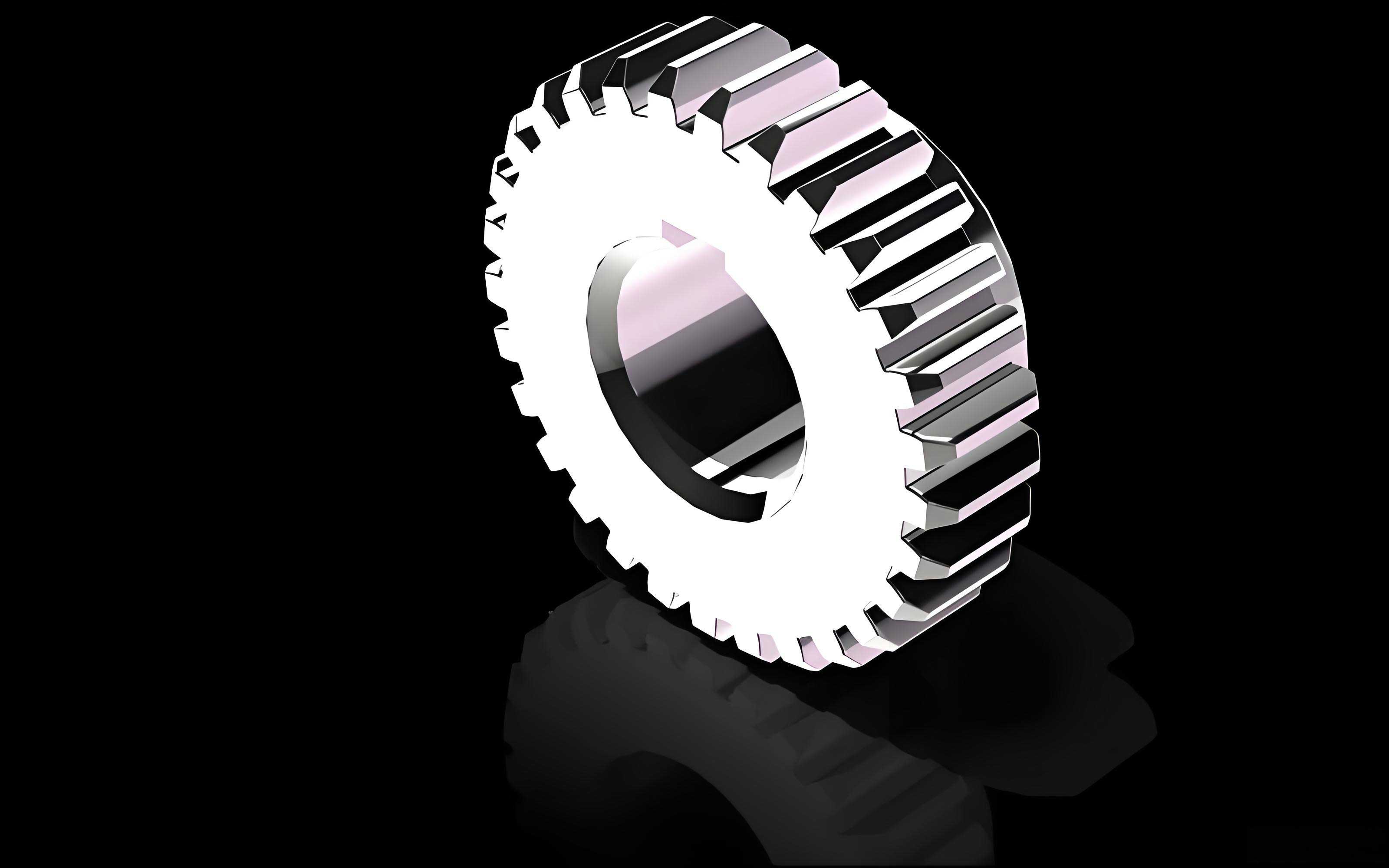
Here, θ_K is the angle parameter, and α_K is the pressure angle at point K. These equations are implemented in SolidWorks to generate the exact tooth profile. By sweeping this profile along the face width and applying mirroring and patterning operations, a complete spur gear model is created. Additional features such as the shaft hole and keyway are then added to finalize the gear model.
After completing the CAD model, we proceed to the static analysis phase using ANSYS Workbench 12.1. The finite element method (FEM) is employed to discretize the spur gear geometry and solve for stress and strain distributions. The meshing strategy involves using hexahedral dominant elements to capture the complex geometry accurately. The mesh is refined in critical regions such as the tooth root and contact areas to ensure solution convergence. The final mesh consists of approximately 48,085 elements and 153,955 nodes, providing a balance between computational efficiency and accuracy.
Loading conditions are applied based on the operational requirements of the reinforced bar straightening machine. The primary load originates from the straightening process, where the steel bar is pressed against the rollers. For a steel bar with diameter D = 8 mm and contact length L = 40 mm, the contact area S is calculated as:
$$ S = \pi D L $$
Assuming the steel bar has a yield strength of 400 MPa and tensile strength of 600 MPa, the force F applied to the first straightening roller can be estimated using:
$$ F = P S $$
where P is the contact pressure. In this analysis, we apply the yield force to simulate worst-case scenarios. The torque T on the input shaft, which is shared by the spur gear, is then derived from:
$$ T = F R $$
Here, R is the radius of the straightening roller. By varying the roller diameter from 123 mm to 153 mm, we obtain different torque values. The calculated torques are:
| Roller Diameter [mm] | Torque on Input Shaft (T) [N·mm] |
|---|---|
| 123 | 2.472 × 10⁷ |
| 133 | 2.673 × 10⁷ |
| 143 | 2.874 × 10⁷ |
| 153 | 3.075 × 10⁷ |
These torque values are applied to the dual-groove roller input shaft, which in turn loads the spur gear train. The gear forces are calculated considering the tangential and radial components. For a spur gear, the tangential force F_t and radial force F_r at the pitch point are given by:
$$ F_t = \frac{2T}{d} $$
$$ F_r = F_t \tan \alpha $$
where d is the pitch diameter of the spur gear, and α is the pressure angle. The normal force F_n, which acts along the line of action, is:
$$ F_n = \frac{F_t}{\cos \alpha} $$
Using these equations, we compute the forces on the spur gears for each torque case. The results are summarized in the table below:
| Torque T [N·mm] | Tangential Force F_t [kN] | Radial Force F_r [kN] | Normal Force F_n [kN] |
|---|---|---|---|
| 2.472 × 10⁷ | 358.233 | 130.456 | 381.123 |
| 2.673 × 10⁷ | 387.357 | 141.032 | 412.456 |
| 2.874 × 10⁷ | 416.482 | 151.608 | 443.789 |
| 3.075 × 10⁷ | 445.607 | 162.184 | 475.122 |
In the finite element model, boundary conditions are applied to simulate realistic constraints. The driving spur gear, mounted on the input shaft, is allowed to rotate freely about its axis by applying a cylindrical support with tangential freedom. The driven spur gear is fixed at its center to represent the reaction from the adjacent shaft. The computed torque values are applied as moment loads on the input shaft in a counterclockwise direction. This setup enables the analysis of stress and strain in the spur gear train under static loading.
The static analysis yields detailed stress and strain distributions for each torque case. The von Mises stress is used to evaluate the equivalent stress, as it is commonly employed for ductile materials like 45 steel. The strain results provide insights into the deformation behavior of the spur gears. The maximum stress and strain values for each case are extracted and compared. The following table presents the key results:
| Torque T [N·mm] | Maximum Stress [MPa] | Maximum Strain [mm] | Location of Maximum Stress |
|---|---|---|---|
| 2.472 × 10⁷ | 124.09 | 6.2043 | Tooth root of driving spur gear |
| 2.673 × 10⁷ | 134.18 | 6.7088 | Tooth root of driving spur gear |
| 2.874 × 10⁷ | 144.27 | 7.2133 | Tooth root of driving spur gear |
| 3.075 × 10⁷ | 154.36 | 7.7178 | Tooth root of driving spur gear |
From these results, we observe a linear relationship between the applied torque and the maximum stress/strain in the spur gear train. As the torque increases, both the stress and strain values increase proportionally. The maximum stress consistently occurs at the tooth root of the driving spur gear, which is a critical region prone to bending fatigue. This is expected because the tooth root experiences the highest bending moment during gear meshing. The stress concentration at the fillet radius exacerbates this effect, making it the likely initiation point for cracks or failures.
The strain distribution follows a similar pattern, with the maximum deformation located at the tooth root. The deformation magnitude increases with torque, indicating that the spur gear teeth deflect more under higher loads. However, even at the highest torque of 3.075 × 10⁷ N·mm, the maximum stress of 154.36 MPa is well below the yield strength of 45 steel (355 MPa). This implies a safety factor of approximately 2.3, which is acceptable for most engineering applications. The spur gear design thus meets the safety requirements under the considered loading conditions.
To further understand the stress distribution, we examine the contact patterns between meshing spur gears. The finite element analysis reveals that the stress is not uniformly distributed along the tooth face. Higher stresses are concentrated near the pitch line and tooth root, while the tip regions experience lower stresses. This non-uniformity is influenced by factors such as load sharing, tooth deflection, and manufacturing tolerances. For spur gears, the contact ratio affects how loads are distributed among multiple tooth pairs. A higher contact ratio can reduce the peak stress by spreading the load over a larger area.
The analysis also considers the effect of gear geometry on stress. Parameters like module, pressure angle, and face width play significant roles in determining the spur gear performance. For instance, increasing the module generally enhances the tooth strength but may lead to larger gear sizes. Similarly, a higher pressure angle improves the load-carrying capacity but can increase radial forces. In this study, the spur gears are designed with standard parameters to balance strength and compactness. Future optimizations could involve adjusting these parameters to minimize stress concentrations.
In addition to the spur gear analysis, we evaluate the input shaft’s stress and strain behavior. The shaft is subjected to combined torsion and bending due to the gear forces. The maximum stress on the shaft is found to be lower than that on the spur gears, indicating that the gears are the critical components. However, the shaft’s deflection should be monitored to ensure proper alignment and meshing of the spur gears. Excessive shaft deformation can lead to misalignment, increased noise, and accelerated wear.
The finite element simulations provide visual representations of stress and strain contours. These contours help identify hotspots and potential failure zones. For example, the stress contours show a gradient from the tooth root to the tip, with the root region exhibiting the highest intensity. The strain contours indicate that deformation is more pronounced in the web and rim sections of the spur gear, especially near the hub. These insights are valuable for design modifications, such as adding fillets or reinforcing certain areas.
To enhance the spur gear performance, several improvements can be considered. First, optimizing the tooth profile through modifications like tip relief or root fillet optimization can reduce stress concentrations. Second, using advanced materials or surface treatments, such as carburizing or nitriding, can increase the surface hardness and fatigue resistance of the spur gears. Third, improving lubrication conditions can minimize friction and wear, thereby extending the spur gear lifespan. These measures are particularly important for high-torque applications like reinforced bar straightening machines.
The static analysis methodology presented here can be extended to dynamic analyses to account for inertial effects and transient loads. In real operation, the spur gear train experiences fluctuating loads due to variations in bar straightening forces. Dynamic simulations would provide a more comprehensive understanding of gear behavior under cyclic loading, which is essential for fatigue life prediction. However, the static analysis serves as a foundational step to validate the design under peak load conditions.
In conclusion, this study demonstrates the importance of static analysis for spur gear trains in reinforced bar straightening machines. By modeling the transmission mechanism and applying finite element methods, we have analyzed the stress and strain distributions under varying torque loads. The results show that the maximum stress and strain occur at the tooth root of the driving spur gear, with values increasing linearly with torque. The design meets safety requirements, as the stresses remain below the material yield limit. This analysis provides a basis for optimizing spur gear designs to enhance reliability and performance. Future work could involve experimental validation, dynamic analysis, and multi-objective optimization to further improve the spur gear system.
The spur gear train is a fundamental component in many mechanical systems, and its static behavior under load is critical for ensuring operational integrity. Through this analysis, we have highlighted key factors that influence spur gear performance, such as geometry, material properties, and loading conditions. By leveraging computational tools like SolidWorks and ANSYS Workbench, engineers can efficiently evaluate and refine spur gear designs, leading to more robust and efficient machinery. The insights gained from this study contribute to the broader field of gear design and analysis, emphasizing the need for rigorous static assessments in engineering practice.