
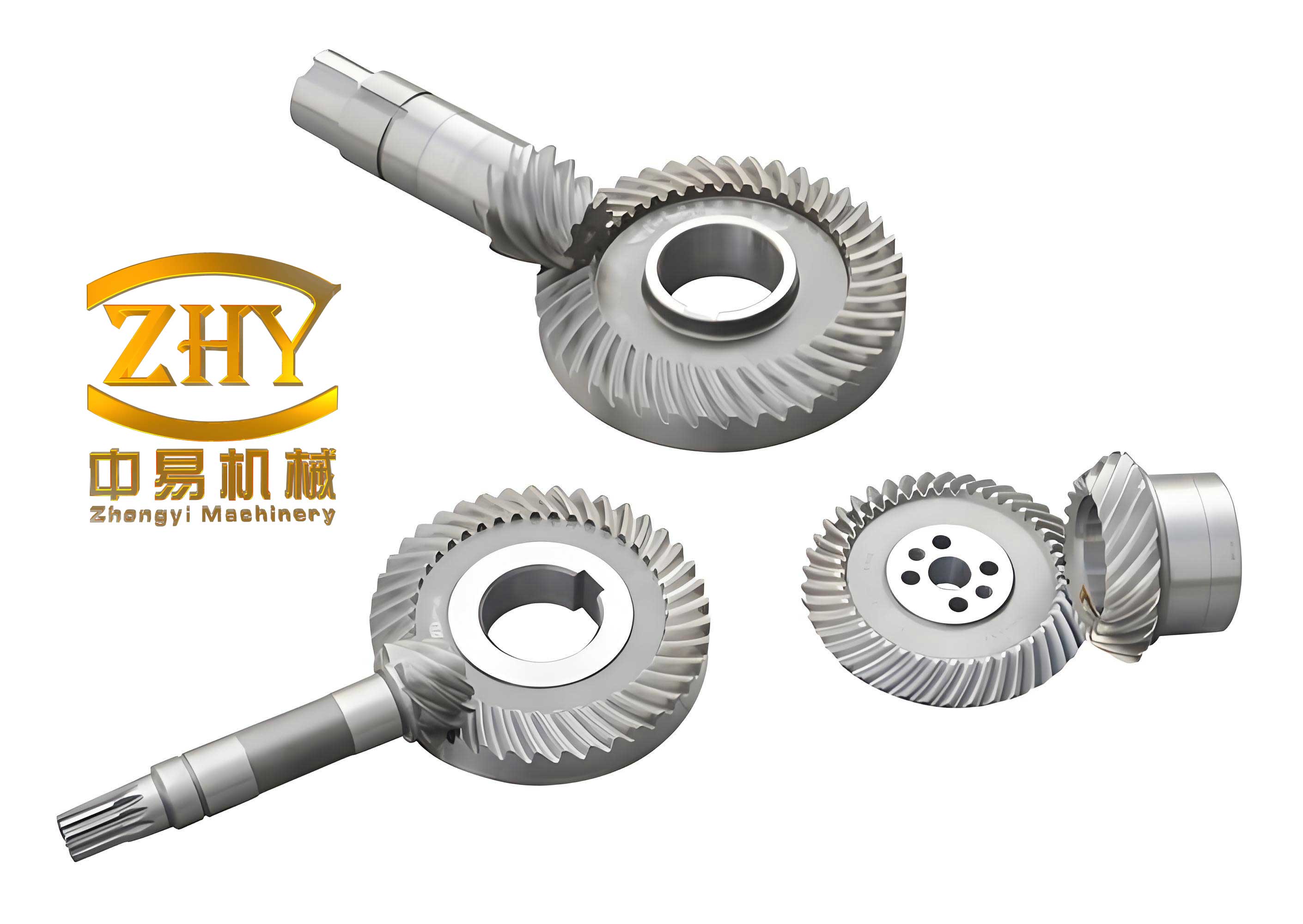
The design and manufacture of hypoid gears, particularly the spiral bevel hypoid gear type, represent a pinnacle of mechanical engineering complexity. Since their inception, continuous theoretical research and practical application by experts worldwide have established a solid foundation in meshing principles, design calculations, and manufacturing methods. However, significant challenges persist, especially in specialized fields like mining and heavy transportation. These applications demand robust, reliable, and efficient power transmission components that can operate under extreme loads and in harsh environments. The primary hurdles involve further optimizing product structure, enhancing transmission quality and service life, shortening design and manufacturing cycles, reducing costs, and responding rapidly to market demands. For spiral bevel hypoid gears used in mining haulage equipment—typically produced in small batches with limited dedicated manufacturing lines and research investment—these challenges are acute. Field failures are frequent, manifesting as poor transmission quality, short service life, and high failure rates, often falling short of operational requirements. Therefore, there is a compelling need to tap into internal engineering potential and strengthen research on integrated design and manufacturing systems to elevate product quality. This article details the development of a comprehensive, modular optimization and selection design system developed to address these very issues.
The core of this effort is a modular software architecture. The Hypoid Gear Optimization and Selection Design System is built upon four principal interconnected modules: Geometric Design, Strength Calculation, Life Estimation, and Optimization Design. These modules can function sequentially or independently, providing flexibility for different design and analysis tasks. The system is developed using Visual Basic for its strong graphical user interface (GUI) capabilities, ensuring an interactive, user-friendly experience on the Windows platform. Key features include dynamic design navigation, automatic chart and table lookup, data inheritance and referencing, comprehensive online help, and automated report generation. The main interface centralizes access to all functions, from creating new projects to executing complex optimization routines.
I. Geometric Design Module: The Foundation
The geometric design module is the cornerstone, calculating all necessary dimensions, positional parameters, and machine setup data for the spiral bevel hypoid gear pair. It automates the well-established calculation methods recommended by Gleason Works, involving over sixty distinct parameters. The process begins with the input of fundamental design parameters. The program logic, outlined in the flowchart below, guides the calculation sequence.
Design Process Flow for Hypoid Gear Geometry:
- Input basic parameters: Pinion teeth (Z1), Gear teeth (Z2), Shaft angle (Σ), Offset (E), Module, Face width, etc.
- Calculate spiral angles and pitch angles.
- Determine gear blank dimensions (pitch diameters, addendum, dedendum).
- Calculate machine setting parameters for generation (cutter radius, sliding base, machine root angle, etc.).
- Perform tooth proportion calculations (based on “balanced” or “oversize” pinion designs).
- Select tooth taper method: The system automatically chooses between Uniform Depth, Dual Depth (Double Crowning), or Tilted Root Line based on calculated addendum taper to avoid excessive tooth pointing.
- Output full geometric dataset and generate drawings.
The input interface is highly interactive, providing context-sensitive help and selection guides for each parameter, ensuring even less-experienced designers can make informed choices. Compared to manual calculation, this module drastically improves speed, eliminates human error inherent in such tedious work, and yields highly reliable and consistent results, validated against field-tested designs.
Table 1: Key Input Parameters for Hypoid Gear Geometric Design
| Parameter Symbol | Description | Typical Source/Selection Guide |
|---|---|---|
| Z1, Z2 | Number of teeth (Pinion, Gear) | Ratio requirements, space constraints. |
| Σ | Shaft Angle | Application layout (commonly 90°). |
| E | Hypoid Offset (Gleason: Pinion Offset) | Dictates drive position, influences strength & smoothness. |
| met or D2 | Gear Outer Module or Pitch Diameter | Based on torque, bending strength preliminaries. |
| b2 | Gear Face Width | Limited by blank forging, 0.25-0.3 of gear cone distance. |
| βm1 | Pinion Mean Spiral Angle | Affects axial thrust, smoothness; typically 45°-55°. |
| SR | Hand of Spiral | Determined by rotation direction and shaft orientation. |
The geometric output forms the essential dataset for all subsequent analysis, including strength rating, life prediction, and ultimately, the generation of manufacturing drawings and machine setup sheets.
II. Strength Calculation Module: Validating the Design
Selecting initial parameters for a hypoid gear based solely on load capacity remains challenging. Therefore, common practice involves choosing parameters via experience and analogy, performing geometric design, and then verifying the design through rigorous strength calculations. This module implements the mainstream rating methodologies, primarily those recommended by Gleason, supplemented by relevant ISO standards (such as ISO 10300) for cross-verification. It can operate directly on the results from the Geometric Design Module or accept manual input of gear geometry for analysis of existing designs.
The strength calculation process requires additional operational data. The core procedure is structured as follows:
- Input Load Spectrum & Conditions: Nominal pinion torque (T1), pinion speed (n1), desired service life (Lh), application factors (KA), etc.
- Determine Dynamic & Load Distribution Factors: Calculate KV (dynamic factor), KHβ, KFβ (face load factors for contact and bending). These account for manufacturing accuracy, system stiffness, and load sharing.
- Calculate Nominal Stresses:
- Bending Stress: Based on the Lewis formula, modified for hypoid geometry.
$$ \sigma_{F0} = \frac{F_t}{b \cdot m_{mn}} \cdot Y_F \cdot Y_S \cdot Y_\beta $$
Where $F_t$ is the tangential force at the mean cone distance, $b$ is the face width, $m_{mn}$ is the mean normal module, $Y_F$ is the tooth form factor, $Y_S$ is the stress correction factor, and $Y_\beta$ is the spiral angle factor. - Contact Stress: Based on the Hertzian contact theory.
$$ \sigma_{H0} = Z_{E} \cdot Z_{H} \cdot Z_{\varepsilon} \cdot Z_{\beta} \cdot \sqrt{\frac{F_t}{b \cdot d_{m1}} \cdot \frac{u+1}{u}} $$
Where $Z_E$ is the elasticity factor, $Z_H$ is the zone factor, $Z_{\varepsilon}$ is the contact ratio factor, $Z_{\beta}$ is the spiral angle factor, $d_{m1}$ is the pinion mean diameter, and $u$ is the gear ratio.
- Bending Stress: Based on the Lewis formula, modified for hypoid geometry.
- Apply Composite Factors & Calculate Actual Stress:
$$ \sigma_F = \sigma_{F0} \cdot K_A \cdot K_V \cdot K_{F\beta} \cdot K_{F\alpha} $$
$$ \sigma_H = \sigma_{H0} \cdot \sqrt{K_A \cdot K_V \cdot K_{H\beta} \cdot K_{H\alpha}} $$
Where $K_{F\alpha}$ and $K_{H\alpha}$ are transverse load factors. - Compare with Permissible Stress: The calculated stresses are compared against the allowable bending fatigue limit $\sigma_{FP}$ and contact fatigue limit $\sigma_{HP}$, which are derived from material properties, heat treatment, and required reliability.
$$ \sigma_F \leq \sigma_{FP} = \frac{\sigma_{Flim} \cdot Y_{NT} \cdot Y_{\delta relT} \cdot Y_{RrelT} \cdot Y_X}{S_{Fmin}} $$
$$ \sigma_H \leq \sigma_{HP} = \frac{\sigma_{Hlim} \cdot Z_{NT} \cdot Z_L \cdot Z_V \cdot Z_R \cdot Z_W \cdot Z_X}{S_{Hmin}} $$
Factors account for life ($Y_{NT}, Z_{NT}$), lubrication ($Z_L$), speed ($Z_V$), roughness ($Z_R$), hardness ratio ($Z_W$), and size ($Y_X, Z_X$). $S_{Fmin}$ and $S_{Hmin}$ are minimum safety factors.
The module performs four key checks: Bending Fatigue Strength, Contact (Pitting) Fatigue Strength, Static (Yield) Bending Strength (for peak loads), and Scoring (Wear) Resistance. The interactive interface displays intermediate results and safety factors, allowing the designer to modify assumptions in real-time. All supporting charts and data tables from the rating standards are integrated for easy reference.
Table 2: Summary of Strength Rating Checks for Hypoid Gears
| Check Type | Governing Equation (Conceptual) | Primary Influencing Factors |
|---|---|---|
| Bending Fatigue | $\sigma_F \leq \sigma_{FP}$ | Tooth root geometry, fillet radius, material core hardness, residual stress. |
| Contact Fatigue | $\sigma_H \leq \sigma_{HP}$ | Surface hardness, curvature radii at contact, lubricant film thickness, surface finish. |
| Static Bending | $\sigma_{Fmax} \leq \sigma_{FlimY}$ | Material yield strength, applied shock load. |
| Scoring/Wear | $T_{inst} \leq T_{scuff}$ or Flash Temperature Criterion | Instantaneous temperature at mesh, lubricant extreme pressure (EP) properties. |
III. Life Estimation Module: Predicting Durability
The Life Estimation Module extends the strength analysis by answering two critical, operationally focused questions: 1) Given the actual loads, what is the predicted service life (in hours or cycles) of the hypoid gear set? 2) For a required finite life, what is the maximum torque the gear set can safely transmit?
This module is intrinsically linked to the Strength Calculation Module. It utilizes the calculated safety factors and stress levels relative to the material endurance limits. The underlying principle is based on the S-N (Wöhler) curve for bending and the pitting life curve for contact stress, typically modeled with power-law equations.
The process for life estimation, particularly for finite-life design, involves:
- For Bending Fatigue:
The basic relationship between stress cycles $N$ and bending stress $\sigma_F$ is:
$$ \sigma_F^m \cdot N = \text{constant} = \sigma_{Flim}^m \cdot N_{F0} $$
Where $m$ is the slope exponent of the S-N curve (e.g., ~6.2 for bending), and $N_{F0}$ is the stress cycle number at the endurance limit (e.g., 3×10^6). If the design stress $\sigma_F$ is lower than the endurance limit $\sigma_{Flim}$, “infinite life” (exceeding a very high cycle count) is predicted. Otherwise, the permissible number of cycles $N_{perm}$ is:
$$ N_{perm} = N_{F0} \cdot \left( \frac{\sigma_{Flim}}{\sigma_F} \right)^m $$
The operating hours are then: $L_h = N_{perm} / (60 \cdot n \cdot q)$, where $n$ is rpm and $q$ is the number of load applications per revolution. - For Contact Fatigue:
A similar relationship holds, often with a different exponent $p$ (e.g., ~6.6 for pitting):
$$ \sigma_H^p \cdot N = \text{constant} = \sigma_{Hlim}^p \cdot N_{H0} $$
Where $N_{H0}$ is typically 5×10^7 or 10^9 cycles. The life calculation follows the same form.
$$ N_{perm} = N_{H0} \cdot \left( \frac{\sigma_{Hlim}}{\sigma_H} \right)^p $$ - Cumulative Damage (Miner’s Rule):
For complex load spectra common in mining machinery, the module can estimate life using Palmgren-Miner’s linear damage summation rule.
$$ D = \sum_{i=1}^{k} \frac{n_i}{N_i} $$
Failure is predicted when the total damage $D \geq 1$. Here, $n_i$ is the number of cycles at stress level $i$, and $N_i$ is the life at that stress level from the S-N curve.
The module’s interface displays these calculations clearly. If the computed life exceeds the required service life by a large margin (i.e., stresses are well below the endurance limit), it signals “Theoretical Infinite Life.” This outcome is highly desirable for critical applications. If the predicted life is insufficient, the designer is prompted to revise geometric parameters or material choices and iterate through the design-analysis cycle again.
IV. Optimization Design Module: Finding the Best Solution
The traditional design of hypoid gears relies heavily on experience and analogy to set initial parameters. These parameters are deeply interdependent, and the calculation process is notoriously complex, involving dozens of equations, some requiring iterative solution. The Optimization Design Module automates the search for an optimal set of primary design variables within defined constraints, moving beyond trial-and-error.
The module focuses on optimizing five key geometric parameters: Pinion tooth number ($Z_1$), Gear outer module ($m_{et}$), Gear face width ($b_2$), Hypoid offset ($E$), and Pinion mean spiral angle ($β_{m1}$). Two primary optimization objectives are offered:
- Minimum Total Gear Pair Volume: Aims to minimize material usage and inertia, leading to cost and weight savings.
$$ \text{Objective: } f_{obj1}(\mathbf{X}) = V_{pinion} + V_{gear} \rightarrow \text{min} $$
Where $\mathbf{X} = [Z_1, m_{et}, b_2, E, β_{m1}]$ is the design variable vector. - Maximum Load Capacity (Torque): Aims to maximize the transmissible torque for given overall size constraints.
$$ \text{Objective: } f_{obj2}(\mathbf{X}) = T_{1, permissible} \rightarrow \text{max} $$
The permissible torque $T_{1, permissible}$ is the maximum pinion torque satisfying all strength and geometric constraints.
The optimization is subject to a comprehensive set of constraints, which form the boundary of feasible design space:
- Geometric Constraints: $Z_1 \ge Z_{1,min}$; $b_2 / A_0 \le 0.3$ (face width relative to outer cone distance); $E / d_{e2}$ within practical limits; avoidance of undercut and pointing.
- Strength Constraints: $\sigma_F \le \sigma_{FP}$; $\sigma_H \le \sigma_{HP}$; with required safety factors.
- Manufacturability & Experience Constraints: Spiral angle limits (e.g., 45°-55°); offset-to-pitch-diameter ratios; tool availability limits on module.
The module employs the Complex Method, a direct search optimization algorithm suitable for nonlinear, constrained problems. The algorithm works as follows:
- Generate an initial “complex” of $k$ points (feasible designs) randomly in the variable space, where $k > n+1$ (n is the number of variables).
- Evaluate the objective function and constraints for all points.
- Identify the worst point (highest $f_{obj}$ for minimization, lowest for maximization).
- Replace the worst point by reflecting it through the centroid of the remaining points.
$$ \mathbf{X}_{new} = \mathbf{X}_c + \alpha (\mathbf{X}_c – \mathbf{X}_{worst}) $$
where $\mathbf{X}_c$ is the centroid and $\alpha > 1$ is the reflection coefficient. - If the new point violates constraints or is still the worst, contract it towards the centroid.
- Repeat steps 2-5 until convergence criteria are met (e.g., small change in objective function across the complex).
The optimization process is computationally intensive as each function evaluation requires a full run of the Geometric Design and Strength Calculation modules for the candidate design vector $\mathbf{X}$. The results, however, are significant. For example, optimizing for maximum load capacity can yield a parameter set that increases the transmissible torque by 10% or more compared to an initial empirical design, without substantially increasing the overall dimensions of the hypoid gear set. This provides a powerful, data-driven foundation for the initial selection of hypoid gear parameters.
Table 3: Optimization Variables, Objectives, and Key Constraints
| Variable | Bounds | Influence on Objectives |
|---|---|---|
| $Z_1$ (Pinion Teeth) | Min: ~5-6 (undercut), Max: By ratio | More teeth → smoother mesh, smaller module for same center distance, affects contact ratio & strength. |
| $m_{et}$ (Gear Module) | Standard tooling range | Directly scales tooth size. Larger $m_{et}$ → stronger in bending but larger diameter/weight. |
| $b_2$ (Face Width) | Max: ~0.3 * Cone Distance | Wider face → lower contact stress, but increases weight and sensitivity to misalignment. |
| $E$ (Offset) | Typically 0.1 – 0.2 * $d_{e2}$ | Larger $E$ → higher hypoid action, potential for more teeth in contact, but increases sliding, affecting efficiency & scoring risk. |
| $β_{m1}$ (Spiral Angle) | Typically 45° – 55° | Larger angle → smoother engagement, higher axial thrust. Affects overlap ratio and axial force components. |
V. System Integration and Application Workflow
The true power of the Hypoid Gear Optimization and Selection Design System lies in the seamless integration of its four core modules. A typical workflow for designing a new hypoid gear set for a mining conveyor drive might proceed as follows:
- Project Initialization: The designer creates a new project, specifying the application (e.g., “Heavy-Duty Mine Conveyor Drive”).
- Preliminary Input & Optimization: Instead of guessing initial parameters, the designer first uses the Optimization Module. Input constraints are defined: shaft arrangement (90°), required ratio (~5:1), available space envelope, input torque range, desired minimum life (e.g., 25,000 hours). The optimizer is set to “Maximize Torque Capacity” and run. It returns a recommended set of starting parameters: e.g., $Z_1=11$, $m_{et}=9.5$mm, $b_2=100$mm, $E=40$mm, $β_{m1}=50°$.
- Detailed Geometric Design: These optimized parameters are automatically passed to the Geometric Design Module. The designer reviews and confirms the detailed geometry, checking for any warnings (e.g., excessive addendum taper). The module generates the full suite of over 60 parameters, including all machine settings for a Gleason-type hypoid generator.
- Strength Verification: The geometric data is inherited by the Strength Calculation Module. The designer inputs the precise load spectrum from the conveyor dynamics analysis, including starting torques and shock loads. The module performs all four strength checks, confirming safety factors are above the specified minima (e.g., $S_H > 1.3$, $S_F > 1.8$ for high reliability). If a check fails, the designer can return to Step 2, adjust a constraint (e.g., slightly increase face width limit), and re-optimize.
- Life Prediction: Once the design passes strength checks, the Life Estimation Module provides a predicted B-10 or B-50 life based on the calculated stress levels and the material’s S-N curves. This predicted life is compared against the application’s requirement. The cumulative damage analysis for the variable load spectrum provides a more realistic life estimate than a simple nominal load calculation.
- Reporting & Output: Finally, the system compiles a comprehensive design report, including all input parameters, geometric data, strength calculation summaries, life predictions, and even generates scaled outline drawings of the gear blanks for manufacturing planning.
This integrated, iterative workflow dramatically reduces design time—from weeks to days—while simultaneously improving design quality. It empowers engineers to systematically explore the design space for hypoid gears, ensuring the final product is not just feasible, but optimal for its specific duty cycle. The system’s validation against field-proven designs and its successful application in troubleshooting underperforming gears in service confirm its practical utility and accuracy.
VI. Advanced Considerations and Future Development
While the current system addresses the core challenges in hypoid gear design, the field continues to evolve. Several advanced topics can be integrated to further enhance the system’s capabilities:
1. Advanced Tooth Modifications: Modern hypoid gears for high-performance applications often require sophisticated micro-geometry modifications (ease-off topography) to optimize contact patterns under load, minimize transmission error, and reduce noise. The system’s geometric kernel can be extended to calculate and specify:
– Profile Modifications: Tip and root relief to prevent edge loading.
– Lengthwise Crown: Controlled by the machine settings and potentially by a modified roll.
– Bias Modifications: To steer the contact pattern away from the tooth edges.
The effect of these modifications on localized contact stress and transmission error could be integrated into the strength and dynamic analysis modules.
2. System Dynamics and NVH Analysis: Hypoid gear noise, vibration, and harshness (NVH) are critical in many applications. A future module could interface the designed gear geometry with a lumped-parameter or finite element-based dynamic model. Key inputs would be the calculated time-varying mesh stiffness (a function of contact ratio and tooth deflection) and static transmission error. The output would predict dynamic loads, which are often significantly higher than nominal loads, and associated vibration spectra. This allows for designing hypoid gears with inherent NVH performance in mind, moving beyond pure static strength.
3. Thermal and Efficiency Analysis: Power loss in hypoid gears is substantial due to the high sliding velocities inherent in their kinematics. A thermal module could estimate power losses from:
– Sliding and rolling friction at the mesh.
– Churning losses from gear oil.
– Bearing and seal losses.
The resulting bulk temperature rise and local flash temperatures at the contact can be calculated. This is vital for selecting lubricants, designing cooling systems, and accurately predicting scoring resistance, which is highly temperature-dependent. The overall efficiency is also a key performance metric for energy-conscious designs.
The governing equation for bulk temperature rise can be approximated as:
$$ \Delta T = \frac{P_{loss}}{K_{th} \cdot A_{case}} $$
where $P_{loss}$ is the total power loss, $K_{th}$ is an effective heat transfer coefficient, and $A_{case}$ is the housing surface area.
4. Manufacturing Simulation Integration: The final gear quality is determined by the manufacturing process—cutting, heat treatment, grinding (for hard-finished gears). Linking the design system to manufacturing simulation software could allow for:
– Predicting heat treatment distortions based on gear geometry and material.
– Simulating the cutting or grinding process to predict surface finish, residual stresses, and potential manufacturing errors.
– Using this simulated “as-manufactured” geometry as the input for a more accurate strength and contact analysis, closing the loop between design intent and manufactured reality.
5. Material Database and Advanced Composites: Expanding the system’s material library to include advanced case-hardening steels, through-hardening steels, and even emerging materials like composites or sintered metals with specific S-N and pitting life curves would broaden its applicability. This would be coupled with more sophisticated models for calculating permissible stresses that account for factors like retained austenite, shot peening intensity, and coating effects.
Table 4: Potential Future Module Enhancements
| Module Enhancement | Key Inputs | Primary Outputs | Benefit |
|---|---|---|---|
| Micro-Geometry Optimization | Load spectrum, misalignment expectations, NVH targets. | Ease-off topography data, machine setup corrections. | Optimal loaded contact pattern, lower noise, higher robustness to misalignment. |
| System Dynamics & NVH | Mesh stiffness curve, inertia of connected components, bearing stiffness. | Dynamic load factor, natural frequencies, vibration accelerations. | Predict and mitigate gear whine, design for quiet operation. |
| Thermal & Efficiency | Sliding velocities, coefficient of friction, lubricant properties, housing design. | Bulk oil temperature, flash temperature, overall efficiency, scoring risk. | Reliable thermal management, energy savings, accurate scoring prediction. |
| Manufacturing Simulation Link | CAD geometry, process parameters (cutting speed, feed, quench rate). | Predicted distortion, residual stress map, surface roughness. | Design for manufacturability, higher first-pass yield, more accurate performance prediction. |
The development of this hypoid gear design system marks a significant step from traditional, experience-driven design towards a systematic, computational, and optimized engineering process. By integrating geometry generation, strength verification, life prediction, and multi-objective optimization into a single, user-friendly platform, it addresses the critical needs of industries like mining machinery: improved quality, extended life, reduced development time, and lower cost. The modular architecture ensures it can serve as a foundation for continuous improvement, ready to incorporate advances in analysis methods, materials science, and digital manufacturing. As computational power increases and simulation technologies mature, the vision of a fully virtual hypoid gear design, test, and validation suite—capable of delivering a right-first-time, high-performance gear set for any application—becomes increasingly attainable.