
In the field of mechanical transmission systems, spur gear pairs play a pivotal role due to their compact structure, reliability, and long service life. As industries move towards heavier loads, higher speeds, and larger-scale applications, understanding the dynamic behavior of spur gear systems becomes increasingly critical. One of the primary internal excitations in gear systems is the periodic variation of meshing stiffness, which induces vibrations and impacts during operation. This study focuses on the external meshing model of spur gear pairs, incorporating the influence of tooth surface contact characteristics on gear stiffness. We employ finite element analysis to model gear pair contact, calculate meshing stiffness, and investigate the effects of axial misalignment and varying load conditions. By examining stress distributions in the contact area, we explore the underlying causes of stiffness variations. Our findings reveal that axial misalignment leads to a reduction in meshing stiffness, while increased loads initially cause a linear rise in stiffness before it stabilizes. This comprehensive analysis aims to contribute to the design and optimization of spur gear systems for enhanced performance and durability.
The meshing stiffness of spur gear pairs is a key parameter that dictates the dynamic response of gear transmissions. It refers to the resistance of the gear teeth to deformation under load, and its time-varying nature during engagement is a major source of vibration. Traditionally, methods like the Ishikawa formula and Weber-Banaschek approach have been used to compute stiffness, but they often simplify gear geometry, leading to reduced accuracy. With advancements in numerical techniques, finite element analysis (FEA) has emerged as a powerful tool for capturing complex contact behaviors in spur gears. In this study, we leverage FEA to model spur gear pairs with realistic involute profiles, considering factors such as axial misalignment and load variations that are common in practical applications. By doing so, we aim to provide insights into how these factors alter meshing stiffness and, consequently, the overall system dynamics.
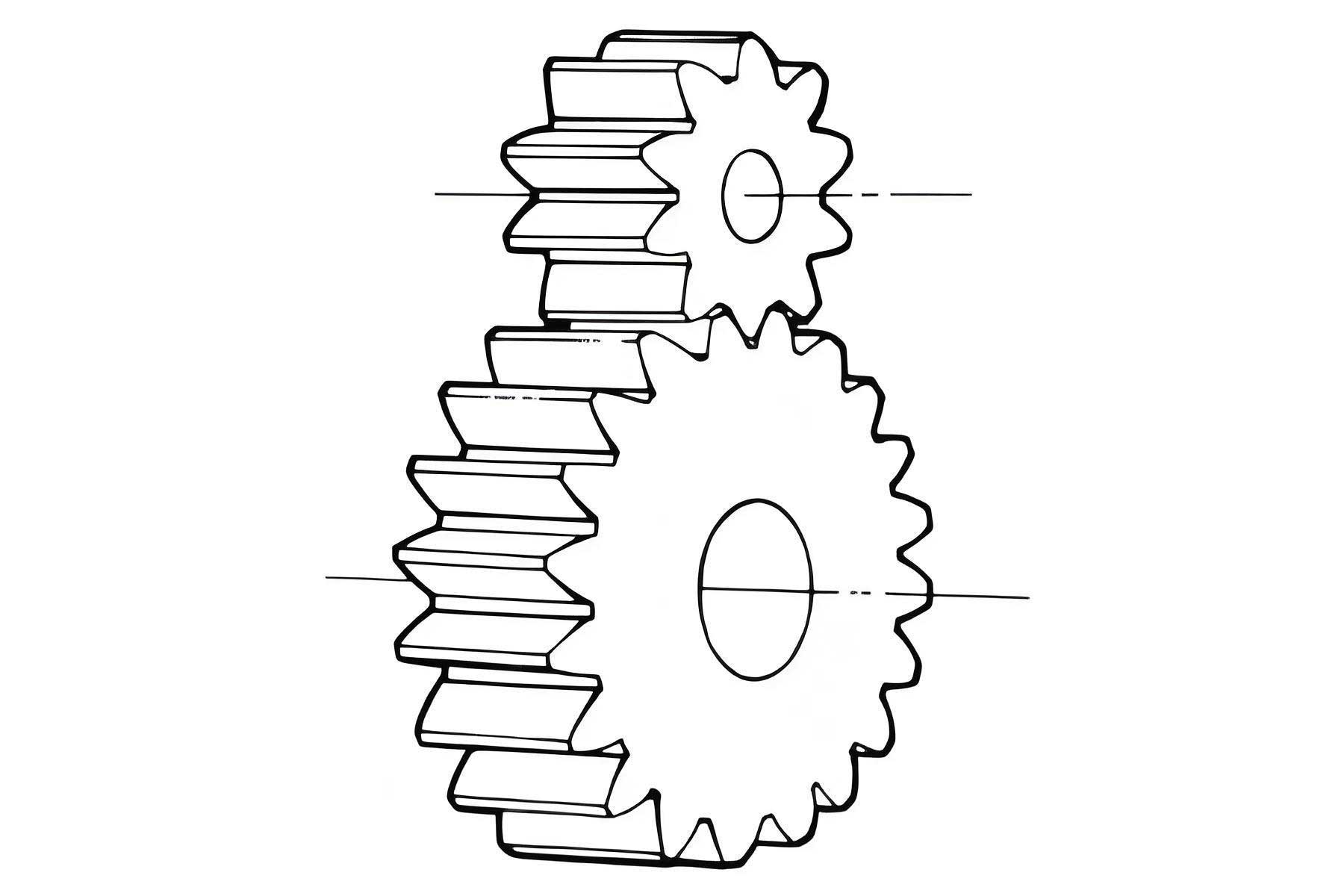
The meshing process of spur gear pairs involves alternating single-tooth and double-tooth engagement, which inherently causes stiffness fluctuations. As the driving spur gear rotates, teeth engage along the line of action, starting from the root of the driving tooth and ending at the tip. This cycle includes phases where two pairs of teeth share the load (double-tooth contact) and phases where only one pair carries the load (single-tooth contact). The transition between these phases results in abrupt changes in meshing stiffness, generating excitation forces that can lead to noise and wear. To quantify this, we define meshing stiffness as the ratio of the normal force per unit width to the equivalent deformation at the meshing line. Mathematically, for a spur gear pair, the stiffness \( k \) is expressed as:
$$ k = \frac{F_n}{\delta} $$
where \( F_n \) is the normal force per unit width, and \( \delta \) is the equivalent deformation along the meshing line. In our FEA approach, we compute this deformation by applying a torque to the driving spur gear and measuring the resulting angular deflection, which is then converted to linear deformation at the base circle. The stiffness calculation involves multiple steps, including model creation, mesh generation, contact definition, and post-processing, as outlined in the flowchart below. We use a parametric model of spur gears to ensure accuracy, with gear parameters summarized in Table 1.
| Parameter | Driving Gear | Driven Gear |
|---|---|---|
| Module (mm) | 3 | 3 |
| Number of Teeth | 34 | 31 |
| Face Width (mm) | 42 | 42 |
| Pressure Angle (°) | 28 | 28 |
To construct the finite element model, we first generate a 3D geometry of the spur gear pair using parametric design software, ensuring precise involute tooth profiles. The model is then imported into FEA software, where material properties are assigned: alloy steel with an elastic modulus \( E = 2.06 \times 10^{11} \) Pa, Poisson’s ratio \( \nu = 0.3 \), and density \( \rho = 7850 \) kg/m³. Meshing is performed using hexahedral elements via a sweeping method, which enhances computational efficiency and accuracy. The contact regions are finely discretized with approximately 21,000 nodes to capture detailed stress distributions, while areas farther from the mesh are coarsely meshed to reduce computational cost. For contact definition, the tooth surface of the driving spur gear is set as the target, and the driven spur gear’s tooth surface as the contact, with a friction coefficient of 0.3. Boundary conditions involve constraining the driven gear’s inner ring completely and applying a torque to the driving gear’s inner ring nodes in a cylindrical coordinate system. The torque \( T_a \) applied per node is given by:
$$ T_a = \frac{F_n r_b}{n r_n} $$
where \( r_b \) is the base circle radius, \( r_n \) is the inner ring radius, and \( n \) is the number of nodes. We use a static analysis approach, dividing one meshing cycle (tooth pitch) into 10 positions to simulate different engagement states. Based on the gear ratio, the rotation angles for the driving and driven spur gears are related by:
$$ \theta_2 = \frac{z_2}{z_1} \theta_1 $$
where \( \theta_1 \) and \( \theta_2 \) are the rotation angles, and \( z_1 \) and \( z_2 \) are the tooth numbers. This allows us to create 10 finite element models representing various meshing positions. The deformation \( \mu_1 \) at the driving gear’s inner ring is extracted from FEA results, and the equivalent deformation \( \mu \) at the meshing line is calculated as:
$$ \delta_1 = \frac{\mu_1}{r_n}, \quad \mu = \delta_1 r_b $$
Finally, the meshing stiffness is computed using:
$$ k = \frac{F_n}{\mu} = \frac{T}{\theta r_b^2} $$
where \( T \) is the applied torque, and \( \theta \) is the angular deformation. We repeat this process for all 10 positions and interpolate the results to obtain a continuous stiffness curve over one meshing cycle.
Our analysis begins with the ideal case of a spur gear pair under a constant torque of 760 N·m. The stiffness variation curve, shown in Figure 1, exhibits a waveform-like pattern with higher stiffness during double-tooth engagement (approximately \( 9.25 \times 10^8 \) N/m) and lower stiffness during single-tooth engagement (approximately \( 6.5 \times 10^8 \) N/m). This pattern arises because load sharing in double-tooth contact reduces individual tooth deformation, increasing overall stiffness. The abrupt transitions between single and double-tooth regions are key sources of vibration excitation in spur gear systems. To mitigate this, designers often aim to minimize stiffness fluctuations through profile modifications or optimized gear geometry. The contact stress distribution, plotted along the extended contour length of the tooth profile, reveals a band-like pattern with higher stresses near the theoretical contact line. Due to friction, the stress distribution is asymmetric, with more pronounced variations toward the tooth tip compared to the root. Edge effects cause stress concentrations at the ends of the contact area, highlighting the importance of considering full 3D contact in spur gear analysis.
Next, we investigate the impact of axial misalignment on spur gear meshing stiffness. In practical applications, shaft bending or assembly errors can cause gears to tilt, leading to uneven load distribution across the face width. We define the axial misalignment displacement as \( \gamma \) and analyze cases where \( \gamma = 0 \mu m \) (ideal), \( 1 \mu m \), and \( 3 \mu m \). The results, summarized in Table 2, show that axial misalignment reduces meshing stiffness, with a more significant decrease in double-tooth regions than in single-tooth regions. For instance, at \( \gamma = 3 \mu m \), stiffness in double-tooth engagement drops by about 15% compared to the ideal case. This reduction is attributed to altered contact patterns: misalignment causes the contact area to shift toward the misaligned side, resulting in localized stress concentrations and increased tooth deformation. The stress distribution becomes irregular, with sharper gradients near the tooth edges. This underscores the need for precise alignment in spur gear installations to maintain optimal stiffness and minimize vibration.
| Axial Misalignment \( \gamma \) (μm) | Double-Tooth Stiffness (×10⁸ N/m) | Single-Tooth Stiffness (×10⁸ N/m) | Percentage Change in Double-Tooth Stiffness |
|---|---|---|---|
| 0 | 9.25 | 6.50 | 0% |
| 1 | 8.70 | 6.30 | -5.9% |
| 3 | 7.85 | 6.10 | -15.1% |
We also explore how varying loads influence the meshing stiffness of spur gear pairs. Load changes are common in operational conditions, and understanding their effect is crucial for dynamic modeling. We select one position in double-tooth engagement and one in single-tooth engagement, applying torques ranging from 25 N·m to 330 N·m. The stiffness response, plotted in Figure 2, indicates that stiffness increases linearly with load in the lower torque range (below 185 N·m for double-tooth and 200 N·m for single-tooth) before stabilizing at higher loads. This behavior can be explained by the contact mechanics of spur gears: at low loads, the contact area is small, leading to higher compliance and lower stiffness. As load increases, the contact area expands, reducing deformation per unit force and thus increasing stiffness. However, beyond a certain threshold, the contact area growth saturates, causing stiffness to plateau. The relationship between stiffness \( k \) and torque \( T \) can be approximated by a piecewise function:
$$ k(T) = \begin{cases}
k_0 + \alpha T & \text{for } T < T_c \\
k_{\text{max}} & \text{for } T \geq T_c
\end{cases} $$
where \( k_0 \) is the initial stiffness, \( \alpha \) is a proportionality constant, \( T_c \) is the critical torque, and \( k_{\text{max}} \) is the saturated stiffness. For spur gears with axial misalignment, the stiffness increase is less pronounced due to additional deformation from shaft bending. This highlights the interplay between load and alignment in determining spur gear performance.
To delve deeper, we analyze the stress distribution in the contact zone under different loads. At low loads, the contact area is narrow, with stresses concentrated along a thin band. As load increases, the contact area widens, and stresses become more uniformly distributed, except at the edges where concentrations persist. This evolution directly affects stiffness: a larger contact area reduces peak stresses and enhances load-bearing capacity, thereby increasing stiffness. The maximum contact stress \( \sigma_{\text{max}} \) can be related to load \( F_n \) via the Hertzian contact theory, adapted for spur gear teeth:
$$ \sigma_{\text{max}} = \sqrt{\frac{F_n E^*}{\pi R}} $$
where \( E^* \) is the equivalent elastic modulus, and \( R \) is the effective radius of curvature. However, due to the complex geometry of spur gear teeth, FEA provides a more accurate stress prediction. Our simulations show that for spur gears under ideal conditions, doubling the load from 100 N·m to 200 N·m increases stiffness by approximately 25%, whereas for misaligned spur gears, the increase is only 18%. This demonstrates that misalignment diminishes the stiffness-enhancing effect of load, potentially leading to premature fatigue in spur gear systems.
In addition to axial misalignment and load, other factors such as tooth profile modifications, surface roughness, and lubrication can influence spur gear meshing stiffness. For example, tip relief or root fillet adjustments alter the contact path, potentially smoothing stiffness transitions. Future studies could incorporate these elements into the FEA model to provide a more comprehensive understanding. Moreover, dynamic analysis considering inertial effects would capture time-varying responses more accurately, especially for high-speed spur gear applications. Our current static approach serves as a foundational step, offering insights into the quasi-static stiffness behavior that underpins dynamic models.
The methodology employed here involves several assumptions worth noting. We assume linear elastic material behavior and neglect thermal effects, which may be significant in high-power spur gear transmissions. The friction coefficient is held constant, though in reality, it varies with sliding velocity and lubrication. Despite these simplifications, our results align with established trends in gear mechanics, validating the approach. To further enhance accuracy, we could use adaptive meshing or sub-modeling techniques to refine contact regions without excessively increasing computational cost. The use of hexahedral elements already improves efficiency compared to tetrahedral meshes, making our method suitable for parametric studies of spur gear design.
From an engineering perspective, the findings have direct implications for spur gear system design. To minimize vibration, designers should aim to reduce stiffness fluctuations by optimizing gear geometry for a more uniform stiffness curve. This could involve adjusting tooth thickness, pressure angle, or using asymmetric teeth. For applications prone to axial misalignment, such as long-shaft transmissions, stiffening the shaft or using crowned teeth can help distribute load more evenly, preserving stiffness. Additionally, operating spur gears within the linear stiffness range (lower loads) may reduce dynamic excitations, though this must be balanced against torque requirements. Our study provides quantitative data to support such decisions, emphasizing the importance of considering contact characteristics in spur gear analysis.
In conclusion, this research investigates the meshing stiffness of spur gear pairs with a focus on tooth surface contact characteristics. Through finite element analysis, we calculate stiffness variations over a meshing cycle and examine the effects of axial misalignment and varying loads. Key findings include: (1) Axial misalignment reduces meshing stiffness, particularly in double-tooth engagement regions, due to shifted contact areas and stress concentrations. (2) Increasing load initially raises stiffness linearly, but it plateaus at higher loads as contact area saturation occurs. (3) Misaligned spur gears exhibit a less pronounced stiffness increase with load compared to ideal gears, owing to additional deformation from shaft bending. These insights contribute to a better understanding of spur gear dynamics and can inform design strategies for improved performance and reliability. Future work could extend this analysis to include dynamic effects, profile modifications, and experimental validation, further advancing the field of spur gear technology.
To summarize the mathematical framework, the core equations used in this study for spur gear stiffness calculation are consolidated below. The stiffness \( k \) is derived from deformation and force relationships, with modifications for practical conditions:
$$ k = \frac{F_n}{\delta} = \frac{T}{\theta r_b^2} $$
$$ \delta = \frac{\mu_1 r_b}{r_n} $$
$$ T_a = \frac{F_n r_b}{n r_n} $$
where all symbols are as defined earlier. For axial misalignment, an empirical correction factor \( \beta(\gamma) \) could be introduced, such that \( k_{\text{misaligned}} = \beta(\gamma) k_{\text{ideal}} \), with \( \beta(\gamma) < 1 \). Similarly, for load effects, the piecewise model above captures the nonlinear behavior. These formulas provide a basis for engineers to estimate spur gear stiffness under various operating conditions.
Throughout this article, the term “spur gear” has been emphasized to highlight its centrality in the study. Spur gears are fundamental components in many mechanical systems, and their meshing behavior is a rich area for investigation. By integrating advanced numerical methods like FEA, we can uncover detailed insights that traditional analytical approaches might miss. This work underscores the value of considering real-world factors such as misalignment and load variations in spur gear analysis, paving the way for more robust and efficient gear designs. As technology progresses, continued research on spur gear dynamics will remain essential for meeting the demands of modern engineering applications.