
The pursuit of silent, reliable, and efficient power transmission is a central theme in mechanical engineering. Among various transmission elements, the spur gear remains a fundamental and widely used component due to its simplicity and ease of manufacture. However, the very nature of spur gear meshing—characterized by time-varying mesh stiffness, manufacturing errors, and backlash—introduces inherent nonlinearities that often lead to undesirable dynamic responses, including vibration and noise. These dynamic excitations are primary sources of failure, limiting the performance and lifespan of geared systems. A critical strategy to mitigate these adverse effects is tooth profile modification, a deliberate deviation from the perfect theoretical involute profile. This article delves into a comprehensive investigation of profile modification for spur gear systems, with a particular focus on establishing a methodology for dynamic modification under various operational conditions.
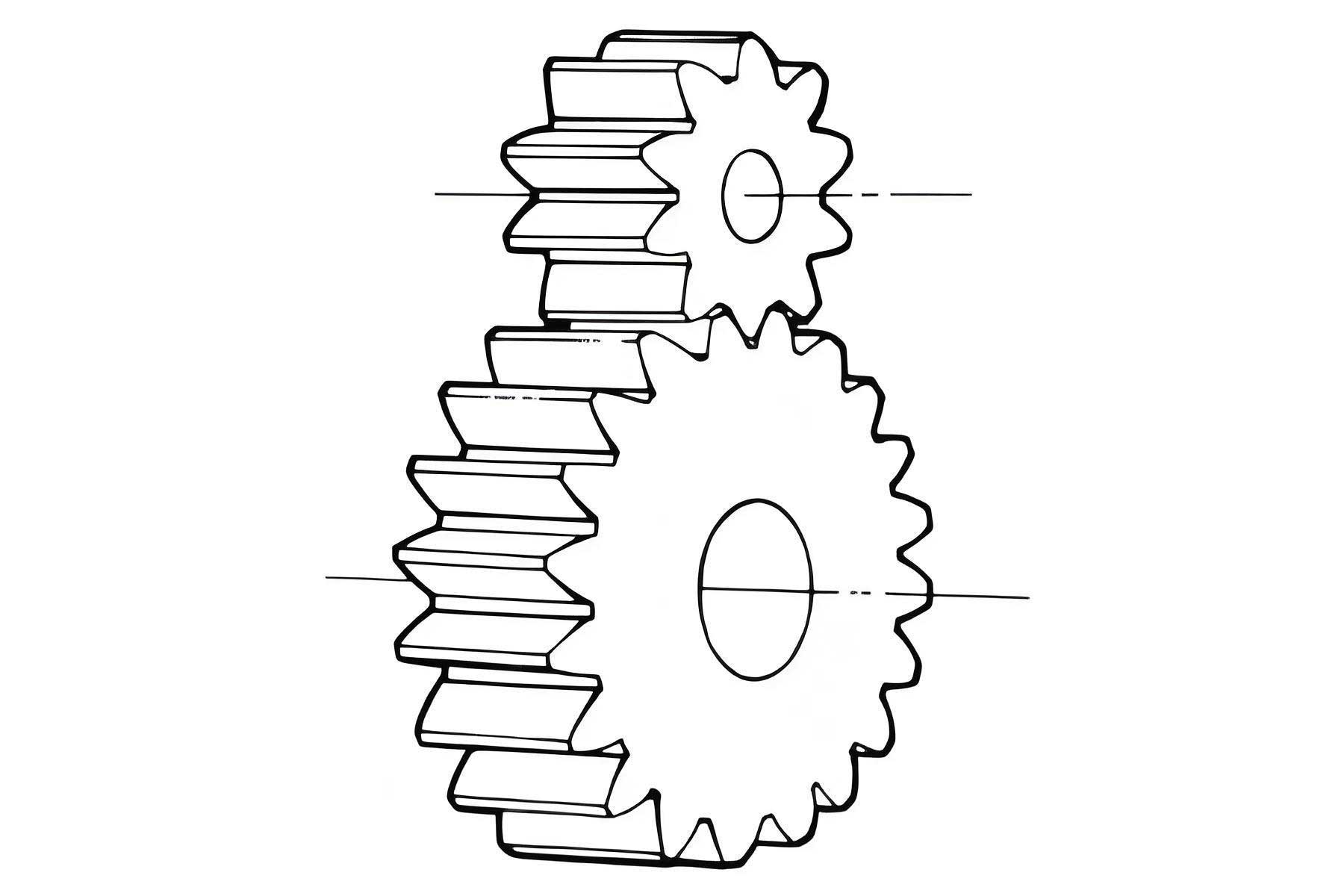
The dynamic behavior of a spur gear pair is governed by a complex interplay of factors. The periodic change in the number of tooth pairs in contact results in time-varying mesh stiffness. Combined with static transmission error, dynamic transmission error, and the unavoidable presence of backlash, the system exhibits strong nonlinear characteristics. This nonlinearity makes the system susceptible to various forms of resonance beyond the primary one, including super-harmonic and combination resonances. While designing gears to avoid all potential resonant frequencies is theoretically ideal, the broad spectrum of excitation frequencies in practice makes this nearly impossible. Therefore, a pragmatic approach is to apply profile modifications, such as tip relief, to actively reduce the vibration amplitude when the system operates near these resonant conditions.
1. Nonlinear Dynamic Modeling of a Spur Gear System
To analyze the influence of profile modification, one must start with a robust dynamic model. The model considered here is a single-degree-of-freedom torsional model projected onto the line of action. It incorporates key nonlinearities: parametric excitation from time-varying mesh stiffness, static and dynamic transmission errors as external excitations, and the clearance-type nonlinearity from gear backlash.
The equation of motion can be expressed in a non-dimensional form as:
$$ \ddot{x}(t) + 2\zeta \dot{x}(t) + \left[1 + \sum_{j=1}^{5} B_j \cos(j\omega_e t + \phi_j)\right] f(x(t)) = F_m + F_{aT}\cos(\omega_{eT} t + \phi_T) + F_{ah}\omega_{eh}^2\cos(\omega_{eh} t + \phi_h) $$
Where \( x(t) \) is the relative dynamic transmission error, \( \zeta \) is the damping ratio, \( B_j \) and \( \phi_j \) are the amplitude and phase of the j-th harmonic of the parametric stiffness excitation at frequency \( \omega_e \). The terms on the right-hand side represent the mean static load \( F_m \), external load fluctuation \( F_{aT} \) at frequency \( \omega_{eT} \), and internal displacement excitation \( F_{ah} \) at frequency \( \omega_{eh} \), respectively.
The nonlinear function \( f(x(t)) \) represents the backlash nonlinearity, typically modeled as a piecewise-linear dead-zone function. For analytical convenience, especially when applying perturbation methods, this discontinuous function is often approximated by a continuous odd polynomial. A 7th-order polynomial provides a good balance between accuracy and analytical manageability:
$$ f(x(t)) = a_1 x(t) + a_3 x(t)^3 + a_5 x(t)^5 + a_7 x(t)^7 = \sum_{k=0}^{3} a_{2k+1} x(t)^{2k+1} $$
The coefficients \( a_1, a_3, a_5, a_7 \) are determined by fitting the polynomial to the ideal dead-zone function over the expected range of motion.
2. Incorporation of Profile Modification into the Dynamic Model
Profile modification is introduced as a deliberate alteration of the ideal tooth profile, effectively changing the contact condition and thus the meshing force-displacement relationship. It is most conveniently modeled as an additional displacement along the line of action. Two primary models exist: one based on the involute roll angle and another based on the position along the line of action. The latter is more intuitive for dynamic analysis as it directly relates to the meshing process.
Let \( C_m = C(\delta) \) represent the modification amount, where \( \delta = s / \lambda \). Here, \( s \) is the distance from the start of modification (e.g., the start of tip relief) along the line of action, and \( \lambda \) is the total length of the modified profile segment, so \( 0 \leq \delta \leq 1 \). The modified backlash nonlinear function \( g(x(t)) \) becomes:
$$ g(x(t)) = f(x(t)) + \frac{\partial f(x(t))}{\partial x(t)} \cdot C_m $$
Substituting the polynomial for \( f(x(t)) \) yields:
$$ g(x(t)) = \sum_{k=0}^{3} a_{2k+1} x(t)^{2k+1} + \left[ \sum_{k=0}^{3} (2k+1) a_{2k+1} x(t)^{2k} \right] C(\delta) $$
The modified equation of motion for the spur gear system with profile modification is therefore:
$$ \ddot{x}(t) + 2\zeta \dot{x}(t) + \left[1 + \sum_{j=1}^{5} B_j \cos(j\omega_e t + \phi_j)\right] \left( \sum_{k=0}^{3} a_{2k+1} x(t)^{2k+1} + \left[ \sum_{k=0}^{3} (2k+1) a_{2k+1} x(t)^{2k} \right] C(\delta) \right) = F_m + F_{aT}\cos(\omega_{eT} t + \phi_T) + F_{ah}\omega_{eh}^2\cos(\omega_{eh} t + \phi_h) $$
3. Critical Parameters in Spur Gear Profile Modification
The effectiveness of profile modification in controlling the dynamic response of a spur gear system hinges on three key parameters: the maximum modification amount \( C_{max} \), the modification length \( \lambda \), and the shape of the modification curve \( C(\delta) \).
3.1 Maximum Modification Amount (\( C_{max} \))
The primary purpose of tip relief is to compensate for the elastic deflection of teeth under load, preventing edge contact and reducing mesh impact at the start and end of single-tooth contact. Under static or quasi-static assumptions, the maximum required relief \( C_{max} \) is often set equal to the maximum comprehensive deflection of the mating teeth at the moment the relieved tooth tip enters or exits contact. This deflection is given by:
$$ e = \frac{W_d}{K_v} $$
where \( W_d \) is the normal tooth load and \( K_v \) is the mesh stiffness at that specific contact point. For dynamic design, \( W_d \) must account for all load components: the mean load \( F_m \), internal excitation \( F_{ah} \), and external excitation \( F_{aT} \). Therefore, the instantaneous maximum load is \( W_{d_{max}} = F_m + F_{ah} + F_{aT} \). The mesh stiffness \( K_v \) is time-varying and reaches a minimum typically at the points of single-tooth contact (highest load per tooth). Thus, a dynamically-informed maximum modification amount can be expressed as:
$$ C_{max} = \frac{W_{d_{max}}}{K_{v_{min}}} = \frac{F_m + F_{ah} + F_{aT}}{K_{v_{min}}} $$
This formula highlights that for spur gear systems subjected to significant dynamic loads, the required modification is larger than that calculated from the nominal static load alone.
3.2 Modification Length (\( \lambda \))
The modification length defines the region of the tooth profile that is altered. For standard tip relief on a spur gear with a contact ratio \( \varepsilon \) less than 2, the relief typically starts at the highest point of single-tooth contact (HPSTC). Measured along the line of action, the length from the tip to this starting point is:
$$ \lambda = P_b (\varepsilon – 1) $$
where \( P_b \) is the base pitch. This ensures the modified portion only affects the meshing period where it is intended to compensate for deflection, leaving the double-tooth contact region nominally unchanged.
3.3 Modification Curve Shape (\( C(\delta) \))
The functional form of \( C(\delta) \) describes how the modification amount transitions from zero at the start (\( \delta=0 \)) to \( C_{max} \) at the tip (\( \delta=1 \)). Various curves have been proposed, each with different implications for the smoothness of load transfer and dynamic response. Common profiles include:
| Curve Type | General Formula | Notes |
|---|---|---|
| Exponential/Power Law | $$ C_m = C_{max} \delta^{b} $$ | Commonly used; \( b \) typically between 1.2 and 1.5 based on elastic beam analysis. |
| Quadratic | $$ C_m = C_{max}(b_0 + b_1\delta + b_2\delta^2) $$ | Offers a parabolic shape; coefficients can be tuned for specific boundary conditions (e.g., zero slope at start). |
| High-Order Polynomial | $$ C_m = C_{max} \sum_{i=0}^{5} b_i \delta^i $$ | Provides high flexibility for optimizing dynamic response but requires determination of more coefficients. |
| Sinusoidal | $$ C_m = C_{max} [ \sin(b_0\delta + b_1) + \cos(b_0\delta + b_2) ] $$ | Less common; can be used to generate very smooth transitions. |
The choice of the optimal curve is not universal; it depends on the specific dynamic characteristics and excitation frequencies of the spur gear system.
4. Formulation of Dynamic Profile Modification for Spur Gears
The central challenge is to determine the modification parameters that minimize the vibration amplitude for a given operating condition. This leads to the concept of dynamic profile modification, where the modification curve \( C(\delta) \) is optimized based on the system’s dynamic response rather than just static deflection.
Using analytical methods like the method of multiple scales or numerical optimization on the modified equation of motion, one can solve for the steady-state periodic response \( x(t) \). The response amplitude, particularly its maximum value \( \alpha_{max} \), becomes a function of all system parameters and the modification function:
$$ \alpha_{max} = g(F_m, F_{ah}, F_{aT}, B_j, \zeta, \omega_0, a_1, a_3, a_5, a_7, C(\delta)) $$
Here, \( \omega_0 \) is the system’s natural frequency. For a given spur gear system, parameters like \( \zeta, \omega_0, a_i, F_m, F_{ah}, F_{aT}, B_j \) can be considered known or measurable. The remaining variable for optimization is the modification curve \( C(\delta) \). The goal is to find the function \( C(\delta) \) that minimizes the maximum response amplitude:
$$ \text{Minimize } [ \alpha_{max} ] = \text{Minimize } \left[ g(F_m, F_{ah}, F_{aT}, B_j, \zeta, \omega_0, a_1, a_3, a_5, a_7, C(\delta)) \right] $$
This is a functional optimization problem. In practice, it is solved by parameterizing \( C(\delta) \) (e.g., as one of the curves in the table above) and then finding the optimal set of parameters \( b, b_i \) that minimize \( \alpha_{max} \). The optimization must consider the specific frequency factor \( \Omega = \omega_e / \omega_0 \) at which the system operates, as the optimal modification differs for primary resonance (\( \Omega \approx 1 \)), super-harmonic resonance (\( \Omega \approx 1/n \)), and combination resonance conditions.
For example, near a primary resonance, the approximate amplitude-frequency relationship derived from a perturbation analysis might take a form that explicitly includes modification parameters. The modification \( C(\delta) \), which itself can be a function of the meshing phase \( \omega_e t \), introduces additional terms in the averaged equations. Solving these equations allows for the derivation of an expression for \( \alpha_{max} \) in terms of the coefficients defining \( C(\delta) \). The optimization then involves adjusting these coefficients to find the minimum of this expression.
The following table illustrates a conceptual framework for how modification parameters might be prioritized under different dynamic conditions for a spur gear:
| Operational Condition (Frequency Factor) | Primary Dynamic Concern | Key Modification Parameter to Optimize | Typical Optimization Goal |
|---|---|---|---|
| Primary Resonance (\( \Omega \approx 1 \)) | Large amplitude resonance peak | \( C_{max} \) and curve shape \( b \) | Flatten and lower the resonance peak, increase effective damping. |
| Super-harmonic Resonance (\( \Omega \approx 1/2, 1/3 \)) | Excitation of higher-order nonlinear responses | Curve shape \( b_i \) (high-order terms) | Detune the nonlinear coupling terms that excite these resonances. |
| High-Speed Operation (\( \Omega \gg 1 \)) | Mesh impact, noise | \( C_{max} \) and \( \lambda \) | Precise compensation for dynamic deflection to minimize impact velocity. |
| Combination Resonance | Parametric instability | Curve shape to alter parametric excitation content \( B_j \) | Modify the phase/modulation of time-varying stiffness to suppress instability thresholds. |
5. Practical Application and Optimization Procedure
The implementation of dynamic profile modification for a spur gear system involves a structured procedure:
- System Identification: Determine the system’s linear natural frequency \( \omega_0 \), damping ratio \( \zeta \), and backlash level to obtain the polynomial coefficients \( a_i \).
- Excitation Characterization: Calculate or measure the mean load \( F_m \), the amplitudes and frequencies of internal excitation \( (F_{ah}, \omega_{eh}) \) from transmission error, and external load fluctuations \( (F_{aT}, \omega_{eT}) \). Obtain the parametric excitation coefficients \( B_j \) from the time-varying mesh stiffness function.
- Dynamic Analysis: For the intended operating speed, calculate the frequency factor \( \Omega \). Identify which type of resonant condition (primary, super-harmonic) is most relevant.
- Optimization Loop:
- Select a parameterized form for the modification curve \( C(\delta; \mathbf{b}) \), where \( \mathbf{b} = [b_1, b_2, …] \) is a vector of parameters (e.g., \( C_{max}, b, b_i \)).
- Solve the dynamic equation (often numerically or via advanced analytical approximations) to obtain the steady-state response and its maximum amplitude \( \alpha_{max}(\mathbf{b}) \).
- Use an optimization algorithm (e.g., gradient-based, genetic algorithm) to find the parameter set \( \mathbf{b}_{opt} \) that minimizes \( \alpha_{max} \).
- Manufacturing Specification: Translate the optimal \( C(\delta; \mathbf{b}_{opt}) \) from the line of action back into a tooth profile coordinate system (e.g., as a function of roll angle) to generate manufacturing instructions.
This process underscores that the “best” modification for a spur gear is not a one-size-fits-all solution but is dynamically tailored to the specific load spectrum and operating speeds of the application. For instance, the optimal relief for a high-torque, low-speed spur gear in a conveyor might emphasize compensating for large static deflections (\( C_{max} \)), while a high-speed spur gear in a turbine drive might require a finely-tuned curve shape (\( b_i \)) to manage super-harmonic resonances excited by mesh frequency harmonics.
6. Conclusion
This study provides a framework for understanding and applying dynamic tooth profile modification to spur gear systems. By integrating modification parameters directly into a nonlinear dynamic model, it moves beyond traditional static deflection compensation. The maximum modification amount \( C_{max} \) must account for dynamic load increments, the length \( \lambda \) is fundamentally tied to the gear’s geometry and contact ratio, and the curve shape \( C(\delta) \) is a powerful but complex design variable. The core of dynamic modification lies in formulating the maximum vibration amplitude \( \alpha_{max} \) as a function of the modification curve and then optimizing this curve to minimize the amplitude for targeted frequency factors. This approach enables the design of spur gear profiles that are specifically tailored to suppress detrimental resonances, leading to significant improvements in noise reduction, vibration control, and overall operational reliability. Future work can expand this methodology to include more complex gear geometries like helical gears and incorporate multi-objective optimization considering both dynamic performance and contact stress.