
In my research, I focus on the static and dynamic vibration characteristics of herringbone gear sets, which are widely used in ship propulsion systems. Traditional analytical methods for predicting the contact stress and dynamic behavior of herringbone gears rely on simplified theoretical models, such as the Hertzian contact theory for straight gears. These approaches often involve numerous assumptions and simplifications that deviate significantly from actual operating conditions. To address these limitations, I employ finite element analysis (FEA) using NX MasterFEM to simulate the static contact and free vibration behavior of a specific herringbone gear pair from a marine gearbox. This work provides a more accurate and intuitive understanding of how herringbone gear deformation and vibration affect system performance, and offers insights for reducing vibration-induced damage.
My analysis begins with the theoretical foundation for load distribution and meshing stiffness in herringbone gears. Due to the overlap ratio, the number of tooth pairs in contact changes during meshing. For a double-tooth contact scenario, the load distribution follows the equilibrium and compatibility conditions. Let \(F_L\) represent the total normal load acting along the line of action. The two tooth pairs share this load, with the relative displacement along the line of action denoted as \(x\). The loads carried by tooth pair 1 (\(F_{s1}\)) and tooth pair 2 (\(F_{s2}\)) can be expressed as:
\[
\begin{cases}
F_{s1} + F_{s2} = F_L \\
F_{s1} = K_{c1} x \\
F_{s2} = K_{c2} x
\end{cases}
\]
Here, \(K_{c1}\) and \(K_{c2}\) are the time-varying meshing stiffnesses of each tooth pair. The load distribution not only changes when the contact transitions from single to double tooth pairs, but also varies continuously with the position of the contact point along the tooth profile. The meshing stiffness of a single tooth pair is determined by the total deformation at the contact point, which consists of three components: the local contact deformation \(\delta_H\), the bending and shear deformation of the tooth \(\delta_T\) (including contributions from both gears), and the deformation of the gear body \(\delta_A\). The meshing stiffness for tooth pair \(j\) is then given by:
\[
K_{cj} = \frac{F_L}{\delta_H + \delta_{T1} + \delta_{T2} + \delta_{A1} + \delta_{A2}}, \quad j = 1,2
\]
In my finite element model, these deformations are directly computed from the nodal displacements of the meshing teeth, providing a more realistic representation of the actual stiffness variation.
The dynamic behavior of herringbone gear transmissions can be idealized as a lumped-parameter model where the gears are represented by equivalent masses acting along the line of action. The equivalent mass \(m_i\) for gear \(i\) is obtained from its moment of inertia \(I_i\) and base circle radius \(r_{bi}\):
\[
m_i = \frac{I_i}{r_{bi}^2}, \quad i=1,2
\]
The system can be reduced to a single-degree-of-freedom model with combined mass \(m = \frac{m_1 m_2}{m_1 + m_2}\) and relative displacement \(x = x_1 + x_2\) between the two gears. The equation of motion is:
\[
m \ddot{x} + K_c(t) x = F_L
\]
where \(K_c(t)\) is the total meshing stiffness, which varies periodically with the meshing cycle. Solving this equation analytically requires dividing one mesh cycle into small intervals with constant stiffness within each interval, then using iterative methods. However, because the herringbone gear system involves coupled torsional, lateral, and axial vibrations, along with multiple meshing pairs and time-varying parameters, a complete theoretical solution becomes extremely complex and often inaccurate. Therefore, I turn to finite element analysis to directly compute the static contact stress and modal characteristics of the herringbone gear pair.
My study object is a herringbone gear pair from a marine gearbox that transmits 25,000 kW from a gas turbine to the propeller shaft. The pinion (small gear) has \(Z_1\) teeth and rotates at 1,000 rpm, while the gear (large gear) has \(Z_2\) teeth. Using I-DEAS NX, I built a solid model of the herringbone gear pair.
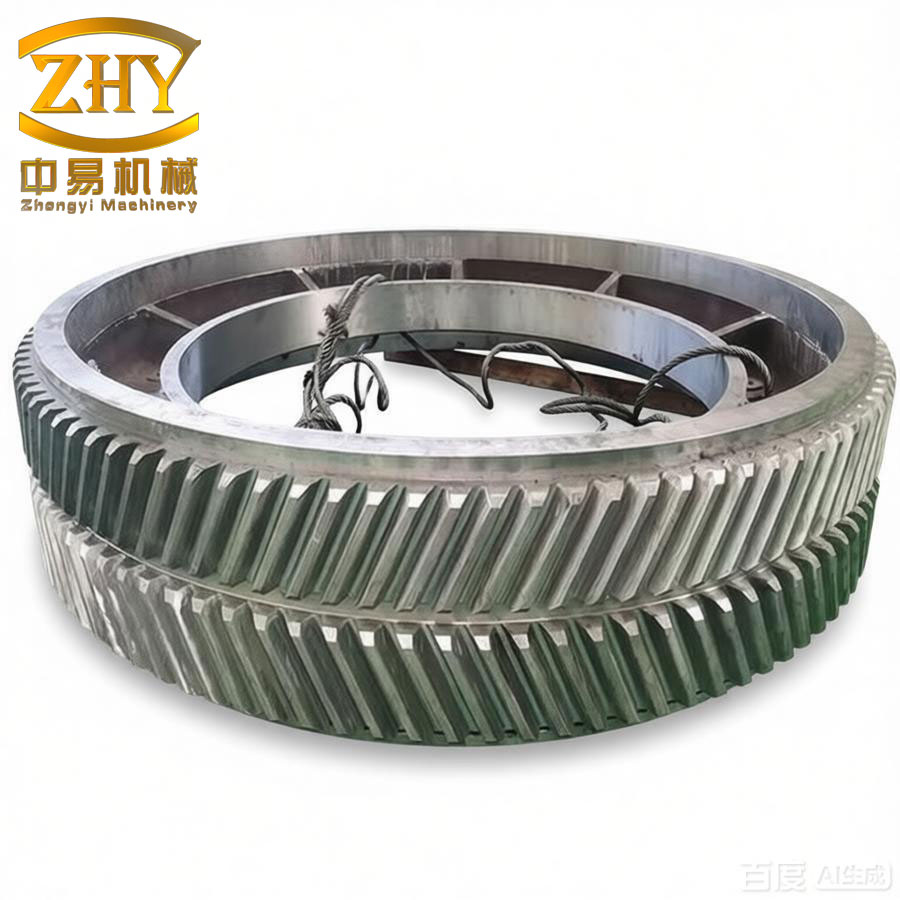
For the static contact analysis, I extracted the key parameters: base circle radii \(r_{b1} = 0.20\,\text{m}\), \(r_{b2} = 1.04\,\text{m}\); moments of inertia \(I_1 = 21.3\,\text{kg·m}^2\), \(I_2 = 4192.4\,\text{kg·m}^2\). The tangential contact force at the pitch circle is calculated from the input torque:
\[
F_L = \frac{9.55 \times 10^3 \times P}{n_1 r_{b1}} = \frac{9.55 \times 10^3 \times 25000}{1000 \times 0.20} = 1.19 \times 10^6\,\text{N}
\]
The equivalent mass of the system is:
\[
m = \frac{m_1 m_2}{m_1 + m_2} = 468.45\,\text{kg}
\]
In the finite element model, I used hexahedral elements with local mesh refinement on the tooth contact surfaces to capture stress gradients accurately. Contact was defined using surface-to-surface contact pairs, with 102 elements in the contact zone and 106 elements in the target zone. Boundary conditions were applied in a local cylindrical coordinate system at the center of each gear. For the static analysis, I fixed all degrees of freedom on the outer rim of the large gear, while allowing only tangential displacement on the pinion rim. The tangential force was applied as a distributed load on the pinion rim nodes, equivalent to the input torque. The computed displacement field shows the local deformation pattern at the meshing zone. This deformation directly influences the meshing stiffness, which is then used in the dynamic analysis.
To study the dynamic response, I performed a free modal analysis of the herringbone gear pair. Unlike the static model, the dynamic model must account for the flexibility of the bearings and gearbox housing. I simulated the bearing supports using four linear springs at each shaft end, with stiffness values determined from a separate housing analysis. The spring stiffnesses are listed in the following table:
| Bearing | Horizontal Stiffness (N/m) | Vertical Stiffness (N/m) |
|---|---|---|
| Pinion (small gear) | 8.45 × 10⁸ | 8.92 × 10⁸ |
| Gear (large gear) | 9.35 × 10⁸ | 9.13 × 10⁸ |
Using the Lanczos method in NX MasterFEM, I extracted the first 50 natural frequencies and mode shapes. For vibration response analysis, the lower modes are most significant. The first 16 modes are summarized in the following table:
| Mode | Frequency (Hz) | Mode Shape Description |
|---|---|---|
| 1 | 32.86 | Large gear radial expansion (breathing) |
| 2 | 64.32 | Large gear lateral bending (horizontal) |
| 3 | 65.39 | Large gear lateral bending (vertical) |
| 4 | 76.18 | Large gear disk lateral bending (horizontal) |
| 5 | 77.09 | Large gear disk lateral bending (vertical) |
| 6 | 126.50 | Large gear axial stretching |
| 7 | 195.05 | Large gear shaft bending (horizontal) |
| 8 | 199.10 | Large gear shaft bending (vertical) |
| 9 | 230.19 | Pinion lateral bending (horizontal) |
| 10 | 231.77 | Pinion lateral bending (vertical) |
| 11 | 296.43 | Pinion radial expansion |
| 12 | 318.35 | Large gear shaft partial radial expansion |
| 13 | 343.64 | Large gear disk staggered torsion |
| 14 | 343.65 | Large gear disk in-phase torsion |
| 15 | 422.60 | Pinion lateral bending (horizontal, opposite phase) |
| 16 | 427.97 | Pinion lateral bending (vertical, opposite phase) |
From the modal results, I observe that the large gear begins to exhibit significant vibration at frequencies as low as 32.9 Hz, while the pinion starts around 230.0 Hz. This indicates that the herringbone gear pair is susceptible to resonant excitation if the operating speed or any harmonic of the meshing frequency falls within these ranges. Specifically, the fundamental meshing frequency for this gear pair is \(f_m = \frac{n_1 Z_1}{60} \approx 500\ \text{Hz}\) (assuming typical tooth numbers). The low-frequency modes of the large gear (around 30–200 Hz) are far below the meshing frequency, but they could be excited by startup transients or external disturbances. The pinion modes near 230–430 Hz are closer to the meshing frequency and may be particularly problematic if the gear pair operates at partial loads or variable speeds.
By combining the static contact deformation results with the modal analysis, I can propose design improvements to reduce vibration and impact damage in herringbone gear systems. For instance, increasing the shaft stiffness or adding damping elements at the bearing supports can shift the natural frequencies away from excitation sources. Alternatively, modifying the tooth profile micro-geometry can adjust the meshing stiffness variation to reduce the dynamic load factor. My finite element approach provides a practical and accurate tool for evaluating such modifications before physical prototyping.
In conclusion, I have demonstrated a comprehensive methodology for analyzing the static and dynamic characteristics of herringbone gear meshing using finite element analysis. The static contact simulation reveals the actual deformation and stiffness distribution along the tooth flank, while the free modal analysis identifies the system’s natural frequencies and mode shapes. These results are essential for predicting vibration response under operating loads and for designing robust herringbone gear transmissions with improved reliability and longevity. Future work will involve transient response analysis under actual torque fluctuations and the optimization of support stiffness and damping to further mitigate vibration.