
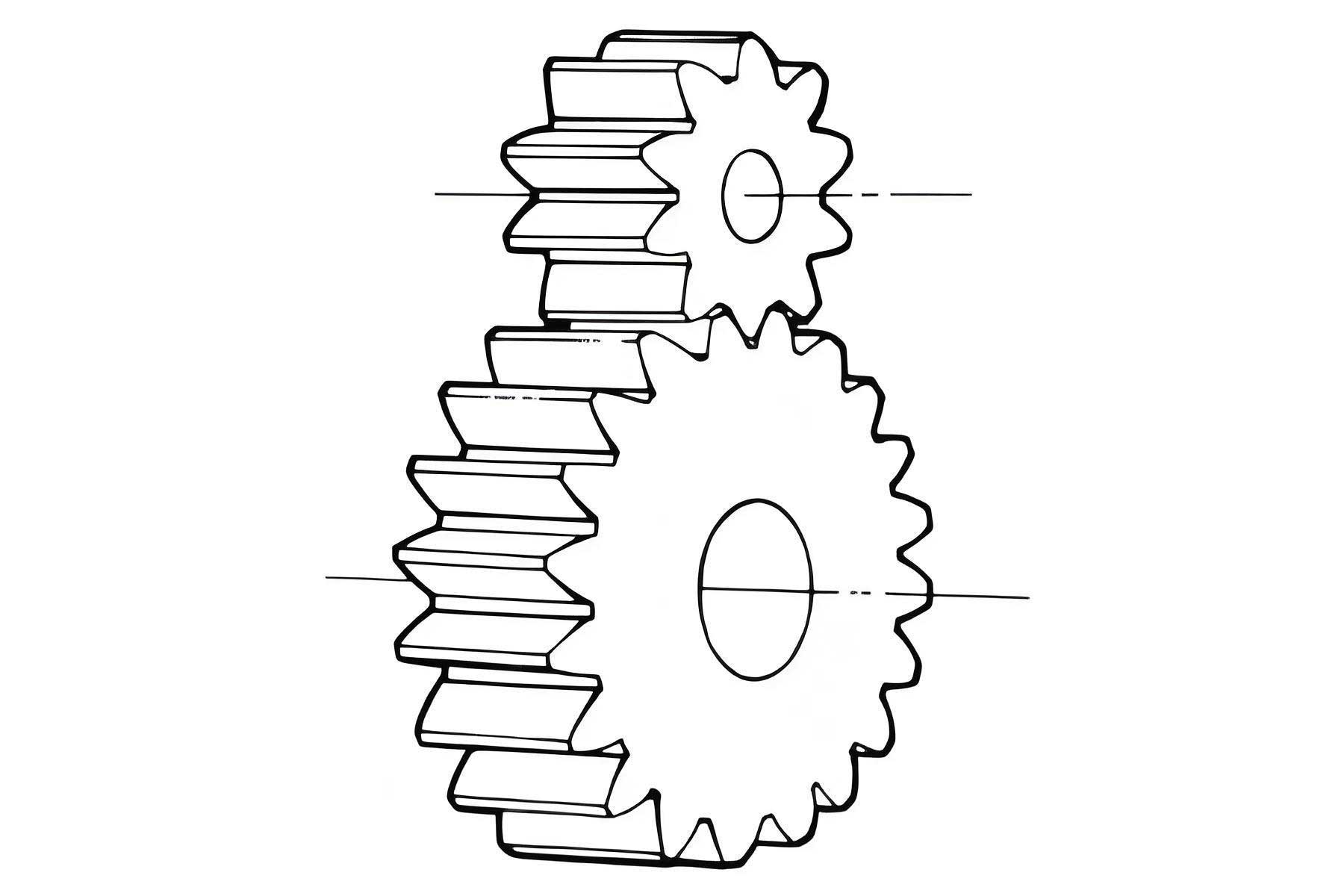
The pursuit of net-shape manufacturing in metal forming demands a profound understanding of material flow, a goal often elusive with traditional design methods reliant on experience and trial-and-error. Superplastic extrusion of spur gears presents a compelling solution, offering advantages such as significant material savings, superior mechanical properties due to dense and uniform microstructure, continuous and favorable grain flow, excellent surface finish, and enhanced bending strength and fatigue life. To unlock the full potential of this precision forming technology, moving beyond empirical approaches is essential. This necessitates a detailed investigation into the deformation mechanisms and metal flow characteristics inherent to the process. This article focuses on the cylindrical spur gear, a quintessential non-axisymmetric component, as the research subject. Employing a synergistic approach that combines three-dimensional rigid-viscoplastic finite element method (FEM) process simulation with physical modeling experiments, we delve into the complex, non-steady-state superplastic extrusion process. The insights gained provide a solid theoretical foundation and practical guidance for optimizing process parameters and die design in actual production.
1. Fundamentals of Process Simulation
In metal plastic forming, elastic and plastic deformations coexist. For bulk forming operations like forging or extrusion, the proportion of elastic deformation is negligible—typically less than 5% in cold working and under 1% in warm working. Consequently, neglecting elastic effects and adopting a rigid-viscoplastic material model for finite element analysis yields satisfactory accuracy while significantly simplifying the solution process. Superplastic deformation is a viscoplastic, large-strain problem. Beyond simple axisymmetric or plane strain cases solvable by elementary methods like the slab method, numerical techniques are indispensable. For thermo-mechanical analysis of superplastic forming, the strain-rate dependent rigid-viscoplastic FEM is the method of choice.
The Backofen equation is a highly effective tool for analyzing superplastic forming processes where the strain rate sensitivity index, \( m \), is approximately constant within a certain strain rate range, and is applicable to complex stress states:
$$ \sigma_i = K \dot{\varepsilon}_i^m $$
where \( \sigma_i \) is the flow stress, \( \dot{\varepsilon}_i \) is the effective strain rate, and \( K \) is a material constant.
Starting from the Perzyna viscoplastic constitutive relation and ignoring elastic deformation, the constitutive equation for superplastic deformation can be derived as:
$$ \dot{\varepsilon}_{ij} = \frac{3}{2K} \dot{\varepsilon}_i^{1-m} S_{ij} $$
where \( \dot{\varepsilon}_{ij} \) are the components of the strain rate tensor and \( S_{ij} \) are the components of the deviatoric stress tensor.
The rigid-viscoplastic FEM solves for the deformation field utilizing the Markov variational principle. Consider a body of rigid-viscoplastic material with volume \( V \) and surface \( S \). Let traction \( p_i \) be prescribed on part of the surface \( S_p \) and velocity \( u_i \) be prescribed on another part \( S_u \). The principle states: Among all kinematically admissible velocity fields \( u_i^* \) that satisfy the compatibility equations, the incompressibility condition, and the velocity boundary conditions, the real solution minimizes the functional \( \Pi \):
$$ \Pi = \int_V \overline{\sigma} \, \dot{\overline{\varepsilon}} \, dV – \int_{S_p} p_i u_i \, dS $$
where \( \overline{\sigma} \) is the effective stress and \( \dot{\overline{\varepsilon}} \) is the effective strain rate. The incompressibility condition (\( \dot{\varepsilon}_{kk} = 0 \)) is difficult to satisfy directly in the velocity field. Therefore, it is introduced into the functional using the Lagrange multiplier method, forming an incomplete generalized variational formulation:
$$ \Pi_L = \int_V \overline{\sigma} \cdot \dot{\overline{\varepsilon}} \, dV + \int_V \lambda \dot{\varepsilon}_{kk} \, dV – \int_{S_p} p_i u_i \, dS $$
Here, \( \lambda \) is the Lagrange multiplier, which physically relates to the hydrostatic pressure. By linearizing and discretizing this functional, the various mechanical field variables (velocity, strain rate, stress) can be solved for the deforming spur gear blank.
2. Conditions for the Simulation of Spur Gear Extrusion
A lead-tin (Pb-38.1%Sn) eutectic alloy was selected as the billet material for simulation. This alloy exhibits superplastic behavior at room temperature with excellent microstructural stability, making it ideal for physical modeling. The simulation parameters were set as follows:
- Ram speed: \( u = 0.6 \, \text{mm/min} \)
- Strain rate sensitivity index: \( m = 0.4 \)
- Material constant: \( K = 109 \, \text{MPa} \cdot \text{min}^{0.4} \)
- Friction coefficient (Coulomb): \( \mu = 0.3 \)
- Spur gear parameters: Module \( m = 5 \, \text{mm} \), Number of teeth \( Z = 10 \)
- Billet dimensions: \( \varnothing 35 \, \text{mm} \times 37 \, \text{mm} \)
For 3D discretization, an 8-node hexahedral isoparametric element was chosen over tetrahedral elements. Hexahedral elements require far fewer elements to mesh a given volume and offer better geometric identification for deformation analysis, leading to greater computational efficiency. The initial mesh of the billet is shown below, consisting of 1392 elements and 1875 nodes. The simulation was performed using the commercial FEM code MSC.Superform.
3. Simulation Results and Analysis for Spur Gear Formation
3.1 Metal Flow Patterns from Velocity Vectors
The simulation tracked the deformation and required periodic remeshing. The nodal velocity vector diagrams at various ram strokes (6.5 mm, 15.0 mm, 17.5 mm, 19.5 mm) reveal the complex, three-dimensional flow during spur gear extrusion.
On a cross-section perpendicular to the axis, the innermost metal flows fastest in the radial direction towards the tooth cavities. The flow velocity decreases towards the outer layers due to constraints from the die entry and frictional resistance. On a longitudinal section parallel to the axis, the metal in the central height region flows radially outward fastest, tending to bulge. The upper region flows slower, and the bottom region flows slowest. Despite similar friction conditions, the bottom material exhibits more sluggish radial flow than the top, leading to a tendency for underfilling or “sink” defects at the tooth tips on the bottom end of the spur gear. The lower central region of the billet remains almost stagnant, acting as a rigid or dead zone until the final stages, where flow concentrates at the bottom tooth tips and into any overflow (relief) chambers.
3.2 Load-Stroke Relationship
The load-stroke curve obtained from simulation, crucial for press selection and die stress analysis, exhibits three distinct stages during spur gear formation:
| Stage | Stroke Range (mm) | Physical Process | Load Characteristic |
|---|---|---|---|
| I: Initial Deformation | 0 – ~6 | Billet contacts die wall, begins free upsetting. | Rapid initial rise, then slow, gradual increase. |
| II: Tooth Cavity Filling | ~6 – ~16 | Material flows into die tooth cavities and relief holes. Main forming stage. | Steady, relatively steep increase, then a prolonged period of moderate increase. |
| III: Final Filling & Overflow | ~16 – End | Tooth cavities fully filled; excess material extruded through relief holes. | Load increases drastically. Curve becomes nearly vertical after ~18 mm as flow space is exhausted. |
This characteristic curve is fundamental for understanding the energy requirements of the spur gear extrusion process.
3.3 Distribution of Effective Strain and Stress
The contours of effective strain \( \overline{\varepsilon} \) reveal significant inhomogeneity in deformation. The non-uniformity is more severe in the radial direction than in the axial direction. The general distribution pattern follows:
$$ \overline{\varepsilon}_{\text{toothtip}}, \, \overline{\varepsilon}_{\text{toothroot}} > \overline{\varepsilon}_{\text{core}} $$
$$ \overline{\varepsilon}_{\text{middle-height}} > \overline{\varepsilon}_{\text{top}}, \, \overline{\varepsilon}_{\text{bottom}} $$
Both the tooth root and tip regions experience intense deformation, with the effective strain, effective strain rate \( \dot{\overline{\varepsilon}} \), and effective stress \( \overline{\sigma} \) reaching their maximum values at the tooth root fillet. This gradient underscores the importance of die design and lubrication in managing strain localization and potential defect formation in the finished spur gear.
4. Physical Modeling Experiment and Validation
To validate the simulation findings, physical modeling experiments were conducted using the Pb-Sn eutectic alloy. Experiments were performed on a 250 kN universal testing machine. The setup included a punch, a die with the spur gear cavity, and a bottom plate. Vaseline was used as a lubricant. A key process variant tested was the use of a central relief hole (or “flash gap”) to lower forming loads. Experiments were run at different ram speeds (0.3, 0.6 mm/min) with and without the relief hole.
The experimental load-stroke curves corroborated the three-stage trend predicted by simulation. The quantitative comparison yielded critical insights:
| Condition | Ram Speed (mm/min) | Peak Load (kN) Approx. | Observation vs. Simulation |
|---|---|---|---|
| With Relief Hole | 0.3 | ~110 | Lower load, good tooth fill on top, slight sink at bottom. |
| With Relief Hole | 0.6 | ~130 | 20% higher load than 0.3 mm/min. Good agreement with simulated curve shape. |
| Without Relief Hole | 0.6 | ~170 | ~25% higher load than with hole. Filling stages occurred earlier. |
The physical parts exhibited good tooth filling on the top end, with some scoring on the tooth crest surface. The predicted “sink” defect at the bottom tooth tips was observed. The close correlation between the experimental and simulated load curves, deformation patterns, and defect formation confirms the accuracy and reliability of the 3D rigid-viscoplastic FEM model for analyzing the superplastic extrusion process of a spur gear.
5. Conclusion
This integrated study employing 3D process simulation and physical experimentation successfully deciphers the metal flow and deformation mechanics in superplastic spur gear extrusion. The key conclusions are:
- Simulation Necessity and Feasibility: The complexity of metal flow in spur gear extrusion makes process control challenging. 3D rigid-viscoplastic FEM simulation is not only necessary but also a highly effective tool for investigating deformation characteristics, predicting defects, and providing a scientific basis for optimizing process and die design.
- Flow and Load Mechanics: The simulation revealed detailed, non-uniform flow patterns, a three-stage load-stroke relationship, and pronounced strain gradients concentrated at the tooth root and tip. Understanding these stages is vital for process design.
- Process Optimization Insight: The physical experiments validated the simulation results. They conclusively demonstrated that incorporating a relief hole can reduce extrusion loads by approximately 25% and that increasing strain rate raises the required load, providing direct guidance for practical process parameter selection in manufacturing spur gear components.
This work establishes a robust framework for the analysis and development of net-shape superplastic forming processes for complex, non-axisymmetric parts like the cylindrical spur gear, contributing to more efficient and reliable precision manufacturing. Future work may involve extending the model to different gear geometries, materials with higher operating temperatures, and integrating microstructural evolution models.