
The precise analysis of gear stress forms the cornerstone for advancing gear design methodologies. In recent years, the finite element method (FEM) has been increasingly applied to the stress analysis of gear teeth roots. However, due to the complex three-dimensional geometry of the tooth, applying FEM based on an accurate computational model to straight bevel gears has been relatively scarce. This article details the establishment of a precise finite element model for straight bevel gear teeth based on the mathematical equations of the tooth flank and the root fillet transition surface. The load distribution along the line of contact is determined using the flexibility matrix method, which subsequently enables the calculation of root bending stress. Following this methodology, corresponding microcomputer programs, including pre- and post-processing modules, were developed. This software suite can solve for load distribution, tooth deformation, and root stress across multiple meshing positions in a single run, including scenarios of double-tooth-pair contact, facilitating a comprehensive analysis of the bending strength of straight bevel gears. An example calculation on a pair of standard orthogonal straight bevel gears is presented, investigating the distribution patterns of flank load and root stress.
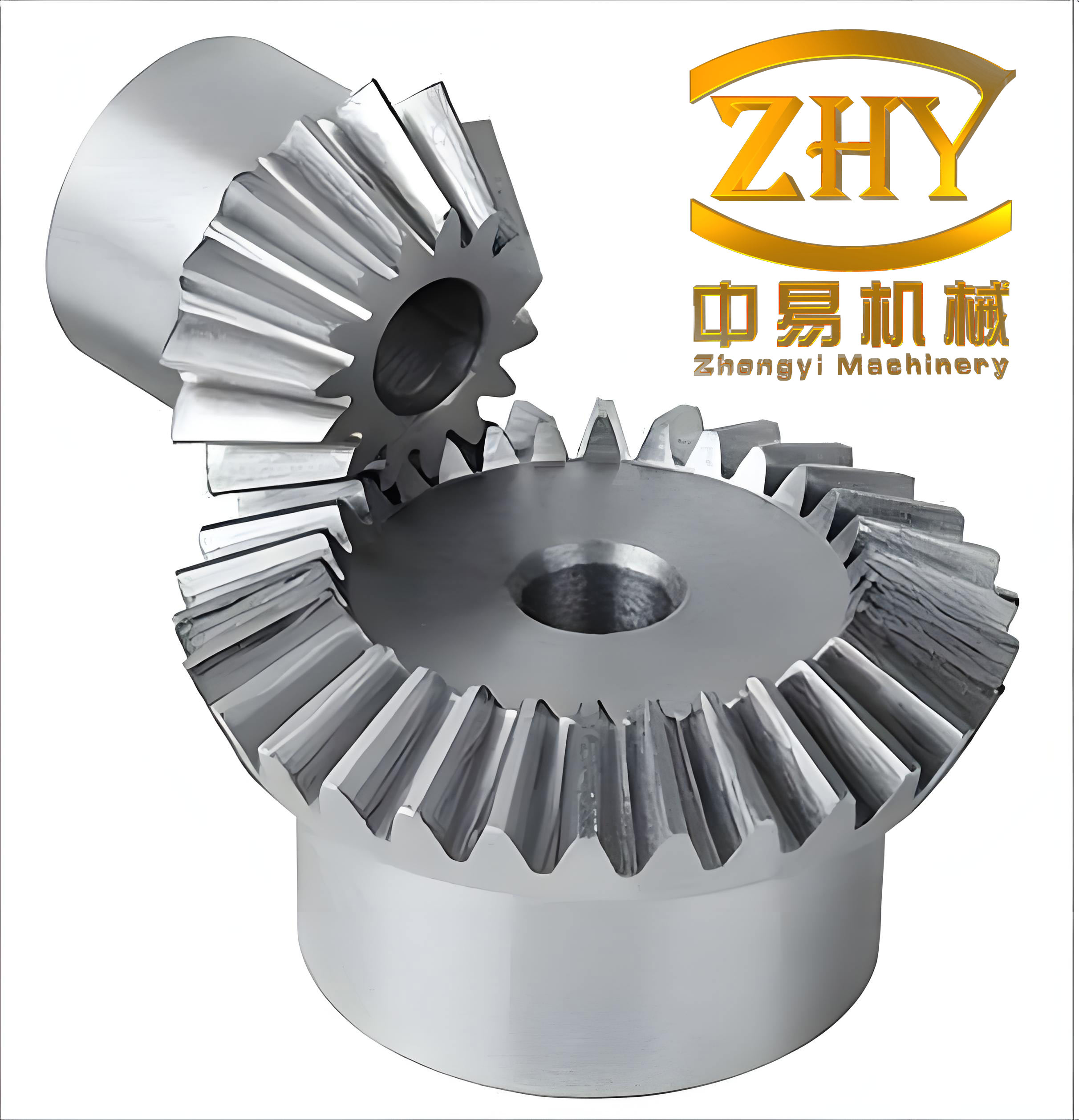
1. Finite Element Model for Root Stress Analysis of Straight Bevel Gears
1.1 Model Simplification and Mesh Generation
The contact ratio for a straight bevel gear pair typically lies between 1 and 2. Consequently, during meshing, single-tooth-pair and double-tooth-pair contact alternate continuously. The magnitude and distribution of load on the tooth flank vary with the meshing position. Considering two adjacent teeth on the same gear, when the leading tooth is working at the boundary point exiting the single-pair contact zone, the following tooth pair begins to enter meshing. When the following tooth works at the boundary point entering the single-pair contact zone, the leading tooth should disengage, and then the following tooth enters the single-pair contact zone. Therefore, for a pair of adjacent teeth, the rear double-contact zone of the leading tooth corresponds to the front double-contact zone of the following tooth. Neglecting differences between individual teeth and the influence of load on one tooth on the displacement of its neighbor, the double-tooth-pair contact condition can be approximated by two corresponding single-tooth-pair meshing positions. Based on this reasoning and referencing practices for spur gears, the meshing of a straight bevel gear pair can be simplified to a single tooth pair engagement for modeling purposes.
The computational model for the gear tooth and its mesh are illustrated in the conceptual diagrams (Figures 1a and 1b in the original text), representing two different mesh schemes: one with 228 nodes and 40 8-node hexahedral elements, and another with 150 nodes and 32 20-node hexahedral elements. The choice depends on the specific analysis requirements. The model boundary is defined at the back-cone surface at the large end, where the distance from point P to the tooth root is $$3m$$ (where $$m$$ is the module). The boundary points on the small end are determined by projecting lines from the large-end boundary points to the cone apex. As a first approximation, the boundary condition is set as zero displacement for all nodes on the surfaces P’Q’, Q’R’, and R’S’.
The coordinates of nodes on the tooth flank are calculated based on formulas derived from the gear generation process. Internal node coordinates are obtained via interpolation. To align with the meshing characteristics and simplify computation, the mesh lines along the face width direction on the tooth flank coincide with the instantaneous lines of contact. Key meshing points—such as the highest point of single-tooth contact (HPSTC), the lowest point of single-tooth contact (LPSTC), the upper and lower boundaries of the single-pair contact zone, and the pitch point—each correspond to a specific mesh line. The mesh lines for the front and rear double-contact zones are offset by a gear rotation angle equal to the angular pitch, enabling the analysis of double-tooth-pair contact. The meshing gear pair utilizes identical, simultaneously generated meshes with one-to-one correspondence between nodes and mesh lines, allowing the simulation of contact at different positions from the root to the tip.
1.2 Load Application and the Flexibility Matrix Method
The load distribution along the line of contact is calculated using the flexibility matrix method. It is assumed that the gear pair is in ideal meshing condition and that contact occurs along the full face width before and after loading. The flexibility coefficients are obtained from the tooth deformations under unit normal loads applied at each potential contact node. These coefficients form the flexibility matrix, which is then used to compute the load at each node on the contact line.
During the solution process, let the total normal load be $$F_n$$. The obtained nodal loads at this stage are termed nodal load distribution coefficients. Multiplying these coefficients by the actual normal load on the tooth yields the actual load value at each node. The governing equation for the contact problem, ensuring compatibility of deformation along the line of contact, can be expressed as:
$$ \{\delta\} = [C]\{P\} $$
where $$\{\delta\}$$ is the vector of approach (or composite deformation) at contact nodes, $$[C]$$ is the flexibility matrix, and $$\{P\}$$ is the vector of unknown nodal contact forces. For a given total load $$F_n$$ and contact condition, this system is solved subject to the constraints:
$$ \sum P_i = F_n \quad \text{and} \quad P_i \ge 0 $$
For a straight bevel gear, the geometric definition of the tooth surface and the line of contact is crucial. The surface coordinates of a straight bevel gear generated by a crown gear cutter can be defined parametrically. The transition surface between the active flank and the root fillet is also described by a set of equations based on the tool tip trajectory.
2. Finite Element Program and Post-Processing
Leveraging microcomputer capabilities, a finite element analysis program for gear tooth root stress was developed. Techniques such as dynamic memory allocation and block-solving for large equation systems were employed. With sufficient memory resources, the program can be adapted for structural analysis under numerous loading conditions. In the presented case study, the program successfully computed nodal displacements for 20 load cases to determine the flexibility matrix, and for 9 additional load cases to obtain displacements and stresses on a 286 microcomputer. Each load case can consist of concentrated forces, distributed pressures, gravity, centrifugal forces, or any combination thereof.
The software system comprises four main modules:
- Mesh Generator: Calculates surface coordinates and generates the 3D finite element mesh node coordinates for the straight bevel gear tooth model, outputting a data file. It can handle standard straight bevel gears with any shaft angle, as well as gears with tangential or profile shift.
- Graphics Pre/Post-Processor: Plots the finite element mesh of the gear tooth and the deformed mesh under load.
- Load Distribution Solver: Computes the load distribution among the nodes on the contact line using the flexibility matrix method.
- Finite Element Solver: The core FE program that calculates and outputs nodal displacements, stresses, etc., as required. Stresses are output per node, including six stress components, three principal stresses, and the von Mises equivalent stress based on the distortion energy theory. Nodal displacements and stresses are also saved in separate data files for further analysis and plotting.
3. Case Study and Computational Results
3.1 Gear Parameters
The analysis was performed on a pair of standard straight bevel gears. The gear pair parameters are as follows:
| Parameter | Pinion | Gear |
|---|---|---|
| Number of Teeth, $$z$$ | 20 | 40 |
| Module, $$m$$ (mm) | 5 | |
| Shaft Angle, $$\Sigma$$ | 90° | |
| Face Width, $$b$$ (mm) | 15 | |
| Tool Tip Radius, $$\rho_a$$ (mm) | 1.5 | |
| Pressure Angle, $$\alpha$$ | 20° | |
| Young’s Modulus, $$E$$ (GPa) | 206 | |
| Poisson’s Ratio, $$\nu$$ | 0.3 | |
The gear pair is designed with standard proportions and a tapered tooth depth.
3.2 Load Distribution Along the Line of Contact
The load distribution coefficients for nodes on five distinct lines of contact, from the pinion tip to the root, are summarized in the table below. Contact lines 1, 3, 5, 7, and 9 correspond to key meshing positions: tip, upper boundary of single-pair contact (UB), pitch point, lower boundary of single-pair contact (LB), and root (near the start of active profile), respectively.
| Contact Line | Node 1 (Large End) | Node 2 | Node 3 | Node 4 | Node 5 (Small End) |
|---|---|---|---|---|---|
| 1 (Tip) | 0.285 | 0.235 | 0.195 | 0.165 | 0.120 |
| 3 (UB) | 0.245 | 0.225 | 0.205 | 0.185 | 0.140 |
| 5 (Pitch Pt.) | 0.240 | 0.223 | 0.207 | 0.188 | 0.142 |
| 7 (LB) | 0.241 | 0.224 | 0.206 | 0.186 | 0.143 |
| 9 (Root) | 0.270 | 0.230 | 0.190 | 0.155 | 0.155 |
To more accurately reflect the load distribution, the equivalent line load density at integration points was calculated through a reverse operation from the nodal forces, ensuring load continuity and equilibrium. The resulting load per unit length distributions for contact lines 1, 3, 5, 7, and 9 on the pinion are plotted conceptually. The results indicate that the load does not follow a strictly linear distribution across the face width; it exhibits some fluctuation when contact is at the root or tip. For meshing at the UB, LB, and pitch point, the load shows a “crown” or barrel-shaped distribution, nearly identical for these three positions due to their proximity on the flank. The maximum load intensity occurs near the large end and gradually decreases towards the small end. This non-linear distribution is a critical aspect of straight bevel gear behavior that simplified methods often overlook.
3.3 Root Stress Distribution in the Gear Tooth
Given the linear elastic, small-deformation assumption, stress is proportional to load. Therefore, the analysis was performed with a unit total normal load on the contact line. The resulting stress values are scaling factors; multiplying by the actual load yields the actual stress. This computed stress is analogous to the nominal stress calculated in standards like ISO before applying various correction factors (e.g., $$K_A$$, $$K_V$$, $$K_{H\beta}$$).
The variation of the maximum principal stress in the root region at a critical cross-section (e.g., Section 5, near the middle of the face width) is shown for both the pinion and gear when contact occurs at lines 1, 3, 5, 7, and 9. The tensile side (positive stress, $$\sigma_1$$) and compressive side (negative stress, $$\sigma_3$$) are both presented. The results show that as the load application point moves from the tip towards the root, the root bending stress generally decreases. The location of the maximum tensile stress also shifts slightly downwards. When contact is at the lowest point (Line 9), the proximity of the load to the root fillet causes an atypical shape in the tensile stress curve. For all meshing positions, the point of maximum tensile and compressive stress lies below the point determined by the 30° tangent method, consistent with FEM findings for spur gears.
The variation of the maximum principal stress across different cross-sections along the face width is plotted for both gears under load at lines 1, 3, 5, 7, and 9. The key observations are:
- Both tensile and compressive root stresses exhibit a crowned distribution across the face width. The crown shape becomes less pronounced as the load moves towards the root.
- The maximum tensile stress occurs at a location approximately 20-30% of the face width from the large end.
- The maximum compressive stress tends to shift towards the large end as the load position lowers.
- The stress level on the tensile side is lower than on the compressive side.
- The root stresses in the larger gear are consistently lower than those in the pinion for corresponding meshing positions.
Since the analysis assumes single-tooth-pair contact, the stress when the load is at the tip (Line 1) is high. In reality, at the tip, the gear pair is often in double-tooth-pair contact, which would reduce the actual load and stress on that tooth.
3.4 Comparison with Standard Calculation Methods
A comparison was made between the maximum tensile stress from the FEM analysis (under unit load, single-pair contact assumption) and the nominal root stress calculated according to a standard method (e.g., ISO 10300), which considers only the stress concentration and form factor, excluding all application factors. The comparison for nine meshing positions is summarized below:
| Meshing Position | FEM Stress (Pinion) [σ_FE/F_n] | Std. Method Stress (Pinion) [σ_ISO/F_n] | Ratio (FEM/ISO) |
|---|---|---|---|
| Tip (Line 1) | 1.85 | 2.40 | 0.77 |
| Between Tip & UB | 1.65 | 2.15 | 0.77 |
| UB (Line 3) | 1.50 | 1.95 | 0.77 |
| Between UB & Pitch | 1.40 | 1.82 | 0.77 |
| Pitch (Line 5) | 1.35 | 1.75 | 0.77 |
| Between Pitch & LB | 1.32 | 1.71 | 0.77 |
| LB (Line 7) | 1.30 | 1.68 | 0.77 |
| Between LB & Root | 1.25 | 1.62 | 0.77 |
| Root (Line 9) | 1.20 | 1.55 | 0.77 |
The comparison reveals that the maximum tensile stress calculated by FEM under tip load (single-pair) is approximately 77% of the value obtained from the standard method. The primary reason is that the standard method uses an equivalent virtual spur gear at the mean cone distance to approximate the straight bevel gear strength. The assumption of a linear load distribution across the face width in that model clearly contradicts the crowned distribution shown by the FEM results for the straight bevel gear. Furthermore, when applying correction factors to bridge the gap between simplified models and reality, safety-oriented design practices often lead to conservative (i.e., larger) factors, resulting in an overestimation of stress by traditional standards for straight bevel gears.
4. Conclusions
Based on the presented methodology and case study, the following conclusions can be drawn regarding the finite element analysis of root stress in straight bevel gears:
- The finite element model established from the precise mathematical equations of the tooth flank and root fillet transition surface for a straight bevel gear is accurate. The mesh generation strategy is rational, and the developed software operates reliably, producing results consistent with other investigations.
- The method for solving the distributed load density along the line of contact provides a more accurate load input condition for subsequent analyses such as elastohydrodynamic lubrication (EHL) studies and contact stress analysis of straight bevel gear teeth.
- The distribution of root bending stress across the face width becomes more uniform as the load application point moves from the tip toward the root. The pinion consistently experiences higher root stress than the gear. Within a tooth cross-section, the point of maximum stress is located below the point found by the 30° tangent method.
- Under the assumption of single-tooth-pair contact with load at the tip, the maximum tensile root stress calculated via the detailed FEM is approximately 77% of the value predicted by the standard (ISO) calculation method for the example straight bevel gear pair. This highlights the conservative nature of the simplified standard approach and the potential for weight optimization using more precise tools like FEM.
The comprehensive finite element analysis framework described herein, incorporating accurate geometry, flexible meshing, and advanced load distribution solving, provides a powerful tool for the detailed investigation and optimization of bending strength in straight bevel gears, contributing to more efficient and reliable gear design.