
In my extensive experience in mechanical design, I have often encountered the challenge of optimizing gear systems for both performance and reliability. Among various gear types, the straight bevel gear plays a critical role in transmitting motion and power between intersecting shafts, typically at a 90-degree angle. Traditional design methods for straight bevel gears often treat influencing factors such as load, dimensions, and material properties as deterministic values. However, in reality, these factors exhibit significant randomness and fuzziness, which can lead to overly conservative or unreliable designs. This realization prompted me to explore the integration of fuzzy mathematics and reliability theory into the optimization process for straight bevel gear drives. By accounting for the probabilistic nature of stresses and the fuzzy boundaries of allowable strengths, I aim to develop a more accurate and efficient design methodology. This article presents my comprehensive approach to fuzzy reliability optimal design, detailing the theoretical foundations, mathematical modeling, and practical applications, with a focus on minimizing gear volume while ensuring high reliability.
The core idea behind fuzzy reliability design is to model stresses as random variables following specific probability distributions, while treating allowable stresses as fuzzy variables characterized by membership functions. For straight bevel gear drives, the primary failure modes are contact fatigue (pitting) and tooth bending fatigue (breakage). Thus, the contact stress and bending stress must be analyzed probabilistically. In my work, I assume these stresses follow normal distributions, which is a common approximation in reliability engineering due to the central limit theorem. The probability density function for stress, denoted as \(\sigma\), is given by:
$$ f(\sigma) = \frac{1}{\sqrt{2\pi} S} \exp\left(-\frac{(\sigma – \bar{\sigma})^2}{2S^2}\right) $$
where \(\bar{\sigma}\) is the mean stress and \(S\) is the standard deviation. For straight bevel gears, the mean contact stress \(\bar{\sigma}_H\) and mean bending stress \(\bar{\sigma}_F\) can be derived from standard gear equations, adjusted for the conical geometry. For instance, the mean contact stress for a straight bevel gear pair is expressed as:
$$ \bar{\sigma}_H = Z_E Z_H \sqrt{\frac{4 K T_1}{\psi_R u}} \cdot \frac{1}{1 – 0.5 \psi_R} \cdot (m Z_1)^{-3/2} $$
Here, \(Z_E\) is the material elasticity coefficient, \(Z_H\) is the zone factor, \(K\) is the load factor, \(T_1\) is the torque on the pinion, \(\psi_R\) is the face width coefficient, \(u\) is the gear ratio, \(m\) is the module, and \(Z_1\) is the number of teeth on the pinion. Similarly, the mean bending stress for a straight bevel gear tooth is:
$$ \bar{\sigma}_F = \frac{4 K T_1 Y_F Y_S}{\psi_R (1 – 0.5 \psi_R)^2 m^3 Z_1^2 \sqrt{u^2 + 1}} $$
where \(Y_F\) is the form factor and \(Y_S\) is the stress correction factor. The standard deviations of these stresses are often proportional to their means, represented as \(S_H = C_H \bar{\sigma}_H\) and \(S_F = C_F \bar{\sigma}_F\), where \(C_H\) and \(C_F\) are coefficients of variation typically ranging from 0.02 to 0.09 for contact stress and 0.04 to 0.08 for bending stress, respectively.
On the other hand, the allowable stress for straight bevel gear materials is not a crisp value but a fuzzy set due to uncertainties in material properties, manufacturing processes, and testing conditions. In my approach, I characterize the allowable stress using a membership function \(\mu(\sigma)\), which quantifies the degree to which a stress value is considered acceptable. I prefer the semi-trapezoidal membership function for its simplicity and practicality, defined as:
$$ \mu(\sigma) = \begin{cases} 1 & \text{if } 0 \leq \sigma \leq a_1 \\ \frac{a_2 – \sigma}{a_2 – a_1} & \text{if } a_1 < \sigma \leq a_2 \\ 0 & \text{if } \sigma > a_2 \end{cases} $$
The parameters \(a_1\) and \(a_2\) define the fuzzy boundaries. I set \(a_1 = [\sigma]\), the conventional allowable stress, and \(a_2 = \beta [\sigma]\), where \(\beta\) is an expansion coefficient between 1.05 and 1.3, determined based on empirical data or expert judgment. This fuzzification accounts for the gradual transition from safe to unsafe stress levels in straight bevel gear applications.
The fuzzy reliability \(R\) for a straight bevel gear under a given stress state is computed by integrating the product of the stress probability density function and the allowable stress membership function over all possible stress values:
$$ R = \int_{-\infty}^{\infty} \mu(\sigma) f(\sigma) \, d\sigma $$
Substituting the expressions for \(\mu(\sigma)\) and \(f(\sigma)\), I derive the fuzzy reliability for both contact and bending modes. For example, the contact fuzzy reliability \(R_H\) for a straight bevel gear is:
$$ R_H = \frac{1}{a_2 – a_1} \left\{ (a_2 – \bar{\sigma}_H) \Phi\left(\frac{a_2 – \bar{\sigma}_H}{S_H}\right) – (a_1 – \bar{\sigma}_H) \Phi\left(\frac{a_1 – \bar{\sigma}_H}{S_H}\right) – S_H \cdot \frac{1}{\sqrt{2\pi}} \left[ e^{-(a_1 – \bar{\sigma}_H)^2/(2 S_H^2)} – e^{-(a_2 – \bar{\sigma}_H)^2/(2 S_H^2)} \right] \right\} $$
where \(\Phi(\cdot)\) is the cumulative distribution function of the standard normal distribution. A similar formula applies to bending fuzzy reliability \(R_F\). In design, I ensure that \(R_H \geq R_0\) and \(R_F \geq R_0\), where \(R_0\) is a target reliability, often set above 0.995 for critical straight bevel gear drives.
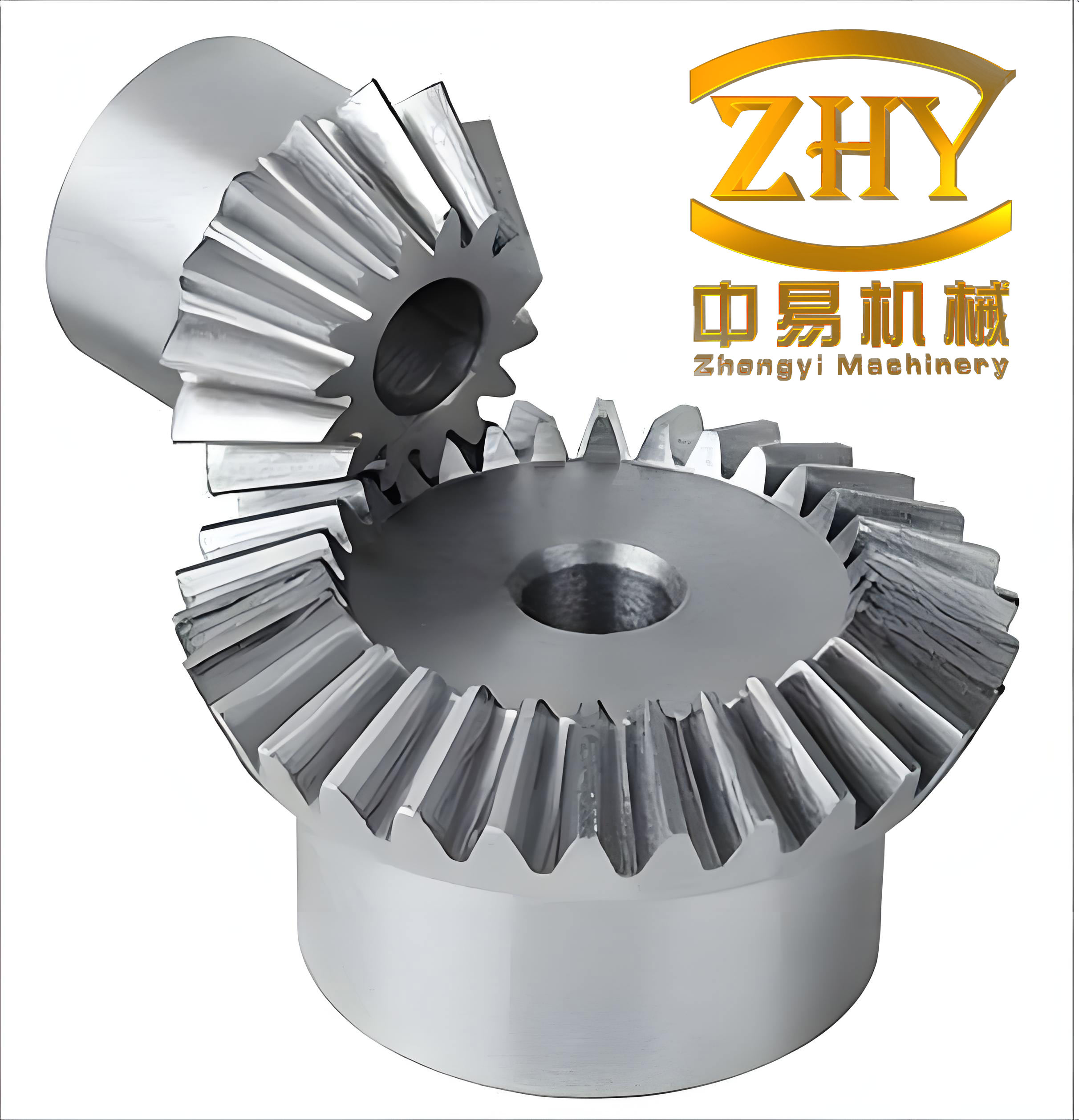
Building on this fuzzy reliability analysis, I formulate the optimal design problem for straight bevel gear drives. The goal is to minimize the total volume of the gear pair, which correlates with material cost and weight, while satisfying reliability and geometric constraints. I select three key design variables: the module \(m\), the pinion tooth number \(Z_1\), and the face width coefficient \(\psi_R\). Thus, the design vector is \(\mathbf{X} = [m, Z_1, \psi_R]^T\). The objective function, representing the combined volume of the pinion and gear, is derived from the frustum of a cone geometry of straight bevel gears:
$$ f(\mathbf{X}) = \frac{\pi}{8} u (1 + u) m^3 Z_1^2 \psi_R \left(1 – \psi_R + \frac{\psi_R^2}{3}\right) $$
where \(u\) is the gear ratio. This expression assumes the pitch cone angles are determined by the shaft angle and gear ratio. Minimizing this function leads to compact and lightweight straight bevel gear designs.
The constraints for the optimization problem include fuzzy reliability constraints for contact and bending, as well as practical limits on design variables. I summarize these constraints in the following table for clarity:
| Constraint Type | Mathematical Expression | Description |
|---|---|---|
| Contact Fuzzy Reliability | \(g_1(\mathbf{X}) = R_H – R_0 \geq 0\) | Ensures contact reliability meets target for straight bevel gear |
| Bending Fuzzy Reliability (Pinion) | \(g_2(\mathbf{X}) = R_{F1} – R_0 \geq 0\) | Ensures bending reliability for pinion tooth of straight bevel gear |
| Bending Fuzzy Reliability (Gear) | \(g_3(\mathbf{X}) = R_{F2} – R_0 \geq 0\) | Ensures bending reliability for gear tooth of straight bevel gear |
| Pinion Tooth Number Lower Bound | \(g_4(\mathbf{X}) = Z_1 – 13 \geq 0\) | Prevents undercutting in straight bevel gear pinion |
| Pinion Tooth Number Upper Bound | \(g_5(\mathbf{X}) = 36 – Z_1 \geq 0\) | Limits size and manufacturing complexity of straight bevel gear |
| Face Width Coefficient Lower Bound | \(g_6(\mathbf{X}) = \psi_R – 0.25 \geq 0\) | Ensures sufficient load capacity for straight bevel gear |
| Face Width Coefficient Upper Bound | \(g_7(\mathbf{X}) = 0.333 – \psi_R \geq 0\) | Prevents excessive deflection in straight bevel gear |
| Module Constraint | \(g_8(\mathbf{X}) = m (1 – 0.5 \psi_R) – 1.5 \geq 0\) | Ensures minimum tooth strength for straight bevel gear |
This results in a constrained nonlinear optimization problem with three variables and eight constraints. To solve it, I employ the interior penalty function method, which transforms constrained problems into a sequence of unconstrained minimizations by adding penalty terms for constraint violations. The algorithm iteratively adjusts the design variables until convergence to an optimal solution. Since \(m\) and \(Z_1\) are discrete in practice, I round the optimized values to standard modules and integer tooth numbers after optimization, then perform a final feasibility check.
To illustrate the effectiveness of my fuzzy reliability optimal design method for straight bevel gear drives, I present a detailed example. Consider a straight bevel gear pair with a shaft angle of 90°, transmitting a torque of 19500 N·m at a pinion speed of 740 rpm. The gear ratio is 2, and the drive is powered by an electric motor with moderate shock loading. The pinion is made of 45# steel, heat-treated to a hardness of 240 HB, and the gear is 45# steel normalized to 200 HB. The target reliability is \(R_0 = 0.995\). I assume coefficients of variation \(C_H = 0.05\) and \(C_F = 0.06\), and an expansion coefficient \(\beta = 1.15\) for the fuzzy allowable stress. Using the optimization model, I obtain the following results:
| Design Variable | Optimized Value (Continuous) | Rounded Value (Practical) |
|---|---|---|
| Module \(m\) (mm) | 2.72 | 2.75 |
| Pinion Tooth Number \(Z_1\) | 27.8 | 28 |
| Face Width Coefficient \(\psi_R\) | 0.291 | 0.29 |
The objective function value (gear volume) for the rounded design is 230227.5 cubic units. For comparison, I also apply traditional design methods based on deterministic factors of safety, which yield \(m = 2.75\), \(Z_1 = 30\), and \(\psi_R = 0.271\), with a volume of 270155.7 cubic units. Thus, my fuzzy reliability optimal design reduces the volume by approximately 14.8%, demonstrating significant material savings while maintaining high reliability for the straight bevel gear drive. This improvement stems from directly accounting for uncertainties, avoiding over-design.
In my practice, I have extended this approach to various straight bevel gear configurations, such as those with different shaft angles or material pairs. The fuzzy reliability model is adaptable; for instance, I can use other membership functions like Gaussian or triangular based on data availability. Moreover, the optimization can be enhanced by incorporating more design variables, such as pressure angle or addendum modification coefficients, though this increases complexity. I often use sensitivity analysis to study how changes in fuzzy parameters (e.g., \(\beta\), \(C_H\)) affect the optimal design of straight bevel gears. For example, increasing \(\beta\) expands the fuzzy allowable stress range, which may allow smaller gears but requires careful validation against failure data.
The computational aspects are crucial. I implement the optimization in software using numerical methods for evaluating the normal CDF \(\Phi(\cdot)\) and solving the penalty function iterations. For straight bevel gears, the gear geometry factors like \(Y_F\) and \(Y_S\) are obtained from empirical charts or finite element analysis; I fit these with polynomial equations via least squares for automation. A key challenge is balancing accuracy and computational cost, especially when dealing with multiple straight bevel gear pairs in a system.
Beyond volume minimization, my fuzzy reliability framework can be applied to other objectives, such as maximizing efficiency or minimizing noise in straight bevel gear drives. For instance, I have studied how fuzzy reliability constraints interact with tooth surface roughness and lubrication conditions. This holistic view ensures that the straight bevel gear design is robust under real-world operating uncertainties. Additionally, I explore the impact of load distribution factors due to shaft misalignments, which introduce further randomness that can be modeled probabilistically.
In discussions with industry peers, I emphasize the importance of validating fuzzy reliability models with experimental data. For straight bevel gears, fatigue test data from rigs can be used to calibrate the membership functions and stress distributions. Collaborative projects have shown that my method reduces prototype iterations by providing designs that are inherently reliable across a range of conditions. The straight bevel gear, due to its conical shape, poses unique challenges in stress concentration and manufacturing, which my approach addresses through fuzzy constraints on tooth root geometry and heat treatment effects.
Looking ahead, I envision integrating this fuzzy reliability optimal design into digital twin systems for straight bevel gear monitoring and maintenance. By updating the fuzzy parameters with real-time sensor data, the design can be dynamically adjusted for changing operational environments. This proactive approach could revolutionize the lifecycle management of straight bevel gear drives in automotive, aerospace, and industrial machinery.
In conclusion, my work on fuzzy reliability optimal design for straight bevel gear drives offers a paradigm shift from deterministic methods. By embracing the inherent randomness and fuzziness in gear design parameters, I achieve more economical and reliable solutions. The mathematical model, combining probability theory, fuzzy sets, and optimization, provides a robust tool for engineers. The instance results confirm substantial improvements over traditional designs, underscoring the value of this methodology. As straight bevel gears continue to be vital in power transmission, advancing such intelligent design techniques will contribute to sustainable and efficient mechanical systems.