
In the realm of gear manufacturing, the production of straight bevel gears presents unique challenges due to their conical geometry. As an engineer deeply involved in precision machining, I have frequently employed the form milling method, particularly on adapted universal milling machines, to produce these components. This article delves into the comprehensive process, from machine modification to final cutting, focusing on the intricacies involved in machining straight bevel gears. The term ‘straight bevel gear’ will be reiterated throughout to emphasize its central role in this discussion.
The core of this method lies in adapting a standard horizontal milling machine. The primary modification involves installing a mechanical slide unit onto the machine bed. This unit provides two key motions: a transverse linear travel for the cutting tool and a rotational adjustment around the longitudinal slide axis. Specifically, the transverse travel of the slide is set to ±50 mm, and the rotational capability is ±30°. This apparatus allows the milling head, relocated to the left side of the bed, to move laterally during operation while retaining its other original functions. The integration of this slide is crucial for achieving the necessary tool paths relative to the straight bevel gear blank.
Electrical system alterations are equally vital. Since the machining principle shifts from generating a cylindrical gear to form-milling a conical one, the control circuitry must be reconfigured. This involves repositioning limit switches on the original milling head slide and the machine bed. Furthermore, the control wiring for the feed motors is swapped. Notably, the power line for the original milling head motor is redirected to a new auxiliary power head motor on the mechanical slide. The control for the rapid traverse motor on the slide is integrated into the main circuit. Additionally, a DC power supply is added to operate the electromagnetic clutch within the slide mechanism. A critical consideration is the power rating disparity; the original milling motor has a significantly higher power than the feed and rapid motors, necessitating a corresponding exchange of contactors in the control panel. Another essential step is setting the longitudinal feed direction selector switch permanently to the “right milling” position. After these modifications, the automated cycle for machining a straight bevel gear proceeds as follows: rapid approach of the tool to the right, engagement of feed, forward working feed, dwell, rapid retraction to the left, indexing combined with rapid retreat of the slide, and then the cycle repeats for the next tooth space.
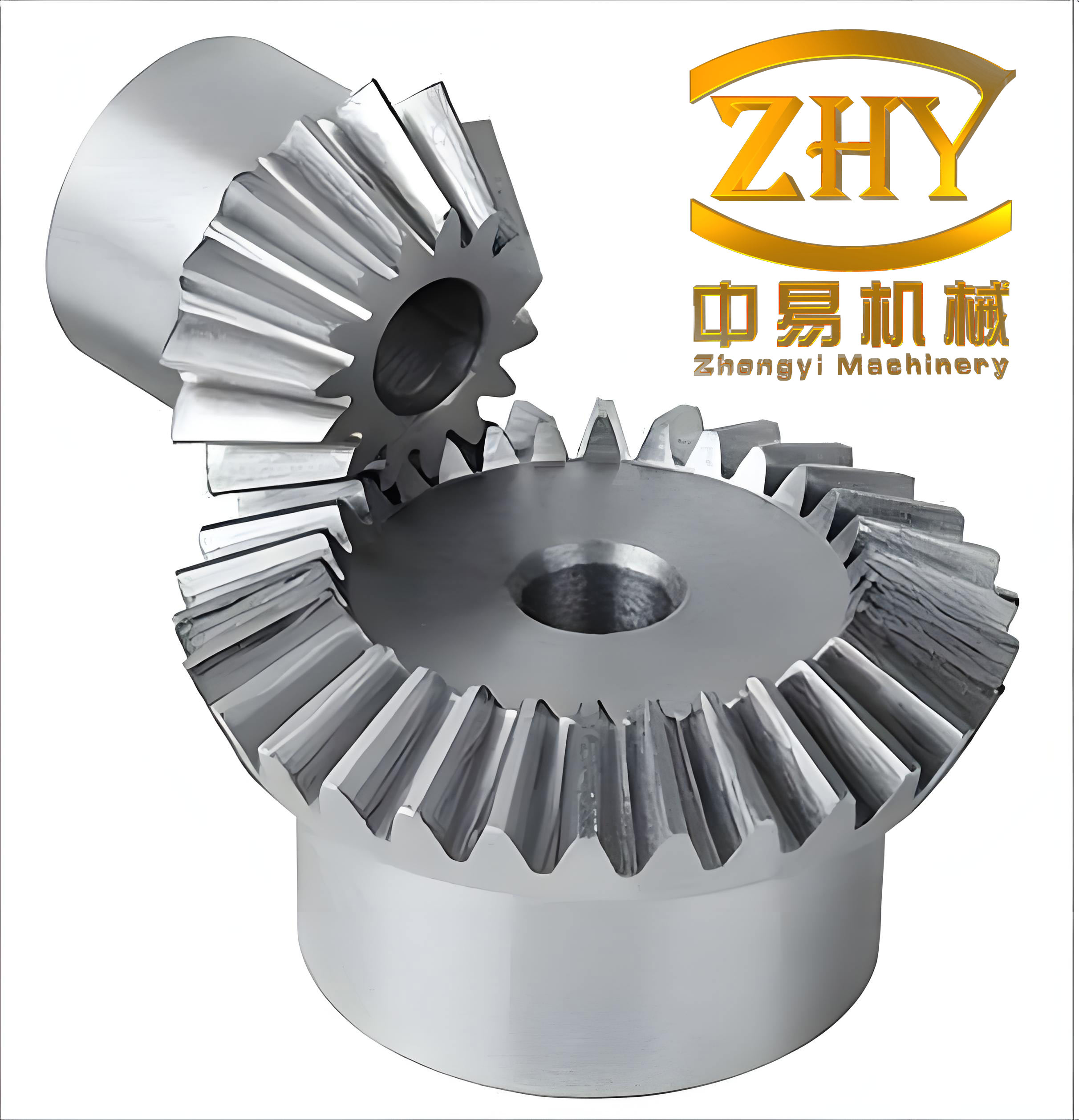
Preparation for machining a straight bevel gear begins with meticulous calculation of the tooth profile’s process dimensions. Based on the drawing specifications—module \(m\), number of teeth \(z\), pitch cone angle \(\delta\), face angle, root angle, cone distance \(R\), face width \(b\), and required accuracy—the profile dimensions at both the large end and small end of the tooth space must be computed and charted with their tolerance bands. The small end dimensions are proportionally derived from the large end. The formula relating the chordal tooth thickness at the large end \(s_e\) and small end \(s_i\) is given by the ratio of their cone distances:
$$ s_i = s_e \cdot \frac{R – b}{R} $$
where \(R\) is the cone distance and \(b\) is the face width. A detailed table is indispensable for setting up the machine correctly.
| Parameter | Symbol | Large End Value | Small End Value | Notes |
|---|---|---|---|---|
| Chordal Tooth Thickness | \(s\) | \(s_e\) | \(s_i\) | Calculated with tolerances |
| Chordal Addendum | \(h_a\) | \(h_{ae}\) | \(h_{ai}\) | For setting tool depth |
| Tooth Depth | \(h\) | \(h_e\) | \(h_i\) | \(h = 2.25m\) typically |
| Cone Distance | \(R\) | As per design | Key reference dimension | |
Selecting the correct form cutter, specifically a finger-type milling cutter, is paramount for machining a straight bevel gear. The cutter number is determined not by the actual number of teeth \(z\), but by the virtual (or formative) number of teeth \(z_v\), which accounts for the conical geometry:
$$ z_v = \frac{z}{\cos \delta} $$
where \(\delta\) is the pitch cone angle. The cutter’s tooth profile is designed for the large end, but its thickness is based on the small end tooth space width for a specific gear geometry (often when \(R/b = 3\)). This means the selected finger cutter is generally smaller than one used for a spur gear of equivalent module. This selection method ensures relative accuracy at the large end of the straight bevel gear, but introduces some profile error along the tooth flank, especially for gears with low tooth counts.
Determining the workpiece rotation angle \(\theta\) and the tool offset \(e\) is the heart of the form milling strategy for a straight bevel gear. After the first cut that mills the central tooth slot, the material remaining on the flanks must be removed in subsequent passes. The rotation angle \(\theta\) is the angle through which the gear blank must be turned about its axis to present the correct flank to the tool. The tool offset \(e\) is the perpendicular distance the cutter must be shifted relative to the initial centerline. These values are derived from the gear geometry and the cutter dimensions. Let \(s\) be the measured tooth thickness on the pitch cone after the first cut, and let the nominal tooth thickness be \(s_n\). The angular rotation \(\theta\) can be approximated by:
$$ \theta \approx \frac{s_n – s}{2R \sin \delta} \text{ (in radians)} $$
or for small angles in degrees:
$$ \theta^\circ \approx \frac{180}{\pi} \cdot \frac{s_n – s}{2R \sin \delta} $$
The tool offset \(e\) is related to this rotation and the geometry at the tooth tip. If \(d_a\) is the outer diameter, the linear displacement at the tip circle due to rotation \(\theta\) is \(d_a \theta / 2\). However, because the tool path is perpendicular to the root cone, the effective offset \(e\) is given by:
$$ e = \frac{d_a}{2} \cdot \theta \cdot \cos \delta_f $$
where \(\delta_f\) is the root angle. In practice, for a straight bevel gear, these values are often determined using graphical projection or tabulated data from the cutter manufacturer. The following table summarizes the relationship for a typical setup.
| Processing Step | Workpiece Motion | Tool Motion | Purpose |
|---|---|---|---|
| First Cut (Roughing) | Indexed between cuts, no rotation. | Centered on tooth space axis. | Mill central slot to full depth at small end. |
| Second Cut (Left Flank) | Rotate by \(-\theta\) (counter-clockwise). | Offset upward by distance \(+e\). | Machine the left/upper flank of the straight bevel gear tooth. |
| Third Cut (Right Flank) | Rotate by \(+\theta\) (clockwise). | Offset downward by distance \(-e\). | Machine the right/lower flank of the straight bevel gear tooth. |
Machine adjustment follows principles similar to spur gear milling but with added dimensions. The indexing mechanism is calculated based on the number of teeth \(z\) of the straight bevel gear. The feed rate of the mechanical slide, the spindle speed of the milling head, and the cutting fluid supply are set according to the workpiece material and cutter specifications. A detailed process plan is then drafted, specifying the workpiece clamping method—ensuring the blank’s axis is aligned with the rotational axis of the index head and that runout is minimized (typically within 0.02 mm for the pitch circle). It is critical to verify the initial position of the cutter relative to the gear blank center; any misalignment will result in asymmetric tooth profiles on the straight bevel gear.
The machining can be executed via a three-cut or two-cut method. The three-cut method, as outlined in the table above, is thorough. The first cut mills all tooth spaces to the full depth (based on the small end). The second and third cuts, with appropriate workpiece rotation and tool offset, remove the excess material on the flanks. For higher productivity, a two-cut method is sometimes employed. Here, the first roughing cut is omitted, and the first finishing cut (corresponding to the second cut of the three-cut method) is performed directly after setting \(\theta\) and \(e\) for one flank. Then, after readjusting for the opposite flank, the second finishing cut completes the tooth. Regardless of the method, a final finishing allowance, often a few hundredths of a millimeter, should be left to achieve the desired surface finish and accuracy on the straight bevel gear.
To solidify these concepts, let’s examine a detailed calculation example for a pair of straight bevel gears. The primary parameters are: Module \(m = 5\,\text{mm}\), Pinion teeth \(z_1 = 20\), Gear teeth \(z_2 = 40\), Pitch cone angles \(\delta_1 = 26.565^\circ\), \(\delta_2 = 63.435^\circ\), Face width \(b = 30\,\text{mm}\), Cone distance \(R = 100\,\text{mm}\), and required accuracy grade 9 per ISO standards.
First, we calculate the virtual number of teeth for cutter selection:
$$ z_{v1} = \frac{z_1}{\cos \delta_1} = \frac{20}{\cos 26.565^\circ} \approx 22.36 $$
$$ z_{v2} = \frac{z_2}{\cos \delta_2} = \frac{40}{\cos 63.435^\circ} \approx 89.44 $$
Based on \(z_v\), standard finger cutter tables would prescribe a specific cutter number for each gear. For instance, for the pinion with \(z_{v1} \approx 22\), a No. 3 or No. 4 cutter might be selected, while for the gear, a No. 7 or No. 8 cutter. The exact number depends on the cutter manufacturer’s numbering system for straight bevel gears.
Next, we compute the tooth space dimensions at both ends. The circular pitch \(p = \pi m = 15.708\,\text{mm}\). The nominal chordal tooth thickness at the large end is approximately \(s_e \approx p/2 = 7.854\,\text{mm}\). Using the proportional formula for the small end:
$$ s_i = s_e \cdot \frac{R – b}{R} = 7.854 \cdot \frac{100 – 30}{100} = 5.498\,\text{mm} $$
Similarly, addendum and whole depth are calculated. A comprehensive table for the pinion is shown below.
| Description | Symbol | Large End (mm) | Small End (mm) |
|---|---|---|---|
| Circular Pitch | \(p\) | 15.708 | 15.708 |
| Chordal Thickness (Nominal) | \(s\) | 7.854 ±0.05 | 5.498 ±0.05 |
| Chordal Addendum | \(h_a\) | 5.00 | 3.50* |
| Tooth Depth | \(h\) | 11.25 | 7.88* |
*Values at small end are approximate, derived from proportional scaling.
Now, determining \(\theta\) and \(e\). After the first cut with the selected finger cutter, we measure the actual tooth thickness on the pitch cone. Suppose the measured value \(s_{meas} = 7.65\,\text{mm}\) at the large end. The deviation from nominal is \(\Delta s = s_n – s_{meas} = 0.204\,\text{mm}\). Using the formula for angular rotation:
$$ \theta \approx \frac{180}{\pi} \cdot \frac{\Delta s}{2R \sin \delta_1} = \frac{180}{\pi} \cdot \frac{0.204}{2 \times 100 \times \sin 26.565^\circ} $$
$$ \theta \approx \frac{180}{3.1416} \cdot \frac{0.204}{200 \times 0.4472} \approx 57.3 \cdot \frac{0.204}{89.44} \approx 0.131^\circ $$
This small angle is typical. The tool offset \(e\) requires knowledge of the outer diameter \(d_a\). For the pinion, \(d_a = m(z + 2\cos\delta) = 5(20 + 2\cos26.565^\circ) \approx 108.944\,\text{mm}\). Using the simplified relation \(e \approx (d_a/2) \cdot \theta \cdot (\pi/180) \cdot \cos\delta_f\), and assuming \(\delta_f \approx \delta – \text{dedendum angle}\), we can estimate. If the root angle \(\delta_f \approx 24^\circ\), then:
$$ e \approx \frac{108.944}{2} \cdot 0.131 \cdot \frac{3.1416}{180} \cdot \cos 24^\circ \approx 54.472 \cdot 0.002285 \cdot 0.9135 \approx 0.114\,\text{mm} $$
Thus, for this straight bevel gear pinion, the workpiece would rotate approximately 0.13 degrees, and the tool would be offset by about 0.11 mm for the flank milling cuts. These values are critical for achieving the correct tooth profile on the straight bevel gear.
The accuracy of the form milling process for straight bevel gears is influenced by multiple factors: cutter profile accuracy, machine tool rigidity, workpiece clamping, blank dimensions, and the skill in setting angles and offsets. The inherent error due to the cutter being perpendicular to the root cone (rather than the pitch cone) introduces a slight profile deviation, but for gears with pitch cone angles up to 70° and grade 9 or coarser accuracy, this is acceptable. To ensure quality, the gear blank must be precision-machined with tight tolerances on the pitch cone runout (recommended within 0.03 mm). The cutter runout should be less than 0.01 mm, and its initial center must coincide with the gear blank axis. For large-diameter straight bevel gear blanks (exceeding 300 mm), counterweights should be attached to the indexing fixture to prevent dynamic imbalance during rotation, a practice borrowed from large gear machining.
In conclusion, the form milling method, facilitated by a suitably modified universal milling machine, provides a practical and accessible means for manufacturing straight bevel gears, especially for small to medium batches or repair work. The key to success lies in meticulous preparation: accurate calculation of gear geometry, careful selection of form cutters, precise determination of workpiece rotation and tool offset, and rigorous machine setup. While the process may involve several cuts per tooth space, it offers good control over the final tooth form. The straight bevel gear, with its conical pitch surface, demands this added layer of complexity compared to spur gears. By adhering to the detailed steps outlined—encompassing mechanical adaptation, electrical reconfiguration, computational rigor, and procedural diligence—one can reliably produce functional straight bevel gears suitable for a range of power transmission applications. Continuous emphasis on the term ‘straight bevel gear’ throughout this discourse underscores its unique geometrical and manufacturing identity within the broader family of gears.