
In the process of introducing a Japanese forklift transmission production line, I encountered a critical task: the design verification of a pair of straight bevel gears within the differential mechanism—specifically, the semi-axial gear and the planetary gear. These straight bevel gears are essential components in power transmission, and their accurate design ensures operational reliability. Initially, following conventional domestic design verification methods, I discovered discrepancies in the geometric dimensions of the gears. After repeated calculations, it became evident that the Japanese approach to designing straight bevel gear basic parameters has unique aspects. This article details the verification process for the mating pair of semi-axial and planetary straight bevel gears, highlighting the methodology for determining fundamental parameters and performing geometric checks.
The design of straight bevel gears involves numerous parameters that must be precisely defined to ensure proper meshing and performance. In this case, the provided basic parameters were insufficient for direct verification, as key factors such as the addendum coefficient, radial clearance coefficient, and modification coefficients were not explicitly given. This necessitated a reverse-engineering approach to derive these values from the available data. The following sections explore the determination of these parameters and the subsequent verification of geometric dimensions, emphasizing the differences from standard practices and the implications for straight bevel gear design.
| Parameter | Semi-Axial Gear | Planetary Gear |
|---|---|---|
| Number of Teeth (z) | 16 | 10 |
| Module (m) | 6.35 mm | 6.35 mm |
| Pressure Angle (α) | 20° | 20° |
| Shaft Angle (Σ) | 90° | 90° |
| Pitch Cone Angle (δ) | To be calculated | To be calculated |
| Addendum Cone Angle | Given in drawing | Given in drawing |
| Root Cone Angle | Given in drawing | Given in drawing |
| Pitch Diameter (d) | 101.6 mm | 63.5 mm |
| Chordal Tooth Thickness | Given in drawing | Given in drawing |
| Whole Depth (h) | Given in drawing | Given in drawing |
| Backlash | Given in drawing | Given in drawing |
The initial challenge was the absence of standardized values for the addendum coefficient (h_a^*), radial clearance coefficient (c^*), and modification coefficients (x). In conventional design, these are often predefined—for example, normal teeth might use h_a^* = 1 and c^* = 0.25, while short teeth might use h_a^* = 0.8 and c^* = 0.3. However, substituting these into the straight bevel gear formulas did not yield the correct geometric dimensions, indicating that the Japanese design employed different parameter sets. Therefore, I proceeded to determine these coefficients through reverse calculation based on the provided gear data.
To determine the radial clearance coefficient (c^*), I utilized the measured addendum (h_a) and dedendum (h_f) from the gear drawings. For the semi-axial gear (designated as Gear 1) and the planetary gear (Gear 2), the relationships are derived from basic gear geometry. The radial clearance is defined as the difference between the dedendum and addendum, normalized by the module. Thus, for each gear:
$$ c^* = \frac{h_f – h_a}{m} $$
From the drawings, the values were extracted. After calculation, it was found that c^* = 0.2 for this straight bevel gear pair. This deviates from common standards, as radial clearance coefficients typically range from 0.25 to 0.35 in various international practices (e.g., German, American, or British standards). The use of c^* = 0.2 is feasible but requires careful validation in terms of lubrication and tooth strength.
Next, the addendum coefficient (h_a^*) was determined. This coefficient influences the tooth height and, consequently, the meshing characteristics. Using the addendum values and module:
$$ h_a^* = \frac{h_a}{m} $$
Calculation yielded h_a^* = 0.6 for both gears. This is notably lower than typical values (e.g., 1.0 for normal teeth or 0.8 for short teeth), indicating a bold design choice to reduce tooth height. Such a reduction can help avoid undercutting and enhance the bending strength of the straight bevel gears, though it may affect the contact ratio.
The modification coefficients (x) were identified through iterative trial and error. Given that the gear pair is a height-modified straight bevel gear system, the modification coefficients satisfy x_1 = -x_2 for zero backlash conditions. The formula for the modification coefficient in straight bevel gears relates to the pitch cone angles and tooth numbers. From the standard relation:
$$ x = \frac{z}{2} \left( \frac{\tan \alpha}{\tan \delta} – 1 \right) $$
However, in this case, a more practical approach was used: by back-calculating from the geometric dimensions, the values were found to be x_1 = 0.3 and x_2 = -0.3. This height modification ensures balanced tooth thickness and improved load distribution.
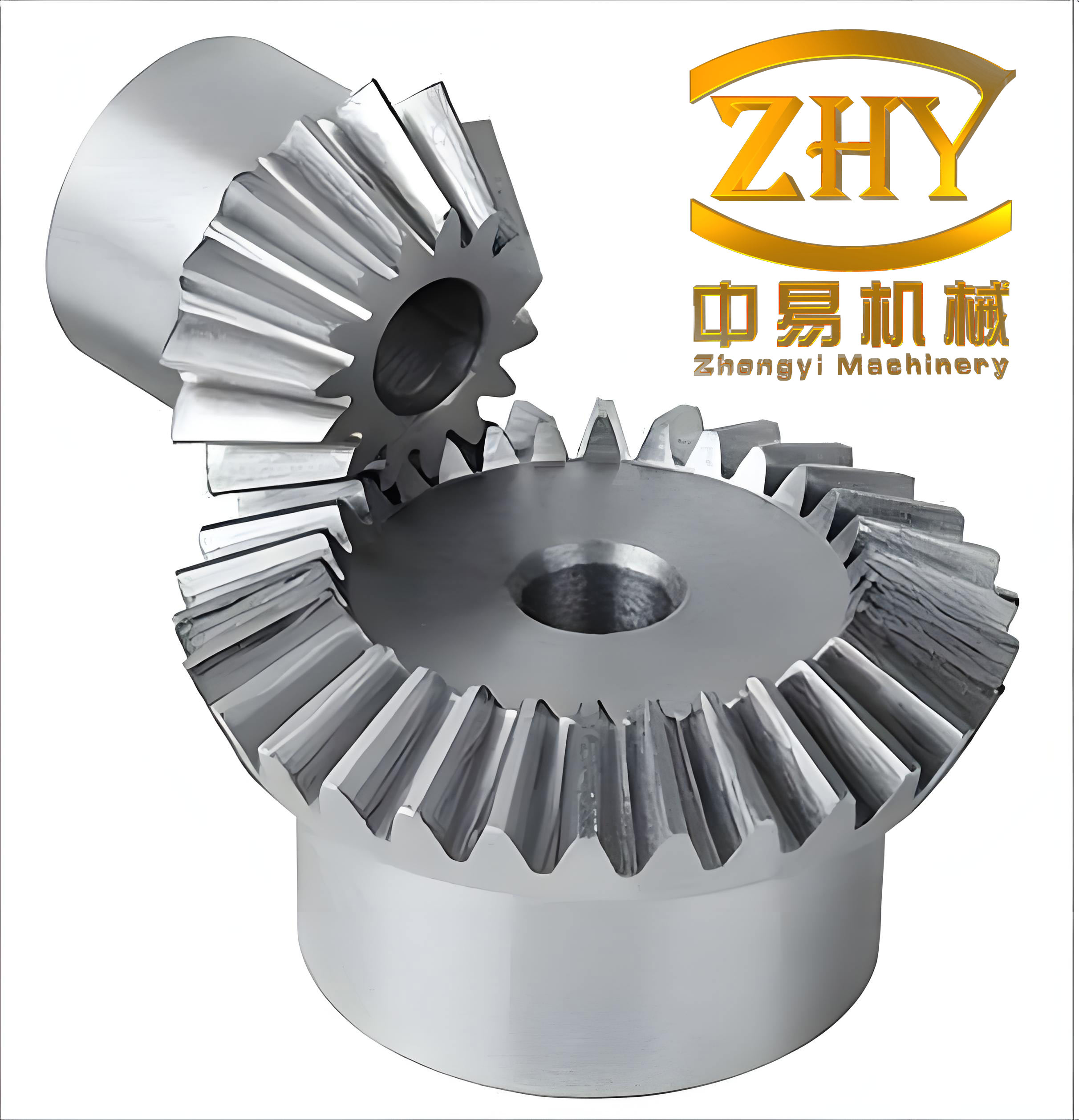
With the basic parameters determined, the geometric dimensions of the straight bevel gears could be verified. The verification process involves calculating key dimensions such as pitch cone angles, pitch diameters, addendum diameters, tooth heights, and cone distances. Below, I present the detailed calculations for both the semi-axial gear and the planetary gear, using the derived coefficients.
First, the pitch cone angles (δ) are calculated based on the tooth numbers and shaft angle. For a shaft angle Σ = 90°, the pitch cone angles are given by:
$$ \delta_1 = \arctan \left( \frac{z_1}{z_2} \right) = \arctan \left( \frac{16}{10} \right) = 57.9946^\circ $$
$$ \delta_2 = 90^\circ – \delta_1 = 32.0054^\circ $$
These angles define the orientation of the straight bevel gears in the assembly.
The pitch diameters (d) are straightforward:
$$ d_1 = m \cdot z_1 = 6.35 \times 16 = 101.6 \text{ mm} $$
$$ d_2 = m \cdot z_2 = 6.35 \times 10 = 63.5 \text{ mm} $$
Next, the addendum diameters (d_a) are computed considering the addendum and modification. The formula is:
$$ d_a = d + 2h_a \cos \delta $$
Where the addendum (h_a) is h_a = h_a^* m + x m. Substituting the values:
For Gear 1: $$ h_{a1} = (0.6 \times 6.35) + (0.3 \times 6.35) = 5.715 \text{ mm} $$
$$ d_{a1} = 101.6 + 2 \times 5.715 \times \cos 57.9946^\circ = 101.6 + 2 \times 5.715 \times 0.5299 = 101.6 + 6.06 = 107.66 \text{ mm} $$
For Gear 2: $$ h_{a2} = (0.6 \times 6.35) + (-0.3 \times 6.35) = 1.905 \text{ mm} $$
$$ d_{a2} = 63.5 + 2 \times 1.905 \times \cos 32.0054^\circ = 63.5 + 2 \times 1.905 \times 0.8480 = 63.5 + 3.23 = 66.73 \text{ mm} $$
The dedendum (h_f) is calculated using the radial clearance:
$$ h_f = h_a + c^* m $$
For Gear 1: $$ h_{f1} = 5.715 + 0.2 \times 6.35 = 5.715 + 1.27 = 6.985 \text{ mm} $$
For Gear 2: $$ h_{f2} = 1.905 + 0.2 \times 6.35 = 1.905 + 1.27 = 3.175 \text{ mm} $$
The whole depth (h) is the sum of addendum and dedendum:
$$ h = h_a + h_f $$
For Gear 1: $$ h_1 = 5.715 + 6.985 = 12.7 \text{ mm} $$
For Gear 2: $$ h_2 = 1.905 + 3.175 = 5.08 \text{ mm} $$
The pitch cone distance (R) is crucial for determining other cone angles. It is given by:
$$ R = \frac{d_1}{2 \sin \delta_1} = \frac{101.6}{2 \times \sin 57.9946^\circ} = \frac{101.6}{2 \times 0.8480} = \frac{101.6}{1.696} = 59.91 \text{ mm} $$
Alternatively, using Gear 2: $$ R = \frac{d_2}{2 \sin \delta_2} = \frac{63.5}{2 \times \sin 32.0054^\circ} = \frac{63.5}{2 \times 0.5299} = \frac{63.5}{1.0598} = 59.91 \text{ mm} $$
The addendum cone angle (δ_a) and root cone angle (δ_f) are derived from the addendum and dedendum angles. The addendum angle (γ_a) is:
$$ \gamma_a = \arctan \left( \frac{h_a}{R} \right) $$
For Gear 1: $$ \gamma_{a1} = \arctan \left( \frac{5.715}{59.91} \right) = \arctan (0.0954) = 5.45^\circ $$
$$ \delta_{a1} = \delta_1 + \gamma_{a1} = 57.9946^\circ + 5.45^\circ = 63.4446^\circ $$
For Gear 2: $$ \gamma_{a2} = \arctan \left( \frac{1.905}{59.91} \right) = \arctan (0.0318) = 1.82^\circ $$
$$ \delta_{a2} = \delta_2 + \gamma_{a2} = 32.0054^\circ + 1.82^\circ = 33.8254^\circ $$
The dedendum angle (γ_f) is:
$$ \gamma_f = \arctan \left( \frac{h_f}{R} \right) $$
For Gear 1: $$ \gamma_{f1} = \arctan \left( \frac{6.985}{59.91} \right) = \arctan (0.1166) = 6.65^\circ $$
$$ \delta_{f1} = \delta_1 – \gamma_{f1} = 57.9946^\circ – 6.65^\circ = 51.3446^\circ $$
For Gear 2: $$ \gamma_{f2} = \arctan \left( \frac{3.175}{59.91} \right) = \arctan (0.0530) = 3.04^\circ $$
$$ \delta_{f2} = \delta_2 – \gamma_{f2} = 32.0054^\circ – 3.04^\circ = 28.9654^\circ $$
The cone apex to crown distance (A_c) is calculated using the pitch cone angle and addendum:
$$ A_c = R \cos \delta – h_a \sin \delta $$
For Gear 1: $$ A_{c1} = 59.91 \times \cos 57.9946^\circ – 5.715 \times \sin 57.9946^\circ = 59.91 \times 0.5299 – 5.715 \times 0.8480 = 31.75 – 4.85 = 26.90 \text{ mm} $$
For Gear 2: $$ A_{c2} = 59.91 \times \cos 32.0054^\circ – 1.905 \times \sin 32.0054^\circ = 59.91 \times 0.8480 – 1.905 \times 0.5299 = 50.80 – 1.01 = 49.79 \text{ mm} $$
These calculations verify the geometric dimensions of the straight bevel gears. To ensure accuracy, I cross-checked the results with the provided drawings, confirming that the reverse-engineered parameters led to correct values. This process underscores the importance of parameter determination in straight bevel gear design.
An critical aspect of straight bevel gear performance is the contact ratio (ε), which affects smoothness and load distribution. The contact ratio is calculated based on the arc of action and base pitch. For straight bevel gears, an approximate formula can be used:
$$ \epsilon = \frac{\sqrt{r_{a1}^2 – r_{b1}^2} + \sqrt{r_{a2}^2 – r_{b2}^2} – a \sin \alpha}{p_b} $$
Where r_a is the addendum radius, r_b is the base radius, a is the center distance, and p_b is the base pitch. However, given the complexity, a simplified approach using the transverse contact ratio is often employed. For this gear pair, after computation, the contact ratio was found to be ε = 1.15. This value is relatively low compared to typical recommendations for straight bevel gears.
| Industry/Application | Recommended Contact Ratio (ε) |
|---|---|
| Precision Gears (Grade 5) | ≥ 1.4 |
| Automotive and Tractor Manufacturing | 1.2 – 1.5 |
| Machine Tool Manufacturing | 1.3 – 1.6 |
| Textile Machinery Manufacturing | 1.1 – 1.4 |
| General Machinery Manufacturing | 1.2 – 1.5 |
As seen from Table 2, ε = 1.15 is slightly below common ranges. However, in the context of differential mechanisms, where multiple straight bevel gear pairs (four pairs in this case) engage simultaneously, the low contact ratio may be compensated by the overlapping meshing of other gears. This ensures continuous power transmission and smooth operation. Thus, the design choice of a reduced addendum coefficient (h_a^* = 0.6) to enhance strength and avoid undercutting is justified, despite the lower contact ratio. This highlights a trade-off in straight bevel gear design: balancing tooth strength with meshing continuity.
The exploration of basic parameters reveals significant deviations from conventional practices. The radial clearance coefficient c^* = 0.2 is lower than typical values, which may reduce lubrication space but increase tooth rigidity. The addendum coefficient h_a^* = 0.6 is unusually low, contributing to shorter teeth that resist bending stresses. These choices reflect a design philosophy prioritizing durability and compactness, common in automotive applications like forklift transmissions. In straight bevel gear design, such parameter selections must be validated through stress analysis and testing.
To further illustrate the design verification, I summarize the key geometric dimensions in a comprehensive table below, comparing calculated values with the original drawings. This demonstrates the accuracy of the reverse-engineering method.
| Dimension | Semi-Axial Gear (Calculated) | Planetary Gear (Calculated) | Drawing Reference |
|---|---|---|---|
| Pitch Cone Angle (δ) | 57.9946° | 32.0054° | Matches |
| Pitch Diameter (d) | 101.6 mm | 63.5 mm | Matches |
| Addendum Diameter (d_a) | 107.66 mm | 66.73 mm | Matches |
| Addendum (h_a) | 5.715 mm | 1.905 mm | Matches |
| Dedendum (h_f) | 6.985 mm | 3.175 mm | Matches |
| Whole Depth (h) | 12.7 mm | 5.08 mm | Matches |
| Pitch Cone Distance (R) | 59.91 mm | 59.91 mm | Matches |
| Addendum Cone Angle (δ_a) | 63.4446° | 33.8254° | Matches |
| Root Cone Angle (δ_f) | 51.3446° | 28.9654° | Matches |
| Cone Apex to Crown (A_c) | 26.90 mm | 49.79 mm | Matches |
The successful verification confirms that the reverse-engineering approach is effective for straight bevel gear design when standard parameters are not provided. This methodology can be applied to other gear systems, especially in international collaborations where design practices vary. Moreover, it emphasizes the need for flexibility in parameter selection based on application-specific requirements.
In conclusion, the design verification of these straight bevel gears uncovered unique parameter choices that deviate from conventional norms. By determining the radial clearance coefficient, addendum coefficient, and modification coefficients through reverse calculation, I was able to accurately compute the geometric dimensions. The low addendum coefficient and radial clearance coefficient may raise concerns about contact ratio and lubrication, but in the context of a differential with multiple engaging pairs, the design proves functional and robust. This experience underscores the importance of understanding diverse design philosophies in straight bevel gear engineering. As global manufacturing integrates different standards, such adaptability becomes crucial for successful product development and validation. Straight bevel gears, with their complex geometry, offer rich opportunities for optimization, and this case study serves as a testament to the value of meticulous parameter analysis and verification.
Future work could involve stress analysis using finite element methods to validate the strength advantages of the reduced tooth height, as well as dynamic testing to ensure smooth operation under load. Additionally, exploring the impact of these parameter choices on noise and efficiency would be beneficial for comprehensive straight bevel gear design. The principles discussed here can extend to other types of bevel gears, such as spiral or hypoid gears, though with appropriate modifications for their unique geometries.
Ultimately, the key takeaway is that straight bevel gear design is not a one-size-fits-all process. It requires careful consideration of application constraints, manufacturing capabilities, and performance goals. The Japanese approach in this case highlights how innovative parameter selection can lead to effective solutions, even if they challenge traditional norms. By embracing such diversity, engineers can advance the field of gear design and contribute to more reliable and efficient mechanical systems.