
The design and operation of modern gear systems are increasingly driven by demands for compactness, light weight, and the ability to handle high speeds under significant loads. In this context, traditional failure modes like bending fatigue are often superseded by surface-initiated failures. Among these, scuffing (or adhesive wear) and various forms of abrasive and surface fatigue wear have become predominant limiting factors for gear performance and longevity. Extensive theoretical and experimental work has consistently demonstrated that the presence and, crucially, the thickness of a lubricating oil film between meshing tooth surfaces play a pivotal role in mitigating these surface failures. For the complex contact conditions found in spiral gear pairs, understanding and predicting this film thickness is therefore not merely an academic exercise but a fundamental requirement for reliable design.
When two machine elements in relative motion are subjected to a load, the friction generated at their interface leads to energy loss, heat generation, and progressive material removal—wear. This wear degrades operational precision, while the generated heat can raise local temperatures to levels that cause seizure or scuffing. The primary engineering solution to these tribological challenges is effective lubrication. Introducing a lubricant film between surfaces separates them, substituting solid-solid contact with much lower internal fluid friction. For spiral gear transmissions, whose contact geometry involves concurrent rolling and sliding motions, the relationship between lubrication regime and failure modes such as pitting, scuffing, and wear is particularly intimate. Consequently, investigating the lubrication mechanism at the meshing interface of spiral gears is of paramount practical importance for analyzing failure root causes and enhancing the reliability and load capacity of these drives. The central parameter in this investigation is the minimum oil film thickness (MOFT), which directly influences the transmission’s load-carrying capacity and service life, acting as the first line of defense against surface distress.
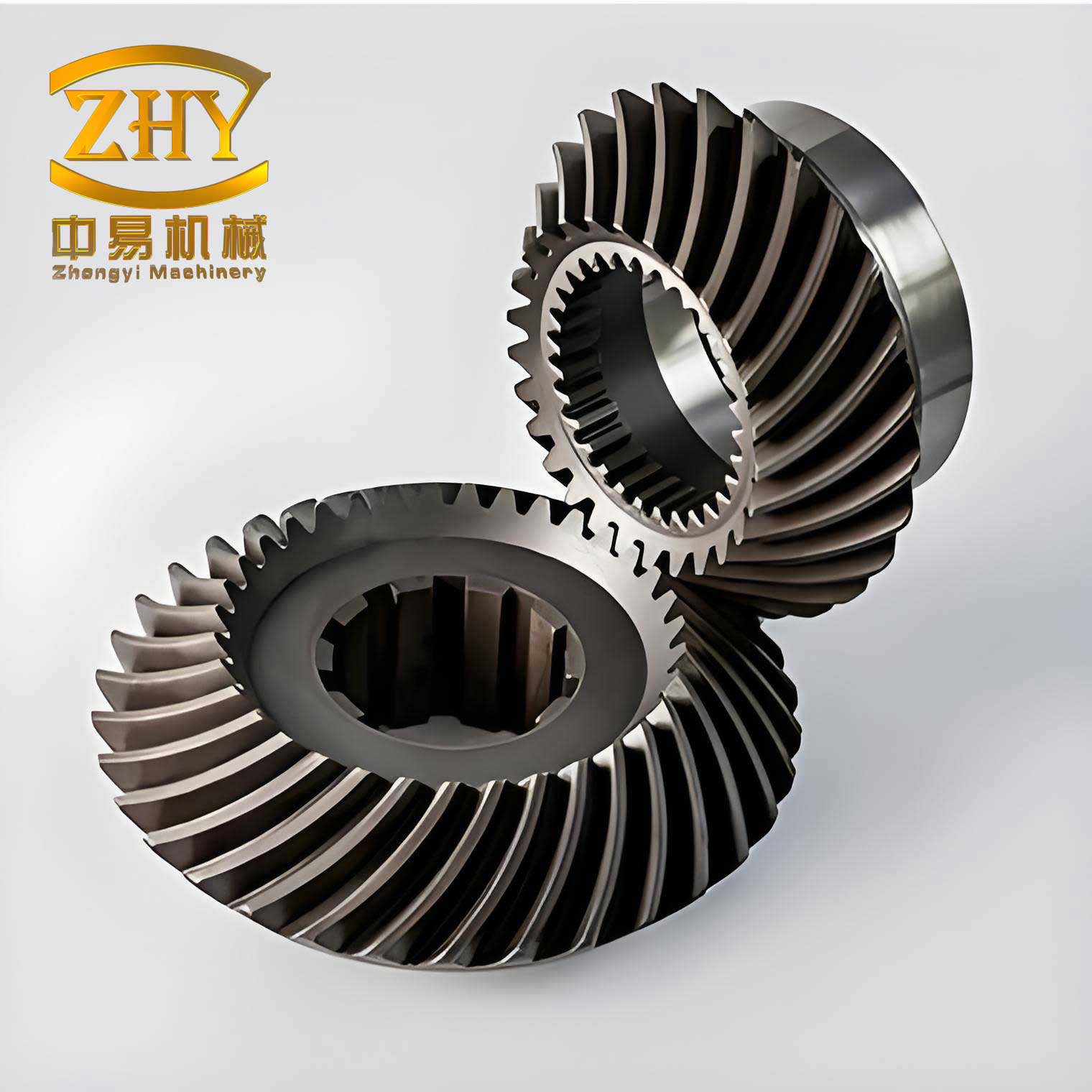
The theoretical framework most suited for analyzing the thin, high-pressure lubricant films in concentrated contacts like those in gears is Elastohydrodynamic Lubrication (EHL) theory. Classical hydrodynamic lubrication theory, which assumes rigid bodies and constant lubricant viscosity, fails under the extreme pressures (often exceeding 1 GPa) found in gear contacts. EHL theory synthesizes three critical phenomena: the elastic deformation of the contacting surfaces under load, the dramatic increase in lubricant viscosity with pressure (piezoviscous effect), and the hydrodynamic action that generates the film. The solution to the EHL problem provides the pressure distribution within the contact and, most importantly, the minimum film thickness separating the surfaces. A seminal work in this field is the empirical formula developed by Dowson and Higginson for line contacts, which has been widely adopted and validated for gear applications. This formula elegantly captures the interplay between material properties, operating conditions, and lubricant characteristics.
Calculating the minimum oil film thickness in a spiral gear pair requires adapting a general EHL model to the specific kinematics and geometry of spiral gear contact. The meshing process of spiral gears is complex, with continuously varying contact geometry, surface velocities, and load distribution along the path of contact. However, a widely accepted and practical simplification is to model the contact at any instantaneous point as equivalent to that between two rotating cylinders. This analogy allows us to apply the Dowson-Higginson formula by substituting the appropriate instantaneous geometric and kinematic parameters of the spiral gear pair at the point of interest, typically the pitch point for conservative estimation or along the entire line of action for a more comprehensive analysis.
The foundational formula for minimum film thickness in a line contact, as per Dowson and Higginson, is:
$$ h_{min} = 2.65 \alpha^{0.54} (\eta_0 u)^{0.7} R^{0.43} E^{‘\, -0.03} (w_n)^{-0.13} $$
where the parameters are defined as follows:
- $h_{min}$: Minimum oil film thickness [m]
- $\alpha$: Pressure-viscosity coefficient of the lubricant [m²/N]
- $\eta_0$: Dynamic viscosity of the lubricant at atmospheric pressure and operating inlet temperature [Pa·s]
- $u$: Average (entrainment) rolling velocity [m/s], $u = (u_1 + u_2)/2$
- $R$: Equivalent (or reduced) radius of curvature in the plane of motion [m]
- $E’$: Effective (or reduced) elastic modulus [Pa], $ \frac{1}{E’} = \frac{1}{2}\left( \frac{1-\nu_1^2}{E_1} + \frac{1-\nu_2^2}{E_2} \right)$
- $w_n$: Normal load per unit face width [N/m]
The challenge for spiral gear application lies in accurately determining the parameters $u$, $R$, and $w_n$ specific to their geometry. The following sections derive these expressions.
Kinematic and Geometric Parameters for Spiral Gears
Spiral gears, also known as crossed helical gears, transmit motion and power between non-parallel, non-intersecting shafts. Their tooth contact is theoretically a point contact, which under load elliptically expands due to elastic deformation. The orientation and dimensions of this contact ellipse are governed by the principal curvatures of the tooth surfaces at the contact point.
Consider a pair of meshing spiral gears with their pitch cylinders tangent at point P. The line t-t is the common tooth tangent direction at P. Let $\beta_1$ and $\beta_2$ be the helix angles of gear 1 and gear 2, respectively. The analysis often uses properties of involute helicoids, but the derived relationships hold general significance. For an involute helicoid, one principal direction lies along the tooth’s straight-line generatrix (the direction of the base helix), where the normal curvature is zero:
$$ \kappa_{I1} = \kappa_{I2} = 0 $$
The other principal direction is perpendicular to this generatrix. The corresponding normal curvatures ($\kappa_{II1}$, $\kappa_{II2}$) for the two gears at the pitch point can be expressed as:
$$ \kappa_{II1} = \frac{2 \cos \beta_{b1}}{d_1 \sin \alpha_{t1}} = \frac{2 \cos^2 \alpha_n}{d_1 \sin \alpha_n (\tan^2 \alpha_n + \cos^2 \beta_1)} $$
$$ \kappa_{II2} = \frac{2 \cos \beta_{b2}}{d_2 \sin \alpha_{t2}} = \frac{2 \cos^2 \alpha_n \cos \beta_2}{d_1 \mu \sin \alpha_n \cos \beta_1 (\tan^2 \alpha_n + \cos^2 \beta_2)} $$
where:
- $\beta_{b1}, \beta_{b2}$: Base cylinder helix angles
- $d_1, d_2$: Pitch diameters
- $\alpha_{t1}, \alpha_{t2}$: Transverse pressure angles at the pitch cylinder
- $\mu$: Gear ratio ($z_2/z_1$)
- $\alpha_n$: Normal pressure angle
The principal directions of the two tooth surfaces are not aligned. The angles $\phi_1$ and $\phi_2$ between the generatrix (first principal direction) of each gear and the common tangent t-t are given by:
$$ \cos \phi_1 = \frac{\cos \beta_1}{\cos \beta_{b1}} = \cos \beta_1 \cos \alpha_n \sqrt{\frac{1}{\cos^2 \beta_1 + \tan^2 \alpha_n}} $$
$$ \cos \phi_2 = \frac{\cos \beta_2}{\cos \beta_{b2}} = \cos \beta_2 \cos \alpha_n \sqrt{\frac{1}{\cos^2 \beta_2 + \tan^2 \alpha_n}} $$
The total angle between the second principal directions of the two surfaces is:
$$ \phi = \phi_1 + \phi_2 $$
(Note: Conventionally, $\phi_1$ is positive for a right-hand helix and negative for a left-hand helix).
Derivation of Equivalent Spiral Gear Contact Parameters
1. Equivalent Radius of Curvature (R)
The contact ellipse’s minor axis direction corresponds to the direction of the maximum relative curvature. For two elastic bodies in point contact, the equivalent radius in a given plane is related to the sum of principal curvatures in that plane. For the complex contact in spiral gears, and considering that the contact ellipse is often highly elongated, it is standard practice to approximate the condition as a line contact along the direction of the major axis (approximately the t-t direction). The effective curvature $A$ in the perpendicular direction (needed for the line contact formula) is derived from the principal curvatures and their relative orientation:
$$ A = \frac{1}{2} \left[ (\kappa_{I1} + \kappa_{II1}) + (\kappa_{I2} + \kappa_{II2}) + \sqrt{ (\kappa_{I1} – \kappa_{II1})^2 + (\kappa_{I2} – \kappa_{II2})^2 + 2(\kappa_{I1} – \kappa_{II1})(\kappa_{I2} – \kappa_{II2}) \cos 2\phi } \right] $$
Substituting $\kappa_{I1}=\kappa_{I2}=0$ simplifies this to:
$$ A = \frac{1}{2} \left[ \kappa_{II1} + \kappa_{II2} + \sqrt{ \kappa_{II1}^2 + \kappa_{II2}^2 + 2 \kappa_{II1} \kappa_{II2} \cos 2\phi } \right] $$
The equivalent radius $R$ for use in the film thickness formula is the reciprocal of this curvature:
$$ \frac{1}{R} = A $$
Therefore,
$$ R = \frac{2}{ \kappa_{II1} \left[ 1 + \frac{\kappa_{II2}}{\kappa_{II1}} + \sqrt{ \left(1 + \frac{\kappa_{II2}}{\kappa_{II1}}\right)^2 + 2\frac{\kappa_{II2}}{\kappa_{II1}} \cos 2\phi } \right] } $$
This expression for $R$ is critical as it encapsulates the unique geometric interaction of the spiral gear pair.
2. Average Rolling Velocity (u)
The entrainment velocity is the mean of the surface velocities of the two gears in the direction perpendicular to the contact line. Let $v_{p1}$ and $v_{p2}$ be the pitch line velocities. The relative sliding velocity $v_{s} = v_{p2} – v_{p1}$ is significant in spiral gears. However, in EHL theory for line contacts, the film thickness is predominantly governed by the entrainment (rolling) action, with sliding having a minor secondary effect. Therefore, a good approximation for the average rolling velocity at the pitch point is:
$$ u \approx \frac{v_{p1} \cos \beta_1 \sin \alpha_n + v_{p2} \cos \beta_2 \sin \alpha_n}{2} $$
If we approximate using the pinion velocity for simplicity in a design formula, and noting $v_{p1} = \pi d_1 n_1 / 60 = \pi m_n z_1 n_1 / (60 \cos \beta_1)$, we get:
$$ u \approx v_{p1} \cos \beta_1 \sin \alpha_n = \pi m_n z_1 n_1 \sin \alpha_n $$
where $n_1$ is the rotational speed of the pinion (rev/s).
3. Normal Load per Unit Face Width (w_n)
The total normal force $F_n$ between the teeth is related to the transmitted torque $T_1$ on the pinion. For a spiral gear pair, the relationship is:
$$ F_n = \frac{2 T_1}{d_1 \cos \beta_1 \cos \alpha_n} $$
Dividing by the effective face width $B$ gives the load per unit width:
$$ w_n = \frac{F_n}{B} = \frac{2 T_1}{d_1 B \cos \beta_1 \cos \alpha_n} $$
Again, substituting $d_1 = m_n z_1 / \cos \beta_1$, we can express it as:
$$ w_n = \frac{2 T_1 \cos \beta_1}{m_n z_1 B \cos \alpha_n} $$
Comprehensive Minimum Film Thickness Formula for Spiral Gears
Substituting the derived expressions for $R$, $u$, and $w_n$ into the Dowson-Higginson formula yields a comprehensive equation for estimating the minimum oil film thickness in a spiral gear mesh. After algebraic consolidation, the formula takes the following form:
$$ h_{min} = 0.085 \, B^{0.13} \sin^{1.13}\alpha_n \, \alpha^{0.54} (\eta_0 n_1)^{0.7} (m_n z_1)^{0.7} T_1^{-0.13} E’^{\, -0.03} \, K_G $$
Where the spiral gear geometry factor $K_G$ is given by:
$$ K_G = \frac{1}{ \cos^{0.73}\alpha_n \cos^{0.43}\beta_1 \left( \tan^2 \alpha_n + \cos^2 \beta_1 \right)^{0.43} \left[ 1 + \frac{\kappa_{II2}}{\kappa_{II1}} + \sqrt{ \left(1 + \frac{\kappa_{II2}}{\kappa_{II1}}\right)^2 + 2\frac{\kappa_{II2}}{\kappa_{II1}} \cos 2\phi } \right]^{0.43} } $$
This equation explicitly shows how the minimum oil film thickness in a spiral gear transmission depends on a wide array of design and operational parameters.
Parameter Influence and Sensitivity Analysis
The derived formula allows for a systematic analysis of how various factors influence the lubricant film thickness in spiral gear operation. Understanding these relationships is key to design optimization for improved durability.
| Parameter | Exponent in Formula | Effect on $h_{min}$ | Practical Design Implication |
|---|---|---|---|
| Lubricant Pressure-Viscosity Coefficient ($\alpha$) | +0.54 | Strong positive effect. Higher $\alpha$ means viscosity increases more with pressure, forming a thicker film. | Selecting lubricants with a high $\alpha$ (e.g., certain synthetic oils) is highly beneficial for spiral gear elastohydrodynamic lubrication. |
| Dynamic Viscosity ($\eta_0$) | +0.7 | Strong positive effect. Higher base viscosity improves load-carrying capacity and film formation. | Use higher viscosity grades, considering trade-offs with churning losses and operating temperature. |
| Pinion Speed ($n_1$) | +0.7 | Strong positive effect. Higher speeds increase entrainment velocity, promoting hydrodynamic film generation. | Spiral gears perform better in lubricated conditions at higher speeds. Low-speed, high-torque operation is more challenging for EHL. |
| Normal Module ($m_n$) & Pinion Teeth ($z_1$) | +0.7 (combined) | Positive effect. Larger $m_n$ or $z_1$ increases pitch diameter, reducing contact curvature and increasing rolling velocity. | Larger modules improve lubrication but increase size and weight. A balanced design is necessary. |
| Transmitted Torque ($T_1$) | -0.13 | Weak negative effect. Increased load flattens the contact more but reduces film thickness slightly. | Film thickness is relatively insensitive to load changes, a hallmark of EHL. However, extreme loads can collapse the film. |
| Effective Elastic Modulus ($E’$) | -0.03 | Very weak negative effect. Harder materials deform less, resulting in a slightly thinner film. | Material choice (steel vs. polymer) has a negligible direct effect on $h_{min}$ via $E’$, but affects surface durability differently. |
| Face Width ($B$) | +0.13 | Weak positive effect. Wider face reduces load per unit width ($w_n$). | Increasing face width helps lubrication modestly, primarily by distributing the load. |
| Normal Pressure Angle ($\alpha_n$) | Complex (see $K_G$) | Mixed effect via $\sin^{1.13}\alpha_n$ and terms in $K_G$. Generally, a larger $\alpha_n$ increases $h_{min}$. | Larger pressure angles (e.g., 25°) are favorable for EHL conditions in spiral gears. |
| Pinion Helix Angle ($\beta_1$) & Gear Ratio ($\mu$) | Complex (see $K_G$) | Complex interaction through the geometry factor $K_G$. Optimal angle depends on the specific pair. | Helix angle selection must balance lubrication ($K_G$), axial thrust, and smoothness of engagement. |
The analysis clearly indicates that operational parameters like speed and viscosity, and lubricant property $\alpha$, have the most potent influence on building a protective oil film in a spiral gear set. Geometric parameters show a more moderate influence. The weak dependence on load is a crucial and reassuring result from EHL theory, explaining why gears can operate under very high pressures without immediate failure.
Design Considerations Beyond Film Thickness Calculation
While calculating the minimum oil film thickness is essential, successful spiral gear design for durability involves several complementary considerations. The calculated $h_{min}$ is often compared to the composite surface roughness $\sigma = \sqrt{R_{q1}^2 + R_{q2}^2}$ to determine the specific film thickness (Lambda ratio): $\lambda = h_{min} / \sigma$. A $\lambda > 3$ typically indicates full-film EHL, while $1 < \lambda < 3$ suggests mixed lubrication, and $\lambda < 1$ signifies boundary lubrication with high risk of wear and scuffing.
Lubricant Selection: The choice of lubricant is paramount. Beyond viscosity ($\eta_0$) and pressure-viscosity coefficient ($\alpha$), modern gear oils contain additives that are critical for spiral gear performance:
- Extreme Pressure (EP) and Anti-Wear (AW) Additives: These form protective surface films through chemical reactions under high-pressure, high-temperature conditions. They are vital for preventing scuffing during startup, shutdown, or in severe mixed/boundary lubrication regimes that may occur even if the nominal $\lambda$ ratio is acceptable.
- Friction Modifiers: Can help reduce sliding friction losses on the tooth flanks.
- Oxidation and Foam Inhibitors: Ensure lubricant stability over long service intervals.
Lubrication Method: The method of delivering lubricant to the spiral gear mesh significantly affects its cooling and lubricating efficiency.
- Jet Lubrication: Oil is sprayed directly into the mesh exit or inlet. This is highly effective for high-speed spiral gears as it provides ample oil for film formation and carries away heat.
- Splash (Bath) Lubrication: Gears dip into an oil sump. Simpler but less controlled; suitable for moderate speeds. Churning losses and heating can be issues.
- Oil Mist/Lubrication: Fine oil droplets are carried by an air stream to the contact. Efficient for cooling and lubrication with low oil volume, reducing windage losses.
The optimal method depends on the spiral gear’s pitch line velocity, power, and operating environment.
Example Calculation
To illustrate the application of the derived formula, consider a spiral gear pair with the following specifications:
- Pinion (Gear 1): $z_1 = 24$, $\beta_1 = 30^\circ$ (RH), $m_n = 3 \text{ mm}$, Face width $B = 30 \text{ mm}$.
- Gear (Gear 2): $z_2 = 48$, $\beta_2 = 15^\circ$ (LH).
- Normal pressure angle: $\alpha_n = 20^\circ$.
- Transmitted torque: $T_1 = 150 \text{ N·m}$.
- Pinion speed: $n_1 = 3000 \text{ rpm} = 50 \text{ rev/s}$.
- Material: Steel, $E_1 = E_2 = 2.07 \times 10^{11} \text{ Pa}$, $\nu=0.3$.
- Lubricant: ISO VG 100, $\eta_0 = 0.09 \text{ Pa·s}$ at operating temperature, $\alpha = 1.8 \times 10^{-8} \text{ m}^2/\text{N}$.
- Surface Roughness: $R_{q1}=R_{q2}=0.4 \mu\text{m}$.
Step 1: Calculate basic geometric parameters.
Gear ratio: $\mu = z_2/z_1 = 2$.
Pitch diameter of pinion: $d_1 = m_n z_1 / \cos \beta_1 = 3 \times 24 / \cos 30^\circ \approx 83.14 \text{ mm}$.
Step 2: Calculate principal curvatures.
$$ \kappa_{II1} = \frac{2 \cos^2 20^\circ}{(0.08314) \sin 20^\circ (\tan^2 20^\circ + \cos^2 30^\circ)} \approx 29.35 \text{ m}^{-1} $$
$$ \kappa_{II2} = \frac{2 \cos^2 20^\circ \cos 15^\circ}{(0.08314) \times 2 \sin 20^\circ \cos 30^\circ (\tan^2 20^\circ + \cos^2 15^\circ)} \approx 14.12 \text{ m}^{-1} $$
Thus, $\frac{\kappa_{II2}}{\kappa_{II1}} \approx 0.481$.
Step 3: Calculate angle $\phi$.
$$ \cos \phi_1 = \cos 30^\circ \cos 20^\circ \sqrt{1/(\cos^2 30^\circ + \tan^2 20^\circ)} \approx 0.860 \Rightarrow \phi_1 \approx 30.7^\circ \text{ (RH, +)} $$
$$ \cos \phi_2 = \cos 15^\circ \cos 20^\circ \sqrt{1/(\cos^2 15^\circ + \tan^2 20^\circ)} \approx 0.932 \Rightarrow \phi_2 \approx 21.2^\circ \text{ (LH, -? Convention: LH often taken as negative. For $\phi=\phi_1+\phi_2$, if $\beta_2$ is LH, $\phi_2$ is negative. So $\phi_2 \approx -21.2^\circ$.)} $$
$$ \phi = 30.7^\circ – 21.2^\circ = 9.5^\circ $$
$$ \cos 2\phi = \cos 19^\circ \approx 0.945 $$
Step 4: Calculate geometry factor $K_G$.
First, compute the denominator term:
$$ D_{term} = \left[ 1 + 0.481 + \sqrt{(1+0.481)^2 + 2 \times 0.481 \times 0.945} \right]^{0.43} $$
$$ = \left[ 1.481 + \sqrt{(2.189) + 0.909} \right]^{0.43} = \left[ 1.481 + \sqrt{3.098} \right]^{0.43} = \left[ 1.481 + 1.760 \right]^{0.43} = (3.241)^{0.43} \approx 1.720 $$
Now compute the rest of the denominator:
$$ \cos^{0.73}20^\circ \approx 0.940^{0.73} \approx 0.958 $$
$$ \cos^{0.43}30^\circ \approx 0.866^{0.43} \approx 0.936 $$
$$ (\tan^2 20^\circ + \cos^2 30^\circ)^{0.43} = (0.132 + 0.750)^{0.43} = (0.882)^{0.43} \approx 0.950 $$
Full denominator: $0.958 \times 0.936 \times 0.950 \times 1.720 \approx 1.433$
Therefore, $K_G = 1 / 1.433 \approx 0.698$.
Step 5: Calculate $E’$ and other factors.
$$ E’ = \left( \frac{1-\nu^2}{E} \right)^{-1} = \frac{E}{1-\nu^2} = \frac{2.07 \times 10^{11}}{1-0.09} \approx 2.275 \times 10^{11} \text{ Pa} $$
$$ B^{0.13} = (0.03)^{0.13} \approx 0.708 $$
$$ \sin^{1.13}20^\circ \approx 0.342^{1.13} \approx 0.304 $$
$$ \alpha^{0.54} = (1.8 \times 10^{-8})^{0.54} \approx (1.8e-8)^{0.54} \approx 2.54 \times 10^{-5} \text{ (Check: } \log(1.8e-8)*0.54 \approx -7.745*0.54=-4.182, 10^{-4.182}\approx 6.57e-5? Let’s calculate carefully: } (1.8e-8)^{0.54} = e^{0.54 \cdot \ln(1.8e-8)} = e^{0.54 \cdot (-17.83)} \approx e^{-9.628} \approx 6.58 \times 10^{-5}) $$
$$ (\eta_0 n_1)^{0.7} = (0.09 \times 50)^{0.7} = (4.5)^{0.7} \approx 2.91 $$
$$ (m_n z_1)^{0.7} = (0.003 \times 24)^{0.7} = (0.072)^{0.7} \approx 0.072^{0.7}. \log(0.072)= -1.143, \times 0.7 = -0.800, so 10^{-0.8} \approx 0.158 $$
$$ T_1^{-0.13} = (150)^{-0.13}. \ln(150) \approx 5.01, \times -0.13 = -0.651, so e^{-0.651} \approx 0.522 $$
$$ E’^{-0.03} = (2.275e11)^{-0.03}. \ln(2.275e11) \approx 26.15, \times -0.03 = -0.7845, so e^{-0.7845} \approx 0.456 $$
Step 6: Assemble the formula.
$$ h_{min} = 0.085 \times 0.708 \times 0.304 \times (6.58 \times 10^{-5}) \times 2.91 \times 0.158 \times 0.522 \times 0.456 \times 0.698 $$
First, combine the coefficients: $0.085 \times 0.708 \times 0.304 \approx 0.0183$.
Combine the powers: $6.58e-5 \times 2.91 \approx 1.915e-4$.
$1.915e-4 \times 0.158 \approx 3.026e-5$.
$3.026e-5 \times 0.522 \approx 1.580e-5$.
$1.580e-5 \times 0.456 \approx 7.205e-6$.
Now, $0.0183 \times 7.205e-6 \approx 1.319e-7$.
Finally, $1.319e-7 \times 0.698 \approx 9.20 \times 10^{-8} \text{ m} = 0.092 \mu\text{m}$.
Step 7: Calculate Lambda Ratio.
Composite roughness: $\sigma = \sqrt{0.4^2 + 0.4^2} \approx 0.566 \mu\text{m}$.
Specific film thickness: $\lambda = h_{min} / \sigma = 0.092 / 0.566 \approx 0.16$.
Interpretation: The calculated $\lambda \approx 0.16$ is far below 1, indicating a severe boundary lubrication regime. This suggests the initial design or operating conditions (perhaps speed is too low or load too high for the chosen viscosity) are inadequate for forming a protective EHL film. The spiral gear pair would be at high risk of rapid wear and scuffing. To improve this, one could: increase pinion speed ($n_1$), select a higher viscosity lubricant ($\eta_0$) or one with a higher $\alpha$, increase the normal module ($m_n$), or apply an EP/AW additive package. This example highlights the practical utility of the film thickness calculation in diagnosing potential lubrication problems at the design stage.
Conclusion
The analysis and calculation of minimum oil film thickness are fundamental to the modern design of reliable spiral gear transmissions operating under high-performance conditions. By applying elastohydrodynamic lubrication theory and adapting the well-established Dowson-Higginson formula to the unique geometry of spiral gear contact, engineers can derive a practical tool for predicting film thickness. The resulting comprehensive formula reveals the strong positive influence of lubricant properties (viscosity and pressure-viscosity coefficient) and operational speed, and the relatively weak negative influence of load. Parameters such as module, pressure angle, and helix angle are woven into a geometry-specific factor that modulates the film thickness.
This analytical approach provides critical insight for optimizing spiral gear design. It allows designers to move beyond traditional strength-based calculations and proactively address surface durability by ensuring adequate lubricant film separation. The final lambda ratio, comparing film thickness to surface roughness, serves as a direct indicator of the expected lubrication regime and associated risk of surface failures. While the calculation of minimum oil film thickness is a cornerstone, a holistic design for spiral gear durability must also incorporate informed lubricant selection—paying attention to base oil properties and essential additive chemistry—and the implementation of an effective lubrication method suited to the operating conditions. Together, these practices enable the development of robust, efficient, and long-lasting spiral gear drives capable of meeting the escalating demands of advanced machinery.