
In my experience with gear manufacturing, the machining of herringbone gears, particularly those with large prime numbers of teeth, presents a significant challenge in achieving high precision. The herringbone gear, a type of double helical gear, is critical in applications requiring smooth torque transmission and high load capacity, such as in heavy machinery and marine propulsion systems. During hobbing operations, the accuracy of the differential change gear calculation directly influences the axial pitch error, which in turn affects the contact pattern and load distribution in herringbone gear pairs. This article delves into the intricacies of calculating differential change gears for large prime herringbone gears, emphasizing methods to minimize errors and enhance gear quality. I will explore the relationship between calculation accuracy and axial pitch error, provide detailed formulas, and share practical insights based on years of hands-on work in this field.
To begin, let’s consider the fundamental issue: when hobbing a large prime herringbone gear, which essentially involves cutting two opposing helical gears (left-hand and right-hand), the differential change gears must account for both the helix angle formation and the prime tooth count adjustment. Any error in this calculation propagates into the axial pitch error, defined as the deviation between the actual and nominal distances between two homologous tooth flanks along a line parallel to the gear axis. For herringbone gears, this error is magnified due to their wider face width and larger helix angles compared to standard helical gears. In practice, I’ve observed that even minor discrepancies can lead to poor meshing traces, ultimately compromising the gear’s performance in transmission systems.
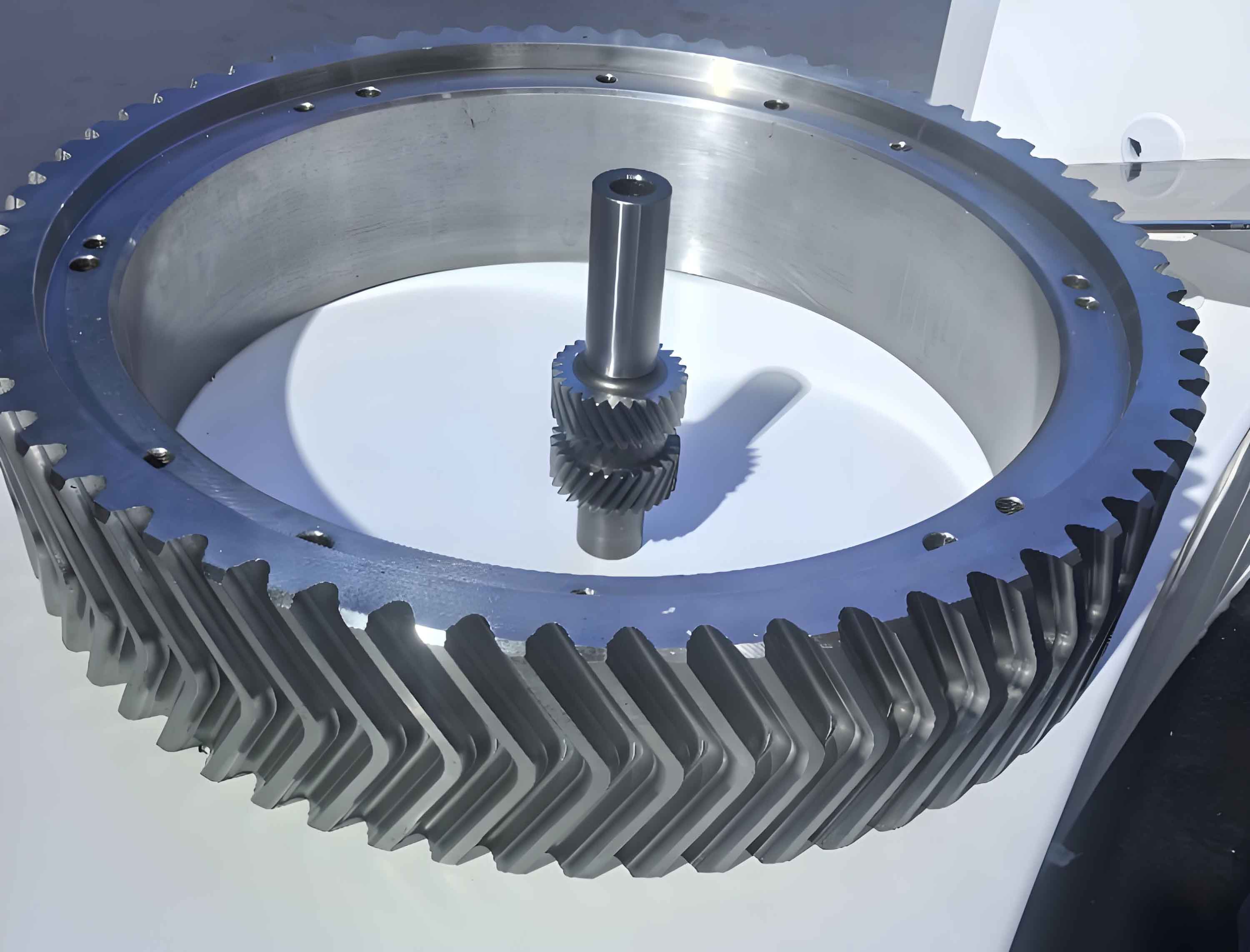
The axial pitch error, denoted as ΔP_x, can be expressed in terms of the normal axial pitch error ΔP_n and the helix angle β: $$ΔP_x = \frac{ΔP_n}{\sin β}$$. This relationship highlights how errors in helix angle β, induced by differential change gear inaccuracies, directly impact the axial pitch. Based on my analysis, axial pitch errors in herringbone gears can be classified into three main types: symmetric deviation, asymmetric deviation, and misalignment deviation. Symmetric deviation occurs when the actual helix angles for both left and right helices are equal but deviate from the nominal value, i.e., β_left = β_right ≠ β_nominal. Asymmetric deviation arises when β_left ≠ β_right, leading to unequal errors. Misalignment deviation happens when the helix angles are correct but the intersection point of the helices does not align with the center of the gap between them. The first two types are non-adjustable, meaning they cannot be corrected during assembly, while the third can be mitigated by axial positioning adjustments. In real-world scenarios, these deviations often coexist, complicating the quality control process for herringbone gears.
The primary causes of axial pitch error in herringbone gear hobbing include machine tool geometric inaccuracies, workpiece installation errors, and, most critically, calculation errors in differential change gears. Machine tool issues, such as misalignment between the vertical travel of the hob head and the workpiece spindle, can introduce deviations, especially after maintenance or repairs. Workpiece errors stem from factors like improper clamping or non-perpendicularity between the bore and face. However, from my perspective, the differential change gear calculation error is the most controllable and significant factor, as it directly dictates the additional rotation of the workpiece table during hobbing. This error leads to helix angle inaccuracies, which are particularly detrimental for herringbone gears due to their extended contact paths.
To understand the calculation process, let’s examine the universal formula for differential change gear ratio i_d when hobbing large prime helical gears, which applies directly to each helix of a herringbone gear. The formula is given by: $$i_d = \frac{A}{B} = C \left( \pm \frac{\sin β}{m_n k} \pm \frac{Δz}{z’} \right)$$ where:
- A and B are the change gear ratios,
- C is the differential constant specific to the hobbing machine,
- β is the helix angle,
- m_n is the normal module,
- k is the number of hob starts,
- Δz is the difference between the actual tooth count z and the assumed tooth count z’ (where Δz = z – z’),
- z’ is the assumed tooth count used for simplifying calculations.
The ± signs depend on the machining setup: for climb hobbing, use “+” when the workpiece and hob have the same hand, and “-” for opposite hands; for conventional hobbing, the reverse applies. A positive result indicates “extra rotation” of the workpiece, while negative indicates “less rotation,” influencing the number of intermediate gears. This formula combines two components: the first term accounts for helix formation, and the second term adjusts for the large prime tooth count. When β = 0, it reduces to the formula for spur gears, and when Δz = 0, it becomes the formula for standard helical gears. Below is a table summarizing differential constants C for common hobbing machines, based on my reference data:
| Machine Model | Differential Constant C |
|---|---|
| Y3150 | 9 |
| Y38 | 7.95775 |
| Y3180 | 6 |
| Y31125 | 8 |
However, I’ve encountered an alternative formula used in some contexts: $$i_d = C \left( \pm \frac{\sin β}{m_n k} \pm \frac{Δz}{z’ + Δz} \right)$$. This version includes an additional factor (z’ + Δz) in the denominator of the second term. Comparing the two, the difference lies in how the prime number adjustment is handled. The second formula introduces a small error, approximately $$ \frac{Δz}{z'(z’ + Δz)} $$, which, for typical values like z’ around 100 and Δz within ±5, results in a relative error of 0.0005 to 0.005. While negligible in some cases, this error can accumulate, especially when machining herringbone gears with high precision requirements. In practice, if both gears in a pair are calculated using the same formula on the same machine, the meshing might still be acceptable due to consistent errors, but using different formulas or machines can exacerbate mismatches. Therefore, I always recommend using the universal formula for critical herringbone gear applications to minimize axial pitch errors.
The impact of calculation error on axial pitch error is profound. For instance, consider a herringbone gear with face width b = 200 mm and helix angle β = 30°. A helix angle error of Δβ = 1 arc-minute (approximately 0.00029 radians) leads to a normal axial pitch error ΔP_n calculated as: $$ΔP_n = b \cdot \sin(Δβ) \approx 200 \times 0.00029 = 0.058 \text{ mm}$$. In actual gear operation, this error can distort the contact pattern, reducing the effective contact ratio and increasing wear. For herringbone gears, where load distribution is paramount, such errors are unacceptable. Thus, ensuring high calculation accuracy is essential. I adhere to a rule of thumb: for Grade 6 precision gears, the absolute error in differential change gear ratio should not exceed 0.00005 when machining on the same machine, and 0.00001 when using different machines. This often requires calculations carried out to 5 or 6 decimal places, surpassing the typical 3-decimal-place values found in standard change gear tables.
To achieve such precision, I employ several strategies. First, I always verify the formula choice, opting for the universal formula over the alternative. Second, I ensure input parameters are exact; for example, the feed per revolution s is often given as a decimal in machine manuals, but I convert it to a fractional form to avoid rounding errors. For instance, if s = 0.5 mm/rev, I use 1/2 instead. Third, I utilize the direct summation method for selecting change gears, which involves iteratively combining available gear teeth to approximate the desired ratio with minimal error. This method, detailed in gear calculation handbooks, allows me to achieve errors as low as 0.000001 in some cases. Additionally, I apply the error compensation principle: when machining a pair of herringbone gears on different machines, I aim for equal but opposite errors in the differential change gears, so that the helix angle errors cancel out during meshing. Mathematically, if the first gear has an error Δi_d1 leading to helix angle error Δβ1, and the second has Δi_d2 leading to Δβ2, setting Δβ1 ≈ -Δβ2 ensures minimal relative error. This principle is crucial for maintaining the integrity of herringbone gear pairs in assembly.
Let me illustrate with a detailed calculation example for a herringbone gear on a Y3150 hobbing machine. Assume the following parameters: herringbone gear with actual tooth count z = 101 (a large prime number), assumed tooth count z’ = 100 (so Δz = 1), normal module m_n = 4 mm, helix angle β = 30°, hob with k = 1 (single start) and right-hand, using conventional hobbing. The machine has differential constant C = 9, and feed per revolution s = 0.5 mm/rev (which I treat as 1/2). The gear has both left-hand and right-hand helices, so calculations are performed separately.
First, for the division change gears, the ratio i_div is: $$i_{div} = \frac{24k}{z’} = \frac{24 \times 1}{100} = 0.24$$. Using available gears, I select a combination such as 24/100, resulting in zero error for this step.
Second, for the feed change gears, from the machine manual, the ratio i_feed is based on s. For Y3150, i_feed = 16/3 when s = 0.5 mm/rev, so I set the feed handle accordingly.
Third, for the differential change gears for the right-hand helix, using the universal formula: $$i_d = C \left( \frac{\sin β}{m_n k} + \frac{Δz}{z’} \right)$$. Plugging in values: sin 30° = 0.5, so $$i_d = 9 \left( \frac{0.5}{4 \times 1} + \frac{1}{100} \right) = 9 \left( 0.125 + 0.01 \right) = 9 \times 0.135 = 1.215$$. To achieve this, I use the direct summation method with available gears (e.g., 100-tooth, 50-tooth gears). Suppose I select gears A=121 and B=100, giving a ratio of 1.21, with an error of 0.005. This corresponds to a helix angle error Δβ ≈ 0.0005 radians or 1.7 arc-minutes. For precision, I might seek a better combination, such as 243/200 = 1.215, yielding zero error.
For the left-hand helix, the calculation is similar, but the sign may change based on hand. Using the same formula: $$i_d = 9 \left( \frac{0.5}{4} – \frac{1}{100} \right) = 9 \times 0.115 = 1.035$$. Selecting gears like 207/200 gives 1.035 with minimal error.
For the quick return change gears, which ensure accurate tool retraction, I use the standard helical gear formula: $$i_{qr} = C \cdot \frac{\sin β}{m_n k} = 9 \times 0.125 = 1.125$$. This can be approximated with gears like 9/8 = 1.125.
In this example, if I had used the alternative formula for the right-hand helix, the calculation would be: $$i_d = 9 \left( \frac{0.5}{4} + \frac{1}{101} \right) = 9 \times (0.125 + 0.00990099) = 9 \times 0.13490099 = 1.21410891$$, leading to a slight difference. The error between formulas is about 0.0009, which for herringbone gears could translate to an axial pitch error of approximately 0.02 mm over a 200 mm face width. While small, such errors accumulate in high-precision applications, reinforcing the need for formula consistency.
Beyond calculations, practical considerations for herringbone gear hobbing include machine calibration and workpiece setup. I always recommend checking the machine’s geometric accuracy periodically, especially the alignment of the hob head with the work table. For workpiece installation, using precision mandrels and ensuring face runout within 0.01 mm can reduce additional errors. During machining, I monitor the chip formation and use trial cuts to verify the helix angle before full-depth hobbing. For herringbone gears, the mid-cut reversal point is critical; I employ laser alignment or digital indicators to ensure the left and right helices meet precisely at the center gap.
In terms of formulas, let’s derive the relationship between differential change gear error and helix angle error. The differential ratio i_d is proportional to sin β, so a small change Δi_d relates to Δβ as: $$Δi_d ≈ C \cdot \frac{\cos β}{m_n k} Δβ$$. Rearranging: $$Δβ ≈ \frac{m_n k}{C \cos β} Δi_d$$. For the herringbone gear example with m_n=4, k=1, C=9, β=30°, cos 30°=0.866, a Δi_d of 0.001 yields Δβ ≈ 0.000051 radians or 0.18 arc-minutes. This sensitivity underscores why high calculation precision is vital.
To further emphasize the importance, consider the contact ratio in herringbone gears. The total contact ratio ε_γ is the sum of the transverse contact ratio ε_α and the overlap ratio ε_β. For herringbone gears, ε_β is given by: $$ε_β = \frac{b \tan β}{p_t}$$ where p_t is the transverse pitch. Axial pitch error ΔP_x affects ε_β by altering the effective helix angle, potentially reducing the smoothness of engagement. In my work, I’ve seen that errors exceeding 0.05 mm in axial pitch can drop ε_β by 5%, leading to noise and vibration. Therefore, controlling differential change gear calculations directly contributes to the acoustic and mechanical performance of herringbone gear systems.
Another aspect is the thermal and load effects during machining. Herringbone gears, often made from alloy steels, undergo heat treatment, which can warp the gear blank. I account for this by pre-calculating compensation factors in the change gear setup. For instance, if the gear is expected to shrink by 0.1% after heat treatment, I adjust the assumed tooth count z’ accordingly to maintain the correct helix angle post-processing. This proactive approach minimizes rework and ensures the herringbone gear meets specifications after final assembly.
In conclusion, the precision calculation of differential change gears for large prime herringbone gears is a multifaceted process that demands attention to detail. From selecting the correct formula to implementing error-minimization techniques, every step influences the final gear quality. The herringbone gear, with its unique double helical design, is particularly sensitive to axial pitch errors, making accurate calculations paramount. By using the universal formula, ensuring high decimal precision, applying methods like direct summation and error compensation, and validating with practical examples, I’ve consistently achieved superior results in herringbone gear manufacturing. As technology advances, digital tools and simulation software can aid these calculations, but the fundamental principles remain essential for any engineer or machinist working with herringbone gears. Ultimately, a rigorous approach to differential change gear calculation not only enhances gear performance but also extends the lifespan of transmission systems, underscoring the critical role of precision in mechanical engineering.