
In the field of power transmission, the pursuit of higher load capacity and longer service life for gears is perpetual. According to gear strength calculation theory, higher surface hardness directly correlates with higher allowable contact stress. Consequently, hardening treatments such as quenching or carburizing and quenching are often employed as powerful measures to enhance the load-bearing capability of gears. However, a significant challenge arises post-heat-treatment: distortion. Despite employing various control methods during heat treatment, deformation is inevitable, and for straight bevel gears, this distortion is particularly complex. For factories not involved in mass production, heat treatment of straight bevel gears rarely utilizes quenching presses, leading to a noticeable decline in gear accuracy after treatment. Even when quenching presses are used, precision often remains unstable. A reduction in the contact pattern accuracy of bevel gears drastically diminishes their load-carrying capacity, sometimes to a level even lower than that of soft-faced gears. Such hardened gears struggle to meet design requirements, failing to realize the inherent superiority of hard-faced gear technology.
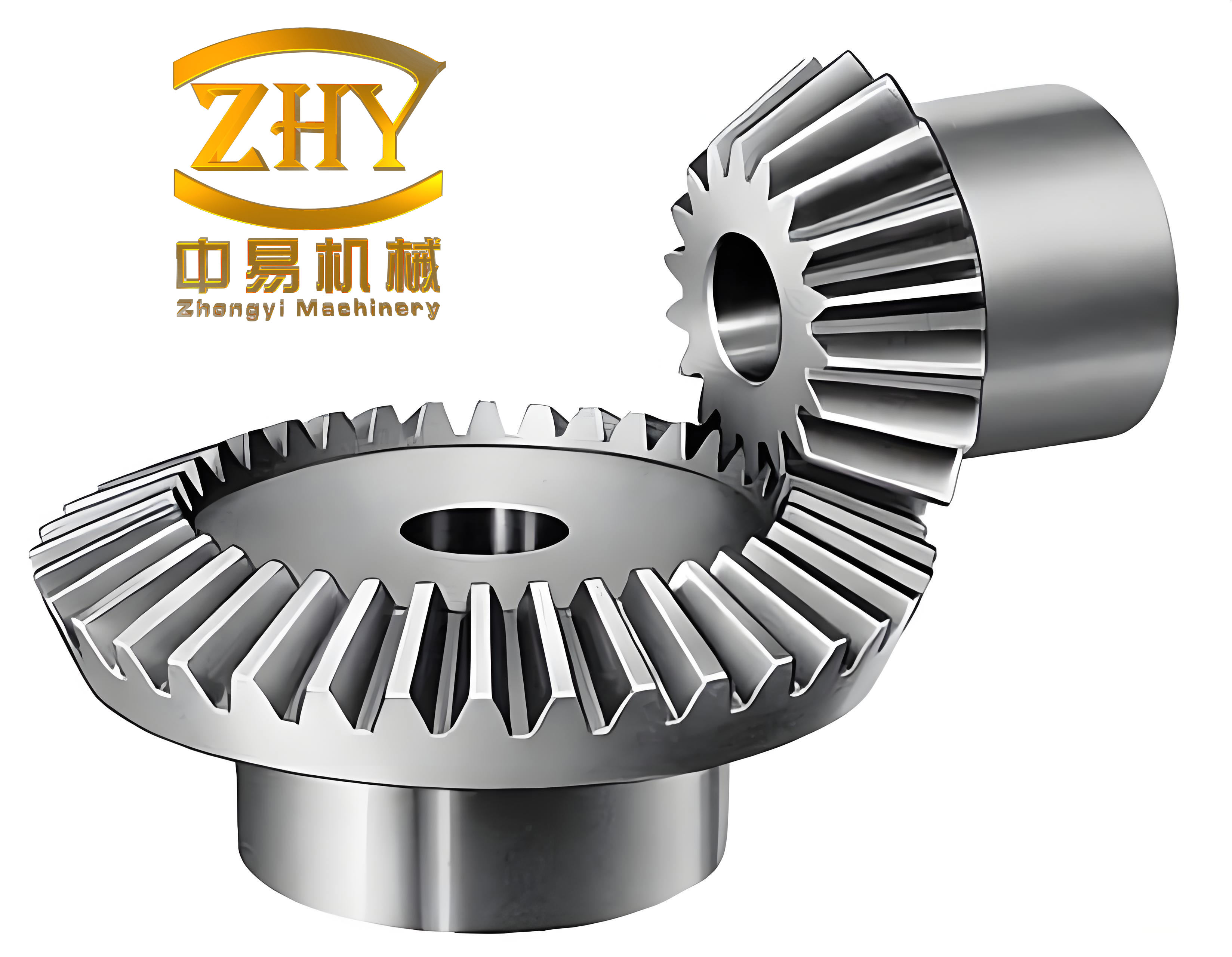
Currently, low-carbon alloy steels, subjected to carburizing or multi-element co-diffusion and quenching, are widely used in many machines, with most gears requiring a precision grade around 8. The influence of post-heat-treatment distortion on accuracy is unavoidable. This raises a critical question: can an economical and feasible process method be found to re-cut quenched gears, thereby improving their post-heat-treatment accuracy? The process of “skiving” hardened gears provides an effective answer. Skiving involves using a special tool tipped with a carbide insert to re-machine the gear after quenching. The tool is characterized by a large cutting edge inclination angle and a negative rake angle. During machining, it removes a very thin layer of metal with each pass, resembling a “scraping” action, hence the name “skiving.”
Internationally, this technique was first developed by a Japanese company using hobs with carbide inserts for skiving hard-faced cylindrical gears. Beyond hobbing, skiving processes for shaping and spiral bevel gears also emerged. Our research and experimentation focused on the skiving of straight bevel gears using a bevel gear planer, and we achieved success. Through simulated cutting tests and practical planing trials, we identified the optimal tool geometry, cutting parameters, and process conditions. We also resolved critical issues related to tool brazing and sharpening. We can now efficiently skive straight bevel gears with a module of 6 mm, face width of 35 mm, made from 20CrMnTi, and with a quenched hardness of HRC 58-62. Post-skiving, the surface finish consistently achieves $\nabla 7$ or better. The contact pattern reaches over 80% in length and 70% in height. Motion accuracy is improved, significantly reducing meshing noise. This processing method has been formally integrated into our production line. The skived bevel gears used in coal mining machinery have been well-received by users.
The application of “skiving” for straight bevel gears represents a major reform and breakthrough over the traditional “planing, heat treatment, and running-in” process sequence. It is anticipated to substantially increase the load capacity and service life of hardened straight bevel gears. Following the success on the bevel gear planer, skiving trials were conducted on a gear shaper and a spiral bevel gear planer for cylindrical gears (material: 40Cr, hardness HRC 45-50) and for等高齿螺旋伞齿轮 (module: 8 mm, hardness HRC 58-62), respectively, both yielding satisfactory results. In the late 1970s, an appraisal committee evaluated this new process, providing affirmation and positive assessment. This article focuses specifically on the skiving process for straight bevel gears.
I. Design and Manufacture of the Skiving Tool
The design and fabrication of the skiving planer tool primarily involve the selection of insert material, determination of geometric angles, and the processes of brazing and sharpening.
1. Selection of Insert Material
We initially selected the “YN” series cemented carbide, a super-fine grain alloy developed through joint research. At room temperature, YN10 exhibits a hardness of HRA 92.5 and a transverse rupture strength of $\sigma_{bb} \geq 1200$ MPa. Its good brazeability is crucial for a brazed-tip planer tool structure. Practice has proven that YN10 is a suitable tool material for machining quenched steel, well-suited for skiving planer tool inserts.
2. Determination of Geometric Angles
Due to the high hardness of the workpiece surface, the geometric angles of a standard gear planer tool are clearly unsuitable. To prevent cutting edge chipping, the tool must employ a negative rake angle. Simultaneously, the tool’s cutting edge inclination angle plays a decisive role in increasing edge strength and improving cutting performance. Therefore, selecting an appropriate combination of inclination angle ($\lambda_s$) and negative rake angle ($\gamma_o$) is the primary task in designing the skiving tool’s geometry.
Tests demonstrated that during planing, the machined surface finish improves slightly with an increase in the inclination angle $\lambda_s$. Tool life shows a more pronounced increase with the increase of both $\lambda_s$ and the rake angle $\gamma_o$ (see trend charts from original text). We selected $\lambda_s = 15^\circ$. Changes in $\lambda_s$ directly affect the working pressure angle of the gear tooth profile. As viewed facing the tool’s motion direction, for a standard planer tool, the relationship between the side rake angle $\alpha_s$ and the nominal normal pressure angle $\alpha_{on}$ is:
$$\tan \alpha_s = \tan \alpha_{on} \cdot \cos \lambda_s$$
For the skiving tool, with $\lambda_s = 15^\circ$, the relationship becomes:
$$\tan \alpha_{s\_skive} = \tan \alpha_{on} \cdot \cos 15^\circ$$
This results in a minor change to the working side rake angle. In tool design for straight bevel gears, which are cut in pairs, this small variation is permissible.
The working clearance angle $\alpha_{oe}$ is given by (see original diagram):
$$\alpha_{oe} = \alpha_o – \lambda_s$$
where $\alpha_o$ is the nominal clearance angle. With $\lambda_s = 15^\circ$ fixed, we optimized the tool’s rake angle $\gamma_o$. Tests proved that for cutting hardness up to HRC 62, a rake angle of $\gamma_o \approx -10^\circ$ yields good tool life. The tool structure is illustrated schematically below (based on original Fig. 4).
| Parameter | Symbol | Recommended Value for Skiving | Typical Value for Standard Planing |
|---|---|---|---|
| Cutting Edge Inclination Angle | $\lambda_s$ | $15^\circ$ | $0^\circ$ to $5^\circ$ |
| Rake Angle | $\gamma_o$ | $-10^\circ$ | $5^\circ$ to $10^\circ$ |
| Working Clearance Angle | $\alpha_{oe}$ | $\alpha_o – 15^\circ$ | $\alpha_o$ |
| Side Rake Angle (for $\alpha_{on}=20^\circ$) | $\alpha_{s\_skive}$ | $\arctan(\tan20^\circ \cdot \cos15^\circ) \approx 19.3^\circ$ | $20^\circ$ |
3. Tool Brazing and Sharpening
During brazing, it is crucial to preheat the insert and tool body slowly. A low-melting-point, high-wettability brazing alloy should be used. Post-brazing, the tool should be placed in asbestos powder or an electric furnace for insulation and slow cooling to prevent thermal cracking. The surface finish of the tool’s front and flank faces should be no less than $\nabla 8$. Sharpening is performed on a dedicated fixture using a resin-bonded diamond wheel with a grit size no larger than 100 for roughing and 280 for finishing, at a concentration of 100. The infeed should not exceed 0.01 mm/pass. The final sharpened finish on the faces should be at least $\nabla 9$.
II. Skiving Process for Straight Bevel Gears
1. Applicability and Pre-Skiving Geometry
Skiving of straight bevel gears is applicable to hard-faced gears subjected to general quenching or carburizing and quenching. It is not suitable for gears treated with nitriding or multi-element co-diffusion. To enhance skiving tool life and prevent the tool corner from participating in the cut, the pre-skiving planer tool must be manufactured with a protuberance or corner relief (based on original Fig. 7). The pre-skiving tooth profile and skiving allowance distribution are shown conceptually below. The skiving allowance on the tooth flank ($\Delta_s$) should be determined based on the post-heat-treatment distortion and processing conditions, generally following $\Delta_s \approx 0.15 \pm 0.05$ mm. For pinion shafts with less distortion, a smaller value can be used; for larger ring gears with more distortion, a larger value is appropriate. To reduce skiving impact, it is essential to avoid carbide concentration at the tooth tips and to chamfer (approx. 0.5 mm) the major and minor ends of the teeth before heat treatment.
2. Cutting Parameters
Through measurement of machine tool cutting power, it was calculated that under identical cutting speed and depth of cut, the cutting force for skiving a hardened face is nearly twice that for planing a non-quenched face. However, given the very small skiving depth, the resultant cutting force is not substantial and does not adversely affect the machine. Due to work hardening during skiving, a surface layer of approximately 0.02-0.03 mm is generated. A subsequent skiving pass must remove this hardened layer. Therefore, the depth of cut per pass should be between 0.03-0.05 mm. A shallower cut can leave the hardened layer intact, and as the uncut chip thickness decreases, the force per unit length on the cutting edge increases proportionally, leading to reduced tool life. Since planing involves a reciprocating cutting motion with significant impact, the cutting speed should not be excessively high, generally taken as $v = 15-25$ m/min. It is advisable to adjust the clearances in the machine’s kinematic pairs before skiving. The use of ample cutting fluid for cooling and lubrication is beneficial for both tool life and surface finish.
| Process Parameter | Recommended Value / Note |
|---|---|
| Skiving Allowance ($\Delta_s$) | $0.10 – 0.20$ mm (adjust based on distortion) |
| Depth of Cut per Pass ($a_p$) | $0.03 – 0.05$ mm |
| Cutting Speed ($v$) | $15 – 25$ m/min |
| Pre-heat-treatment Tip Chamfer | ~0.5 mm |
| Coolant/Lubricant | Ample supply required |
III. Mechanism of Hard-Faced “Skiving”
During the “skiving” process, despite the tool’s negative rake angle, the high strength of the carburized and quenched surface layer means the metal in the shear zone undergoes minimal grain flattening under the “shear” action of the tool’s rake face. The shear angle ($\phi$) relative to the cutting speed direction does not decrease significantly. Consequently, the chip does not fracture in the primary deformation zone, resulting in continuous chips. Measurement of actual skiving chips shows a length contraction coefficient ($K_l = L_{chip}/L_{cut}$) of approximately 1.1.
When machining quenched low-carbon alloy steel gears, the chips appear as tubular or spirally curved segments (based on original Fig. 12). Dry skiving produces dark yellow or light blue chips, which are elastic. Skiving with coolant produces silvery-white chips.
The cutting edge inclination angle is highly advantageous for the cutting action. The inclination causes the tool, as it moves forward, to subject the shear zone not only to a “pushing and squeezing” shear force from the rake face but also to a transverse “twisting and rubbing” force. Metal grains subjected to simultaneous “push-squeeze” and “twist” forces are more readily “peeled” from the base metal (based on original Fig. 13). It can be argued that a larger $\lambda_s$ is more favorable for cutting.
Due to the high surface hardness, grain deformation during cutting is minimal. When the chip is “sheared” from the metal surface, very few residual crystal aggregates remain on the newly formed surface. Additionally, the tool corner and flank face exert an “extrusion” or “ironing” effect on the metal surface (based on original Fig. 14), contributing to the high surface finish achieved after skiving. Tool wear occurs roughly equally on the rake and flank faces, but the actual corner displacement is not severe, ensuring the stability of the skiving profile accuracy.
The metal surface, under the combined extruding action of the tool’s negative rake angle and flank face, develops a work-hardened layer. Because the uncut chip thickness is very small and the cutting force is not excessive, and the base material strength is high, this hardened layer is not very deep, and the hardness increase is moderate (based on original Fig. 15).
IV. Impact of Skiving on Gear Performance Characteristics
1. Improvement in Geometric Accuracy
Post-skiving, the geometric errors induced by heat treatment distortion are corrected, and the gear’s geometric accuracy is restored. For straight bevel gears, the location and size of the contact pattern become controllable through machine setup adjustments prior to skiving and inspection via rolling tests. This controllability makes the “controllable” contact pattern of hardened straight bevel gears a reality. The improvement in all accuracy indices, particularly contact accuracy, undoubtedly enhances the gear’s load-carrying capacity. Naturally, machine vibration and noise are also reduced.
2. Enhancement of Surface Finish
The surface finish after skiving is consistently $\nabla 7$ or better. Improved finish reduces the coefficient of friction between contacting surfaces, decreasing frictional forces and thus contact stress. Additionally, reduced friction-generated heat lowers operating temperatures. Higher surface finish benefits gear resistance to pitting and scuffing, and contributes to noise reduction.
3. Change in Surface Layer Structure
The original tooth surface may have poor finish, tool marks, handling damage (macro-defects), as well as heat treatment corrosion, oxidation, inclusions, and micro-cracks (micro-defects). Skiving removes this defective layer, exposing fresh metal. Furthermore, the surface layer becomes denser due to the extrusion during cutting. Post-skiving, a work-hardened layer approximately 0.03 mm deep is present. Compared to an un-skived surface, the hardness of the skived surface increases by about HV 50-100 within the first 0.02 mm, transitioning smoothly inward (based on original Fig. 16). The un-skived surface may have a decarburized layer around 0.05 mm.
4. Alteration in Residual Stress State and its Implications
A critical change occurs in the residual stress state: the skived surface exhibits tensile residual stress. This has a detrimental effect on the gear’s fatigue strength. Under load, this tensile stress can promote the initiation of micro-cracks along grain boundaries, potentially leading to surface pitting and spalling over time. This is a notable disadvantage of the skiving process. Controlling surface tensile stress within acceptable limits is a vital task for the process. The benefits gained from improved contact accuracy must fully compensate for and exceed the strength loss caused by tensile stresses; otherwise, skiving hard-faced gears loses significant value.
To minimize detrimental tensile stresses: First, use inserts with higher hardness. A greater hardness differential between tool and workpiece material tends to reduce the magnitude of work-hardening induced tensile stress. Second, ensure sufficient depth of cut in subsequent passes to remove the work-hardened layer from the previous pass. Third, heat treatment must be properly controlled—similar to grinding, improper heat treatment can lead to grinding cracks. Fourth, the selection of tool geometry should consider not only tool life but also how to minimize the generation of tensile stress. These areas require further experimentation and research.
| Aspect | Effect of Skiving | Implication for Gear Performance |
|---|---|---|
| Geometric Accuracy | Corrects heat treatment distortion, restores profile. | Higher load capacity, lower noise & vibration. |
| Surface Finish ($R_a$) | Improves to $\nabla 7$ or better consistently. | Lower friction, reduced contact stress, better anti-pitting & anti-scuffing. |
| Surface Integrity | Removes defective layer, creates denser, fresh surface. | Eliminates stress concentrators from defects. |
| Surface Hardness | Increases by HV 50-100 in top ~0.02 mm layer. | Improved wear resistance. |
| Residual Stress | Introduces near-surface tensile stress. | Potentially reduces fatigue life; must be managed. |
V. Conclusion
In summary, the “skiving” of hardened straight bevel gears is a novel finishing process for case-hardened gears. It provides another effective means to correct distortion caused by heat treatment and restore geometric accuracy for straight bevel gears with general precision requirements. The tools for straight bevel gear skiving are simple to manufacture, require no specialized equipment, involve low investment, and are easy to adopt widely. Our research and experimentation on hard-faced gear skiving is merely a beginning. Numerous issues concerning skiving tools, processes, and particularly the final performance effects on gears require further in-depth exploration. The balance between the significant benefits in accuracy and contact pattern control and the potential detriment of induced tensile stresses remains a key area for optimization to fully harness the potential of this promising technology for straight bevel gears.