
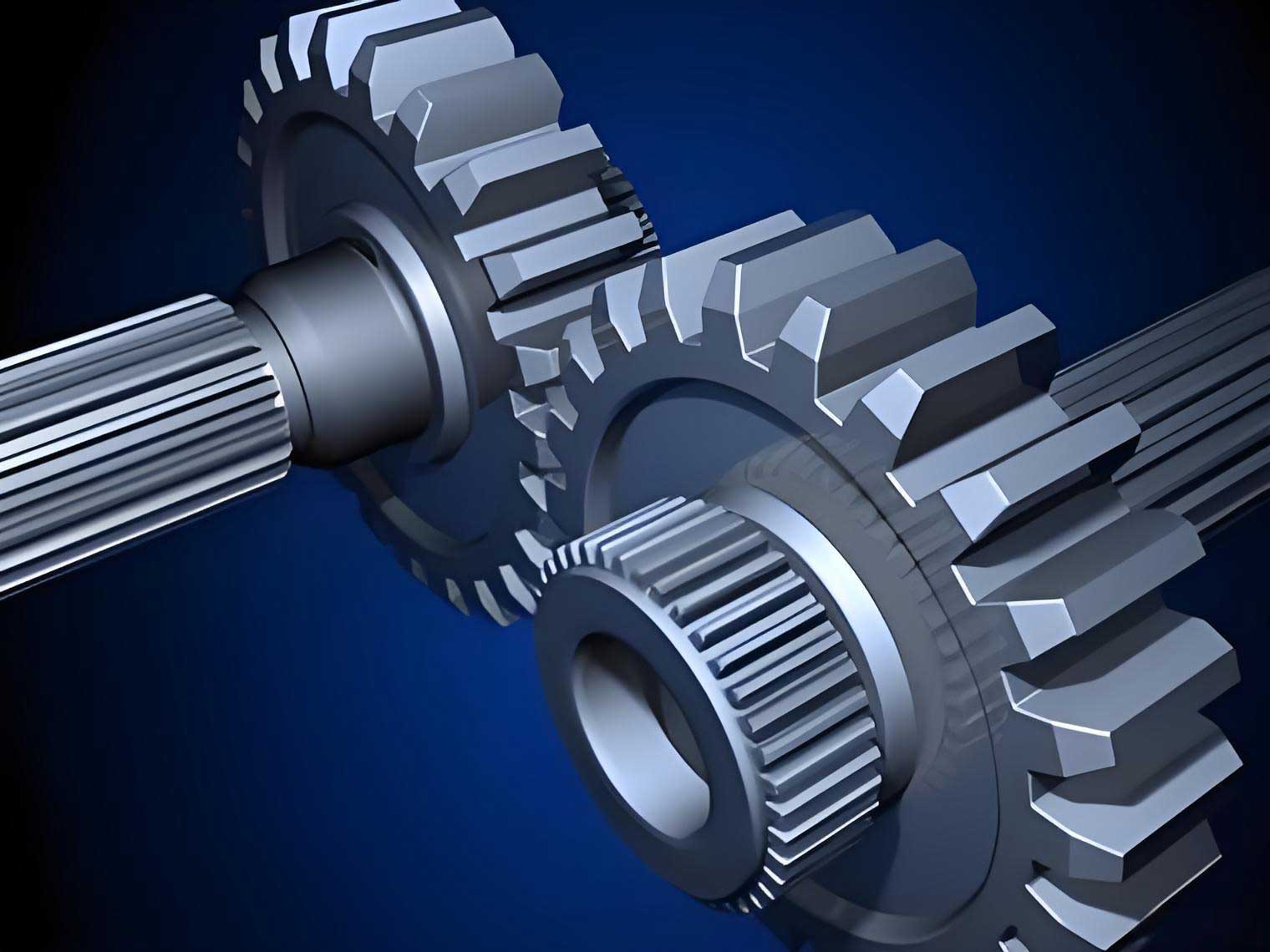
As a researcher in the field of precision forming, I have dedicated significant effort to improving the manufacturing processes for critical components in heavy-duty vehicles. Among these, spur gears play a pivotal role in transmission systems, especially in wheel-edge reducers. The demand for high-precision spur gears is ever-increasing, with annual production often exceeding 1.5 million units in supporting factories. Traditional machining methods, such as cutting, are time-consuming and inefficient, leading to high material waste and costs. Therefore, the composite precision forming process of “cold extrusion + cold sizing” has emerged as a mainstream technique for producing spur gears with large modulus. However, the longevity of cold extrusion molds remains a critical challenge. In this article, I will delve into the optimization design of a combined die for cold extrusion of spur gears, focusing on reducing stress concentrations and enhancing模具寿命 through advanced modeling and algorithms.
The spur gear under study has a modulus of m=4, a tooth count of Z=16, a pressure angle of α=20°, and a modification coefficient of x=0.45. The cold extrusion process involves several steps: hot forging for blank preparation, spheroidizing annealing, shot blasting, turning for blank forming, phosphating and saponification, and finally cold extrusion. The extrusion is performed using a “piece-by-piece” approach through a tooth-shaped凹模, as illustrated in the process diagram. The high working pressures during extrusion necessitate a robust die design, typically employing a three-layer combined die structure to prevent longitudinal cracking at the inner wall of the die cavity.
In the design of the combined die, key structural parameters include the equivalent inner diameter of the die insert’s tooth-shaped cavity, diameter ratios, and interference coefficients. These parameters directly influence the stress distribution within the die. To formulate an optimization problem, I define the design variables as follows: let D1 be the equivalent inner diameter of the tooth-shaped cavity, n2 = D2/D1, n3 = D3/D1, and n4 = D4/D1 represent the diameter ratios, and β2 = 2U1/D2 and β3 = 2U2/D3 represent the interference coefficients. Here, D2, D3, and D4 denote the outer diameters of the die insert, middle layer, and outer ring, respectively, while U1 and U2 are the unilateral radial interferences between the die insert and middle layer, and between the middle layer and outer ring. The ranges for these variables are summarized in Table 1.
| Variable | Lower Bound | Upper Bound |
|---|---|---|
| D1 (mm) | 56.6 | 74.2 |
| n2 | 1.55 | 1.80 |
| n3 | 2.45 | 3.25 |
| n4 | 4.00 | 6.00 |
| β2 | 0.0025 | 0.0045 |
| β3 | 0.0020 | 0.0040 |
The objective function is to minimize the maximum equivalent stress Y on the inner wall of the die insert, as this stress is a primary indicator of potential cracking and failure. The relationship between the design variables and Y is complex and nonlinear, necessitating the use of surrogate modeling techniques. I employ the Kriging model, a powerful interpolator that provides accurate predictions based on limited sample data. To generate the sample data, I use Latin Hypercube Sampling (LHS), which ensures a uniform coverage of the design space. The minimum sample size N for m=6 variables is given by:
$$ N = \frac{(m+1)(m+2)}{2} = 28 $$
Thus, I generate 28 sample points using LHS, with an additional 2 random points for model validation. The sample data, including the design variables and corresponding maximum equivalent stress Y obtained from finite element simulations, are partially shown in Table 2.
| Sample No. | D1 (mm) | n2 | n3 | n4 | β2 | β3 | Y (MPa) |
|---|---|---|---|---|---|---|---|
| 1 | 60.85 | 1.58 | 3.17 | 5.31 | 0.0043 | 0.0023 | 3400 |
| 2 | 57.21 | 1.71 | 3.08 | 4.21 | 0.0041 | 0.0021 | 2750 |
| 3 | 74.20 | 1.80 | 3.25 | 5.45 | 0.0035 | 0.0025 | 2100 |
| 4 | 61.46 | 1.67 | 3.11 | 5.59 | 0.0025 | 0.0028 | 2400 |
| 5 | 59.63 | 1.76 | 3.22 | 4.34 | 0.0026 | 0.0024 | 1800 |
| … | … | … | … | … | … | … | … |
| 28 | 56.60 | 1.55 | 2.45 | 4.55 | 0.0035 | 0.0035 | 4100 |
Finite element analysis (FEA) is conducted to simulate the cold extrusion process for each sample point. The model captures the stable forming stage where the forming force is maximal. The combined die is modeled as an assembly of three elastic layers: the die insert made of YG15, the middle layer of H13, and the outer ring of 42CrMo. Interference fits are applied at the contact surfaces to simulate pre-stressing. To reduce computational cost, an eighth-symmetry model is used, with shear friction coefficient set to 0.12. The FEA results provide the maximum equivalent stress Y for each design configuration, which serves as the response for the Kriging model.
The Kriging model is constructed using the 28 sample points, with a Gaussian kernel function. The model’s accuracy is validated against the two additional random points. The relative errors between the FEA results and Kriging predictions are below 2%, confirming the model’s reliability. The Kriging model effectively approximates the nonlinear relationship between the design variables and the maximum equivalent stress, expressed as:
$$ Y = f(D1, n2, n3, n4, β2, β3) + \epsilon $$
where ε represents the error term. With the surrogate model in place, I employ the Particle Swarm Optimization (PSO) algorithm to find the optimal design variables that minimize Y. PSO is a population-based stochastic optimization technique inspired by social behavior. The algorithm parameters are set as: swarm size of 30, inertia weight w=0.7, learning factors c1=c2=2, and maximum iterations of 100. The optimization process converges after 57 iterations, yielding the optimal solution: D1=61.5817 mm, n2=1.7454, n3=3.0401, n4=4.4630, β2=0.0025, β3=0.0027. This corresponds to the following combined die dimensions: D2=107.485 mm, D3=187.215 mm, D4=274.839 mm, U1=0.134 mm, U2=0.253 mm. The predicted minimum maximum equivalent stress is 1877.9 MPa.
To contextualize the optimization results, I compare them with a traditional empirical design approach. For spur gears with an outer diameter of 74.2 mm, empirical guidelines suggest: D4 = (4~6)D1 = 296.8~445.2 mm (taking 400 mm), D2 ≥ 1.6D1 = 118.72 mm (taking 120 mm), and D3 ≥ 2.56D1 = 189.952 mm (taking 190 mm). The interference coefficients are typically chosen between 0.002 and 0.0045; here, β2 and β3 are set to 0.004, resulting in U1=0.240 mm and U2=0.380 mm. FEA of this empirical design shows a maximum equivalent stress of 3300 MPa on the inner wall of the die insert, specifically at the tooth groove in the venting zone. In contrast, the optimized design reduces the stress to 1870 MPa, a reduction of over 43%. Moreover, the optimized die is more compact, with an overall size only 68.75% of the empirical design, leading to material savings and cost efficiency.
The stress distribution within the die insert is analyzed in detail. Under pre-stressing conditions, the die insert experiences circumferential compressive stress due to the interference fits, with maximum equivalent stress occurring at the inner wall. During extrusion, the working stress superimposes on the pre-stress. In the optimized design, the maximum equivalent stress remains at the tooth groove in the venting zone, but the value is significantly lower. Importantly, no circumferential tensile stresses appear, which mitigates the risk of cracking in the hard alloy die insert. The stress variations along the wall thickness are examined using point tracking. The results indicate that under both pre-stressing and working conditions, the maximum equivalent stresses are always at the inner walls of each layer, decreasing radially outward. The circumferential stresses in the die insert remain compressive, while the middle and outer layers experience tensile stresses, as expected for a pre-stressed assembly.
The optimization methodology leverages advanced techniques to enhance the performance of cold extrusion dies for spur gears. The Kriging model provides a computationally efficient surrogate for the expensive FEA simulations, enabling rapid exploration of the design space. The PSO algorithm efficiently locates the global optimum, avoiding local minima. The combination of these methods offers a quantitative approach to die design, moving beyond reliance on empirical rules. This is particularly beneficial for complex geometries like spur gears, where traditional formulas based on Lame’s equations may not apply.
To validate the optimized design, practical production tests are conducted. For manufacturing convenience, the optimized dimensions are rounded to: D2=105 mm, D3=180 mm, D4=275 mm, while maintaining the same interferences. The molds are fabricated and used in actual production of spur gears for heavy-duty vehicles. Over a production run, the模具寿命 reaches approximately 150,000 cycles without any incidents of tooth breakage or cracking. Post-production measurement shows a wear amount of about 0.03 mm after 150,000 extrusions, indicating excellent durability. This performance underscores the effectiveness of the optimization design in real-world applications.
The significance of this work extends beyond the specific case study. The methodology can be adapted to other gear types and cold extrusion processes. For instance, similar optimization could be applied to helical gears, bevel gears, or other precision-formed components. The use of surrogate modeling and evolutionary algorithms is a growing trend in manufacturing optimization, offering a pathway to lightweight, high-performance模具 designs. Furthermore, the insights gained from stress analysis can inform material selection and heat treatment processes, potentially leading to further improvements in模具寿命.
In conclusion, the optimization design of cold extrusion combined dies for spur gears demonstrates substantial benefits over traditional methods. By systematically varying key structural parameters and employing modern computational tools, it is possible to achieve significant reductions in stress concentrations, leading to longer模具寿命 and reduced material usage. The optimized die not only meets the technical requirements but also contributes to cost savings and sustainability. This approach provides a robust framework for the design of cold extrusion dies for spur gears and other complex-shaped components, paving the way for more efficient and reliable manufacturing processes in the automotive industry.