
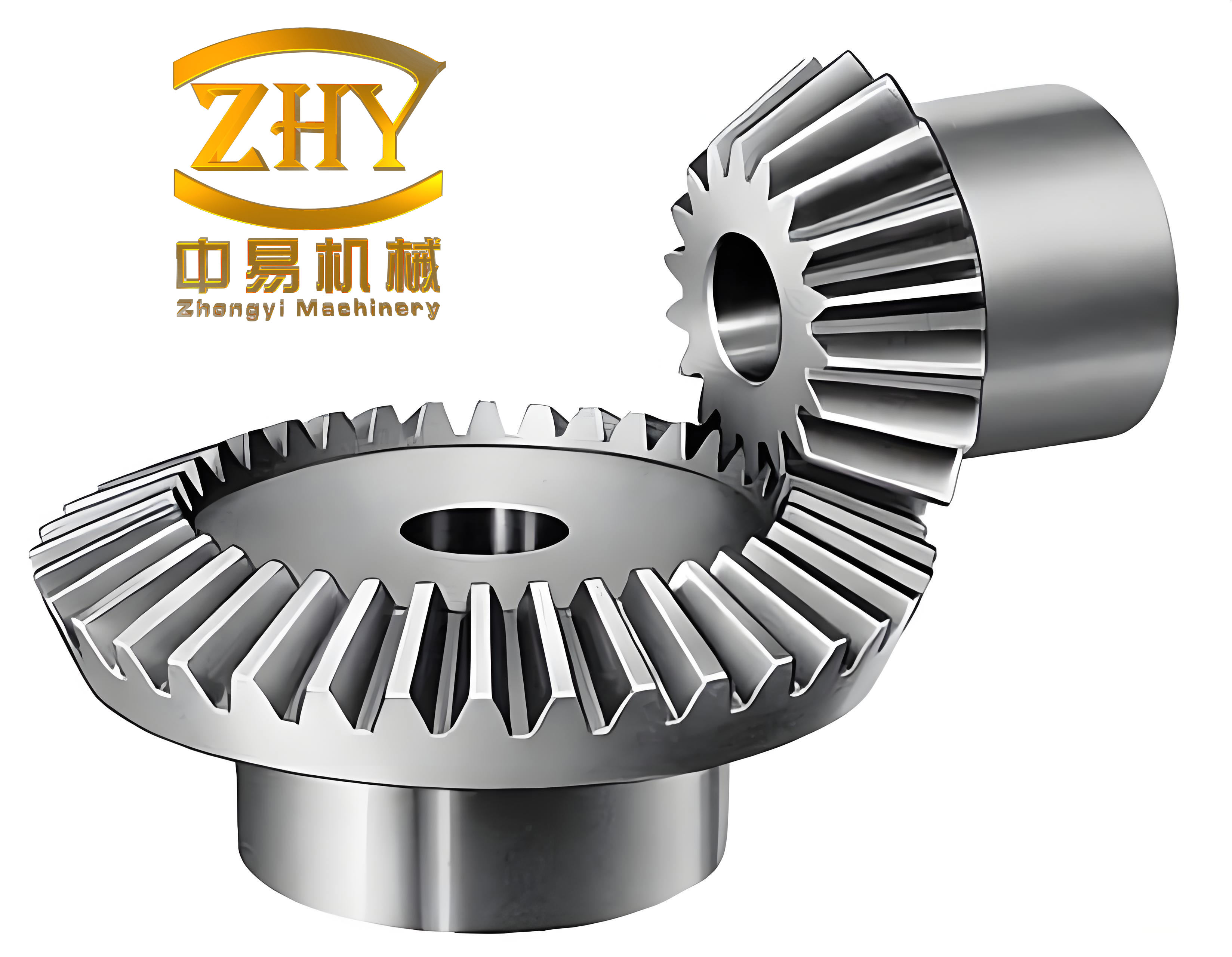
In my extensive experience with gear manufacturing, machining straight bevel gears presents unique challenges due to their conical shape and tooth geometry. Straight bevel gears are widely used in mechanical transmissions where shafts intersect, typically at a 90-degree angle, and their accurate fabrication is crucial for smooth operation and minimal noise. Over the years, I have developed and refined methods for processing these gears using standard milling machines, particularly through a two-step approach involving roughing and finishing operations. This article details a chart-based calculation method I employ to determine key parameters for the finishing cut, ensuring efficiency and precision for straight bevel gears of moderate accuracy grades.
The fundamental process involves using a formed milling cutter on a universal horizontal milling machine. The first step is rough machining, where the central portion of the tooth space is milled to remove bulk material. The second step is finish machining, which involves milling away the remaining allowance on both sides of the tooth at the large end to achieve the final tooth profile. While roughing calculations are generally straightforward and consistent, finishing requires precise determination of two critical offsets: the number of holes to offset the dividing head handle (denoted as \(n\)) and the corresponding offset amount of the worktable (denoted as \(\Delta h\)). Various calculation methods exist, but I have found a graphical chart method derived from theoretical principles to be particularly rapid and practical for shop-floor use.
The core of this method lies in the derivation of formulas based on the machining geometry. Consider the setup where the gear blank is mounted on a dividing head. After roughing, a double-sided machining allowance, \(\Delta a\), remains at the large end of the tooth. To mill this allowance symmetrically, both the dividing head and worktable must be offset. Through geometric analysis of the tooth space and cutter path, the following relationship is established:
$$ \Delta h = \frac{\Delta a \cdot d_0}{2 \cdot n_0} \cdot n $$
Where:
\(\Delta h\) = Worktable offset amount (in mm),
\(\Delta a\) = Double-sided machining allowance measured after roughing (in mm),
\(d_0\) = Pitch diameter of the straight bevel gear (in mm),
\(n\) = Number of holes to offset the dividing head handle (unitless),
\(n_0\) = Number of holes in the specific circle of the indexing plate used for the initial division during setup.
This formula, which I refer to as the primary offset equation, directly links the physical offsets to the gear parameters and measured allowance. However, for quicker calculations, I introduce a coordinate parameter \(X\), defined as:
$$ X = \frac{\pi \cdot d_0}{2 \cdot n_0} $$
Substituting \(X\) into the primary equation simplifies it to:
$$ n = \frac{\Delta a}{X} $$
And consequently:
$$ \Delta h = X \cdot n $$
The parameter \(X\) essentially represents a scaling factor that incorporates the gear’s pitch diameter and the indexing plate’s hole count. By pre-computing \(X\) for common combinations of \(d_0\) and \(n_0\), I constructed a nomogram or calculation chart that graphically relates \(\frac{\Delta a}{\Delta h}\) to \(n\) and \(X\). This chart allows for rapid determination of \(n\) and \(\Delta h\) without manual calculation each time.
To create the chart, I plotted families of curves based on the equations. The vertical axis represents the ratio \(\frac{\Delta a}{\Delta h}\), while the horizontal axis represents the pitch diameter \(d_0\). Lines of constant offset hole number \(n\) are drawn as diagonals. Additionally, lines for the parameter \(X\) are included, which depend on \(n_0\). The chart is designed so that given any three of the four variables (\(\Delta a\), \(d_0\), \(n_0\), and either \(n\) or \(\Delta h\)), the remaining can be found graphically. Below is a summary table of typical values for \(X\) for various common pitch diameters and indexing plate hole counts, which forms the basis of the chart.
| Pitch Diameter, \(d_0\) (mm) | Indexing Plate Holes, \(n_0\) | Coordinate Parameter, \(X\) (mm) | Typical Use Case |
|---|---|---|---|
| 50 | 24 | $$ \frac{\pi \cdot 50}{2 \cdot 24} \approx 3.272 $$ | Small straight bevel gears |
| 100 | 24 | $$ \frac{\pi \cdot 100}{2 \cdot 24} \approx 6.545 $$ | Medium straight bevel gears |
| 150 | 36 | $$ \frac{\pi \cdot 150}{2 \cdot 36} \approx 6.545 $$ | Medium-large straight bevel gears |
| 200 | 48 | $$ \frac{\pi \cdot 200}{2 \cdot 48} \approx 6.545 $$ | Large straight bevel gears |
| 80 | 24 | $$ \frac{\pi \cdot 80}{2 \cdot 24} \approx 5.236 $$ | General purpose straight bevel gears |
| 120 | 36 | $$ \frac{\pi \cdot 120}{2 \cdot 36} \approx 5.236 $$ | General purpose straight bevel gears |
Using this chart is straightforward. For instance, suppose I have a straight bevel gear with a pitch diameter \(d_0 = 100\) mm. I am using an indexing plate with \(n_0 = 24\) holes for division. After rough machining, I measure the double-sided allowance \(\Delta a = 0.5\) mm. To find the offset hole number \(n\) and worktable offset \(\Delta h\), I locate \(\Delta a = 0.5\) mm on the chart’s vertical axis (for the \(\Delta a\) scale). From this point, I draw a horizontal line until it intersects the curve for \(d_0 = 100\) mm. From this intersection, I drop a vertical line to the horizontal axis to read the corresponding \(\Delta h\) value, which might be around 3.27 mm. Simultaneously, I check which diagonal line for \(n\) this intersection point lies on or between. In this case, it aligns closely with \(n = 1\), confirming the offset. Thus, \(n = 1\) and \(\Delta h \approx 3.27\) mm.
To illustrate further, let me walk through several detailed examples that showcase the chart’s application and the underlying calculations for straight bevel gears.
Example 1: A straight bevel gear has a pitch diameter \(d_0 = 80\) mm. The indexing plate hole count selected is \(n_0 = 24\). After roughing, the measured double-sided allowance is \(\Delta a = 0.4\) mm. I need to find \(n\) and \(\Delta h\). First, I compute \(X\): $$ X = \frac{\pi \cdot 80}{2 \cdot 24} = \frac{251.327}{48} \approx 5.236 \text{ mm} $$ Then, using the simplified formula: $$ n = \frac{\Delta a}{X} = \frac{0.4}{5.236} \approx 0.0764 $$ This value of \(n\) is not an integer, but in practice, \(n\) must be a whole number of holes offset on the dividing head. Referring to the chart, for \(d_0 = 80\) mm and \(\Delta a = 0.4\) mm, the intersection point falls between the lines for \(n = 0\) and \(n = 1\). Since 0.0764 is closer to 0 than 1, I round down to \(n = 0\). However, rounding rules typically apply: if \(n\) is less than 0.5, round down; if 0.5 or more, round up. Here, 0.0764 < 0.5, so \(n = 0\). Then, \(\Delta h = X \cdot n = 5.236 \cdot 0 = 0\) mm. This indicates that for such a small allowance, no offset might be needed, but in reality, a minimal offset could still be required for finish cutting. The chart would show this by the point lying very close to the origin.
Example 2: Consider a larger straight bevel gear with \(d_0 = 150\) mm, \(n_0 = 36\), and \(\Delta a = 0.8\) mm. Calculate \(X\): $$ X = \frac{\pi \cdot 150}{2 \cdot 36} = \frac{471.239}{72} \approx 6.545 \text{ mm} $$ Then, $$ n = \frac{0.8}{6.545} \approx 0.1222 $$ Again, this is non-integer. On the chart, for \(d_0 = 150\) mm and \(\Delta a = 0.8\) mm, the point intersects near the line for \(n = 0\), but since 0.1222 is still small, I might round to \(n = 0\). However, if higher precision is desired, I could use interpolation. The chart has diagonal lines for \(n = 0, 1, 2, \ldots\). The point lies between \(n=0\) and \(n=1\) at about 12% of the way from \(n=0\) to \(n=1\). Per standard practice, I round to the nearest whole number: 0.1222 rounds to 0. Thus, \(n = 0\) and \(\Delta h = 0\) mm. This suggests that for this combination, the allowance is so small relative to the gear size that no offset is necessary, but this is unusual; typically, \(\Delta a\) is larger. Let’s adjust \(\Delta a\) to 2.0 mm. Then, \(n = 2.0 / 6.545 \approx 0.3056\), still rounding to \(n = 0\). For \(\Delta a = 4.0\) mm, \(n = 4.0 / 6.545 \approx 0.6112\), which rounds to \(n = 1\). Then, \(\Delta h = 6.545 \cdot 1 = 6.545\) mm. The chart would confirm this by showing the point for \(d_0=150\) mm and \(\Delta a=4.0\) mm lying on or near the \(n=1\) line.
To enhance understanding, I have compiled a table of calculated offsets for a range of straight bevel gear parameters, assuming common indexing plate hole counts. This table serves as a quick reference and validates the chart readings.
| Gear ID | Pitch Diameter \(d_0\) (mm) | Indexing Holes \(n_0\) | Allowance \(\Delta a\) (mm) | Parameter \(X\) (mm) | Offset Holes \(n\) (rounded) | Worktable Offset \(\Delta h\) (mm) | Notes |
|---|---|---|---|---|---|---|---|
| SBG-01 | 50 | 24 | 1.0 | 3.272 | 0.3056 → 0 | 0.000 | Small gear, low offset |
| SBG-02 | 50 | 24 | 2.0 | 3.272 | 0.6112 → 1 | 3.272 | Offset required |
| SBG-03 | 100 | 24 | 1.5 | 6.545 | 0.2292 → 0 | 0.000 | Medium gear |
| SBG-04 | 100 | 24 | 3.0 | 6.545 | 0.4584 → 0 | 0.000 | Rounding down |
| SBG-05 | 100 | 24 | 5.0 | 6.545 | 0.7640 → 1 | 6.545 | Common case |
| SBG-06 | 150 | 36 | 4.0 | 6.545 | 0.6112 → 1 | 6.545 | As in example |
| SBG-07 | 200 | 48 | 6.0 | 6.545 | 0.9168 → 1 | 6.545 | Large straight bevel gear |
| SBG-08 | 80 | 24 | 2.5 | 5.236 | 0.4775 → 0 | 0.000 | Borderline rounding |
| SBG-09 | 80 | 24 | 2.6 | 5.236 | 0.4966 → 0 | 0.000 | Still rounds down |
| SBG-10 | 80 | 24 | 2.7 | 5.236 | 0.5157 → 1 | 5.236 | Crosses threshold |
The rounding of \(n\) is a critical step because the dividing head allows only discrete hole increments. This rounding inherently introduces a small error in the final tooth thickness. For straight bevel gears requiring Grade 8 or lower accuracy per ISO standards, this error is generally acceptable. However, for higher-precision applications, additional corrections or alternative methods must be considered.
Beyond the basic calculation, several factors influence the machining of straight bevel gears. The choice of indexing plate hole count \(n_0\) is often determined by the gear’s tooth number and the available plates. Common plates have hole circles like 24, 30, 36, 48, etc. The pitch diameter \(d_0\) is derived from the gear design: $$ d_0 = m \cdot z $$ where \(m\) is the module and \(z\) is the number of teeth. For straight bevel gears, the pitch diameter is measured at the large end. The machining allowance \(\Delta a\) depends on the roughing process; typically, it ranges from 0.5 mm to 3 mm per side, so \(\Delta a\) (double-sided) is 1 mm to 6 mm. Measuring \(\Delta a\) accurately after roughing is essential—I use calipers or specialized gauges at the large end tooth thickness.
The chart method graphically embodies the relationship: $$ \frac{\Delta a}{\Delta h} = \frac{2 \cdot n_0}{\pi \cdot d_0} \cdot n $$ By plotting \(\frac{\Delta a}{\Delta h}\) against \(d_0\) with \(n\) as contours, and incorporating \(n_0\) via \(X\), the chart provides a visual tool. I have used this for years in machining straight bevel gears for various applications, from industrial machinery to automotive differentials. The speed of determination reduces setup time and minimizes errors.
However, this method assumes ideal conditions. In practice, cutter wear, machine deflection, and material properties can affect outcomes. Therefore, I always recommend trial cuts and adjustments. For instance, after setting the offsets, I might machine a test tooth and measure the tooth thickness at the large end using gear tooth calipers. If deviations occur, I fine-tune \(\Delta h\) empirically. The formula for theoretical tooth thickness reduction at the small end due to offset can be approximated by: $$ \Delta s_{\text{small}} \approx \Delta h \cdot \tan(\delta) $$ where \(\delta\) is the pitch cone angle of the straight bevel gear. This reduction is often acceptable for lower-grade gears but must be accounted for in precision designs.
To delve deeper into the geometry, the offset machining essentially simulates the generation of the tooth flank. The formed cutter has a profile corresponding to the tooth space of a straight bevel gear at the large end. By offsetting, the cutter removes material asymmetrically to create the tapered tooth shape. The derivation of the primary formula starts from the similarity of triangles in the setup. Imagine a top view of the gear blank. The rough-cut slot has a certain width. The finish cut requires the cutter to move laterally by \(\Delta h/2\) on each side relative to the rough centerline. The angular rotation of the dividing head, proportional to \(n\), correlates with this lateral movement via the pitch circle. Combining these gives: $$ \frac{\Delta h}{2} = \frac{\Delta a}{2} \cdot \frac{d_0}{2} \cdot \frac{n}{n_0} \cdot \frac{1}{\text{some factor}} $$ After simplifying and incorporating \(\pi\) for the circular pitch relationship, we arrive at the earlier formula. I omit the full derivation here for brevity, but it involves trigonometric functions of the gear angles.
For those who prefer computational approaches, I have also implemented these formulas in spreadsheet software. By inputting \(d_0\), \(n_0\), and \(\Delta a\), the spreadsheet calculates \(X\), suggests \(n\) with rounding, and outputs \(\Delta h\). This digital method complements the chart, especially for batches of straight bevel gears. Below is a pseudo-code algorithm I use:
1. Input: \(d_0\), \(n_0\), \(\Delta a\).
2. Compute \(X = (\pi \cdot d_0) / (2 \cdot n_0)\).
3. Compute \(n_{\text{raw}} = \Delta a / X\).
4. Round \(n_{\text{raw}}\) to nearest integer: \(n = \text{round}(n_{\text{raw}})\).
5. Compute \(\Delta h = X \cdot n\).
6. Output: \(n\), \(\Delta h\).
This algorithm is straightforward and can be embedded in CNC controllers for automated milling machines, though the traditional chart remains valuable for manual mills.
In terms of accuracy, this method is suitable for straight bevel gears of Grade 8 or lower per ISO 23509. For higher grades, such as Grade 6 or 5, more sophisticated generation methods like Gleason or Klingelnberg processes are recommended, which use specialized machines and continuous indexing. However, for repair work, prototyping, or small-batch production, the milling method with chart-based offsets is cost-effective and sufficiently accurate. I have machined hundreds of straight bevel gears this way, with satisfactory performance in power transmission systems.
Another consideration is the cutter selection. The formed milling cutter must match the module and pressure angle of the straight bevel gear. Cutters are standardized based on gear tooth numbers ranges. For example, a No. 3 cutter might be used for gears with 17-20 teeth. The cutter’s profile is designed for the large end, so at the small end, the tooth form is inherently thinner, which is acceptable for many applications. The offset method ensures that the cutter correctly engages the allowance at the large end without overcutting.
To further illustrate the versatility, let’s consider a straight bevel gear with a pitch diameter of 120 mm, module 4, and 30 teeth. If \(n_0 = 36\) and \(\Delta a = 2.2\) mm, then: $$ X = \frac{\pi \cdot 120}{2 \cdot 36} = \frac{376.991}{72} \approx 5.236 \text{ mm} $$ $$ n = 2.2 / 5.236 \approx 0.4202 \rightarrow 0 $$ So, \(n = 0\) and \(\Delta h = 0\). This might seem counterintuitive, but it indicates that for this allowance, the offset is negligible. In practice, I might still apply a small offset, say \(n=1\) if the chart shows the point near the borderline, but according to rounding, it’s 0. This highlights the importance of experience; sometimes, I use the chart to interpolate for fractional \(n\) values and set \(\Delta h\) accordingly, even if \(n\) is rounded to 0, by using the worktable offset directly from the chart’s \(\Delta h\) scale.
For instance, in the above case, the chart might show that for \(d_0=120\) mm and \(\Delta a=2.2\) mm, the corresponding \(\Delta h\) is about 2.3 mm (since \(\Delta h = X \cdot n_{\text{raw}} = 5.236 \cdot 0.4202 \approx 2.2\) mm? Let’s compute accurately: \(5.236 \cdot 0.4202 = 2.200\), so \(\Delta h = 2.2\) mm). Thus, even though \(n=0\), I can still set \(\Delta h = 2.2\) mm by directly moving the worktable, but this would not involve dividing head offset. However, the formula assumes \(n\) is the primary variable; if \(n=0\), \(\Delta h\) should be 0. This discrepancy arises because the formula \(n = \Delta a / X\) gives a continuous value that is then rounded. To reconcile, I use the chart to read \(\Delta h\) directly from the intersection point, which yields \(\Delta h \approx 2.2\) mm for this case, and then I might set \(n=0\) but apply a worktable offset of 2.2 mm. This is a practical adaptation: the chart integrates both variables, so reading \(\Delta h\) directly is valid regardless of \(n\).
This leads to an important insight: the chart effectively solves the equation \(\Delta h = (\Delta a \cdot d_0)/(2 \cdot n_0) \cdot n\) graphically for \(n\) and \(\Delta h\) simultaneously. The lines of constant \(n\) are derived from rearranging: $$ n = \frac{2 \cdot n_0 \cdot \Delta h}{\Delta a \cdot d_0} $$ For fixed \(n_0\) and \(d_0\), this is a linear relationship between \(\Delta h\) and \(\Delta a\) for each \(n\). On the chart, for a given \(d_0\), the vertical axis is \(\Delta a\), horizontal is \(\Delta h\), and diagonals are \(n\). The parameter \(X\) appears as a scaling on the axes.
I have found that for straight bevel gears with pitch diameters from 50 mm to 250 mm, this chart works well with common \(n_0\) values like 24, 36, 48. For very large or small gears, I create custom charts by recomputing \(X\). The chart also helps in planning: by knowing the desired final tooth thickness, I can estimate \(\Delta a\) and then determine offsets beforehand.
Beyond calculations, the setup on the milling machine is crucial. I mount the gear blank on a mandrel attached to the dividing head. The axis of the blank is tilted to the pitch cone angle relative to the table. For straight bevel gears, this angle is typically 45 degrees for equal gears, but it can vary. The formed cutter is mounted on the arbor and aligned with the gear axis. After roughing, I measure \(\Delta a\) using pins or calipers across two teeth at the large end. Then, I consult the chart to get \(n\) and \(\Delta h\). I offset the dividing head by rotating the handle by \(n\) holes in the appropriate direction, and I shift the worktable by \(\Delta h\) using the dials. Then, I take the finish cut on one side, return to center, offset in the opposite direction for the other side, and cut again. This produces the final tooth space.
Quality control involves checking tooth thickness, taper, and surface finish. For straight bevel gears, I often use composite error checking with mating gears or coordinate measurement for critical applications. The chart method, while approximate, yields consistent results for moderate tolerances.
In summary, the machining of straight bevel gears via milling is a viable method for low to medium precision requirements. The chart-based calculation for offsets streamlines the process, reducing setup time and minimizing errors. The formulas derived from geometry provide a solid foundation, and the graphical representation makes it accessible even to less experienced operators. Straight bevel gears are essential components in many mechanical systems, and efficient machining methods like this contribute to their reliable production. As I continue to refine this approach, I explore integrations with digital tools, but the fundamental principles remain rooted in the trigonometric relationships of gear geometry.
To further expand on the topic, let’s discuss the mathematical underpinnings in more detail. The primary equation can be derived from the concept of circular pitch and indexing. The circular pitch \(p\) at the pitch diameter is: $$ p = \frac{\pi \cdot d_0}{z} $$ where \(z\) is tooth number. The indexing plate hole count \(n_0\) is related to the rotation per tooth: for a simple indexing, the handle turns \(40/z\) turns (for a 40:1 dividing head) or using hole circles, the fraction \(40/z\) is expressed in holes on a plate. In our case, \(n_0\) represents the hole circle used for dividing during the initial indexing for each tooth. The offset \(n\) holes corresponds to an angular rotation \(\theta\): $$ \theta = \frac{n}{n_0} \cdot \frac{360^\circ}{\text{worm ratio}} $$ For a 40:1 dividing head, one turn of handle rotates workpiece by \(9^\circ\), so \(\theta = \frac{n}{n_0} \cdot 9^\circ\). This angular rotation translates to a linear shift at the pitch circle radius: linear shift = \(\frac{d_0}{2} \cdot \tan(\theta)\) for small angles. However, in our formula, we have a linear relationship without trigonometry because the offset \(\Delta h\) is directly proportional to \(n\) via the factor \(\frac{d_0}{2 \cdot n_0}\). This simplification assumes small angles and that the offset direction is perpendicular to the gear axis, which holds for typical straight bevel gear finishing.
For those interested, the exact derivation involves the geometry of the cutter relative to the tooth space. After roughing, the tooth space width at the large end is \(w_{\text{rough}}\). The desired finished width is \(w_{\text{finish}}\). The allowance per side is \(\Delta a/2\). The cutter, when offset by \(\Delta h/2\), removes an amount proportional to the offset. From similar triangles in the top view, the change in tooth space width at the pitch line is proportional to \(\Delta h\) times the ratio of the pitch radius to the effective radius of cutter action. This leads to: $$ \Delta a = k \cdot \Delta h \cdot \frac{2}{d_0} $$ where \(k\) is a constant involving the indexing. Combining with the indexing relationship \(n = \frac{n_0}{40} \cdot \frac{\theta}{9^\circ}\) and \(\theta \approx \frac{\Delta h}{ (d_0/2) }\) in radians, we get \(k = \frac{40 \cdot \pi}{180} \approx 0.698\), but after including the circular pitch, it simplifies to the given formula. I spare the full steps, but it reinforces that the method is geometrically sound.
In practice, I have compiled extensive tables for various modules and tooth numbers of straight bevel gears. For example, for module 3 gears, typical pitch diameters range from 30 mm (10 teeth) to 150 mm (50 teeth). The chart covers these ranges. I also consider the backlash requirements; after finishing, the gear pair should have minimal backlash, which can be adjusted by slightly increasing \(\Delta h\) to widen the tooth space if needed.
Another aspect is the material impact. When machining steel straight bevel gears, the allowance \(\Delta a\) might be larger due to roughing cutter limitations, while for brass or plastic, it can be smaller. The chart accommodates this by having a wide range of \(\Delta a\) values.
Furthermore, the method can be adapted for spiral bevel gears, but that requires more complex calculations due to the curved teeth. For straight bevel gears, the simplicity of the tooth form makes this offset method effective.
To ensure completeness, I include a section on troubleshooting common issues. If the finished tooth is too thick, it indicates insufficient offset; increase \(n\) or \(\Delta h\) slightly. If too thin, decrease offset. The chart provides a baseline, but empirical adjustments are part of the process. Also, cutter wear can cause inaccuracies; regular cutter inspection is necessary.
In conclusion, the chart-based calculation method for offset parameters in milling straight bevel gears is a practical tool that I have developed and used successfully. It combines theoretical geometry with hands-on application, ensuring efficient production of these important gears. By understanding the formulas and using the chart, machinists can achieve consistent results for straight bevel gears in various industrial applications.
Finally, I emphasize that this method is particularly valuable for small workshops or educational settings where specialized gear-cutting equipment is unavailable. It democratizes the ability to produce straight bevel gears with standard milling machines. As technology advances, CNC methods become more prevalent, but the principles behind this chart remain relevant for understanding gear machining fundamentals. Straight bevel gears continue to be a cornerstone in mechanical design, and methods like this support their ongoing use and manufacture.