
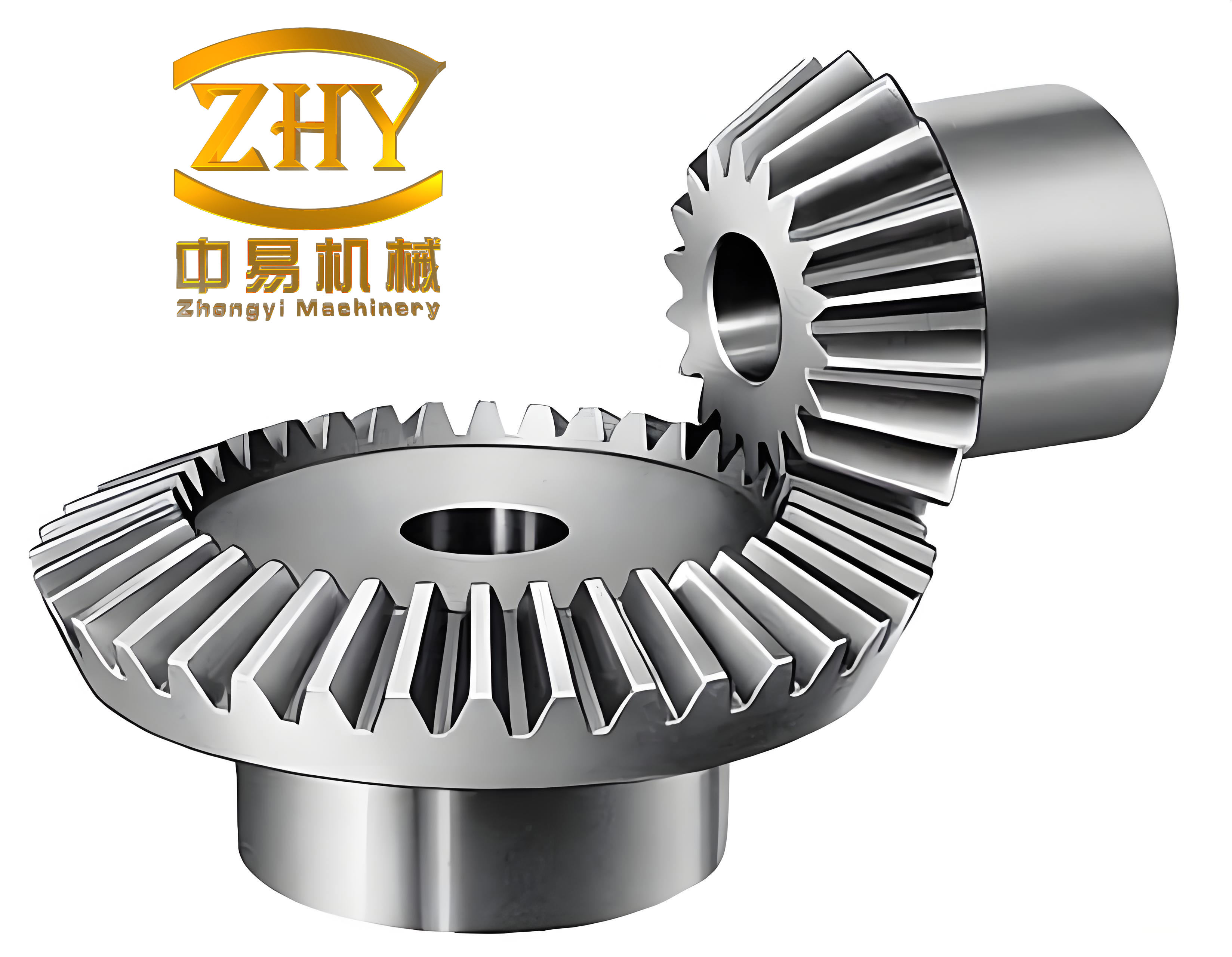
The manufacturing of straight bevel gears through precision forging represents a significant advancement in production technology, offering high efficiency, material savings, and superior economic benefits. This technique is widely adopted in the automotive and machinery sectors for producing transmission and differential components. A critical post-forging operation is the trimming or flash removal process, which directly impacts the final quality and dimensional accuracy of the gear teeth. The integrity and precision of the tooth profile on the back-cone are contingent upon the effectiveness of this trimming step.
Currently, the optimal method for machining the trimming die cavity is Wire Electrical Discharge Machining (WEDM). However, a primary challenge arises from the geometric relationship between the forged gear and the die. The large-end tooth profile of the forged straight bevel gears lies on a conical surface that is inclined at an angle δ (the pitch cone angle) relative to the planar surface of the trimming die’s cutting edge. This spatial relationship makes it difficult to directly and accurately define the die’s cutting profile for WEDM programming. Consequently, many manufacturers resort to die-sinking EDM, which requires the prior fabrication of specialized tooth-form cutters and electrode gears. This alternative approach suffers from low efficiency, high cost, reduced cutting edge precision, shorter die life, and ultimately, poorer trimming quality.
This article addresses this manufacturing bottleneck by presenting a robust method for fitting the theoretical involute profile of a trimming die with circular arcs. This approach enables the generation of precise die cavity contours suitable for direct WEDM programming, eliminating the need for complex electrodes.
Theoretical Foundation of the Trimming Die Profile
The true tooth form of a straight bevel gears is a spherical involute, which is notoriously complex for design, calculation, and manufacturing. In practical engineering, this is approximated with high accuracy by the involute profile on the back cone. The error introduced by this substitution is minimal and falls well within acceptable limits for transmission performance, making it the standard approach in industry.
To derive the cutting edge profile of the trimming die, we begin with the profile of the equivalent spur gear on the back cone at the large end of the forged straight bevel gears. Let’s define the coordinate system and key parameters:
- Coordinate System (X_vO_vY_v): Defined on the plane of the large-end back cone.
- Key Radii: $r_{vb}$ (base circle), $r_v$ (pitch circle), $r_{va}$ (addendum circle), $r_{vf}$ (dedendum circle).
- Pressure Angle: $\alpha_i$ is the pressure angle at an arbitrary point on the involute.
- Gear Parameters: Module $m$, Number of teeth $z$, Pressure angle $\alpha$, Addendum modification coefficient $\zeta$, Pitch cone angle $\delta$.
The parametric equations for the large-end tooth profile (equivalent gear involute) in the $X_vO_vY_v$ system are:
$$
\begin{align}
x_v &= r_{vb} \left[ (\varphi + \theta) \cos \varphi – \sin \varphi \right] \\
y_v &= r_{vb} \left[ \cos \varphi + (\varphi + \theta) \sin \varphi \right]
\end{align}
$$
where the auxiliary variables are defined as:
$$
\begin{align}
\varphi &= \tan \alpha_i – \theta \\
\theta &= \frac{\pi}{2z_v} + \frac{2\zeta \tan \alpha}{z_v} + \tan \alpha – \alpha \\
r_{vb} &= \frac{m z \cos \alpha}{2 \cos \delta} \\
z_v &= \frac{z}{\cos \delta} \quad \text{(Virtual number of teeth)}
\end{align}
$$
The trimming die operates on a plane. The spatial relationship between the forged gear’s back-cone coordinate system ($X_vO_vY_v$) and the trimming die’s coordinate system ($XOY$) is crucial. The $O_vX_v$ axis is parallel to the $XOY$ plane, while the $O_vY_v$ axis is inclined at the pitch cone angle $\delta$ relative to the $XOY$ plane. The projection relationship is straightforward: the $x$-coordinate remains unchanged, while the $y$-coordinate is compressed by a factor of $\cos \delta$.
| Original Coordinate (Back Cone) | Transformed Coordinate (Die Plane) | Description |
|---|---|---|
| $x_v$ | $x = x_v$ | Coordinate along the face width direction is unchanged. |
| $y_v$ | $y = y_v \cos \delta$ | Coordinate along the tooth height direction is scaled by $\cos \delta$. |
Applying this transformation to equations (1) and (2), we obtain the parametric equations for the theoretical cutting edge curve of the trimming die in the $XOY$ plane:
$$
\begin{align}
x &= \frac{r_{b}}{\cos \delta} \left[ (\varphi + \theta) \cos \varphi – \sin \varphi \right] \\
y &= r_{b} \left[ \cos \varphi + (\varphi + \theta) \sin \varphi \right]
\end{align}
$$
Note that $r_b = r_{vb}$, representing the base circle radius of the original straight bevel gears. The first and second derivatives of $y$ with respect to $x$, which are essential for curvature calculations, are given by:
$$
\begin{align}
y’ &= \frac{dy}{dx} = -\frac{\cos \delta}{\tan \varphi} \\
y” &= \frac{d^2y}{dx^2} = -\frac{\cos^2 \delta}{r_b (\varphi + \theta) \sin^3 \varphi}
\end{align}
$$
The locus of the center of curvature (the evolute) for this profile is described by the coordinates $(x_0, y_0)$:
$$
\begin{align}
x_0 &= x – \frac{y'(1 + y’^2)}{y”} \\
y_0 &= y + \frac{1 + y’^2}{y”}
\end{align}
$$
Consequently, the radius of curvature $R$ at any point on the die’s theoretical profile is:
$$
R = \sqrt{(x – x_0)^2 + (y – y_0)^2} = \frac{(1 + y’^2)^{3/2}}{|y”|}
$$
Circular Arc Fitting Methodology
Modern CNC systems, including those driving WEDM machines, primarily support linear and circular interpolation. To machine a complex curve, it must be approximated by a series of these simple geometric entities. This section details a method for approximating the involute portion of the trimming die profile for straight bevel gears with a sequence of tangential circular arcs.
Consider a small segment of the theoretical profile between two closely spaced points $C(x_i, y_i)$ and $D(x_{i+1}, y_{i+1})$. Let their corresponding radii of curvature, calculated via equation (11), be $R_i$ and $R_{i+1}$. The goal is to find a single circular arc that passes through both points $C$ and $D$ and provides a good approximation of the true curve between them.
A suitable choice for the radius $\bar{R}_i$ of this fitting arc is the harmonic mean of the endpoint curvatures:
$$
\bar{R}_i = \frac{2 R_i R_{i+1}}{R_i + R_{i+1}}
$$
This choice tends to minimize the approximation error over the segment. The fitting arc is defined by its center $O_i(x_{oi}, y_{oi})$ and radius $\bar{R}_i$. It must satisfy two conditions: 1) its distance to points $C$ and $D$ equals $\bar{R}_i$, and 2) the center lies on the perpendicular bisector of chord $CD$.
The equation of the perpendicular bisector of $CD$ is:
$$
y = k x + b
$$
where
$$
k = -\frac{x_{i+1} – x_i}{y_{i+1} – y_i}, \quad b = \frac{x_{i+1}^2 + y_{i+1}^2 – x_i^2 – y_i^2}{2(y_{i+1} – y_i)}
$$
The equation of the circle with center $O_i$ and radius $\bar{R}_i$ is:
$$
(x – x_{oi})^2 + (y – y_{oi})^2 = \bar{R}_i^2
$$
Since $O_i$ lies on the bisector, we have $y_{oi} = k x_{oi} + b$. Substituting this into the circle equation and solving for $x_{oi}$ yields:
$$
\begin{align}
c &= \frac{x_i + k(y_i – b)}{1 + k^2} \\
d &= \frac{x_i^2 – \bar{R}_i^2 + (y_i – b)^2}{1 + k^2} \\
x_{oi} &= c – \sqrt{c^2 – d} \quad \text{(The appropriate root is chosen based on geometry)} \\
y_{oi} &= k x_{oi} + b
\end{align}
$$
The arc spanning from point $C$ to $D$ with center $O_i$ and radius $\bar{R}_i$ is the fitting arc for the $i$-th segment. By successively applying this procedure along the entire active profile (from the start of the involute at the base circle to the addendum), a piecewise-circular approximation is constructed. The transition points between arcs ($C, D, \dots$) are chosen to ensure the arcs are tangent to each other, resulting in a smooth composite curve.
Accuracy Analysis and Error Estimation
The overall error in representing the trimming die profile comes from two main sources: the modeling approximation and the interpolation approximation.
- Modeling Error ($\epsilon_m$): This is the error incurred by using the back-cone involute to approximate the true spherical involute of the straight bevel gears. As established in gear theory, this error is negligible for practical engineering purposes and will not be discussed further here.
- Interpolation/Approximation Error ($\epsilon_i$): This is the local error due to replacing a segment of the exact die profile (from equations 7 & 8) with a circular arc. This error must be quantified and controlled.
To analyze the interpolation error for the $i$-th segment, consider a test point $E(x_j, y_j)$ on the theoretical profile within that segment, defined by its parameter $\varphi_j$. Its corresponding center of curvature is $O_j(x_{oj}, y_{oj})$, calculated using the formulas for the theoretical curve (equations analogous to (9) and (10)).
The line $E O_j$ passes through both the test point and its center of curvature. Its equation is:
$$
y = k_j (x – x_j) + y_j, \quad \text{where} \quad k_j = \frac{\tan \varphi_j}{\cos \delta}
$$
We find the intersection point $\bar{E}(\bar{x}_j, \bar{y}_j)$ of this line with the fitting arc (centered at $O_i$ with radius $\bar{R}_i$). This involves solving the system formed by equations (17) and (20). The algebraic manipulation leads to the following expression for the x-coordinate difference:
$$
\bar{x}_j – x_j = \frac{ \sqrt{ (1+k_j^2) \bar{R}_i^2 – q^2 } – p }{1 + k_j^2}
$$
where
$$
p = x_j – x_{oi} + k_j(y_j – y_{oi}), \quad q = y_j – y_{oi} – k_j(x_j – x_{oi})
$$
The local fitting error $\epsilon_{ij}$ at test point $E$ is defined as the distance between $E$ and the intersection point $\bar{E}$ on the fitting arc along the line $EO_j$:
$$
\epsilon_{ij} = \sqrt{ (\bar{x}_j – x_j)^2 + (\bar{y}_j – y_j)^2 } = |\bar{x}_j – x_j| \sqrt{1 + k_j^2}
$$
To evaluate the error for the entire $i$-th segment, multiple test points ($j=1,2,…,m$) are distributed along the theoretical curve between $C$ and $D$. The maximum error among them is taken as the segment’s fitting error:
$$
\epsilon_i = \max( \epsilon_{ij} ), \quad \text{for } j = 1, 2, …, m
$$
By ensuring $\epsilon_i$ is below a specified tolerance (e.g., a fraction of the gear’s manufacturing tolerance) for all segments, the overall accuracy of the WEDM-machined die is guaranteed.
Implementation via CAD/CAM Integration
The proposed arc-fitting algorithm is ideally suited for integration within a CAD/CAM environment for the automated design and manufacturing of trimming dies for straight bevel gears. The workflow can be fully systematized:
- Data Input: The system accepts the fundamental parameters of the precision-forged straight bevel gears.
Table 2: Required Input Parameters for Die Design Parameter Symbol Unit Module $m$ mm Number of Teeth $z$ – Pressure Angle $\alpha$ ° Addendum Modification Coefficient $\zeta$ – Pitch Cone Angle $\delta$ ° Addendum Circle Radius $r_a$ mm Dedendum Circle Radius $r_f$ mm - Computation: A dedicated software module executes the algorithm described in sections 2 and 3. It calculates the parameters (center coordinates $x_{oi}, y_{oi}$, radius $\bar{R}_i$, start/end points) for all circular arcs constituting one-half of a single tooth space in the trimming die.
- Geometry Construction: Using a scripting interface (e.g., AutoCAD VBA, SolidWorks API), the arcs are automatically drawn in the CAD system. The half-profile is then mirrored across the tooth centerline. Finally, a polar array pattern is created to generate the complete, multi-tooth die cavity profile.
- NC Code Generation: The geometric model serves as the input for CAM processing. Two primary routes exist:
- Direct Code Generation: The arc parameters extracted from the CAD model can be formatted into machine-specific G-code (using G02/G03 commands) manually or via a simple post-processor.
- APT/CLDATA Path: The CAD model can be exported as a DXF file or similar, which is then read by a CAM system. The CAM system’s toolpath generator, using a wire EDM strategy, creates Cutter Location (CL) data. A post-processor finally translates this CL data into the specific NC code for the target WEDM machine.
Extended Application Example
To demonstrate the efficacy of the method, let’s consider the design of a trimming die for a precision-forged planetary straight bevel gears, similar to the one referenced in the original text. The process begins with the complete set of gear data.
| Parameter | Value | Calculated Parameter | Value (mm) |
|---|---|---|---|
| Module, $m$ | 6.35 mm | Base Radius, $r_b$ | 24.945 |
| Number of Teeth, $z$ | 10 | Addendum Radius, $r_a$ | 31.000 |
| Pressure Angle, $\alpha$ | 22.5° | Dedendum Radius, $r_f$ | 23.520 |
| Addendum Mod. Coeff., $\zeta$ | +0.226 | Virtual Teeth, $z_v$ | 11.79 |
| Pitch Cone Angle, $\delta$ | 32° | Half Tooth Angle, $\theta$ | 0.176 rad |
The calculation proceeds as follows: First, the parameter $\theta$ is computed. Then, for the involute portion, a series of points is defined by selecting values for $\alpha_i$ ranging from the pressure angle at the start of active profile (SAP) up to the pressure angle at the addendum. For each point, $\varphi$ and the coordinates $(x, y)$ in the die plane are calculated using equations (7) and (8). The curvature radius $R$ is also computed using equation (11). Pairs of adjacent points form the segments for arc fitting.
The arc fitting algorithm is applied segment-by-segment. The addendum and fillet regions are treated separately. The addendum is simply a circular arc with radius equal to the projected addendum radius. A fillet arc (radius = 1.5 mm in this case) connects the dedendum circle to the start of the fitted involute. The results for the half-tooth profile are summarized below.
| Segment | Arc Type / Region | Center Coordinates ($x_{oi}$, $y_{oi}$) | Fitted Radius $\bar{R}_i$ (mm) | Max. Error $\epsilon_i$ (mm) |
|---|---|---|---|---|
| 1 | Dedendum Fillet | (5.705, 24.284) | 1.50000 | 0.00000 |
| 2 | Involute (near base) | (4.546, 25.450) | 0.92035 | 0.00036 |
| 3 | Involute | (2.577, 25.252) | 2.45424 | 0.00047 |
| 4 | Involute | (0.600, 24.938) | 4.41761 | 0.00039 |
| 5 | Involute | (-1.286, 24.766) | 6.31087 | 0.00079 |
| 6 | Involute | (-3.124, 24.413) | 8.18077 | 0.00085 |
| 7 | Involute | (-4.908, 23.899) | 10.04003 | 0.00098 |
| 8 | Involute | (-6.640, 23.216) | 11.89357 | 0.00092 |
| 9 | Involute | (-8.306, 22.405) | 13.74368 | 0.00082 |
| 10 | Involute | (-9.906, 21.478) | 15.59158 | 0.00048 |
| 11 | Involute (near addendum) | (-11.440, 20.452) | 17.43740 | 0.00021 |
| 12 | Addendum Arc | (0.000, 31.000) | 31.00000 | 0.00000 |
The table clearly shows that the maximum fitting error across all involute segments is less than 0.001 mm (1 micron), which is an exceptionally high level of precision, more than adequate for trimming die applications for straight bevel gears. The complete die cavity profile is formed by mirroring this half-profile and patterning it around the die’s center.
Generalization and Conclusion
The arc-fitting methodology presented here is not limited to a specific straight bevel gears but is universally applicable. It can be directly extended to the design and manufacturing of trimming dies for any type of precision-forged bevel gear (including Zerol and spiral bevel gears with appropriate modifications to the base profile equations) and even cylindrical gears, where the projection step ($\delta = 0$) simplifies the equations.
The key advantages of this approach are its computational simplicity, high precision, and seamless integration into digital manufacturing workflows. By deriving the die profile from first principles and approximating it with machine-executable circular arcs, it bridges the gap between complex gear geometry and practical CNC machining. This method effectively eliminates the dependency on costly and less accurate electrode-based EDM for producing trimming dies for straight bevel gears.
In summary, this article has detailed a complete technical framework for the precision curve fitting of trimming die profiles. It encompasses the derivation of the theoretical profile based on gear geometry, a robust circular arc fitting algorithm with explicit error analysis, and a clear path for implementation within a CAD/CAM system. This framework provides a reliable and efficient solution for advancing the manufacturing of high-quality precision-forged straight bevel gears.