
The relentless pursuit of higher power density, compactness, and operational reliability in modern machinery, particularly within aerospace, marine, and heavy industrial applications, drives the evolution of advanced gear transmission systems. Conventional single-path transmissions often reach their limits under extreme demands of high speed and heavy load. To overcome these constraints, power-branching configurations have emerged as a superior solution. These systems ingeniously split the input power along multiple parallel kinematic paths before recombining it at the output. This architecture offers a compelling advantage: it significantly reduces the load borne by individual gear meshes within each path, thereby enhancing the overall system’s load-carrying capacity and service life while allowing for a more compact and lightweight design compared to a single, heavily loaded gear train.
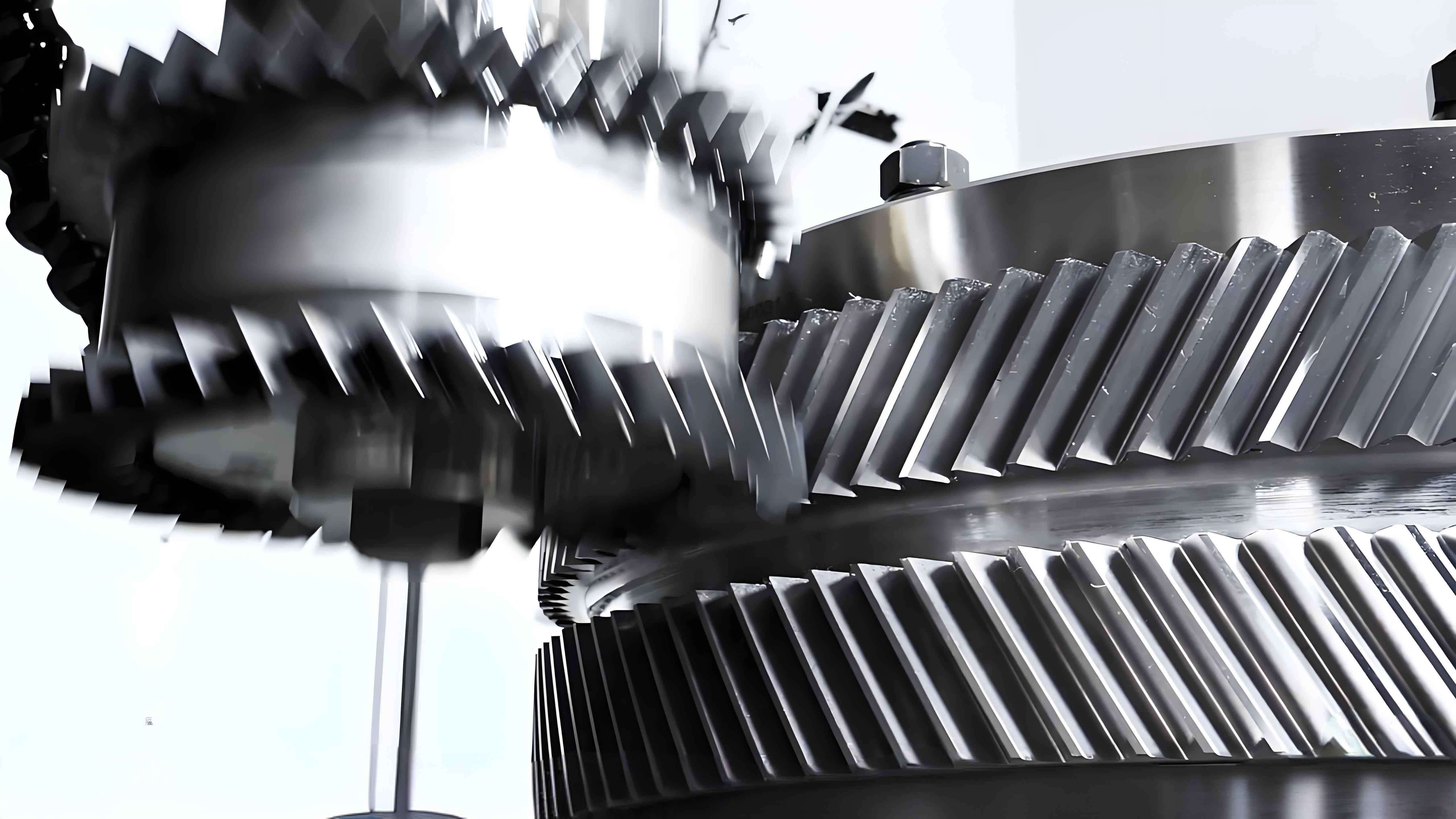
Among various gear types, herringbone gears are exceptionally well-suited for such high-performance branching systems. Their inherent double-helical design provides axial force cancellation, leading to smoother operation, reduced vibration, and the ability to handle substantial torque loads—attributes paramount in high-power transmission. The core challenge in designing these multi-path systems lies in achieving optimal load sharing, or “equalization,” among the parallel branches. Manufacturing inaccuracies, assembly misalignments, and subtle deflections under load can disrupt the ideal power distribution, causing one branch to carry disproportionally more load than others. This imbalance not only diminishes the system’s overall reliability but can also lead to premature failure of the overloaded components.
This investigation focuses on a specific and potent configuration: a triple-path transmission system utilizing herringbone gears. The system features a unique integration where two conventional parallel branches are combined with a third branch incorporating a planetary gear stage. The primary objective is to develop a robust simulation methodology to analyze the power flow distribution among these three paths under various realistic operating conditions, including the presence of installation errors. By establishing a detailed mathematical model grounded in gear meshing theory and solving it through computational optimization, this research provides critical insights into the load-sharing behavior, paving the way for the design of more robust and efficient high-power transmission systems.
System Configuration and Mathematical Modeling
The triple-branch system under study represents an evolution from a dual-path design. Its operational principle is to divide the input power from a single pinion into three distinct yet synchronized paths that converge to drive a common output gear. A key innovation in this configuration is the incorporation of a planetary gear train as the third power branch.
The power flow can be traced as follows: The input power is delivered to the primary pinion (Gear 1). This pinion simultaneously drives two first-stage herringbone gears (Gears 2 and 3) via direct mesh. These gears are connected through flexible shafts and couplings to their respective second-stage pinions (Gears 4 and 5), which finally drive the common second-stage bull gear (Gear 7). Concurrently, the input pinion (Gear 1) also drives a sun gear (Gear 8) of a planetary set via a central through-shaft. The planetary carrier is fixed. The sun gear drives multiple planet gears (Gear 10), which in turn drive a ring gear (Gear 11). The rotation of the ring gear is then transferred via another flexible shaft and coupling to a third second-stage pinion (Gear 6), which also meshes with and drives the common bull gear (Gear 7). Thus, the input power is split into three parallel streams that recombine at the output.
To analyze this complex system, a lumped-parameter mechanical model is constructed. This model simplifies the physical components into discrete elements characterized by their stiffness and the torques they transmit. The planetary branch is treated as an equivalent speed reducer with the same overall ratio as the other two parallel branches for modeling consistency at the system level. The core of the analysis lies in satisfying two fundamental physical principles: static torque equilibrium and geometric compatibility of deformations.
The torque equilibrium equations for the system are derived by considering the balance of torques at each shaft and gear mesh. For the input stage and the subsequent paths, the sum of torques must equal zero. The equations can be expressed as follows, where \( T_{ij} \) represents the torque transmitted by the gear pair between gear \(i\) and gear \(j\), and \( r_i \) represents the base radius of gear \(i\) (or its equivalent in the planetary stage):
$$
T_{in} + T_{12} + T_{13} + T_{18} = 0
$$
$$
T_{47} – T_{12} \cdot (r_2 / r_1) \cdot (r_4 / r_7) = 0
$$
$$
T_{57} – T_{13} \cdot (r_3 / r_1) \cdot (r_5 / r_7) = 0
$$
$$
T_{67} – T_{18} \cdot (r_8 / r_1) \cdot (r_6 / r_7) = 0
$$
The deformation compatibility condition is more intricate. It states that the total angular displacement (or deflection) along any closed loop in the system from the input to the common output gear must be equal for all three branches. This accounts for the torsional wind-up of shafts, the bending and contact deformation of gears, and the inherent geometric transmission error. For the \(k\)-th discrete meshing position in a mesh cycle (typically 5 positions are analyzed per cycle), the condition for branches 1-2-4-7 and 1-3-5-7 can be written as:
$$
\theta_{12}^{(k)}(T_{12}) \cdot \frac{r_1}{r_2} + \theta_{shaft24}(T_{12}) + \theta_{47}^{(k)}(T_{47}) = \theta_{13}^{(k)}(T_{13}) \cdot \frac{r_1}{r_3} + \theta_{shaft35}(T_{13}) + \theta_{57}^{(k)}(T_{57})
$$
A similar equation enforces compatibility between the first branch and the planetary branch (1-8-6-7). Here, \( \theta_{ij}^{(k)}(T) \) is the loaded angular displacement at the \(k\)-th meshing position of gear pair \(ij\) as a function of transmitted torque \(T\), and \( \theta_{shaft}(T) \) is the torsional deflection of the connecting shaft.
Load Tooth Contact Analysis and Stiffness Characterization
The heart of accurate power flow simulation lies in precisely defining the relationship \( \theta_{ij}^{(k)}(T) \), the loaded angular transmission error (LTE). For herringbone gears, this LTE is a composite of several elastic deformations. It is not simply linear with load due to the nonlinear nature of contact deformation.
We employ a discrete tooth surface theory and Loaded Tooth Contact Analysis (LTCA) to determine this function. The tooth surface is discretized into a grid of potential contact points. Under load, the contact pattern and pressure distribution are solved considering tooth bending, shear, foundation deflection, and most importantly, the localized Hertzian contact deformation. The total LTE at a given meshing position \(k\) can be empirically modeled as a function of the mesh load \(F_m\) (related to torque \(T\)) using a combination of terms:
- Geometric Transmission Error (\( \delta_g \)): A constant term originating from design modifications (e.g., profile relief) and manufacturing deviations.
- Linear Deflection Term (\( \delta_b \)): Primarily from tooth bending and shear, which is proportional to load: \( \delta_b = C_b \cdot F_m \).
- Nonlinear Contact Term (\( \delta_c \)): Governed by Hertzian contact theory, which states that contact deformation is proportional to the load raised to the power of 2/3: \( \delta_c = C_c \cdot F_m^{2/3} \).
Therefore, the composite linear displacement at the mesh can be fitted to the form:
$$
\delta_{LTE} = \delta_g + C_b \cdot F_m + C_c \cdot F_m^{2/3}
$$
Converting this to an angular error on the gear (\( \theta \)) involves dividing by the base radius \(r\): \( \theta = \delta_{LTE} / r \). Consequently, the torque-deflection function for a herringbone gear pair at a specific meshing position is:
$$
\theta_{ij}^{(k)}(T) = \alpha^{(k)} + \beta^{(k)} \cdot T + \gamma^{(k)} \cdot T^{2/3}
$$
where the coefficients \( \alpha^{(k)}, \beta^{(k)}, \gamma^{(k)} \) are unique to each gear pair and each meshing position \(k\). They are determined numerically by performing LTCA at three different torque levels (e.g., 0.1Tin, 0.5Tin, 0.9Tin) and fitting the results to the above equation. The torsional stiffness of the intermediate shafts is typically linear, giving a simpler relation: \( \theta_{shaft}(T) = \kappa \cdot T \).
Simulation Algorithm for Power Flow Analysis
With the system equations and nonlinear stiffness relations established, the goal is to solve for the set of unknown torques \( T_{12}, T_{13}, T_{18}, T_{47}, T_{57}, T_{67} \) at each of the \(k\) meshing positions. Directly solving the coupled, nonlinear system of equations from the equilibrium and compatibility conditions is challenging due to the complexity of the \( T^{2/3} \) terms and the need for initial guesses.
A more robust approach is to formulate the problem as a constrained optimization. The decision variables (optimization parameters) are the gear mesh torques. The objective is to minimize the violation of the deformation compatibility equations—ideally driving the difference in total path deflection to zero. The constraints are the torque equilibrium equations and the physical reality that torques must align with their corresponding deflections.
For each meshing position \(k\), the optimization problem is formulated as:
Minimize:
$$ f_1 = \left| \left( \theta_{12}^{(k)}(T_{12}) \cdot \frac{r_1}{r_2} + \kappa_{24} \cdot T_{12} + \theta_{47}^{(k)}(T_{47}) \right) – \left( \theta_{13}^{(k)}(T_{13}) \cdot \frac{r_1}{r_3} + \kappa_{35} \cdot T_{13} + \theta_{57}^{(k)}(T_{57}) \right) \right| $$
and
$$ f_2 = \left| \left( \theta_{12}^{(k)}(T_{12}) \cdot \frac{r_1}{r_2} + \kappa_{24} \cdot T_{12} + \theta_{47}^{(k)}(T_{47}) \right) – \left( \theta_{18}^{(k)}(T_{18}) \cdot \frac{r_1}{r_8} + \kappa_{86} \cdot T_{18} + \theta_{67}^{(k)}(T_{67}) \right) \right| $$
Subject to:
$$ T_{in} + T_{12} + T_{13} + T_{18} = 0 $$
$$ T_{47} – \eta_{247} \cdot T_{12} = 0 $$
$$ T_{57} – \eta_{357} \cdot T_{13} = 0 $$
$$ T_{67} – \eta_{867} \cdot T_{18} = 0 $$
$$ T_{ij} \cdot \theta_{ij}^{(k)}(T_{ij}) \geq 0 \quad \text{(for all gear pairs)} $$
Here, \( \eta \) represents the fixed speed ratio factors from the input to the final mesh. The final constraint ensures torque and deflection are in the same direction (positive power flow). A solver like the Newton-Raphson method or a sequential quadratic programming (SQP) algorithm can be used to find the torques that minimize \(f_1\) and \(f_2\). The resulting torque values, when multiplied by the rotational speed, give the instantaneous power flow in each branch at that meshing position. Repeating this across one full mesh cycle reveals the dynamic behavior of power sharing.
Case Study and Analysis of Results
A simulation was conducted for a system with an input power of 1,556 kW at 6,000 rpm. The key parameters for the herringbone gears are summarized in the table below.
| Parameter | Gear 1 (Input Pinion) | Gears 2, 3, 8 | Gears 4, 5, 6 | Gear 7 (Bull Gear) |
|---|---|---|---|---|
| Number of Teeth | 28 | 66 | 32 | 84 |
| Normal Module (mm) | 6 | 6 | 6 | 6 |
| Pressure Angle (°) | 20 | 20 | 20 | 20 |
| Helix Angle (°) | 29.5 | 29.5 | 29.5 | 29.5 |
| Face Width (mm) | 120 | 110 | 120 | 110 |
| Young’s Modulus (GPa) | 210 | 210 | 210 | 210 |
The power flow was simulated over two complete mesh cycles for several operating conditions: 1) ideal, error-free assembly; and conditions with simulated installation errors (e.g., minor axis misalignment) introduced individually into gear pairs (1-2), (1-3), (4-7), (5-7), (6-7), and finally a combined case with errors in all pairs.
The results clearly demonstrate the principle and challenges of triple-branch systems. In the ideal, error-free condition, the power is almost perfectly equally divided among the three branches at every point in the mesh cycle. The curves for \(P_{12}\), \(P_{13}\), and \(P_{18}\) (the power shares from the input pinion) are virtually superimposed, as are the curves for \(P_{47}\), \(P_{57}\), and \(P_{67}\) (the power at the final mesh). This represents the optimal load-sharing state, maximizing the system’s load capacity.
The introduction of a single installation error disrupts this balance. For instance, an error in the first-stage mesh (1-2) causes the power in branch 1-2-4-7 to deviate from the other two. The specific error influences the phase and amplitude of the power fluctuation throughout the mesh cycle. Crucially, errors in the second-stage meshes (e.g., 4-7, 5-7, 6-7) were found to have a more pronounced effect on power distribution than comparable errors in the first stage. This highlights the sensitivity of the final convergence point at the bull gear.
The most significant imbalance occurs in the combined error scenario. The individual errors, each affecting the stiffness and geometric relationships at different meshing positions, accumulate. This leads to power flow curves that show substantial and persistent deviation from the equal-share baseline across the entire mesh cycle. One branch may consistently carry 5-15% more power than another, depending on the error magnitudes. This underscores the critical importance of precision manufacturing and assembly, as well as the potential need for intentional design modifications (floating components, flexible couplings) to promote load equalization in real-world herringbone gear branching systems.
Conclusion
This study presents a comprehensive simulation framework for analyzing the complex power flow dynamics in a triple-path transmission system employing herringbone gears. By integrating a detailed lumped-parameter model with nonlinear stiffness characteristics derived from Loaded Tooth Contact Analysis (LTCA), the method effectively predicts load distribution under both ideal and flawed assembly conditions.
The key findings are threefold. First, the power split among branches is not static but exhibits cyclic fluctuations synchronized with the gear mesh frequency, dictated by the varying meshing stiffness at different contact positions. Second, in a perfectly aligned system, near-ideal equal load sharing is achievable, validating the fundamental advantage of the triple-branch architecture for load distribution. Third, and most importantly, installation errors are a primary source of load imbalance. Errors closer to the final output mesh have a more severe impact, and the combined effect of multiple small errors can lead to significant and problematic uneven power distribution, potentially jeopardizing system reliability.
The simulation algorithm developed herein serves as a powerful virtual prototyping tool. It enables designers to assess the sensitivity of a herringbone gear triple-branch system to various tolerances and to evaluate the effectiveness of different load-equalizing design strategies before physical manufacture. This capability is vital for advancing the development of compact, reliable, and ultra-high-power density transmission systems for the most demanding industrial applications.