
In the field of mechanical transmission, miter gears play a crucial role in transferring motion and power between intersecting shafts, typically at a 90-degree angle. As a straight bevel gear variant, miter gears are widely adopted due to their simplicity in design, manufacturing, and installation. However, machining large-diameter miter gears presents significant challenges, especially when specialized gear-cutting equipment is unavailable. In this article, I will share my experience and methodology for machining large straight bevel gears, specifically miter gears, using a CNC horizontal boring mill. This approach leverages advanced programming techniques, error compensation strategies, and innovative tooling to achieve precise results, even for gears with diameters beyond conventional machine capacities.
The core of this process lies in adapting a CNC horizontal boring mill for gear cutting, which is not its primary function. By utilizing the machine’s rotary table, precise axial movements, and programmable logic, we can simulate the action of a dedicated gear hobber. This method is particularly useful for producing large miter gears where standard gear-cutting machines fall short. Throughout this discussion, I will emphasize the importance of meticulous planning, mathematical modeling, and programming finesse to ensure the accuracy and efficiency of the machining process. The integration of miter gears into various industrial applications, from heavy machinery to automotive systems, underscores the relevance of this technique.
To begin, let’s consider the fundamental geometry of miter gears. These gears are characterized by their straight teeth cut along the cone surface, with the pitch cone angle typically set at 45 degrees for a 90-degree shaft intersection. The key parameters include the module (m), number of teeth (z), pressure angle (α), and addendum and dedendum heights. For the purpose of this article, I will reference a specific case study involving a large miter gear, but the principles can be generalized. Below is a table summarizing the basic parameters used in our machining example:
| Parameter | Symbol | Value |
|---|---|---|
| Module | m | 2.5 mm |
| Number of Teeth | z | 272 |
| Pitch Cone Angle | δ | 45° (implied for miter gears) |
| Pressure Angle | α | 20° |
| Chordal Tooth Thickness | s_c | 3.7170 mm (with tolerance -0.15 mm) |
| Chordal Addendum | h_c | 2.5 mm |
| Material | – | 45 Steel |
From these parameters, we can derive essential dimensions using standard gear formulas. The pitch diameter (d) is calculated as:
$$ d = m \times z = 2.5 \times 272 = 680 \, \text{mm} $$
For miter gears, the addendum (h_a) and dedendum (h_f) are critical for tooth profile generation. Typically, the addendum coefficient (h_a^*) is 1, and the dedendum coefficient (c^*) is 0.2, leading to:
$$ h_f = (h_a^* + c^*) \times m = (1 + 0.2) \times 2.5 = 3 \, \text{mm} $$
These calculations form the basis for our machining model, ensuring that the gear tooth geometry aligns with functional requirements. The large number of teeth in this miter gear example—272—introduces complexities in angular division, which I will address in the following sections.
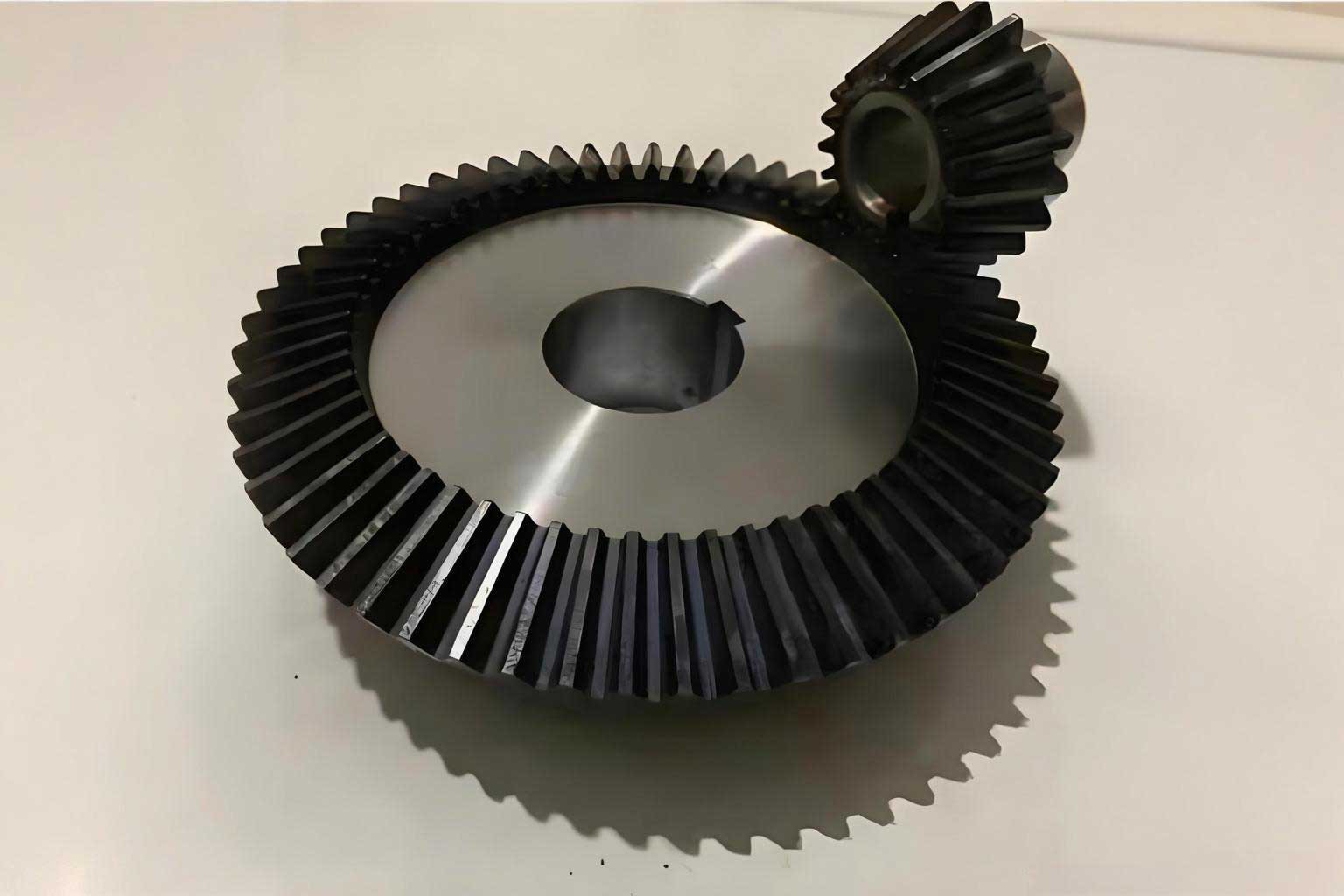
When machining miter gears on a CNC horizontal boring mill, the primary challenge is achieving accurate angular indexing for each tooth. The rotary table of the mill must rotate by a precise angle per tooth, defined as:
$$ \alpha = \frac{360^\circ}{z} $$
For our miter gear with z = 272, the ideal angle per tooth is:
$$ \alpha = \frac{360^\circ}{272} \approx 1.3235294^\circ $$
However, most CNC systems, including the FANUC 16i used in this case, have limited resolution—often up to three decimal places for angular commands. If we program α directly as 1.324° or 1.323°, the cumulative error over 272 teeth becomes significant. For instance:
$$ \beta = 272 \times 1.324^\circ = 360.128^\circ $$
or
$$ \beta = 272 \times 1.323^\circ = 359.856^\circ $$
Both results deviate from the required 360°, leading to an inaccurate tooth distribution on the miter gear. To mitigate this, I implement an error compensation strategy that involves periodic adjustments during machining. The key insight is to avoid reversing the rotary table direction due to backlash, which can exacerbate errors. Therefore, I choose α = 1.323° for programming, resulting in a cumulative rotation of 359.856°. Then, I introduce compensation every few teeth to bring the total closer to 360°.
I opt to compensate every four teeth, as this provides a manageable frequency without introducing fractional teeth. The compensation angle (ε) is calculated as:
$$ \varepsilon = \frac{360^\circ – 359.856^\circ}{68} \approx 0.002^\circ $$
Here, 68 is the number of compensation cycles (272 teeth / 4 teeth per cycle). The total compensation over all cycles is:
$$ \sum \varepsilon = 68 \times 0.002^\circ = 0.136^\circ $$
Thus, the net rotation becomes:
$$ \beta = 359.856^\circ + 0.136^\circ = 359.992^\circ $$
This is acceptably close to 360°, ensuring that the miter gear teeth are evenly spaced within tolerance limits. The table below summarizes this compensation approach:
| Parameter | Symbol | Value |
|---|---|---|
| Programmed Angle per Tooth | α | 1.323° |
| Cumulative Rotation without Compensation | β | 359.856° |
| Compensation Frequency | – | Every 4 teeth |
| Number of Compensation Cycles | n | 68 |
| Compensation Angle per Cycle | ε | 0.002° |
| Total Compensation | ∑ε | 0.136° |
| Net Cumulative Rotation | β_net | 359.992° |
This mathematical framework is essential for machining precise miter gears, as it minimizes errors inherent in discrete angular movements. The success of this method hinges on careful planning and programming, which I will detail in subsequent sections.
Before diving into the programming specifics, thorough preparation is required for machining miter gears on a CNC horizontal boring mill. The setup involves selecting appropriate tools, fixtures, and machine parameters to ensure stability and accuracy. For this application, I use a standard gear milling cutter mounted on a toolholder with dimensions of Ø50 mm × 350 mm. The machine is equipped with a FANUC 16i control system, and I set the spindle speed to 200 rpm for optimal cutting conditions. The workpiece, made of 45 steel, is secured on the rotary table using either three parallel blocks or a magnetic chuck, ensuring that the spindle does not interfere with the table during operation. Alignment is critical: the gear blank must be concentric with the rotary axis, achieved by dialing with a dial indicator. Additionally, I use a micrometer for measuring chordal dimensions to verify tooth accuracy during and after machining.
The machining process for miter gears is performed in three passes to gradually form the tooth profile, reducing cutting forces and improving surface finish. Each pass involves coordinated movements of the spindle (Z-axis), rotary table (B-axis), and radial movements (X and Y axes). The use of polar coordinate programming simplifies these motions, allowing us to define positions in terms of radius and angle relative to the gear center. This is particularly effective for generating the conical tooth shape of miter gears. Below, I outline the key steps in the machining sequence:
| Step | Action | Purpose |
|---|---|---|
| 1 | Align workpiece and set coordinate systems | Ensure concentricity and define reference points |
| 2 | Rough cutting (first pass) | Remove bulk material to approximate tooth shape |
| 3 | Semi-finish cutting (second pass) | Refine tooth profile and reduce errors |
| 4 | Finish cutting (third pass) | Achieve final dimensions and surface quality |
| 5 | Periodic compensation | Adjust angular position to minimize cumulative error |
This structured approach ensures that the miter gears meet the required precision, typically adhering to standards like AGMA or ISO for bevel gears. In our case, the gear is specified with an accuracy grade of 988—9C, which corresponds to moderate tolerance levels suitable for general industrial use.
Programming the CNC horizontal boring mill for miter gear machining involves a combination of main and subprograms, leveraging the power of polar coordinates and multiple workpiece coordinate systems. The FANUC 16i system supports these features, enabling complex motion control with minimal code redundancy. The main program (O0001) initializes the machine, sets the coordinate system (G54), and calls subprograms to execute the cutting cycles. Key programming elements include:
- Polar Coordinate Mode (G16): This allows positioning in terms of radius (X) and angle (Y), simplifying the definition of points on the gear circumference. For miter gears, the angle corresponds to the tooth position, while the radius controls the depth of cut.
- Subprogram Calls (M98): By nesting subprograms, we can repeat cutting patterns for each tooth and implement compensation cycles efficiently. This modular approach enhances code readability and flexibility.
- Multiple Workpiece Coordinate Systems (G54-G59): Using different offsets (e.g., G56, G57, G58) enables easy adjustment of reference points for various machining stages, such as roughing and finishing.
- Absolute and Incremental Modes (G90/G91): Switching between these modes reduces calculation overhead, especially for repetitive movements like stepping through teeth.
To illustrate, the main program sets the initial conditions and then invokes a subprogram (O0011) that handles the cutting for a group of teeth. Within this, further subprograms (e.g., O0012, O0013) manage individual passes and compensation moves. The compensation logic is embedded in subprogram O0017, which adds a small angular shift (ε = 0.002°) every four teeth. This structured programming mirrors the mathematical compensation strategy discussed earlier, ensuring that the miter gear teeth are machined with high positional accuracy.
For clarity, let’s break down the programming flow with a simplified example. Suppose we are machining a single tooth of a miter gear. The tool path involves moving to a starting position defined by polar coordinates, then executing a linear cut along the tooth flank. In polar terms, this can be expressed as:
$$ \text{Start: } (r_1, \theta_1), \quad \text{End: } (r_2, \theta_2) $$
where r represents the radial distance from the gear center, and θ is the angular position. For straight bevel gears like miter gears, the radial component varies with the cone angle, but in our flat projection onto the rotary table, we approximate it as constant per pass. The actual tool path is a series of linear interpolations in polar space, controlled by G01 commands with feed rates.
The use of multiple coordinate systems is particularly advantageous when machining miter gears with large diameters. By shifting the workpiece zero point, we can avoid recalculating absolute coordinates for each tooth, instead relying on incremental moves relative to a local origin. This is implemented in the program through successive G56, G57, and G58 calls, each offset to account for different cutting depths or compensation adjustments. The interplay between G90 and G91 modes further streamlines the code; for instance, after setting a position in absolute mode, we can use incremental moves to advance the tool by a fixed step.
Error management in programming is crucial for miter gears. Beyond angular compensation, we must consider factors like tool deflection, thermal expansion, and machine backlash. While the compensation strategy addresses cumulative angular error, other errors can be mitigated through process controls. For example, I program the cutting passes with conservative feed rates and depths of cut to minimize forces. Additionally, the program includes pauses for measurement checks using the micrometer, allowing for mid-process corrections if deviations are detected.
To generalize the programming approach, I have developed a set of equations that relate gear parameters to CNC code variables. For a miter gear with module m, number of teeth z, and pressure angle α, the key programming variables include:
$$ \text{Angle per tooth: } \alpha_{\text{prog}} = \text{round}\left(\frac{360^\circ}{z}, 3\right) $$
where “round” denotes rounding to three decimal places as per CNC limitation. The compensation angle is then:
$$ \varepsilon = \frac{360^\circ – z \times \alpha_{\text{prog}}}{z / k} $$
Here, k is the compensation frequency (e.g., 4 teeth per cycle). This formula ensures that the total rotation error is distributed evenly across the miter gear circumference.
In practice, the program for machining miter gears can be adapted to different sizes and specifications by adjusting these variables. The table below provides a template for parameter mapping:
| Gear Parameter | CNC Variable | Calculation |
|---|---|---|
| Module (m) | Tool diameter and depth of cut | Based on tooth geometry |
| Number of Teeth (z) | Angular increment (α_prog) | α_prog = 360°/z (rounded) |
| Pitch Diameter (d) | Radial coordinates in polar mode | r = d/2 ± offset for cuts |
| Compensation Frequency | Number of subprogram cycles | n = z / k |
This systematic mapping facilitates the programming of various miter gears, from small precision components to large industrial gears. By automating the code generation through parametric programming or macro B on FANUC systems, we can further streamline the process for batch production of miter gears.
The advantages of machining miter gears on a CNC horizontal boring mill extend beyond mere capability for large diameters. This method offers flexibility in tooling, as standard milling cutters can be used instead of specialized hobs or shaping tools. Moreover, the machine’s rigidity and precision contribute to good surface finish and dimensional accuracy, essential for the smooth operation of miter gears in power transmission systems. However, there are limitations: the process is slower than dedicated gear cutting, and it requires skilled programming and setup. For one-off or small-batch production of large miter gears, though, it is often the most viable solution.
In terms of quality control, machining miter gears on a boring mill allows for in-process verification. I typically measure chordal tooth thickness and addendum at regular intervals using a gear micrometer or coordinate measuring machine (CMM). The chordal thickness formula for bevel gears is approximated as:
$$ s_c = m \cdot z \cdot \sin\left(\frac{90^\circ}{z}\right) $$
For our miter gear with m=2.5 and z=272, this yields a value close to the specified 3.7170 mm, validating the machining accuracy. Additionally, visual inspection of tooth contact patterns can assess the conjugate action of miter gears when meshed with a mating gear.
Looking ahead, the methodology for machining miter gears on CNC horizontal boring mills can be enhanced with advanced technologies. For instance, integrating adaptive control systems can dynamically adjust cutting parameters based on real-time feedback, improving efficiency. Simulation software can also predict errors and optimize tool paths before actual machining, reducing trial-and-error for complex miter gear geometries. Furthermore, the rise of additive manufacturing may complement this process by producing near-net-shape gear blanks, minimizing material waste and cutting time.
In conclusion, the machining of miter gears on CNC horizontal boring mills is a testament to the adaptability of modern manufacturing techniques. By combining precise mathematical modeling, innovative programming, and robust process planning, we can overcome the limitations of conventional gear-cutting equipment. This approach not only enables the production of large-diameter miter gears but also contributes to the broader knowledge base in gear manufacturing. As industries continue to demand larger and more precise power transmission components, methods like this will play an increasingly vital role. The key takeaways include the importance of error compensation, the utility of polar coordinate programming, and the value of modular code structure—all of which ensure that miter gears meet their functional requirements in diverse applications.
Ultimately, the success of machining miter gears hinges on a deep understanding of both gear theory and CNC capabilities. Through continuous refinement and sharing of best practices, we can push the boundaries of what is possible in gear production, driving innovation in mechanical systems worldwide.