
In the realm of advanced aerospace propulsion and power transmission systems, the precision and reliability of gear mechanisms are paramount. Throughout my extensive involvement in research and development, I have observed that the inspection of meshing regions, particularly for high-performance gears like spiral bevel gears and cylindrical gears, poses significant challenges. While spiral bevel gears are renowned for their smooth operation and high load capacity, cylindrical gears remain the backbone of countless mechanical systems due to their simplicity and versatility. This article, drawing from firsthand experience and technical analysis, delves into the evolution of inspection techniques, advocating for a shift from traditional methods to modern, data-driven approaches. The core argument centers on the feasibility and necessity of employing coordinate measuring machine (CMM) based inspections as a primary control method, a principle that is profoundly applicable and beneficial for cylindrical gears as well. The integration of such methodologies ensures interoperability, reduces ambiguity, and enhances the overall quality assurance process in gear manufacturing and assembly.
The fundamental challenge in gear inspection lies in accurately characterizing the tooth flank contact pattern under operational conditions. For spiral bevel gears, the contact region is highly sensitive to assembly misalignments and load-induced deformations. Traditional practice relies heavily on a “meshing instruction sheet” derived from iterative analysis of actual wear patterns, which specifies the desired location, size, and shape of the contact imprint under various operational scenarios, such as startup and continuous operation. This specification is crucial for both manufacturing and final assembly verification. However, a similar philosophy, though often less complex, applies to high-precision cylindrical gears where load distribution and noise are critical concerns. The legacy method for verifying these contact patterns has been the application of a coloring agent (e.g., Prussian blue) to one gear’s flank, meshing the gear pair, and inspecting the transferred imprint on the mating gear. This method, while intuitive, is fraught with subjectivity and measurement inaccuracy.
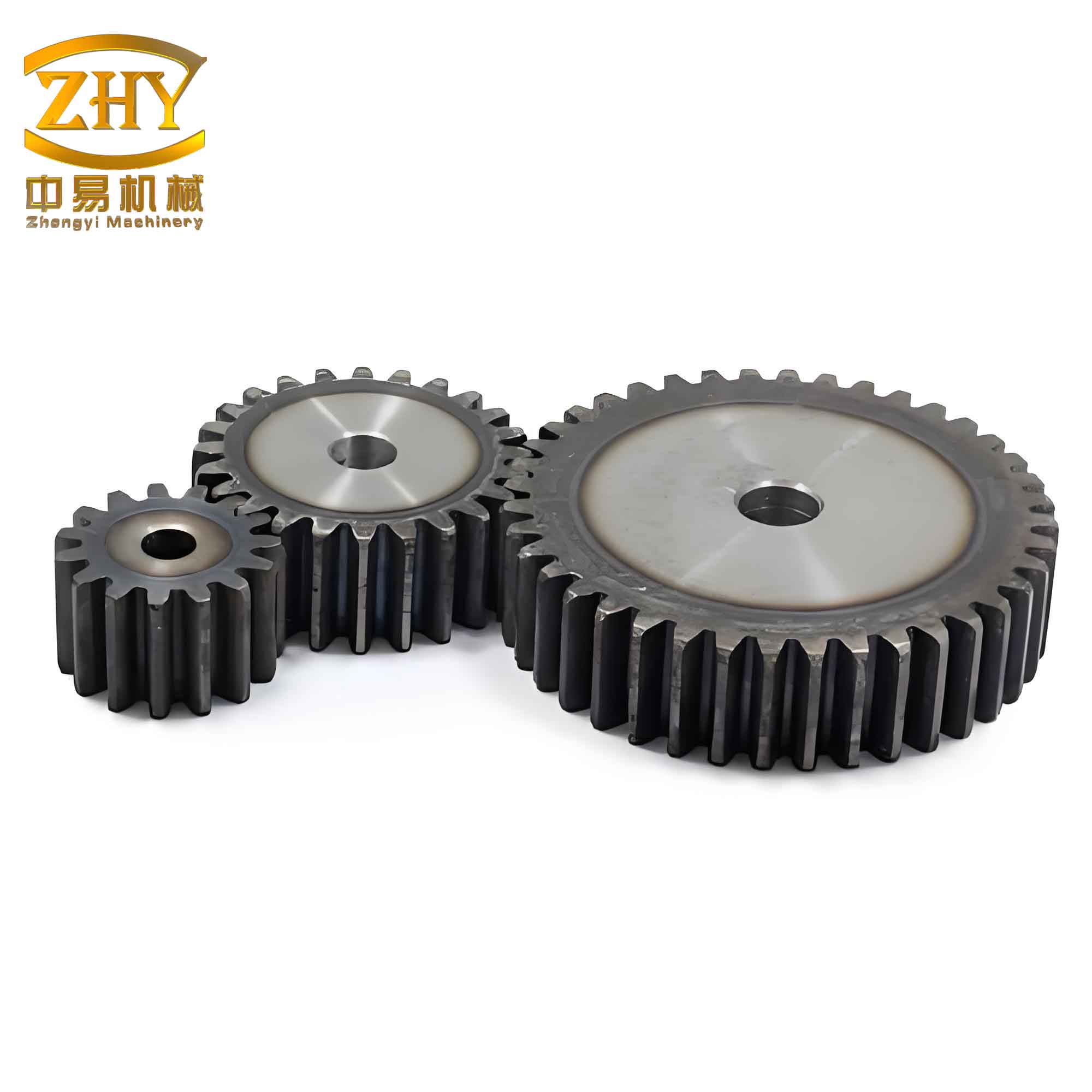
The limitations of the coloring inspection method are multifaceted and become even more pronounced when considering modern design requirements for both spiral bevel and cylindrical gears. Firstly, contemporary gear design mandates tooth profile chamfering and rounding to prevent edge loading and improve fatigue life. This process obscures the clear boundary of the contact imprint, making dimensional measurement highly unreliable and subjective. The visual assessment of the imprint’s shape, size, and position often leads to interpretive disagreements between suppliers and OEMs, especially for cylindrical gears produced in high volumes. Secondly, the method struggles to accommodate the stringent demands of modern gear design, such as ensuring uniform case hardening depth and preserving the integrity of the tooth surface finish. Controlling grinding stock allowance in pre-heat treatment roughing stages (e.g., milling) based on coloring checks is impractical. A more precise, quantitative method is required to control the stock allowance to guarantee subsequent finishing quality, a requirement equally critical for precision cylindrical gears.
The feasibility of replacing subjective coloring checks with objective coordinate measurement is rooted in mathematical logic. Any complex surface, including a gear tooth flank, can be accurately represented by a sufficiently dense set of discrete points. By measuring these points and performing surface fitting, one can derive comprehensive geometric characteristics such as profile deviation, lead deviation, and contour errors. Modern gear CMMs are equipped with sophisticated software capable of automatic grid generation on the tooth flank, programmed point measurement, and automated calculation and evaluation against nominal data. This capability is standard for inspecting cylindrical gears and is increasingly applied to bevel gears. For instance, the deviation of the actual fitted surface from the theoretical surface provides a direct, numerical assessment of flank quality. This point-cloud approach not only quantifies errors but also facilitates gear interchangeability, eliminating the need for selective pairing—a significant advantage for the mass production of cylindrical gears.
Let us formalize the mathematical foundation. The tooth flank surface \( S(u,v) \) can be defined by parametric equations. A CMM measures a set of points \( P_i(x_i, y_i, z_i) \) on the actual surface. The best-fit surface \( S_{fit}(u,v) \) is obtained by minimizing the sum of squared errors between the measured points and the nominal surface \( S_{nom}(u,v) \). The profile and lead errors can then be computed as deviations along specific paths on the surface. For a cylindrical gear, the profile error \( f_{H\alpha} \) and lead error \( f_{H\beta} \) are standard ISO parameters. The CMM directly outputs these values, along with a comprehensive map of flank topography. The overall conformity can be assessed using a root-mean-square (RMS) error metric:
$$ \text{RMS} = \sqrt{\frac{1}{N} \sum_{i=1}^{N} \left[ d(S_{nom}(u_i,v_i), P_i) \right]^2 } $$
where \( d \) is the normal distance from the measured point \( P_i \) to the nominal surface \( S_{nom} \), and \( N \) is the total number of measured points. This quantitative analysis is far superior to qualitative imprint judgment.
| Aspect | Traditional Coloring Inspection | Modern CMM-Based Inspection |
|---|---|---|
| Principle | Visual transfer of contact pattern | Discrete point measurement and surface fitting |
| Output | Qualitative imprint image | Quantitative error data (µm), 3D flank topography |
| Objectivity | Low, subjective interpretation | High, based on numerical standards |
| Measurement of Modified Teeth | Difficult (chamfers/rounds obscure edges) | Accurate, points defined on nominal geometry |
| Applicability to Cylindrical Gears | Common but prone to debate | Ideal, standard practice for quality control |
| Gear Interchangeability | Requires pairing; not guaranteed | Enables true interchangeability |
| Integration with CAD/CAM | Minimal | Full digital thread integration |
In the manufacturing process, the application of CMM inspection varies between finishing (grinding) and roughing (milling) operations. For the final grinding of spiral bevel gears, the proposed hybrid methodology is “CMM-based inspection as the primary method, supplemented by coloring check.” The CMM provides the definitive, data-rich verification of flank geometry, ensuring it meets the theoretical meshing requirements. The supplementary coloring check on a rolling tester (e.g., Gleason No. 523) serves a practical purpose: it offers immediate visual feedback for machine adjustment (V-H adjustments) and provides a holistic, albeit qualitative, assessment of meshing smoothness and noise potential. This dual approach leverages the strengths of both methods. For the milling operation, which precedes heat treatment, there is typically no meshing instruction requirement. However, to control grinding stock for case depth uniformity, I strongly advocate for a “complete replacement of coloring inspection with CMM inspection” at this stage. By measuring the milled flank via CMM, the remaining stock distribution can be precisely mapped and controlled, a process directly analogous to the stock control practiced for high-quality cylindrical gears prior to hardening and finishing.
The control strategy extends critically into the assembly phase. For spiral bevel gears, the ideal meshing contact region is defined for the theoretical assembly position. The concept of “Fixed-Distance Assembly” is pivotal. It involves calculating and setting the axial positions of the gear shafts using adjustment shims so that the assembly replicates the theoretical mounting distance used during the final gear grinding and inspection. This ensures the gear pair operates in its designed, optimal contact regime. The shim calculation is based on a detailed dimensional chain analysis of the assembly components: housing dimensions, bearing widths, and the theoretical gear mounting distances. All components must be measured with high precision, and bearing axial play must be accounted for within the specifications of the meshing instruction sheet (which often includes checks for normal, maximum, and minimum backlash to cover system elasticity and tolerances).
Consider a generic calculation for an adjustment shim thickness \( S \) in a pinion assembly. The dimensional chain can be expressed as:
$$ S = \sum L_{\text{add}} – \sum L_{\text{sub}} $$
Where:
\( \sum L_{\text{add}} \) might include: Housing bore depth (\(L_{h}\)), Distance from housing datum to shaft center (\(L_{c}\)), Pre-defined operational axial play (\(L_{p}\)).
\( \sum L_{\text{sub}} \) might include: Gear mounting distance (\(L_{m}\)), Bearing width(s) (\(L_{b1}, L_{b2}\)), Spacer width (\(L_{s}\)).
Thus:
$$ S = (L_{h} + L_{c} + L_{p}) – (L_{m} + L_{b1} + L_{b2} + L_{s}) $$
This deterministic approach removes guesswork from assembly. After fixed-distance assembly, a final verification via a simple coloring check is still recommended as a secondary safeguard. This check can quickly reveal any gross errors stemming from calculation mistakes, measurement oversights, or component stack-up, confirming the correct contact trend and position. This combined “Fixed-Distance Assembly supplemented by coloring check” method has proven highly effective in ensuring consistent quality, as evidenced by its successful implementation in series production of aero-engine gearboxes, resulting in reliable performance and absence of field failures related to meshing issues. The same principle of deterministic assembly based on precise component measurement is a cornerstone of high-reliability assembly for critical cylindrical gear pairs in transmissions, where center distance and alignment are controlled via housing machining and selective shimming.
The transition to CMM-based inspection is not merely a change in equipment but a fundamental shift in quality philosophy. It aligns with the broader trends of Industry 4.0 and smart manufacturing. The 3D point cloud data from gear inspection can be fed into digital twin models for performance simulation, used for predictive maintenance analytics, or to optimize manufacturing processes through closed-loop feedback. For cylindrical gears, which are often produced using high-volume automated lines, the integration of in-line or near-line CMMs enables 100% inspection and real-time statistical process control (SPC). Key parameters like profile deviation, pitch error, and runout can be monitored on control charts. The mathematical model for process capability analysis, such as calculating the Process Capability Index \( C_{pk} \) for a gear parameter \( X \), becomes empowered by this data:
$$ C_{pk} = \min \left( \frac{USL – \mu}{3\sigma}, \frac{\mu – LSL}{3\sigma} \right) $$
where \( \mu \) is the process mean, \( \sigma \) is the process standard deviation, and \( USL \), \( LSL \) are the specification limits for the gear error (e.g., tooth-to-tooth composite error). This level of quantitative control is unattainable with traditional coloring methods.
| Manufacturing Stage | Recommended Inspection Protocol | Key Benefit for Cylindrical Gears |
|---|---|---|
| Rough Machining (Milling) | Full CMM inspection of flanks to control stock allowance. | Ensures uniform hardening depth; prevents finishing issues. |
| Finish Grinding | Primary: CMM flank grid measurement. Secondary: Coloring check on rolling tester. |
Provides objective pass/fail criteria; enables interchangeability. |
| Gear Assembly | Primary: Fixed-distance assembly via calculated shims. Secondary: Coloring check for gross error detection. |
Ensures design-intent meshing under load; reduces debug time. |
| Incoming Quality Control | CMM verification of key flank geometry parameters. | Standardized acceptance criteria between vendor and customer. |
The argument for CMM-based inspection extends logically to straight bevel gears and, most emphatically, to all forms of cylindrical gears. The geometric complexity of cylindrical gears, while different from bevel gears, equally demands precise control over profile, lead, and pitch. The challenges of subjective imprint evaluation are identical. Major gear manufacturers and standards bodies already endorse and utilize CMMs as the definitive method for inspecting cylindrical gears. The methodology involves generating a measurement grid along the tooth flank, as shown in the conceptual diagram below, which applies universally. The data yields not only composite error ratings but also detailed maps of individual flank deviations, facilitating root-cause analysis for corrections in hobbling, shaping, or grinding processes. For cylindrical gears, the benefits of moving away from subjective master gear rolling checks (the cylindrical gear analog to bevel gear rolling checks) towards CMM-based metrology are well-documented: reduced cost of master gears, elimination of master gear wear influence, and full traceability of measurements to international standards.
In conclusion, based on rigorous analysis and practical validation, the following key findings are presented. Firstly, the process control methodology utilizing “CMM-based inspection to replace coloring inspection” for tooth flank meshing region control is not only feasible but technically superior. This holds true for spiral bevel gears and is directly and powerfully applicable to cylindrical gears, enhancing quality, consistency, and supply chain communication. Secondly, the integrated inspection and assembly strategy—employing “CMM-based inspection as primary, supplemented by coloring check” in grinding, “full CMM replacement” in milling, and “Fixed-Distance Assembly supplemented by coloring check” in final assembly—constitutes a robust, modern framework for gear quality assurance. This framework seamlessly integrates with smart manufacturing paradigms. Finally, the underlying principles are universally valid, making this advanced inspection methodology equally suitable and recommended for straight bevel gears and, most significantly, for the vast array of cylindrical gears that form the foundation of mechanical power transmission across industries. The future of gear inspection is digital, quantitative, and interconnected, and the adoption of these methods is a critical step towards achieving the highest levels of performance and reliability for cylindrical gears and other precision gear types.
The evolution towards data-driven inspection necessitates a reevaluation of legacy standards and practices. For cylindrical gears, which are ubiquitous from automotive transmissions to industrial machinery, the economic and qualitative impact of this shift is profound. By replacing ambiguous visual checks with precise numerical data, manufacturers can achieve tighter tolerances, reduce scrap and rework, and accelerate time-to-market. Furthermore, the digital artifact of the gear inspection—the complete 3D point cloud—becomes a valuable asset for the product lifecycle, useful in design validation, warranty analysis, and remanufacturing. As we advance, the integration of artificial intelligence for automated anomaly detection in flank topography maps will further revolutionize the field. The journey from the artisan’s dye to the metrologist’s point cloud represents a pivotal leap in engineering practice, one that ensures the humble yet critical cylindrical gear continues to meet the ever-growing demands of modern technology.