
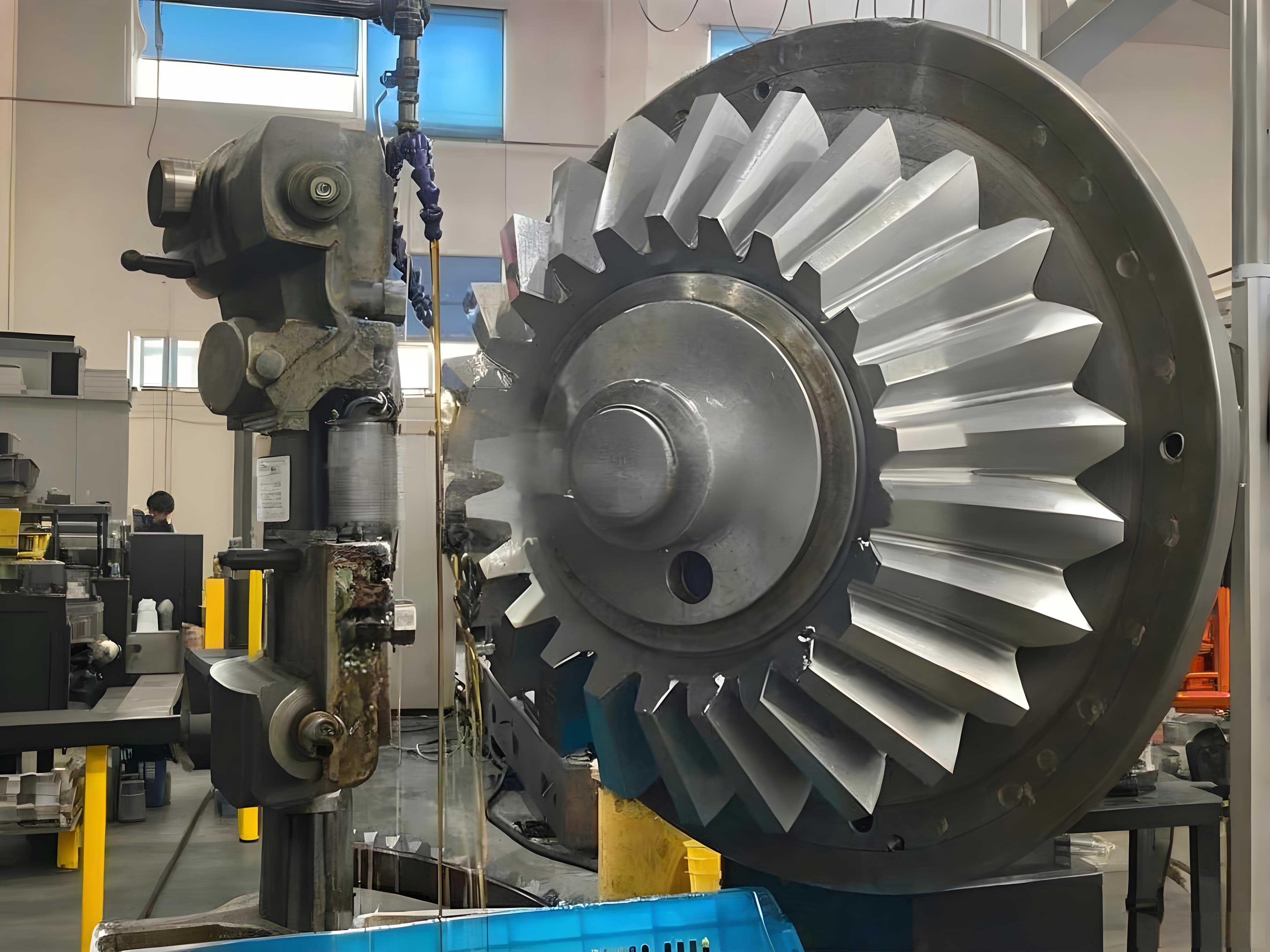
In the design and assembly of miter gears, installation errors inevitably arise due to human factors, measurement tools, and environmental conditions. These errors can lead to unsteady meshing transmission, noise, vibration, impact, and edge contact, significantly affecting the performance and longevity of gear systems. Therefore, analyzing the sensitivity of modified tooth surfaces in miter gears to installation errors is crucial for enhancing transmission quality. In this article, I will explore a method to quantify this sensitivity using the Gauss curvature of differential surfaces, optimize key parameters to reduce sensitivity, and provide practical insights through computational examples. The focus will be on miter gears, as they are widely used in applications requiring precise right-angle power transmission, and their installation error sensitivity directly impacts operational reliability.
To begin, I establish a meshing coordinate system that incorporates installation errors for miter gears. This system includes dynamic coordinate systems attached to the pinion (small gear) and gear (large gear), denoted as $S_1$ and $S_2$, respectively, with origins at $O_1$ and $O_2$ and rotational axes along $x_1$ and $x_2$. A fixed coordinate system $S_f$ is linked to the machine tool, with origin $O_f$ and axis $x_f$. Auxiliary coordinate systems $S_h$, $S_i$, and $S_j$ define the relationships among installation errors. Key error parameters include axial misalignment $\Delta A$, shaft separation error $\Delta B$, and shaft angle variation error $\Delta \beta$. The installation distance for the gear along $x_f$ is $R_f$, and the rotation angles during meshing are $\phi_1’$ for the pinion and $\phi_2’$ for the gear. The transformation matrices between these coordinate systems are derived to account for error effects. For instance, the transformation from $S_1$ to $S_f$ involves rotation and translation due to errors:
$$ \mathbf{r}_f^{(1)} = \mathbf{M}_{f1} \cdot \mathbf{r}_1, $$
where $\mathbf{M}_{f1}$ is a 4×4 homogeneous transformation matrix that includes rotations by $\phi_1’$ and error offsets. Similarly, for the gear, $\mathbf{r}_f^{(2)} = \mathbf{M}_{f2} \cdot \mathbf{r}_2$, with $\mathbf{M}_{f2}$ accounting for $\phi_2’$, $\Delta A$, $\Delta B$, and $\Delta \beta$. Using the theory of gearing (TCA), at any meshing point, the position vectors and normal vectors of both tooth surfaces must coincide in $S_f$. This leads to the following equations:
$$ \mathbf{r}_f^{(1)}(l_1, d_1, \phi_1′) = \mathbf{r}_f^{(2)}(l_2, d_2, \phi_2′), $$
$$ \mathbf{n}_f^{(1)}(l_1, d_1, \phi_1′) = \mathbf{n}_f^{(2)}(l_2, d_2, \phi_2′), $$
where $l_1, d_1$ are the pinion tooth surface parameters, and $l_2, d_2$ are the gear tooth surface parameters. By decomposing these vector equations into five nonlinear algebraic equations with six unknowns (including rotation angles and surface parameters), I can solve for contact points along the meshing path by varying $\phi_1’$ incrementally. This forms the basis for analyzing how installation errors alter contact patterns in miter gears.
Next, I delve into the sensitivity analysis using differential surface geometry. Consider two tooth surfaces $\Sigma_1$ and $\Sigma_2$ that are in point contact at a point $M$, with a common tangent plane. The distance between the surfaces near $M$ along a direction $\alpha$ in the tangent plane is given by:
$$ \Delta \delta = \delta_1 – \delta_2 = \frac{1}{2} \Delta k_n (\Delta L)^2, $$
where $\Delta k_n = k_{n1} – k_{n2}$ is the relative normal curvature (or differential curvature) along $\alpha$, and $\Delta L$ is the projection length. If $\alpha$ makes an angle $\theta$ with a principal direction $\alpha_1$ on $\Sigma_1$, the normal curvatures can be expressed using Euler’s formula. For the pinion surface $\Sigma_1$:
$$ k_{n1} = k_{n1}^{(1)} \cos^2 \theta + 2 \tau_{g1}^{(1)} \sin \theta \cos \theta + k_{n2}^{(1)} \sin^2 \theta, $$
and for the gear surface $\Sigma_2$:
$$ k_{n2} = k_{n1}^{(2)} \cos^2 \theta + 2 \tau_{g1}^{(2)} \sin \theta \cos \theta + k_{n2}^{(2)} \sin^2 \theta. $$
Here, $k_{n1}^{(i)}$ and $k_{n2}^{(i)}$ are the principal curvatures, and $\tau_{g1}^{(i)}$ is the geodesic torsion for surface $i$. The relative normal curvature $\Delta k_n$ is then:
$$ \Delta k_n = \Delta k_{n1} \cos^2 \theta + 2 \Delta \tau_{g1} \sin \theta \cos \theta + \Delta k_{n2} \sin^2 \theta, $$
where $\Delta k_{n1} = k_{n1}^{(1)} – k_{n1}^{(2)}$, $\Delta k_{n2} = k_{n2}^{(1)} – k_{n2}^{(2)}$, and $\Delta \tau_{g1} = \tau_{g1}^{(1)} – \tau_{g1}^{(2)}$. This expression mirrors Euler’s formula, defining a differential surface whose normal curvature in any direction equals the relative normal curvature of the two tooth surfaces. The Gauss curvature $K_{12}$ of this differential surface serves as a key indicator of installation error sensitivity for miter gears. It is computed as:
$$ K_{12} = \Delta k_{n1} \cdot \Delta k_{n2} – (\Delta \tau_{g1})^2 = \kappa_{12}^{(1)} \cdot \kappa_{12}^{(2)}, $$
where $\kappa_{12}^{(1)}$ and $\kappa_{12}^{(2)}$ are the relative principal curvatures. Since $K_{12}$ is a coordinate invariant, it reliably quantifies sensitivity: when $K_{12} = 0$, the gears are in line contact, which is highly sensitive to errors; when $K_{12} > 0$, point contact occurs, and higher values indicate lower sensitivity. For miter gears, I aim for $K_{12} > 0$ to avoid surface interference, and optimizing $K_{12}$ enhances error tolerance. Thus, I refer to $K_{12}$ as the tooth surface installation error sensitivity coefficient.
To calculate $K_{12}$ at a meshing point $M$, I determine the position vector $\mathbf{r}_M(l, d)$ and normal vector $\mathbf{n}_M(l, d)$. The principal directions and curvatures for both surfaces are derived from surface geometry. For miter gears, I often select a design reference point $M$ at the mid-point of the tooth width on the pitch cone. The principal directions on the pinion at $M$ are $\mathbf{e}_f$ and $\mathbf{e}_h$, with curvatures $k_f$ and $k_h$; on the gear, they are $\mathbf{e}_s$ and $\mathbf{e}_q$, with curvatures $k_s$ and $k_q$. By aligning the direction $\alpha$ with $\mathbf{e}_s$, I simplify the computation and use the formulas above to find $K_{12}$. This approach allows me to analyze how factors like reference point location and second-order contact parameters influence sensitivity in miter gears.
I now investigate the effects of various parameters on the sensitivity coefficient $K_{12}$ for miter gears. The reference point $M$ can be shifted along the tooth profile: let $\Delta x$ denote movement along the pitch line (negative toward the toe, positive toward the heel), and $\Delta y$ denote movement along the tooth height (negative toward the root, positive toward the tip). Second-order contact parameters include $\eta_2$ (the angle between the contact path tangent and the root cone at $M$), $m_{21}’$ (a parameter controlling transmission error amplitude), and $a$ (half the length of the contact ellipse major axis). Through parametric studies, I observe the following trends, which are summarized in the table below:
| Parameter | Variation | Effect on $K_{12}$ | Sensitivity Implication |
|---|---|---|---|
| $\Delta x$ (along pitch line) | Toe to heel | $K_{12}$ decreases | Sensitivity increases |
| $\Delta y$ (along tooth height) | Root to tip | $K_{12}$ increases | Sensitivity decreases |
| $\eta_2$ (contact path angle) | Increase | $K_{12}$ increases | Sensitivity decreases |
| $m_{21}’$ (error amplitude control) | Increase | $K_{12}$ decreases | Sensitivity increases |
| $a$ (contact ellipse half-length) | Increase | $K_{12}$ decreases significantly | Sensitivity increases markedly |
The data reveals that the contact ellipse major axis length $2a$ has the most substantial impact on $K_{12}$, with unit changes in $a$ causing larger deviations in $K_{12}$ compared to other parameters. For instance, a unit increase in $a$ might reduce $K_{12}$ by approximately -2.23, whereas changes in $\eta_2$ yield only about $1.26 \times 10^{-5}$ per unit. This underscores the importance of optimizing $2a$ to manage installation error sensitivity in miter gears. To formalize this, I develop an optimization framework using the penalty function method. The goal is to minimize the deviation of $K_{12}$ at all meshing points from its value at the reference point $M$, with $2a$ as the design variable. The objective function is:
$$ f(2a) = \min \sum_{i=1}^{n} \| K_{12}^{(i)} – K_{12}^{(M)} \|, $$
where $K_{12}^{(i)}$ is the sensitivity coefficient at the $i$-th meshing point, and $K_{12}^{(M)}$ is at $M$. Constraints include maintaining gear bending strength and ensuring $K_{12} > 0$. The penalty function incorporates these constraints, and I solve the optimization iteratively to find an optimal $2a$ that reduces sensitivity. For miter gears, I apply tooth surface modifications to the pinion, including parabolic profile crowning in the lengthwise direction and changed ratio of roll in the profile direction. The modified pinion surface equation is:
$$ \mathbf{r}_1(l, d) = [l_1, -a_1 l_1^2, d_1, 1], $$
with crowning coefficient $a_1 = 0.0046$. The roll ratio $I$ for profile modification is:
$$ I = \frac{\cos \theta}{\sin \delta} + 2b (\gamma + \gamma_0), $$
where $b = 0.003$ is the profile modification coefficient, $\theta$ is the dedendum angle, $\delta$ is the pitch cone angle, $\gamma$ is the cradle angle, and $\gamma_0$ is the initial cradle angle. After optimization, I obtain contact patterns that exhibit lower sensitivity to installation errors, with contact paths nearly perpendicular to the root cone—a configuration that enhances error absorption in miter gears.
To illustrate, I present a computational example with miter gear parameters. The table below lists the basic design parameters for the pinion and gear:
| Parameter | Pinion | Gear |
|---|---|---|
| Number of teeth | 32 | 37 |
| Module (mm) | 2.5 | 2.5 |
| Pressure angle (°) | 20 | 20 |
| Shaft angle (°) | 90 | 90 |
| Addendum (mm) | 2.5 | 2.5 |
| Dedendum (mm) | 3.0 | 3.0 |
| Face width (mm) | 18.344 | 18.344 |
| Outer cone distance (mm) | 61.148 | 61.148 |
| Tip cone angle (°) | 40.8553 | 49.1449 |
| Root cone angle (°) | 38.0444 | 46.3351 |
Installation error tolerances are derived from similar analyses for spiral bevel gears, adapted for miter gears. The table below summarizes the error ranges:
| Installation Error | Minimum Value | Maximum Value | Tolerance Band |
|---|---|---|---|
| Axial misalignment $\Delta A$ (mm) | -0.5631 | 1.2511 | 1.8142 |
| Shaft separation $\Delta B$ (mm) | -0.6207 | 1.7926 | 2.4133 |
| Shaft angle variation $\Delta \beta$ (°) | -2.5216 | 3.0315 | 5.5531 |
Using the optimized contact ellipse major axis from the penalty function method, I simulate contact patterns under various error conditions. Without installation errors, the contact path is centrally located along the tooth surface. With errors, the contact path shifts: for negative $\Delta A$ or $\Delta \beta$, it moves toward the heel; for positive values, toward the toe. Conversely, $\Delta B$ causes opposite shifts. However, due to optimization, these shifts are minimal, and the contact path remains nearly perpendicular to the root cone, indicating low sensitivity. This demonstrates that modified miter gears can effectively absorb installation errors, maintaining stable meshing and reducing noise and vibration.
In conclusion, my analysis highlights several key findings for miter gears. First, the contact ellipse major axis length $2a$ exerts the greatest influence on the tooth surface installation error sensitivity coefficient $K_{12}$, making it a critical parameter for optimization. Second, by applying the penalty function method to optimize $2a$, I can achieve contact patterns with low sensitivity to installation errors in miter gears. Third, when the contact path is perpendicular to the root cone, the sensitivity is further reduced, enhancing the meshing performance of modified miter gears. These insights contribute to improved design practices for miter gears, ensuring reliability in real-world applications where installation errors are unavoidable. Future work could extend this approach to other gear types or dynamic loading conditions, but for now, focusing on miter gears provides a solid foundation for error-resistant gear systems.