
Additive Manufacturing, widely known as 3D printing, has revolutionized prototyping and manufacturing by enabling the direct fabrication of complex geometries from digital models. The process builds parts layer-by-layer, offering significant advantages in design freedom, tooling elimination, and lead time reduction. Among various applications, the fabrication of functional mechanical components, such as gears, presents a unique challenge and opportunity. This study focuses on the herringbone gear, a sophisticated gear type known for its high load capacity and smooth, axial-force-canceling operation. Manufacturing a herringbone gear through traditional subtractive methods is notoriously difficult and expensive due to its opposing helical teeth. Fused Filament Fabrication (FFF), a prevalent 3D printing technology, offers a viable path for its economical production, especially in prototypes or low-volume applications.
The quality and structural integrity of FFF-produced parts are critically dependent on process parameters. Key among these are the nozzle temperature, build chamber (or environmental) temperature, and print speed. These parameters govern the thermal history of the material, directly influencing layer adhesion, crystallinity, residual stress, and ultimately, the mechanical properties and internal soundness of the part. Acrylonitrile Butadiene Styrene (ABS) is a common thermoplastic in FFF, valued for its strength and thermal resistance, but it is particularly prone to warping and poor inter-layer bonding if processed at sub-optimal temperatures. This investigation systematically examines the influence of build chamber temperature on the internal structure of an ABS herringbone gear. By employing non-destructive ultrasonic testing, we correlate temperature settings with the presence of internal flaws such as voids and delaminations.
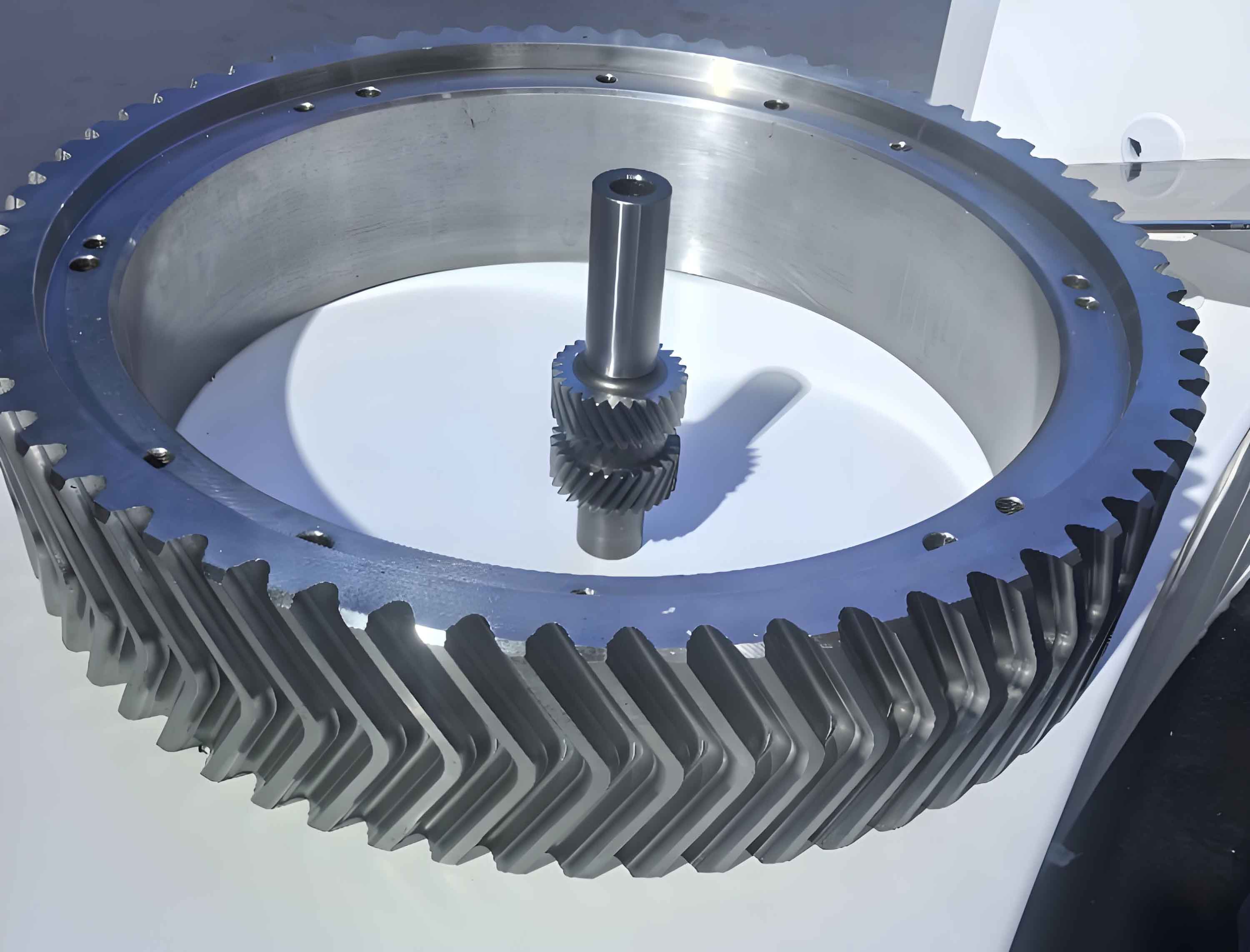
The geometry of the test specimen was meticulously designed. The herringbone gear was chosen for its complexity, which tests the printer’s ability to handle overhangs and intricate details without supports. The primary design parameters are summarized in the table below.
| Parameter | Symbol | Value | Unit |
|---|---|---|---|
| Normal Module | $$m_n$$ | 2.5 | mm |
| Number of Teeth | $$z$$ | 20 | – |
| Face Width | $$B$$ | 10 | mm |
| Normal Pressure Angle | $$\alpha_n$$ | 20 | ° |
| Helix Direction | – | Left Hand | – |
| Helix Angle | $$\beta$$ | 20 | ° |
| Pitch Diameter | $$d$$ | $$d = \frac{m_n \cdot z}{\cos\beta} \approx 53.2$$ | mm |
| Tip Diameter | $$d_a$$ | $$d_a = d + 2 \cdot m_n \approx 58.2$$ | mm |
| Root Fillet Radius | $$\rho_f$$ | 0.25 | mm |
The pitch diameter $$d$$ is calculated considering the helix angle, demonstrating the basic gear geometry relationship. The 3D model was created using CAD software and exported for slicing. All gears were printed using the same FFF printer with a 0.4 mm nozzle diameter. The material was standard 1.75 mm diameter ABS filament. To isolate the effect of build chamber temperature, other critical parameters were held constant, as detailed below.
| Process Parameter | Value |
|---|---|
| Nozzle Temperature | 230 °C |
| Print Speed | 50 mm/s |
| Layer Height | 0.2 mm |
| Infill Density | 100% (Solid) |
| Raster Angle | 45° / -45° (Alternating per layer) |
| Build Platform | Heated, 110 °C |
| Build Chamber Temperature | 30°C, 60°C, 90°C |
The build chamber temperature was the controlled variable. A chamber temperature of 30°C represents a near-ambient, unenclosed printer environment. At 60°C, the chamber is warm, approaching the glass transition temperature ($$T_g$$) of ABS, which is typically around 105°C. At 90°C, the chamber temperature is just below $$T_g$$, significantly slowing the cooling rate of the deposited material.
Theoretical models help explain the expected outcomes. The bonding between adjacent filaments (roads) is a diffusion-driven process governed by temperature and time. The degree of healing or coalescence can be modeled. One fundamental equation describing the growth of the contact width $$w$$ between two viscous cylinders over time $$t$$ is derived from Frenkel’s model and modified for polymers:
$$
\left( \frac{w}{D} \right)^2 = \frac{\Gamma t}{\eta D}
$$
Where $$D$$ is the initial filament diameter, $$\Gamma$$ is the surface tension, and $$\eta$$ is the viscosity. The viscosity is highly temperature-dependent, often following an Arrhenius-type relationship:
$$
\eta(T) = \eta_0 \exp\left(\frac{E_a}{RT}\right)
$$
Here, $$E_a$$ is the flow activation energy, $$R$$ is the gas constant, and $$T$$ is the absolute temperature. A higher chamber temperature $$T_{chamber}$$ keeps the previously deposited layer at a higher temperature $$T_{layer}$$ for a longer time. When a new hot filament is deposited, the interface temperature $$T_{interface}$$ is higher than in a cold chamber scenario. According to the equations, a higher $$T_{interface}$$ leads to a lower $$\eta$$, which significantly increases the rate of coalescence $$\left( \frac{w}{D} \right)^2$$. Conversely, at low $$T_{chamber}$$, the previous layer cools rapidly, resulting in a high viscosity at the interface when the new layer arrives, severely limiting molecular diffusion and bond formation. This creates weak boundaries that act as potential sites for crack initiation.
The printing process was executed three times, once for each chamber temperature setting. The gear printed at 30°C exhibited severe visual defects: significant warping, layer delamination, and a rough, dimensionally inaccurate surface. It was deemed a failed print and excluded from further non-destructive analysis as its structural inadequacy was evident. The gears printed at 60°C and 90°C were visually sound, with good geometrical fidelity and surface finish for the herringbone gear profile.
To probe the internal structure non-destructively, Ultrasonic Testing (UT) was employed. UT works on the principle of sending high-frequency sound waves (typically 0.5-20 MHz) into a material and interpreting the reflected signals. In a pulse-echo configuration, a single transducer acts as both transmitter and receiver. When the ultrasonic wave encounters an interface with different acoustic impedance (e.g., a void, crack, or the back wall of the part), a portion of the wave is reflected back to the transducer.
The key parameters in ultrasonic evaluation are:
- Time-of-Flight (ToF): The time taken for the wave to travel to a reflector and back. It relates to the depth of the reflector: $$d = \frac{v \cdot ToF}{2}$$, where $$v$$ is the speed of sound in the material.
- Amplitude: The height of the reflected signal on the display. The amplitude of a back-wall echo is related to the material’s attenuation and the presence of scatterers.
- Attenuation Coefficient (α): A measure of how much ultrasonic energy is lost per unit distance traveled. It increases with frequency and is sensitive to microstructure, porosity, and internal scattering. It can be approximated from back-wall echo amplitudes: $$\alpha \approx \frac{1}{2x} \ln\left(\frac{A_0}{A_1}\right)$$, where $$x$$ is the thickness, and $$A_0$$ and $$A_1$$ are the amplitudes of the first and second back-wall echoes, respectively.
A 5 MHz normal-incidence immersion probe was used to scan the web region of the herringbone gear. Couplant was applied to ensure efficient sound transmission. The resulting A-scans (amplitude vs. time) for the two viable gears are described qualitatively and quantitatively.
Gear Printed at 60°C Chamber Temperature: The A-scan showed a strong initial pulse (surface echo), followed by a highly attenuated and noisy signal within the body of the gear. Multiple small, irregular reflections were observed between the front and back wall echoes. The first back-wall echo (BWE1) was present but had a significantly reduced amplitude compared to a theoretical flawless sample. The second back-wall echo (BWE2) was barely discernible above the noise floor. This pattern is characteristic of a material with high acoustic scattering and absorption, indicative of numerous micro-voids, poor inter-layer bonds, and potentially micro-cracks. These discontinuities scatter the ultrasonic energy in all directions, preventing a coherent, strong reflection from the back wall and causing high signal attenuation.
Gear Printed at 90°C Chamber Temperature: The A-scan presented a markedly cleaner signal. The initial pulse was sharp, and the region between it and the back-wall echo was relatively free of spurious indications. The first back-wall echo (BWE1) was strong and clear. A distinct second back-wall echo (BWE2) was also visible, indicating that sufficient energy had passed through the material, reflected off the back wall twice, and returned to the transducer. This pattern signifies low attenuation and minimal internal scattering, which translates to a more homogeneous and densely consolidated internal structure with fewer and smaller flaws.
The quantitative assessment is summarized in the following table, using relative dB values normalized to a known reference. The attenuation is inferred from the relative amplitudes of the back-wall echoes.
| Sample (Chamber Temp.) | Back-Wall Echo 1 Amplitude (Relative dB) | Back-Wall Echo 2 Visible? | Inferred Attenuation | Internal Flaw Indications |
|---|---|---|---|---|
| 60°C | -18 dB | No | Very High | Numerous, distributed |
| 90°C | -3 dB | Yes | Low | Few, minor |
The results unequivocally demonstrate the profound impact of build chamber temperature on the integrity of the 3D printed ABS herringbone gear. At 30°C, thermal stresses induced by rapid cooling exceed the inter-layer bond strength, causing immediate macroscopic failure. At 60°C, while the part holds together, the thermal gradient between the hot nozzle deposit and the cooler surrounding layers is still substantial. The deposited ABS filament undergoes a rapid quenching effect. This limits the time available for polymer chain diffusion across layer boundaries, leading to a microstructure riddled with incomplete welds and micro-porosity. These act as stress concentrators and significantly degrade mechanical properties like tensile strength, fatigue life, and impact resistance, which are critical for a functional herringbone gear.
At 90°C, the environment minimizes the thermal gradient. The previously deposited layers remain close to their glass transition temperature, keeping them in a more compliant state. When a new layer is deposited, the heat from the nozzle does not dissipate as quickly, maintaining the interface at an elevated temperature for a longer period. This extended “thermal window” allows for more complete polymer chain entanglement and diffusion across the interface, effectively “healing” the boundary and creating a more monolithic, isotropic structure with properties closer to bulk ABS. The ultrasonic evidence of low attenuation confirms this superior consolidation.
For a functional component like a herringbone gear, which is subject to cyclic bending and contact stresses, internal flaws are detrimental. The fatigue life $$N_f$$ of a material is highly sensitive to flaw size $$a$$, as described by Paris’ law for crack growth:
$$
\frac{da}{dN} = C (\Delta K)^m
$$
Where $$\Delta K$$ is the stress intensity factor range, proportional to $$\Delta \sigma \sqrt{\pi a}$$. Larger initial flaws ($$a$$) resulting from poor layer bonding at low temperatures lead to a higher initial $$\Delta K$$, dramatically accelerating crack propagation and leading to premature gear tooth failure. Therefore, optimizing the chamber temperature is not merely about achieving geometric form, but about ensuring the structural durability of the herringbone gear.
In conclusion, this study provides a clear, data-driven correlation between the FFF build chamber temperature and the internal structural quality of an ABS herringbone gear. Non-destructive ultrasonic testing served as an effective tool for quantifying this relationship, revealing high attenuation and significant flaw populations at lower temperatures versus low attenuation and superior consolidation at elevated temperatures. The optimal chamber temperature of 90°C for ABS, close to but below its $$T_g$$, facilitates the necessary molecular diffusion for strong inter-layer bonding, directly translating to improved mechanical integrity. While this investigation focused on a specific ABS herringbone gear, the underlying thermal principles and the methodology are broadly applicable. Future work could extend this analysis by correlating UT findings with quantitative mechanical testing (tensile, fatigue, impact) on specimens printed under identical conditions. Furthermore, developing a comprehensive thermo-mechanical model that predicts optimal chamber and nozzle temperatures for different geometries and materials would be a significant advancement for the reliable 3D printing of high-performance, load-bearing components like the herringbone gear.