
The nonlinear dynamics of gear transmission systems, particularly those involving clearance and time-varying parameters, present significant challenges to operational stability and longevity. This is especially critical in applications such as high-speed train transmission gearboxes, where gear failures and excessive vibration are often attributed to backlash and parametric excitations. Among various gear types, miter gears, a specific configuration of straight bevel gears with a 1:1 ratio and typically 90-degree shaft axes, are fundamental components in many power transfer applications requiring direction change. This study focuses on the complex nonlinear vibrational behavior of a miter gear system, investigating the intricate coupling between periodic motion bifurcations, tooth surface impacts, non-meshing states, and dynamic load fluctuations. The primary objective is to map the global transition landscape of these dynamic characteristics across a two-parameter plane, providing a comprehensive theoretical foundation for selecting optimal design and operational parameters to mitigate adverse dynamic effects.
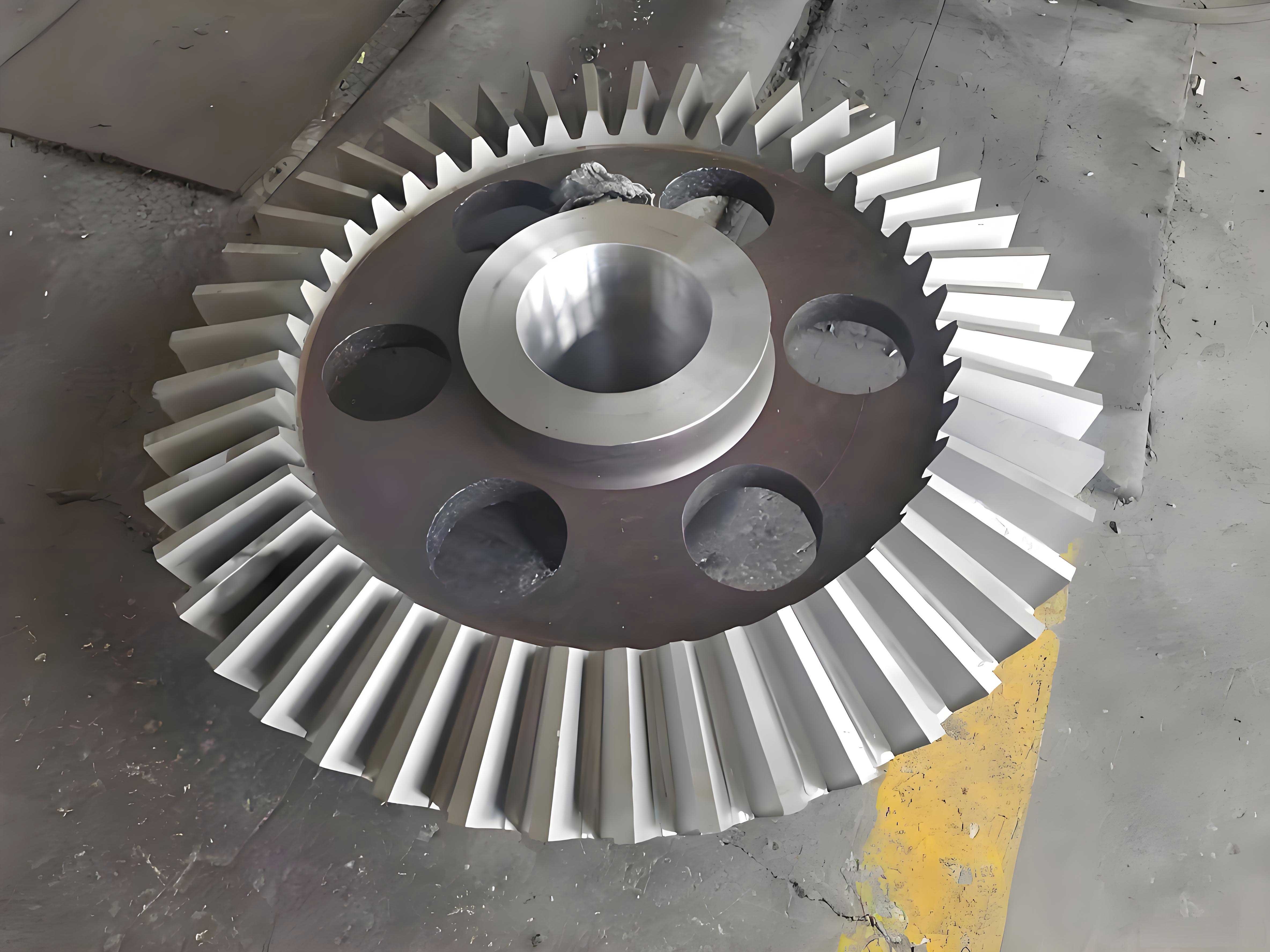
Previous research on gear dynamics has extensively explored bifurcation and chaos using methods like wavelet analysis and numerical integration. However, these methods often lack efficiency in revealing global bifurcation transition structures across parameter spaces. The cell mapping principle, combined with advanced continuation methods, offers a powerful alternative for constructing global solution domain boundaries. In this work, we employ an improved Continuous-Poincaré-Newton-Floquet (CPNF) method within a cell-mapping framework to efficiently solve for periodic orbits, track their stability, and simultaneously characterize associated impact and load metrics across a vast parameter grid. This approach allows us to systematically uncover the rich bifurcation phenomena and their direct consequences on the operational integrity of a miter gear pair.
1. Dynamic Model of the Miter Gear System
The dynamical model considers a pair of straight bevel miter gears with orthogonal axes, incorporating time-varying meshing stiffness, static transmission error, and backlash. Each gear is supported by flexible bearings modeled with stiffness and damping components along three translational directions. The system is assumed to have 7 degrees of freedom (DOF): three translational motions for each gear mass at the mid-point of the face width, and one rotational DOF derived from the combined torsional vibration along the line of action. The gears are considered rigid bodies, neglecting bending and tilting vibrations. The driving pinion is subjected to a torque consisting of a constant mean component and a small variable component, while the driven gear is under a constant resisting torque.
The dynamic transmission error along the line of action, \(\lambda(\tau)\), which is the fundamental coordinate capturing the gear pair interaction, is defined as:
$$
\lambda = (x_1 – x_2)a_1 – (y_1 – y_2)a_2 – (z_1 + \bar{r}_1\theta_1 – z_2 – \bar{r}_2\theta_2)a_3 – e(\tau)
$$
where \(x_j, y_j, z_j\) (j=1,2) are the dimensionless translational displacements of the pinion and gear, \(\theta_j\) are the torsional coordinates, \(\bar{r}_j\) are the dimensionless base circle radii, \(a_1, a_2, a_3\) are geometric constants derived from the pitch cone angle \(\delta_1\) and normal pressure angle \(\alpha_n\), and \(e(\tau)\) is the dimensionless static composite error, expanded as a Fourier series:
$$
e(\tau) = \sum_{l=1}^{N} E_l \cos(l\omega \tau + \phi_l^e)
$$
The time-varying meshing stiffness \(k(\tau)\) is also expressed as a Fourier series around its mean value:
$$
k(\tau) = k_m + \sum_{l=1}^{N} k_l \cos(l\omega \tau + \phi_l^k)
$$
The backlash nonlinearity is modeled by a piecewise linear function \(f(\lambda, b)\):
$$
f(\lambda, b) =
\begin{cases}
\lambda – b, & \lambda > b \\
0, & |\lambda| \le b \\
\lambda + b, & \lambda < -b
\end{cases}
$$
where \(b\) is the dimensionless half-backlash. The meshing force \(F_n\) and its components along the coordinate axes are:
$$
\begin{aligned}
F_n &= k(\tau) f(\lambda, b) + c_h \dot{\lambda} \\
F_x &= -a_4 F_n \\
F_y &= a_5 F_n \\
F_z &= a_3 F_n
\end{aligned}
$$
where \(c_h\) is the meshing damping, and \(a_4, a_5\) are additional geometric constants. Applying Newton’s second law and consolidating the torsional equations using the dynamic transmission error leads to the final dimensionless equations of motion for the 7-DOF system:
$$
\begin{aligned}
\ddot{x}_1 + 2\xi_{x1}\dot{x}_1 + 2a_4\xi_{h1}\dot{\lambda} + \kappa_{x1}x_1 + a_4 \bar{k}_{h1} f(\lambda, b) &= 0 \\
\ddot{y}_1 + 2\xi_{y1}\dot{y}_1 – 2a_5\xi_{h1}\dot{\lambda} + \kappa_{y1}y_1 – a_5 \bar{k}_{h1} f(\lambda, b) &= 0 \\
\ddot{z}_1 + 2\xi_{z1}\dot{z}_1 – 2a_3\xi_{h1}\dot{\lambda} + \kappa_{z1}z_1 – a_3 \bar{k}_{h1} f(\lambda, b) &= 0 \\
\ddot{x}_2 + 2\xi_{x2}\dot{x}_2 – 2a_4\xi_{h2}\dot{\lambda} + \kappa_{x2}x_2 – a_4 \bar{k}_{h2} f(\lambda, b) &= 0 \\
\ddot{y}_2 + 2\xi_{y2}\dot{y}_2 + 2a_5\xi_{h2}\dot{\lambda} + \kappa_{y2}y_2 + a_5 \bar{k}_{h2} f(\lambda, b) &= 0 \\
\ddot{z}_2 + 2\xi_{z2}\dot{z}_2 + 2a_3\xi_{h2}\dot{\lambda} + \kappa_{z2}z_2 + a_3 \bar{k}_{h2} f(\lambda, b) &= 0 \\
-a_1\ddot{x}_1 + a_2\ddot{y}_1 + a_3\ddot{z}_1 + a_1\ddot{x}_2 – a_2\ddot{y}_2 – a_3\ddot{z}_2 + \ddot{\lambda} + 2a_3\xi_h\dot{\lambda} + a_3 \bar{k}_h(\tau) f(\lambda, b) &= f_m + f_v(\tau) + f_e \omega^2 \cos(\omega \tau)
\end{aligned}
$$
where \(\xi\) terms are damping ratios, \(\kappa\) terms are stiffness ratios, \(\omega\) is the dimensionless excitation frequency (ratio of meshing frequency to natural frequency), \(f_m\) is the mean force, \(f_v\) is the variable excitation, and \(f_e\) is the error excitation amplitude. The parameters \(\bar{k}_{h1}, \bar{k}_{h2}, \bar{k}_h\) relate to the meshing stiffness distribution. This model comprehensively captures the essential nonlinearities of a miter gear system for dynamic analysis.
2. Dynamic Characterization Metrics
To quantitatively assess the system’s dynamic performance, several key metrics are defined based on the periodic solution for the dynamic transmission error \(\lambda(\tau)\).
2.1 Impact State and Periodicity (I/P)
The tooth contact state within a motion period is classified by the minimum value of \(\lambda(\tau)\), \(\lambda_{min}\), relative to the backlash boundaries \(\pm b\):
| Impact State (I) | Condition on \(\lambda_{min}\) | Physical Description |
|---|---|---|
| 0 | \(\lambda_{min} > b\) | No impact, continuous meshing |
| 0* | \(\lambda_{min} = b\) | Tooth surface friction/slide (Grazing) |
| 1 | \(-b < \lambda_{min} < b\) | Unilateral impact (Tooth separation) |
| 1* | \(\lambda_{min} = -b\) | Tooth back friction/slide (Grazing) |
| 2 | \(\lambda_{min} < -b\) | Bilateral impact (Back-side contact) |
The periodicity \(P\) denotes the number of excitation periods in one complete motion cycle. The combined notation \(I/P\) (e.g., 1/1, 2/3) fully characterizes a periodic motion’s impact nature and multiplicity.
2.2 Non-Meshing and Back-Meshing Duty Coefficients
The severity of tooth separation and back-side contact is quantified by duty coefficients, defined as the fraction of time within one motion period \(T\) spent in each state:
$$
\delta_{NMDC} = \frac{t_{non-mesh}}{T}, \quad \delta_{BMDC} = \frac{t_{back-mesh}}{T}
$$
where \(t_{non-mesh}\) is the total time when \(|\lambda(\tau)| < b\) (Impact State 1), and \(t_{back-mesh}\) is the total time when \(\lambda(\tau) < -b\) (Impact State 2). These coefficients range from 0 to 1.
2.3 Dynamic Load Coefficient
The dynamic load factor, representing the magnification of the mean load due to vibrations, is defined as:
$$
\delta_{DLC} = \frac{ \max_{\tau \in [0,T]} | F_n(\tau) | }{F_m} = \frac{ \max_{\tau \in [0,T]} | \, k(\tau)f(\lambda, b) + 2\xi_h \dot{\lambda} \, | }{f_m}
$$
where \(F_m\) is the dimensionless mean meshing force. This metric is crucial for gear strength design and fatigue life prediction.
3. Methodology: Cell Mapping and CPNF Continuation
To explore the global dynamics across parameter space, we employ a cell mapping approach combined with the CPNF method for efficient and accurate tracking of periodic solutions.
3.1 Parameter Domain Discretization
A two-parameter plane \(\Theta: (\omega, \alpha) \in [\omega_l, \omega_u] \times [\alpha_l, \alpha_u]\) is constructed, where \(\omega\) is the frequency ratio and \(\alpha\) is the amplitude coefficient of the time-varying meshing stiffness (\(k_l/k_m\)). This plane is discretized into a grid of \(N \times M\) cells. Each cell \(c_{ij}\) represents a unique parameter combination \((\omega_i, \alpha_j)\):
$$
\omega_i = \omega_l + i \cdot \Delta \omega, \quad \Delta \omega = (\omega_u – \omega_l)/N
$$
$$
\alpha_j = \alpha_l + j \cdot \Delta \alpha, \quad \Delta \alpha = (\alpha_u – \alpha_l)/M
$$
3.2 The CPNF Solution and Continuation Procedure
For each parameter cell, the periodic solution of the non-autonomous system \(\dot{\mathbf{X}} = \mathbf{F}(\mathbf{X}, \tau; \omega, \alpha)\) with period \(T = 2\pi m/\omega\) (where \(m\) is the periodicity) is sought. The CPNF method solves the two-point boundary value problem defined by the Poincaré map \(\mathbf{P}\):
$$
\mathbf{G}(\mathbf{X}_0, \omega, \alpha) = \mathbf{X}_0 – \mathbf{P}(\mathbf{X}_0, \omega, \alpha) = \mathbf{0}
$$
where \(\mathbf{X}_0\) is the state vector at \(\tau=0\). The Jacobian \(\mathbf{DG} = \mathbf{I} – \mathbf{DP}(\mathbf{X}_0)\) is obtained by integrating the variational equations alongside the state equations. The Newton-Raphson iteration is used to find the fixed point \(\mathbf{X}_0^*\).
Continuation along a parameter (e.g., \(\omega\)) is performed using a predictor-corrector scheme. The tangent predictor at step \(k\) for parameter \(\omega_{k+1} = \omega_k + \delta\omega\) is:
$$
\mathbf{X}_{0,k+1}^{(0)} = \mathbf{X}_{0,k} – [\mathbf{G}_{\mathbf{X}}(\omega_k, \mathbf{X}_{0,k})]^{-1} \mathbf{G}_{\omega}(\omega_k, \mathbf{X}_{0,k}) \delta\omega
$$
where \(\mathbf{G}_{\omega} = -\mathbf{P}_{\omega}\) is obtained by integrating the sensitivity equation \(\dot{\mathbf{P}}_{\omega} = \mathbf{F}_{\mathbf{X}}\mathbf{P}_{\omega} + \mathbf{F}_{\omega}\). This predicted state is then corrected using Newton’s method to converge to the true fixed point \(\mathbf{X}_{0,k+1}^*\) for the new parameter.
3.3 Stability and Bifurcation Detection
The stability of a periodic orbit is determined by the Floquet multipliers \(\mu_i\), the eigenvalues of the monodromy matrix \(\mathbf{DP}(\mathbf{X}_0^*)\). A multiplier crossing the unit circle indicates a bifurcation:
| Bifurcation Type | Multiplier Criterion | Dynamic Consequence |
|---|---|---|
| Saddle-Node (SN) | \(\mu = +1\) (Real) | Creation/annihilation of periodic orbits |
| Period-Doubling (PD) | \(\mu = -1\) (Real) | Period-2 orbit emerges |
| Hopf (HP) | \(\mu_{1,2} = e^{\pm i\theta}\) (Complex pair) | Onset of quasi-periodic motion |
| Grazing (G) | Discontinuity in \(\mathbf{DP}\) at \(\lambda = \pm b\) | Sudden change in impact state |
| Period-3 (3T) | Associated with 3-cycle | Route to chaos (Intermittency) |
When a bifurcation is detected during continuation in a cell, the tracking is halted. The new born periodic solution (e.g., period-doubled) is then solved for using the PNF method from a perturbed initial condition, and its own continuation is initiated. This process maps out the intricate web of solution branches within each parameter cell.
3.4 Construction of Solution Domain Boundaries
The algorithm sweeps through the parameter grid. For a fixed \(\alpha_j\), it starts at \(\omega_l\), finds an initial periodic solution, and continues along \(\omega\) until a bifurcation or the boundary \(\omega_u\) is reached. After completing the \(\omega\)-sweep for one \(\alpha\) level, the algorithm increments \(\alpha_j\) and repeats the process. For each successfully computed periodic orbit, the metrics \(\delta_{NMDC}\), \(\delta_{BMDC}\), and \(\delta_{DLC}\) are calculated. The collection of all \(I/P\) states and their corresponding metrics across the entire grid forms the “solution domain boundary structure.” This structure visually reveals regions of different dynamic behaviors (periodic, quasi-periodic, chaotic) and how performance metrics vary with parameters.
4. Results: Dynamic Characteristics in the Frequency-Stiffness Parameter Plane
Simulations were performed for the dimensionless parameter set: \(\xi_{ij}=0.01\), \(\xi_{h1}=\xi_{h2}=0.0125\), \(\xi_h=0.05\), \(\kappa_{ij}=1.0\), \(\bar{k}_{h1}=\bar{k}_{h2}=0.5\), \(f_m=0.5\), \(f_v=0\), \(f_e=0.2\), \(b=1.0\). The time-varying stiffness is \(k(\tau)=1 + \alpha \cos(\omega \tau)\). The parameter plane \(\Theta: (\omega, \alpha) \in [1.2, 1.7] \times [0.05, 0.55]\) was discretized into a 501×501 grid.
4.1 I/P Solution Domain Structure
The \(I/P\) structure, shown conceptually below, reveals a rich tapestry of dynamical behaviors for the miter gear system. Dominant regions of period-1 motion (P=1) are observed, coexisting with higher periodic orbits (P=2, 3, 9, 10, 18, 32), quasi-periodic (QP), and chaotic (C) motions. All three impact states (0, 1, 2) are present, with unilateral impact (State 1) being the most prevalent.
Key observations from the structure include:
- Low \(\alpha\) region (\(\alpha < 0.15\)): As \(\omega\) increases, the system undergoes saddle-node (SN) and period-3 (3T) bifurcations, leading to transitions between 0/1, 1/1, and 1/3 motions. The dynamics are relatively simple, dominated by single-period responses.
- Medium \(\alpha\) region (\(0.15 < \alpha < 0.30\)): This zone exhibits complex routes to chaos. System trajectories encounter period-doubling (PD) cascades, Hopf bifurcations (HP) leading to quasi-periodicity, and sudden chaotic transitions via interior crises (CIC). The interplay between stiffness variation and inertia forces becomes significant.
- High \(\alpha\) region (\(0.30 < \alpha < 0.55\)): Strong parametric excitation leads to abundant grazing bifurcations (G), period-3 windows within chaos, and boundary crises. Notably, near \(\omega \approx 1.6\), a very narrow parameter band shows extreme sensitivity, with rapid alternations between periodic and chaotic attractors. This indicates a potential “danger zone” for operational instability.
- Frequency Dependence: For \(\omega < 1.25\), dynamics are dominated by transitions between the three impact states within P=1 motion. The range \(1.25 < \omega < 1.5\) shows the most stable periodic behavior. For \(\omega > 1.5\), complex sequences of HP, 3T, and CIC bifurcations govern the transition from periodicity to chaos and back.
This structure underscores that the stiffness variation coefficient \(\alpha\), linked to load sharing and contact ratio in miter gears, is a primary driver of nonlinear phenomena. Increasing \(\alpha\) significantly raises the probability of tooth separation and back-side contact. Furthermore, the system exhibits classic nonlinear signatures like period-3 bifurcations, a common precursor to chaos in gear systems.
4.2 Duty Coefficients and Dynamic Load Structures
The solution domains for the performance metrics \(\delta_{NMDC}\), \(\delta_{BMDC}\), and \(\delta_{DLC}\) are directly correlated with the \(I/P\) structure. Their values exhibit sharp jumps across bifurcation boundaries, highlighting the discontinuous nature of the system’s response to parameter changes.
| Metric | Parameter Dependence within a Stable I/P Region | Maximum Value & Location | Correlation with Dynamics |
|---|---|---|---|
| \(\delta_{NMDC}\) (Non-Meshing) | Increases with \(\alpha\); Decreases with \(\omega\) | ~0.55 near G-bifurcations in 1/1 regions | Not necessarily maximal in chaotic zones. Severe separation can occur in simple periodic motions with grazing. |
| \(\delta_{BMDC}\) (Back-Meshing) | Increases with \(\alpha\); Increases with \(\omega\) in State 2 regions | ~0.38 in 2/1 regions | Most severe in stable bilateral impact (2/1) zones. Chaos does not necessarily maximize back-contact. |
| \(\delta_{DLC}\) (Dynamic Load) | Increases with \(\alpha\); Varies with \(\omega\) and impact state | ~2.8 in 2/1 and 2/N regions | Strongly correlated with impact severity. Highest loads occur during bilateral impact states, posing greatest risk for fatigue. |
The trends are mathematically summarized as:
$$
\frac{\partial \delta_{NMDC}}{\partial \alpha} > 0, \quad \frac{\partial \delta_{NMDC}}{\partial \omega} \bigg|_{I/P=\text{const}} < 0
$$
$$
\frac{\partial \delta_{BMDC}}{\partial \alpha} > 0, \quad \frac{\partial \delta_{BMDC}}{\partial \omega} \bigg|_{I/P=\text{const}} > 0 \ (\text{for State 2})
$$
$$
\frac{\partial \delta_{DLC}}{\partial \alpha} > 0, \quad \delta_{DLC}^{\max} \in \{\text{Regions with } I=2\}
$$
4.3 Validation and Detailed Bifurcation Sequences
To validate the CPNF-generated domain structure, conventional numerical integration (Runge-Kutta) was used to create bifurcation diagrams at fixed \(\alpha\) slices. The results confirmed the identified periodicities, impact states, and bifurcation points. Two representative slices are analyzed:
For \(\alpha = 0.20\): As \(\omega\) increases, the system undergoes: 1/1 (State 1) \(\xrightarrow[\text{3T Bif.}]{}\) 2/3 (State 2) \(\xrightarrow[\text{Hopf Bif.}]{}\) Quasi-periodic motion on a torus \(\xrightarrow[\text{CIC}]{}\) Chaos (State 2) \(\xrightarrow[\text{Crisis}]{}\) 1/1 (State 1). This sequence confirms the role of period-3 and Hopf bifurcations as routes to chaos for the miter gear system.
For \(\alpha = 0.40\): The sequence is: 0/1 \(\xrightarrow[\text{SN/G}]{}\) 2/1 \(\xrightarrow[\text{3T Bif.}]{}\) 2/3 \(\xrightarrow[\text{3T Cascade}]{}\) 2/9 \(\rightarrow\) 2/18 \(\rightarrow\) … \(\rightarrow\) Chaos (State 2). This demonstrates a classic period-3 cascade into chaos, prevalent in systems with piecewise-smooth nonlinearities like backlash.
The corresponding duty coefficients and dynamic load for the \(\alpha=0.40\) slice show:
\(\delta_{NMDC}\) drops within the 1/1 region as \(\omega\) increases but jumps at bifurcations.
\(\delta_{BMDC}\) rises within the 2/1 and 2/N regions and exhibits spikes at the onset of intermittency.
\(\delta_{DLC}\) is lowest in the no-impact 0/1 region, moderate in the 1/1 region, and peaks in the bilateral impact regions (2/1, 2/N), clearly linking high dynamic loads with severe impact conditions.
5. Discussion and Design Implications
The parametric solution domain structures provide a powerful visual tool for understanding the global dynamics of miter gear systems. The simultaneous analysis of bifurcation, impact, non-meshing, and dynamic load boundaries reveals their intrinsic coupling.
Key Findings:
- Bifurcation Diversity: The miter gear system exhibits a full spectrum of bifurcations—saddle-node, period-doubling, Hopf, grazing, and period-3—leading to complex behaviors including multi-periodicity, quasi-periodicity, and chaos.
- Impact-Driven Loads: The dynamic load coefficient \(\delta_{DLC}\) is not merely a function of vibration amplitude but is acutely sensitive to the type of impact. Bilateral impact (State 2) generates the highest dynamic loads, significantly more than unilateral separation (State 1).
- Parameter Selection Guide: The solution maps offer clear guidance for selecting operational parameters (\(\omega\)) and design parameters (influencing \(\alpha\)).
- Avoidance Zones: Regions with chaotic motion (labeled I/N), high \(\delta_{BMDC}\), and \(\delta_{DLC} > 2.0\) should be avoided in design.
- Preferred Zones: The 0/1 (no impact, continuous meshing) regions, typically found at lower \(\alpha\) and mid-range \(\omega\), offer the smoothest operation and lowest loads.
- Trade-off: If high \(\alpha\) (e.g., from low contact ratio design) is unavoidable, the frequency ratio \(\omega\) should be carefully tuned to lie within a stable 0/1 or 1/1 tongue extending from the low-\(\alpha\) region.
- Efficiency of Methodology: The CPNF method within the cell-mapping framework proved highly effective for this global analysis, directly computing stable periodic solutions without simulating transient periods, offering a substantial computational advantage over long-time numerical integration.
Mathematical Insight: The prevalence of grazing and period-3 bifurcations is a direct consequence of the piecewise-linear backlash nonlinearity interacting with the parametric stiffness excitation. The sudden change in system Jacobian at \(\lambda = \pm b\) (the grazing boundaries) is the root cause of the complex bifurcation structures observed, which are characteristic of non-smooth dynamical systems like miter gear drives.
6. Conclusion
This investigation comprehensively analyzed the nonlinear dynamic characteristics of a straight bevel miter gear system with backlash and time-varying stiffness. By constructing two-parameter solution domain structures for periodicity/impact, non-meshing duty, back-meshing duty, and dynamic load coefficient, the intricate coupling between bifurcation phenomena and practical performance metrics was elucidated. The principal conclusions are:
- The cell-mapping-based CPNF method is an efficient and robust numerical strategy for determining global parametric solution domain boundaries in complex, non-smooth gear systems.
- The dynamics of the miter gear system are exceedingly rich, featuring saddle-node, period-doubling, Hopf, grazing, catastrophe, and period-3 bifurcations. The intensity of tooth surface impact and chaotic motion escalates with increasing time-varying stiffness coefficient \(\alpha\).
- Tooth separation, back-side contact, and dynamic load factors undergo discontinuous jumps driven by bifurcations and impact state transitions. Within a stable solution domain, non-meshing and back-meshing weaken with increasing frequency ratio \(\omega\) but are exacerbated by increasing stiffness variation \(\alpha\). The most severe dynamic loads are consistently associated with bilateral impact states.
The resulting solution domain maps serve as a direct design aid. They enable the identification of “safe” operational windows—combinations of rotational speed (related to \(\omega\)) and gear design parameters (influencing \(\alpha\))—that minimize harmful impacts, reduce dynamic loads, and avoid chaotic motion, thereby enhancing the reliability and service life of miter gear transmissions in demanding applications such as aerospace, automotive, and rail vehicle differentials. Future work will extend this analysis to include the effects of friction, multi-mesh interactions in planetary miter gear arrangements, and stochastic excitations.