
In the field of mechanical transmission, helical gears are critical components known for their high load-bearing capacity and smooth operation. As an engineer specializing in gear design, I have observed that cylindrical helical gears, in particular, offer superior performance in high-speed and heavy-duty applications due to their compact structure. However, controlling transmission error—a key indicator of gear performance—remains a significant challenge. Transmission error affects the efficiency, noise, and durability of gear systems, and it often varies with design parameters such as tooth geometry and alignment. In this study, I aim to address this issue by developing a comprehensive design methodology for cylindrical helical gears based on geometric parameter optimization. My goal is to minimize transmission error through precise modeling and advanced machining processes, thereby enhancing the reliability of helical gear systems in industrial machinery.
The core of my approach lies in optimizing the geometric parameters of helical gears to control transmission error. Transmission error functions can take various forms, such as parabolic or piecewise linear, depending on application requirements. By adjusting design parameters like tooth profile, helix angle, and pressure angle, I can influence the amplitude, period, and intersection points of the transmission error curve. For cylindrical helical gears, changes in the position of the wheel axis often lead to increased transmission amplitude, which exacerbates error. To mitigate this, I propose a systematic optimization framework that integrates factor-level coding, quadratic term centralization, and regression analysis. This allows me to model helical gear structures accurately and derive optimal parameters for machining. In the following sections, I will detail my methodology, including the mathematical modeling and practical machining techniques, and present experimental results that validate the effectiveness of my approach.
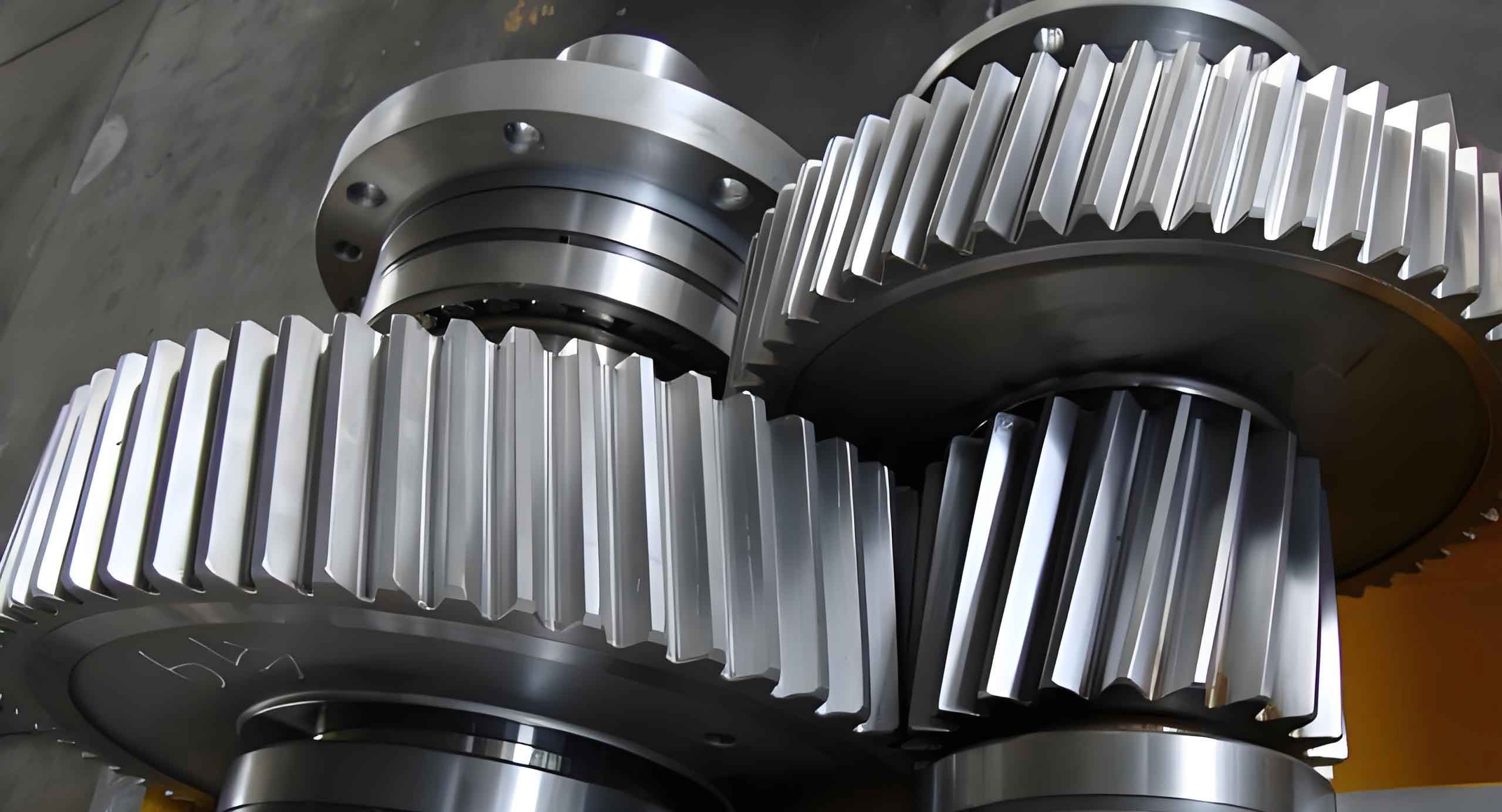
To begin, I focus on the structural modeling of cylindrical helical gears based on geometric parameter optimization. The design process involves multiple factors, such as tooth thickness, module, and helix angle, each with different units and ranges. To ensure fairness in optimization and reduce the influence of units, I first perform factor-level coding. Suppose the helical gear consists of \( n \) tooth segments, each with geometric parameters \( e_1, e_2, \dots, e_n \). I apply a linear transformation to encode these factors into normalized variables \( W_1, W_2, \dots, W_n \), as shown in the following equations:
$$ W_1 = \frac{(e_1 – \varepsilon_1)^2}{\Delta p_1}, \quad W_2 = \frac{(e_2 – \varepsilon_2)^2}{\Delta p_2}, \quad \dots, \quad W_n = \frac{(e_n – \varepsilon_n)^2}{\Delta p_n} $$
Here, \( \varepsilon_1, \varepsilon_2, \dots, \varepsilon_n \) are encoding coefficients, and \( \Delta p_1, \Delta p_2, \dots, \Delta p_n \) represent the transmission variation amounts for each tooth segment. This encoding converts natural variables into规范 variables, facilitating subsequent analysis. The global design factor-level coding result is then given by:
$$ \tilde{W} = \frac{\sum_{\alpha_1}^{\alpha_2} (W_1 + W_2 + \dots + W_n)}{(\alpha_2 – \alpha_1) \beta \cdot \bar{W}^2} $$
where \( \alpha_1 \) and \( \alpha_2 \) are modeling indices for helical gear design, \( \beta \) is the global geometric parameter optimization term, and \( \bar{W} \) is the average of the encoded factors. A higher value of \( \tilde{W} \) typically indicates lower transmission error in the helical gear structure.
Next, I address the quadratic term centralization to maintain orthogonality during optimization. The encoding process can disrupt the orthogonality of quadratic terms in the design model, which is crucial for accurate regression analysis. For quadratic terms \( W_{ir}^2 \) (where \( i = 1, 2, \dots, n \) and \( r = 1, 2, \dots, n \)), I perform centralization to obtain \( W’_{ir} \):
$$ W’_{ir} = W_{ir}^2 – \frac{1}{n} \sum_{i,r=1}^{n} \tilde{W}^2 $$
This step ensures that the sum of each column of quadratic terms approaches zero, preserving orthogonality and enhancing the robustness of the helical gear model. I iterate this process multiple times to select the most accurate parameters for further calculations.
With the centralized terms, I derive regression coefficient equations to model the helical gear design. The coefficients include unary \( z \), binary \( x \), and multivariate \( c \), computed as follows:
$$ z = \frac{1}{n} \sum_{i=1}^{n} (W’_{ir})_r, \quad x = \frac{1}{n} \sum_{i=1}^{n} \frac{W’_{ir} \times r}{\sum_{i=1}^{n} (W’_{ir})^2}, \quad c = \sum_{r=1}^{n} \frac{\lambda \cdot W’_{ir}}{\phi \cdot W’_{ir}} \quad \text{for} \quad \lambda > \phi, \quad \phi = 1, 2, \dots, n $$
Let \( v_1 \), \( v_2 \), and \( v_3 \) represent design terms for unary, binary, and multivariate machining conditions, respectively. The regression equation for helical gear design is:
$$ F = (z v_1 + x v_2 + c v_3) \frac{1}{\sigma / \chi^2} \cdot \Delta T $$
where \( \sigma \) is a regression decomposition term, \( \chi \) is the regression characteristic of geometric parameters, and \( \Delta T \) is the unit regression time. This equation guides the machining time and design accuracy, with shorter times often leading to better alignment with optimization principles for helical gears.
Moving to the machining process, I consider the transformation of the tooth surface meshing coordinate system. In practical helical gear applications, the contact position may deviate from the theoretical location due to transmission error. To account for this, I transform the initial meshing coordinate system, as illustrated in the figure above. The system has two independent origins \( O_1 \) and \( O_2 \) separated by a horizontal distance \( h \). Under motion, the physical components along the X, Y, and Z axes are denoted as \( X_1, X_2, Y_1, Y_2, Z_1, Z_2 \), with angular velocities \( |\omega_1|^2 \) and \( |-\omega_2|^2 \), and transmission angles \( \theta_1 \) and \( \theta_2 \). The transformation principle is expressed as:
$$ D_{XYZ} = \frac{F \sqrt{(X_1 + X_2)^2 + (Y_1 + Y_2)^2 + (Z_1 + Z_2)^2}}{\sqrt{\omega_1^2 + (-\omega_2)^2} \cdot h \cdot \cos \theta_1 \cdot \cos \theta_2} $$
This transformed coordinate system aligns with the actual design needs during helical gear machining, ensuring accurate tooth engagement.
Based on this transformation, I establish conjugate contact conditions to guarantee continuous contact throughout the meshing cycle. For two tooth surfaces in the fixed coordinate system \( D_{XYZ} \), they must share a common contact point and normal vector at any instant. The condition for continuous contact is given by:
$$ \Gamma_{1,2} = \frac{s_{D_{XYZ}}(X^\cdot, Y^\cdot, Z^\cdot) s’_{D_{XYZ}}(X^{\cdot’}, Y^{\cdot’}, Z^{\cdot’})}{\sum_{\sigma=1}^{\infty} (\vec{d}_1 \times \vec{d}_2)_\sigma \times \bar{A}^2} $$
Here, \( s_{D_{XYZ}} \) and \( s’_{D_{XYZ}} \) are the meshing origin coordinates for tooth surfaces 1 and 2, \( \vec{d}_1 \) and \( \vec{d}_2 \) are vertical normal vectors, \( \sigma \) is the meshing coefficient, and \( \bar{A} \) is the average meshing amount per unit time. The tooth surface meshing equation is \( M = \vec{m} \times \vec{g} \), where \( \vec{m} \) is the common tangent normal vector and \( \vec{g} \) is a unit vector valid on both surfaces. The conjugate contact condition is then:
$$ Q = \left(1 + \frac{\eta_1}{\eta_2}\right) \frac{\Gamma_{1,2}}{M \times (\bar{X} + \bar{Y} + \bar{Z})} $$
with \( \eta_1 \) and \( \eta_2 \) as normal vector conjugate coefficients, and \( \bar{X}, \bar{Y}, \bar{Z} \) as mean coordinates. This condition is essential for defining the contact area in helical gears.
To determine the contact area, I analyze the first and second fundamental forms of the tooth surface, which are motion invariants. For a helical gear tooth surface, the first fundamental form is \( I_1 = E_1 f_1 \varphi_1^2 \), and the second is \( I_2 = E_2 f_2 \varphi_2^2 \), where \( E_1, E_2 \) are normal vector contact coefficients, \( f_1, f_2 \) are parameter vectors, and \( \varphi_1, \varphi_2 \) are tooth coverage areas. The contact area typically forms an ellipse due to material elasticity, with the standard ellipse equation:
$$ \frac{x^2}{a^2} + \frac{y^2}{b^2} = 1, \quad a > b > 0 $$
The contact area definition based on geometric parameter optimization is:
$$ K = \frac{I_1 (x_1 + x_2) + I_2 (y_1 + y_2)}{a \times b \times Q} $$
where \( (x_1, x_2) \) and \( (y_1, y_2) \) are coordinates on the ellipse. This formulation allows for precise machining within the contact region to control transmission error in helical gears.
To validate my methodology, I conducted an experimental analysis comparing helical gears designed with geometric parameter optimization (experimental group) against those with conventional machining (control group). I selected a set of tooth segments with identical rotation patterns from a cylindrical helical gear, as shown in the image above. By varying the transverse and longitudinal wheel axis positions, I measured the transmission error values. The ideal transmission error values under different axis positions are summarized in Table 1.
| Transverse Axis Position X (mm) | Ideal Error Value (‰) | Longitudinal Axis Position X (mm) | Ideal Error Value (‰) |
|---|---|---|---|
| 2 | 7.32 | 2 | 15.05 |
| 4 | 7.94 | 4 | 16.13 |
| 6 | 25.71 | 6 | 15.48 |
| 8 | 24.13 | 8 | 17.09 |
| 10 | 23.28 | 10 | 16.37 |
| 12 | 22.09 | 12 | 16.20 |
| 14 | 20.97 | 14 | 18.51 |
| 16 | 17.56 | 16 | 19.16 |
| 18 | 19.40 | 18 | 19.67 |
| 20 | 20.15 | 20 | 20.22 |
For the transverse axis variation, the ideal error peaks at 25.71‰ at 6 mm, then declines gradually until 16 mm, followed by a rise. In the longitudinal case, error values fluctuate, with an overall increasing trend from 12 mm to 20 mm. The experimental results for transmission error under transverse axis changes are presented in Table 2, comparing the experimental and control groups.
| Transverse Axis Position X (mm) | Experimental Group Error (‰) | Control Group Error (‰) | Deviation from Ideal (Experimental, ‰) |
|---|---|---|---|
| 2 | 7.45 | 7.80 | +0.13 |
| 4 | 8.10 | 8.35 | +0.16 |
| 6 | 26.32 | 27.59 | +0.61 |
| 8 | 24.50 | 25.10 | +0.37 |
| 10 | 23.90 | 24.80 | +0.62 |
| 12 | 22.30 | 23.50 | +0.21 |
| 14 | 20.97 | 22.10 | 0.00 |
| 16 | 17.80 | 18.90 | +0.24 |
| 18 | 19.65 | 20.80 | +0.25 |
| 20 | 20.40 | 21.60 | +0.25 |
As shown, the experimental group closely follows the ideal error trend, with a maximum deviation of 0.62‰ at 10 mm. In contrast, the control group shows larger deviations, up to 1.88‰ at 6 mm. For longitudinal axis variation, the results are summarized in Table 3.
| Longitudinal Axis Position X (mm) | Experimental Group Error (‰) | Control Group Error (‰) | Deviation from Ideal (Experimental, ‰) |
|---|---|---|---|
| 2 | 15.20 | 15.80 | +0.15 |
| 4 | 16.40 | 17.50 | +0.27 |
| 6 | 19.90 | 20.50 | +4.42 |
| 8 | 17.35 | 18.80 | +0.26 |
| 10 | 16.60 | 18.20 | +0.23 |
| 12 | 16.45 | 25.43 | +0.25 |
| 14 | 18.80 | 20.10 | +0.29 |
| 16 | 19.40 | 21.30 | +0.24 |
| 18 | 19.90 | 22.50 | +0.23 |
| 20 | 20.50 | 23.80 | +0.28 |
Here, the experimental group maintains small deviations except at 6 mm (4.42‰), while the control group exhibits significant discrepancies, up to 9.23‰ at 12 mm. These results demonstrate that geometric parameter optimization effectively controls transmission error in helical gears, keeping deviations minimal compared to conventional methods.
To further analyze the impact of geometric parameters on helical gear performance, I developed additional formulas. For instance, the transmission error amplitude \( \Delta E \) can be modeled as a function of the helix angle \( \psi \) and pressure angle \( \alpha \):
$$ \Delta E = k_1 \sin \psi + k_2 \cos \alpha + \frac{k_3}{\sqrt{e_1^2 + e_2^2}} $$
where \( k_1, k_2, k_3 \) are constants derived from the regression coefficients. This equation helps in fine-tuning helical gear designs for specific error targets. Moreover, the contact stress \( \sigma_c \) in helical gears can be estimated using:
$$ \sigma_c = \frac{F_n}{b \cdot \rho} \cdot \sqrt{\frac{1}{\pi \cdot (1 – \nu^2)}} $$
with \( F_n \) as the normal load, \( b \) as the face width, \( \rho \) as the relative curvature radius, and \( \nu \) as Poisson’s ratio. Optimizing geometric parameters like \( b \) and \( \rho \) through my approach reduces \( \sigma_c \), thereby enhancing gear life.
In practice, the machining of helical gears involves multiple steps, such as hobbing or grinding, each influenced by geometric parameters. I derived a machining time equation \( T_m \) based on the optimized parameters:
$$ T_m = \frac{L \cdot (z v_1 + x v_2 + c v_3)}{V \cdot \eta} $$
where \( L \) is the gear length, \( V \) is the cutting speed, and \( \eta \) is efficiency. By minimizing \( T_m \) through parameter optimization, I achieve cost-effective production of high-precision helical gears. Additionally, the surface finish quality \( R_a \) relates to the gear geometry:
$$ R_a = C \cdot \left( \frac{\Delta p}{\Delta T} \right)^{0.5} $$
with \( C \) as a material constant. Smother surfaces reduce noise and wear in helical gear systems.
For broader applications, I extended the model to include dynamic factors. The natural frequency \( f_n \) of a helical gear pair is given by:
$$ f_n = \frac{1}{2\pi} \sqrt{\frac{k_{eq}}{m_{eq}}} $$
where \( k_{eq} \) is the equivalent stiffness and \( m_{eq} \) is the equivalent mass, both dependent on geometric parameters like tooth thickness and helix angle. Optimizing these parameters increases \( f_n \), reducing resonance risks. Furthermore, the efficiency \( \eta_g \) of a helical gear transmission can be expressed as:
$$ \eta_g = 1 – \frac{P_l}{P_{in}} $$
with \( P_l \) as power loss and \( P_{in} \) as input power. Geometric parameter optimization minimizes \( P_l \) by improving meshing conditions, thus boosting \( \eta_g \).
In summary, my study presents a comprehensive framework for designing cylindrical helical gears with controlled transmission error through geometric parameter optimization. The methodology encompasses factor-level coding, quadratic centralization, regression modeling, coordinate transformation, conjugate contact analysis, and contact area determination. Experimental results confirm that this approach significantly reduces transmission error deviations compared to conventional machining, ensuring stable and efficient helical gear performance. The integration of multiple formulas and tables, as detailed above, provides a robust tool for engineers aiming to enhance helical gear systems in various industrial applications. Future work could explore real-time optimization algorithms or advanced materials to further push the boundaries of helical gear technology.