
In the field of robotic joint design and power transmission systems, the accurate prediction of dynamic behavior and structural integrity is paramount. Miter gears, a specific subset of bevel gears with a 1:1 ratio and typically 90-degree shaft axes, are frequently employed in applications requiring a compact and efficient change in the direction of rotational motion without altering the speed, such as in the wrist joints of multi-axis robots. My investigation focuses on the comprehensive digital development process for a straight miter gear train used in a robotic joint assembly. This article details my comparative analysis of modeling methodologies, the implementation of a precise, parametric modeling approach, and subsequent multi-domain simulation analyses to validate the design and understand its performance characteristics.
Introduction and Background
The demand for high-precision and reliable motion control in robotics, automotive differentials, and industrial machinery places significant importance on the quality of gear design. Straight bevel gears, and specifically miter gears, are favored for intersecting shaft applications due to their straightforward design and manufacturing compared to their spiral or hypoid counterparts. However, the transition from a conceptual design to a functional, optimized component requires robust virtual prototyping techniques. The core challenge lies in creating a geometrically accurate three-dimensional model that faithfully represents the theoretical tooth form, which is based on a spherical involute. The accuracy of this model directly dictates the reliability of any subsequent simulation, be it kinematic, dynamic, or structural. My goal was to establish a fully digital workflow that begins with a precise parametric model of a miter gear pair and extends through dynamic system simulation and finite element analysis, thereby creating a foundational tool for the analysis and optimization of such robotic joint mechanisms.
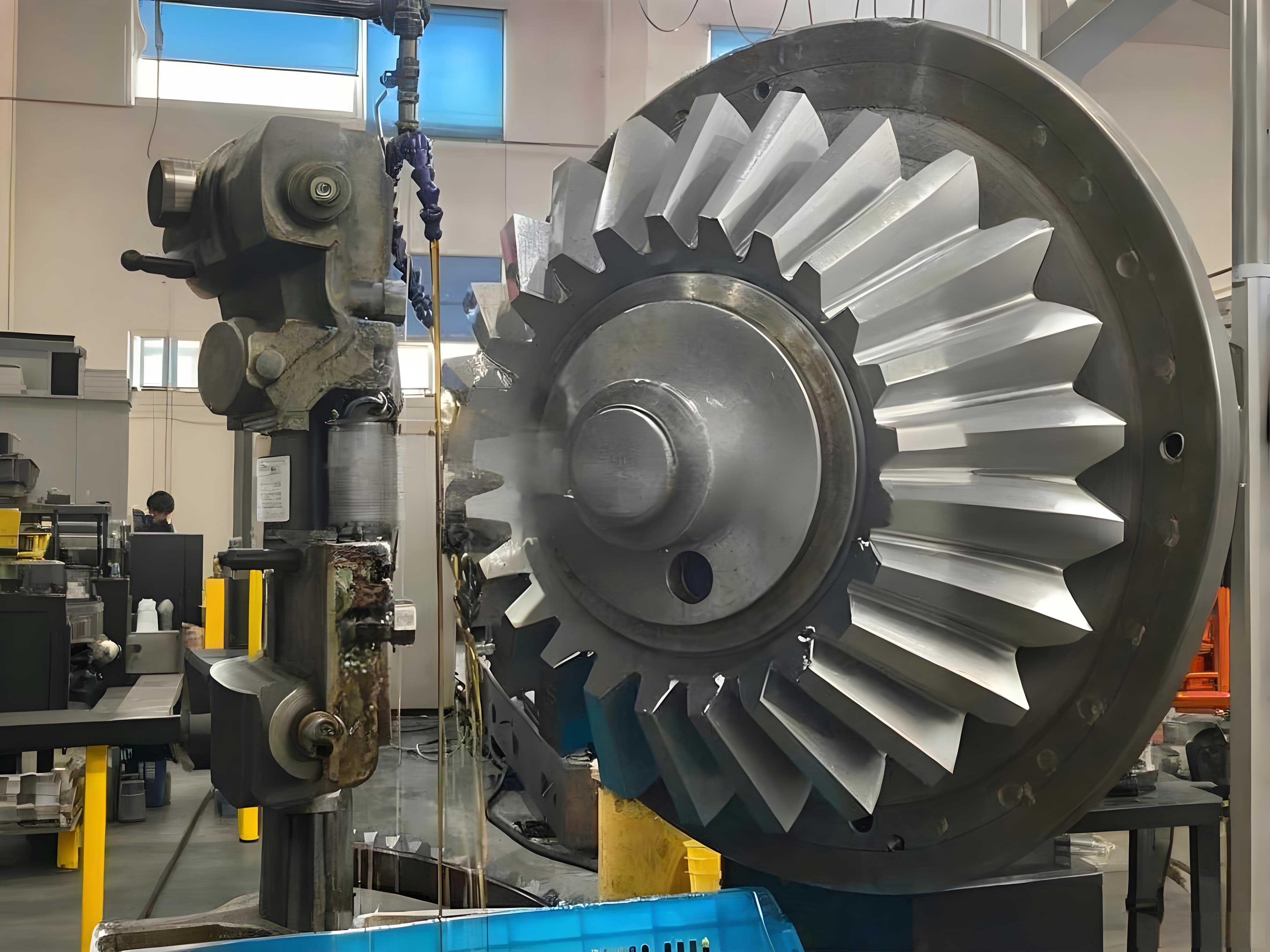
Comparative Analysis of Straight Bevel Gear Modeling Methodologies
Before committing to a modeling strategy, I evaluated the three predominant methods for generating straight bevel gear geometry in CAD software. Each approach has distinct advantages and limitations concerning accuracy, complexity, and integration into a parametric framework.
| Modeling Method | Core Principle | Advantages | Disadvantages | Suitability for Parametric Modeling |
|---|---|---|---|---|
| Back-Cone Approximation (Tredgold’s Method) | Approximates the spherical involute tooth profile by developing it on the back cone surface, which is then unfolded onto a plane. This creates an “equivalent” spur gear. | Conceptually simple, widely used in design manuals, and is the basis for many CAD plugin tools. | Introduces geometric error, especially when the cone distance-to-module ratio is small. The profile is not a true spherical involute. | Good. Parameters from standard design equations can be easily linked. |
| Manufacturing Simulation (Generation Method) | Simulates the physical gear cutting process (e.g., using a simulated crown rack or face-mill cutter) mathematically or via CAD mechanisms to generate the tooth surface. | Very accurate, as it replicates the actual manufactured gear. Provides a direct link to production processes. | Computationally intensive. Requires in-depth knowledge of machine tool kinematics and complex coordinate transformations. | Moderate. Parameters are tied to cutter geometry and machine settings, which can be parameterized but with complex relations. |
| Theoretical Derivation (Spherical Involute Method) | Directly employs the mathematical equations of the spherical involute curve, derived from the spherical rolling principle, to define the tooth flank surface. | Provides the highest geometric fidelity to the theoretical tooth form. The error is limited to computational precision. | Requires derivation or implementation of the governing equations. Less intuitive than approximation methods. | Excellent. The entire geometry is driven by fundamental gear parameters (module, teeth, pressure angle) and their mathematical relationships. |
For my purpose of obtaining a maximally accurate digital twin for high-fidelity simulation, the theoretical derivation via the spherical involute method was selected. While the back-cone method is sufficient for many general applications, the potential for error propagation into dynamic contact and stress analyses made it less desirable. The manufacturing simulation method, though accurate, was deemed overly complex for the initial parametric model creation phase. Therefore, I proceeded with the spherical involute theory to construct the geometry of the miter gears.
Parametric Modeling Based on Spherical Involute Theory
The chosen robotic joint utilizes a gear train where two independent motors drive separate miter gear pairs to articulate two degrees of freedom. For modeling, I focused on one representative pair. The core of the modeling process in Pro/ENGINEER (Creo Parametric) involves defining the spherical involute curve, constructing surfaces from these curves, and solidifying them into a parameter-driven feature.
Mathematical Foundation and Parameter Definition
The generation of a spherical involute can be visualized as a point on a great circle of a sphere rolling without slipping on the base cone’s great circle. The resulting 3D curve lies on the surface of the sphere with radius equal to the cone distance (R). The parametric equations governing a point on this curve are:
$$ x = R(\sin\phi \sin\psi + \cos\phi \cos\psi \sin\theta) $$
$$ y = R(-\cos\phi \sin\psi + \sin\phi \cos\psi \sin\theta) $$
$$ z = R \cos\psi \cos\theta $$
Where $\phi$ is the generating (rolling) angle and $\psi$ is the spherical involute function angle. These are related by $\psi = \phi \sin\theta$. The base cone angle $\theta$ and cone distance $R$ are derived from the basic gear design parameters:
$$ \theta = \arcsin(\cos\alpha \cdot \sin\delta) $$
$$ R = \frac{m \cdot z}{2 \sin\delta} $$
Here, $m$ is the module, $z$ is the number of teeth, $\alpha$ is the pressure angle, and $\delta$ is the pitch cone angle (45° for standard miter gears). Other key derived parameters include addendum ($h_a$), dedendum ($h_f$), and their corresponding angles: addendum angle $\delta_a = \delta + \arctan(h_a / R)$ and dedendum angle $\delta_f = \delta – \arctan(h_f / R)$.
I implemented these relationships within Pro/E’s parameters and relations table. This creates a fully parametric model where changing a fundamental parameter like module ($m$) or tooth count ($z$) automatically updates all dependent dimensions and regenerates the geometry.
Step-by-Step Geometric Construction
The construction follows a disciplined “curve-surface-solid” workflow:
- Curve Creation: Using the “From Equation” datum curve tool, I input the spherical involute equations to create curves for both the heel (large end) and toe (small end) of the tooth. Concurrently, datum circles for the heel/toe addendum, dedendum, and pitch circles are sketched on their respective cone surfaces.
- Surface Generation: The two spherical involute curves form the primary boundaries for a lofted (boundary blend) surface, creating the tooth flank. This surface is mirrored about a plane passing through the gear axis and the pitch point to form the opposite flank of a single tooth space. Separate revolving surfaces are created for the outer (addendum) cone and the root (dedendum) cone.
- Surface Trimming and Merging: Using the tooth flank surfaces as trimming tools, the addendum and dedendum cone surfaces are cut to form the precise boundaries of one tooth gap. The resulting set of surfaces—two flanks, an addendum patch, and a dedendum patch—are then merged into a single quilted surface. The ends of this quilt are capped with planar or blend surfaces.
- Solidification and Patterning: The closed, merged surface quilt is solidified into a 3D protrusion, representing one tooth gap. A root fillet with a variable radius is added at the intersection of the flank and dedendum surfaces to reduce stress concentration. This entire feature (tooth gap + fillet) is then patterned around the axis. The number of pattern instances is set equal to the parameter $z$, and the rotation angle is $360/z$ degrees, completing the ring of teeth.
- Final Geometry: The gear body (hub, web, bore) is created using standard protrusion and cut features, all dimensions linked to the master parameters. The process is repeated for the mating miter gear. Finally, the pair is assembled using axis alignments and mating surface constraints, also defined parametrically. A global interference check confirms a clean, zero-interference mesh.
System-Level Dynamics Simulation in ADAMS
With the precise 3D CAD assembly of the complete gear train, the next step was to evaluate its kinematic and dynamic performance. I exported the model to MSC ADAMS, a multi-body dynamics software. The goal was to simulate the transmission of motion and torque from the input motors through the gear train to the output joints, identifying velocity fluctuations and system response.
Model Preparation and Contact Definition
The imported parts were assigned appropriate materials (steel). Revolute joints were applied to all rotating shafts. The critical element in a dynamic gear simulation is the definition of the contact force between mating teeth. I employed a penalty-based impact force function of the form:
$$ F_{impact} =
\begin{cases}
K \cdot \delta^e + C(\delta) \cdot \dot{\delta}, & \delta > 0 \\
0, & \delta \le 0
\end{cases} $$
Where $K$ is the contact stiffness, $\delta$ is the penetration depth, $e$ is the force exponent (typically >1), $C$ is a damping coefficient, and $\dot{\delta}$ is the penetration velocity. The stiffness $K$ for each of the four gear pairs was calculated based on material properties and estimated contact geometry. Friction was also included using a static and dynamic Coulomb model. Drivers were applied to the two input shafts using STEP functions to smoothly ramp up to constant angular velocities (e.g., 120 deg/s and 90 deg/s). Corresponding resistive torques, also applied via STEP functions, were placed on the output joints to simulate varying load conditions.
Simulation Results and Analysis
The simulation was run for a sufficient duration to capture several meshing cycles. The primary outputs were the angular velocities of the two output joints. The results were then compared to the theoretical ideal values based on the gear ratios.
| Output Axis | Simulated Avg. Velocity (deg/s) | Theoretical Velocity (deg/s) | Relative Error | Notes |
|---|---|---|---|---|
| Load Axis 1 (driven by Miter Pair 1) | 90.38 | 90.11 | 0.30% | Direct 1:1 miter gear drive. Velocity oscillates slightly around the mean but tracks input closely. |
| Load Axis 2 (driven by Miter Pair 2 + Spur Gears) | 97.08 | 94.61 | 2.50% | Two-stage transmission. Higher error and initial transient due to error accumulation from multiple meshing interfaces and system compliance. |
The simulation successfully demonstrated the expected motion transfer. The very low error for the direct miter gear drive validates the accuracy of the geometric model and the contact force parameters. The higher error in the two-stage transmission highlights the cumulative effect of modeling approximations and compliance in a more complex train, which is a valuable insight for system design. The dynamic simulation confirms the functional viability of the modeled miter gear train.
Finite Element Analysis of Gear Contact Stresses
To assess the structural performance and contact stress distribution of the miter gears under load, I conducted a nonlinear transient finite element analysis. I selected the first miter gear pair for this detailed study. The process involved high-quality meshing, realistic boundary condition application, and explicit dynamic solution.
Mesh Generation and Model Setup
Using Altair HyperMesh, I partitioned the gear bodies to isolate the region of potential contact (about 7 teeth in the path of rotation) from the rest of the hub and web. This allowed me to apply a fine, structured hexahedral mesh (C3D8R elements) in the contact region for accuracy in stress calculation, while using a coarser tetrahedral mesh (C3D10M elements) for the supportive structure to reduce computational cost. The two mesh regions were connected using a tie constraint in the solver. The model was then imported into SIMULIA ABAQUS/Explicit.
| Component / Region | Element Type | Mesh Strategy | Purpose |
|---|---|---|---|
| Contact Region (Tooth Flanks & Roots) | C3D8R (8-node linear brick, reduced integration) | Structured Hexahedral (SolidMap) | Accurate resolution of contact pressures and bending stresses. |
| Gear Body, Hub, Web | C3D10M (10-node modified tetrahedron) | Free Tetrahedral (Tetramesh) | Efficient modeling of stiffness and mass with fewer elements. |
Material properties for steel (Elastic Modulus = 210 GPa, Poisson’s Ratio = 0.3, Density = 7850 kg/m³) were assigned. Boundary conditions were applied via reference points coupled to the gear bores using kinematic coupling constraints. A constant angular velocity (31.4 rad/s) was applied to the driving gear’s reference point, and a constant resistive torque (100 N·m) was applied to the driven gear’s reference point. A general contact definition with a penalty friction formulation was established between all potential tooth surfaces.
Results: Stress Distribution and Contact Pattern
The explicit dynamic analysis was run for a time sufficient to allow multiple teeth to engage and disengage. The results provided a time-history of the stress state.
- Dynamic Stress Propagation: The stress contour plots over time clearly showed the stress wave propagating through the gears. Initially, stress concentrated at the hub due to the applied torque. As the simulation progressed, high stress regions moved sequentially across the contacting tooth flanks, vividly illustrating the dynamic meshing process. The maximum von Mises stress was observed in the contact zone and at the root fillet, as expected.
- Node History and Contact Pattern: By probing the contact stress (CPRESS) history at a specific node on a driving gear tooth, I observed a classic pattern: the stress rose sharply as the node entered the contact zone, remained at a relatively high level during the roll-through, and dropped to near zero upon exit. Furthermore, plotting the contact stress distribution along a path of nodes from the toe to the heel of a tooth at a given instant revealed the contact pattern. The resulting curve was mostly flat across the central portion of the face width, indicating uniform contact. Slightly elevated stresses at the extremes suggested edge contact, which is a typical characteristic of unmodified straight bevel and miter gears, highlighting a potential area for profile modification (crowning) to improve load distribution.
The FEA confirmed that the modeled miter gears operated within acceptable stress limits under the specified load and provided crucial visual and quantitative data on the contact mechanics, which is essential for fatigue life prediction and design refinement.
Conclusion
This comprehensive study successfully demonstrates a complete digital engineering workflow for the design and analysis of a straight miter gear train. Beginning with a critical evaluation of modeling techniques, I justified the selection of the spherical involute method for its superior geometric accuracy. I then implemented this method within a parametric CAD environment (Pro/E), creating a robust and flexible model of the gear train. This precise model served as the foundation for two critical analyses.
The multi-body dynamics simulation in ADAMS validated the kinematic function of the system, showing excellent correlation with theoretical motion transfer for the direct miter gear drives and providing insights into error accumulation in multi-stage transmissions. Subsequently, the advanced finite element analysis, facilitated by HyperMesh and ABAQUS, provided a detailed look at the transient contact stresses and load distribution across the tooth face, verifying structural integrity and identifying characteristic contact patterns.
In summary, the integration of precise parametric modeling with multi-domain simulation tools forms a powerful framework for the development and optimization of power transmission components like miter gears. The methodologies and results presented here provide a validated reference model and a proven analytical pipeline. This foundation is directly applicable to further research into this specific robotic joint, including topology optimization, dynamic response to variable loading, acoustic analysis, and the study of other similar geared mechanisms where accuracy and reliability are critical.