
In the realm of mechanical transmission, miter gears—specifically straight bevel gears with intersecting axes—play a crucial role in various industries such as automotive, agricultural machinery, and machine tools. Their ability to transmit motion and power between intersecting shafts makes them indispensable. However, the manufacturing of miter gears has long been challenged by the need for specialized equipment and complex adjustments. Traditional gear milling machines, like the Y2726 double cradle straight bevel gear milling machine, rely on mechanical systems with change gears, which require tedious recalibration and custom parts for different gear sets. This not only increases production lead times but also limits flexibility. In this article, I will detail a comprehensive numerical control (CNC) retrofit project for such a machine, aimed at enhancing precision, efficiency, and adaptability. The retrofit replaces most mechanical传动链 with servo-driven systems, enabling seamless加工 of various miter gears without hardware changes. Throughout this discussion, I will emphasize the importance of miter gears in modern machinery and how CNC technology revolutionizes their production.
The Y2726 double cradle miter gear milling machine, based on German technology, has been widely used for over two decades. It employs a generating motion method to cut barrel-type teeth on straight bevel gears, which are essentially miter gears when designed for 90-degree shaft angles. The machine features two独立的加工 heads, each comprising a cradle and a workpiece spindle, allowing sequential roughing and finishing of both gears in a pair. The generating motion involves a复合 rotation: the workpiece must both rotate on its own axis (self-rotation) and revolve around the cradle axis (公转), simulating the rolling action between the gear and a imaginary generating gear represented by the cutting tool. This motion is critical for achieving accurate tooth profiles in miter gears. Mechanically, this is accomplished through a complex传动链 involving worm gears, planetary mechanisms, and change gears (denoted as z1, z2, z3, z4 in the original design). For different miter gear pairs with varying tooth counts and ratios, these change gears must be recalculated, manufactured, and installed—a process that is time-consuming and error-prone. The machine’s structure includes components like the cutter head, cradle, workpiece head, hydraulic slides, and a base, all coordinated to produce high-volume batches of miter gears efficiently. However, the reliance on mechanical adjustments hampers adaptability in today’s diverse manufacturing landscape.
To address these limitations, I embarked on a数控化改造 focused on the generating motion system. The core idea was to eliminate the change gears and most mechanical linkages by using computer-controlled servo motors. For each加工 head, two servo motors were employed: one to drive the cradle rotation and another to drive the workpiece spindle rotation. This directly controls the复合运动 required for generating miter gears. The retrofit retains the essential worm gear pairs for torque amplification and precision but replaces the entire upstream mechanical传动 with digital commands. Specifically, the cradle servo motor rotates the cradle via a精密蜗轮蜗杆副, while the workpiece servo motor rotates the workpiece head through another similar pair. During generating motion, these two motors interpolate their movements based on the gear parameters, ensuring the correct rolling relationship. For indexing (分齿运动), only the workpiece motor moves to rotate the gear to the next tooth position, while the cradle motor remains stationary. This design simplifies the machine’s mechanics, reduces wear, and enhances accuracy. The mathematical relationships governing these motions are derived from the generating principle for miter gears. For a gear pair with小轮齿数 \( z_1 \) and大轮齿数 \( z_2 \), the generating motion requires协调 angles. Let \( \theta_1 \) be the cradle rotation angle and \( \theta_2 \) be the workpiece rotation angle. During cutting of the小轮 (pinion), the relationship is:
$$ \theta_2 = \frac{z_1}{\sqrt{z_1^2 + z_2^2}} \theta_1 $$
For cutting the大轮 (gear), it is:
$$ \theta_2 = \frac{z_2}{\sqrt{z_1^2 + z_2^2}} \theta_1 $$
During indexing, the workpiece motor rotates by:
$$ \theta_2 = \frac{360}{z_1} \text{ for the pinion, or } \theta_2 = \frac{360}{z_2} \text{ for the gear} $$
These equations are programmed into the CNC system, allowing automatic adjustment for any miter gear set without physical change gears. The retrofit also maintains the existing hydraulic systems for cutter head approach and slide movements, which are now controlled via the CNC’s programmable logic controller (PLC). The overall mechanical transformation reduces the number of custom parts, lowers maintenance costs, and improves reliability, all while catering to the precise demands of miter gear production.
The electrical control system was pivotal in realizing this retrofit. After evaluating various options, I selected the Siemens 802C CNC system for its cost-effectiveness and robustness. This system supports up to four axes of control, which perfectly matches the requirement: four servo motors (two for each加工 head) to drive the cradles and workpiece spindles. The configuration involves setting the 802C as a 4-axis system with two pairs of interpolating axes. Each pair—cradle motor and workpiece motor for a given head—operates in coordination to execute the generating motion, while the PLC handles auxiliary functions like cutter head rotation, hydraulic slide positioning, and coolant control. The control circuit integrates servo drives, motors, and feedback devices, ensuring closed-loop precision. A key innovation was programming the CNC to manage the complex motion profiles for miter gears, including variable feed rates for roughing and finishing cycles. The system stores gear parameters—such as tooth numbers, module, entry angle, exit angle, indexing clearance angle, and cutting speeds—as R-parameters. This allows operators to simply input new values for different miter gears, with no need to alter mechanical settings or rewrite core programs. The table below summarizes the key CNC parameters and their functions in the context of miter gear machining:
| Parameter | Description | Role in Miter Gear Machining |
|---|---|---|
| R1 | Pinion tooth count (\( z_1 \)) | Defines generating motion ratio for小轮 |
| R2 | Gear tooth count (\( z_2 \)) | Defines generating motion ratio for大轮 |
| R3 | Module (m) | Determines tooth size for miter gears |
| R4 | Entry angle (degrees) | Controls initial engagement in cutting |
| R5 | Exit angle (degrees) | Controls final disengagement in cutting |
| R6 | Indexing clearance angle | Ensures tool clearance during分齿 |
| R7 | Cutting speed (mm/min) | Sets feed rate for roughing/finishing |
The CNC program orchestrates the entire machining sequence. For each miter gear, the process involves: positioning the workpiece via hydraulic slides, initiating cutter head rotation, executing generating motion with interpolated servo movements, performing indexing, and repeating until all teeth are cut. The program uses subroutines for roughing and finishing passes, with different speeds to optimize tool life and surface quality. This level of automation reduces operator intervention and minimizes human error, which is especially beneficial for high-volume production of miter gears. Moreover, the system’s flexibility allows quick changeovers between different miter gear designs, supporting just-in-time manufacturing.
The benefits of this CNC retrofit are substantial. In terms of efficiency, the elimination of change gear adjustments cuts setup time by over 70%, and the ability to run continuous cycles boosts overall throughput. Comparative tests showed a 50% increase in production rate compared to the original mechanical machine. For precision, the servo-driven motions provide finer control over generating trajectories, resulting in miter gears with improved tooth profile accuracy and consistency. Post-retrofit measurements indicated that the machined miter gears consistently achieve AGMA quality level 7 (equivalent to ISO 7级), which is suitable for most industrial applications. The enhanced精度 stems from reduced backlash and smoother interpolation, critical for the complex geometry of miter gears. Additionally, the retrofit extends the machine’s lifespan by replacing wear-prone mechanical parts with reliable electronic components. The following table contrasts key performance metrics before and after the CNC retrofit, highlighting the advancements in miter gear manufacturing:
| Metric | Original Mechanical Machine | CNC-Retrofitted Machine |
|---|---|---|
| Setup time for new miter gear set | 2-4 hours (includes change gear fabrication) | 10-15 minutes (parameter input only) |
| Production rate (gears per hour) | 6-8 pairs | 12-15 pairs |
| Gear accuracy (AGMA level) | 8-9 | 7 |
| Flexibility for different miter gears | Low (requires physical changes) | High (software adjustable) |
| Maintenance frequency | High (mechanical wear) | Low (electronic reliability) |
The success of this project underscores the transformative potential of CNC technology in gear manufacturing. For miter gears, which often serve in critical传动 applications, precision and efficiency are paramount. The retrofitted machine not only meets these demands but also offers a scalable model for modernizing other legacy gear cutters. The integration of servo control allows for advanced features like adaptive cutting forces and real-time monitoring, which could be explored in future upgrades. Moreover, the use of standard CNC components reduces overall costs and simplifies maintenance, making it an attractive option for small to medium-sized enterprises producing miter gears.
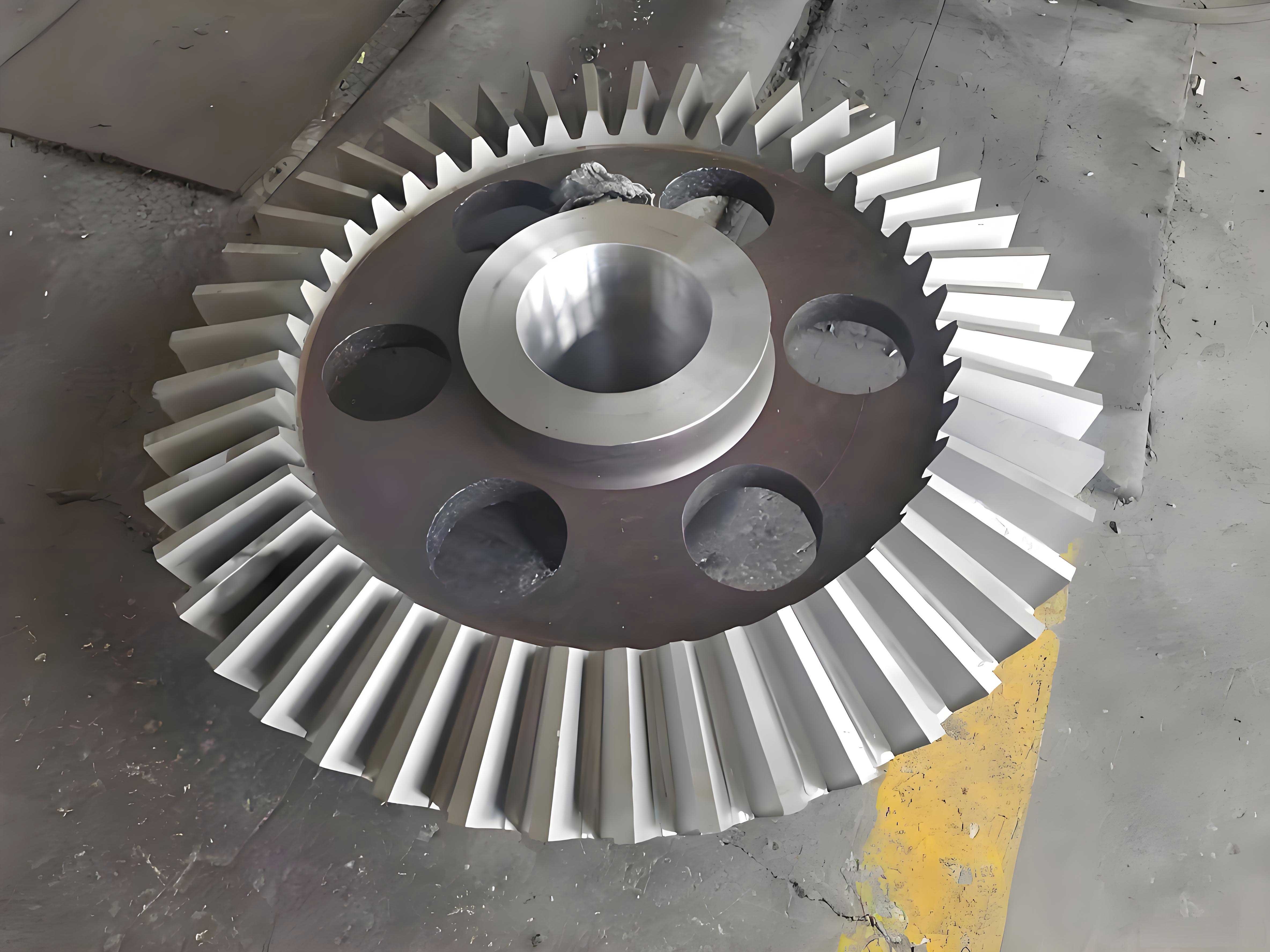
In conclusion, the CNC retrofit of the double cradle miter gear milling machine represents a significant leap forward in gear加工 technology. By replacing mechanical传动链 with digitally controlled servo motors, the machine achieves higher accuracy, faster production, and greater flexibility for manufacturing miter gears. The Siemens 802C system provides a robust platform for managing complex motions, while the retained hydraulic systems ensure reliable auxiliary functions. This改造 has been well-received in the industry, with multiple adoptions reported. As the demand for high-quality miter gears grows in sectors like automotive and robotics, such retrofits offer a cost-effective way to upgrade existing assets. Future work may focus on integrating IoT capabilities for predictive maintenance or expanding the system to handle spiral bevel gears. Ultimately, this project highlights how traditional machinery can be revitalized through smart engineering, ensuring that miter gears continue to power modern机械传动 with reliability and precision.
From a technical perspective, the mathematical foundation of the generating motion is worth elaborating. For miter gears, the generating process mimics the meshing of a imaginary crown gear. The cradle rotation angle \( \theta_1 \) and workpiece rotation angle \( \theta_2 \) must satisfy the fundamental关系 derived from the pitch cone geometry. Given a miter gear pair with shaft angle \( \Sigma = 90^\circ \), the pitch cone angles for pinion and gear are equal (\( \delta_1 = \delta_2 = 45^\circ \)) in standard cases, but the retrofit handles arbitrary ratios. The generating ratio \( i_g \) is defined as:
$$ i_g = \frac{\sin \delta_2}{\sin \delta_1} = \frac{z_2}{z_1} $$
For the generating motion, the relationship between cradle and workpiece rotation can be expressed in differential form. During cutting, the relative motion ensures that the tool envelope generates the correct tooth profile. The equations provided earlier are simplified versions for practical CNC implementation. In reality, the motion may involve non-linear corrections for tooth flank modifications, which can be incorporated into the CNC program via additional parameters. This flexibility is crucial for optimizing the performance of miter gears under load.
Another aspect is the tooling. The machine uses a 600 mm diameter cutter head with 36 inserted blades, which rotates at a fixed speed. The CNC retrofit does not alter this, but it allows for better synchronization with the generating motion. For不同模数的 miter gears, the cutter head can be adjusted mechanically, but the CNC ensures that the generating motion adapts accordingly. The table below lists typical cutting parameters for miter gears of various sizes, demonstrating the machine’s versatility:
| Miter Gear Module (mm) | Cutter Head Speed (rpm) | Generating Feed Rate (mm/rev) | Recommended Roughing Speed | Recommended Finishing Speed |
|---|---|---|---|---|
| 2-4 | 80-120 | 0.5-1.0 | High (e.g., 1.0 mm/rev) | Low (e.g., 0.5 mm/rev) |
| 4-6 | 60-100 | 0.3-0.8 | 0.8 mm/rev | 0.3 mm/rev |
| 6-10 | 40-80 | 0.2-0.5 | 0.5 mm/rev | 0.2 mm/rev |
These parameters are stored in the CNC and can be tweaked based on material properties—such as steel or cast iron—common in miter gear applications. The ability to fine-tune speeds and feeds digitally contributes to longer tool life and better surface finish on the miter gears.
In terms of operational workflow, the retrofitted machine simplifies tasks for the operator. After loading a blank for miter gear production, the operator inputs the gear parameters via the CNC interface. The system then automatically calculates the motion profiles, sets up the hydraulic slides, and initiates the cutting cycle. The two加工 heads work sequentially: first roughing and finishing the pinion, then the gear, or vice versa. This continuity minimizes idle time. During operation, the CNC displays real-time data like axis positions and cycle time, enabling monitoring and optimization. For批量生产 of miter gears, this automation is a game-changer, reducing labor costs and enhancing consistency.
Furthermore, the retrofit incorporates safety features. The PLC monitors limits for axis movements and hydraulic pressures, preventing collisions or overloads. Emergency stops are integrated, and the system includes software limits for the cradle and workpiece rotations to protect the mechanical structure. These features are essential when machining hardened materials for durable miter gears.
Looking ahead, the success of this CNC retrofit opens avenues for further innovation. For instance, adding a fifth axis for tilt adjustments could enable the machining of non-standard miter gears with modified shaft angles. Integrating vision systems for in-process inspection could ensure that each miter gear meets tight tolerances. Additionally, connecting the CNC to a工厂 network could facilitate data logging and predictive maintenance, further boosting uptime. As industries evolve, the demand for custom miter gears with specific performance characteristics will grow, and such advanced capabilities will become increasingly valuable.
In summary, this project demonstrates that even decades-old machinery can be transformed into state-of-the-art equipment through strategic CNC retrofitting. For manufacturers specializing in miter gears, this approach offers a balance of performance enhancement and cost savings. The key lies in understanding the generating motion principles, selecting appropriate CNC components, and designing intuitive software interfaces. By sharing this experience, I hope to inspire similar initiatives across the gear manufacturing sector, ultimately driving progress in the production of high-quality miter gears for diverse mechanical systems.