
The strain wave gear, a revolutionary transmission concept introduced based on elastic deformation theory, represents a significant advancement in precision gearing technology. This unique mechanism, comprising a rigid circular spline (CS), a flexible spline (FS), and a wave generator (WG), offers unparalleled advantages such as high reduction ratios in a single stage, exceptional positional accuracy, minimal backlash, and compact design. These attributes have cemented its role in demanding applications across robotics, aerospace, and precision instrumentation. The core of its operation lies in the controlled elastic deformation of the FS by the WG, typically an elliptical cam or a set of rollers, which creates a moving wave of engagement with the CS.
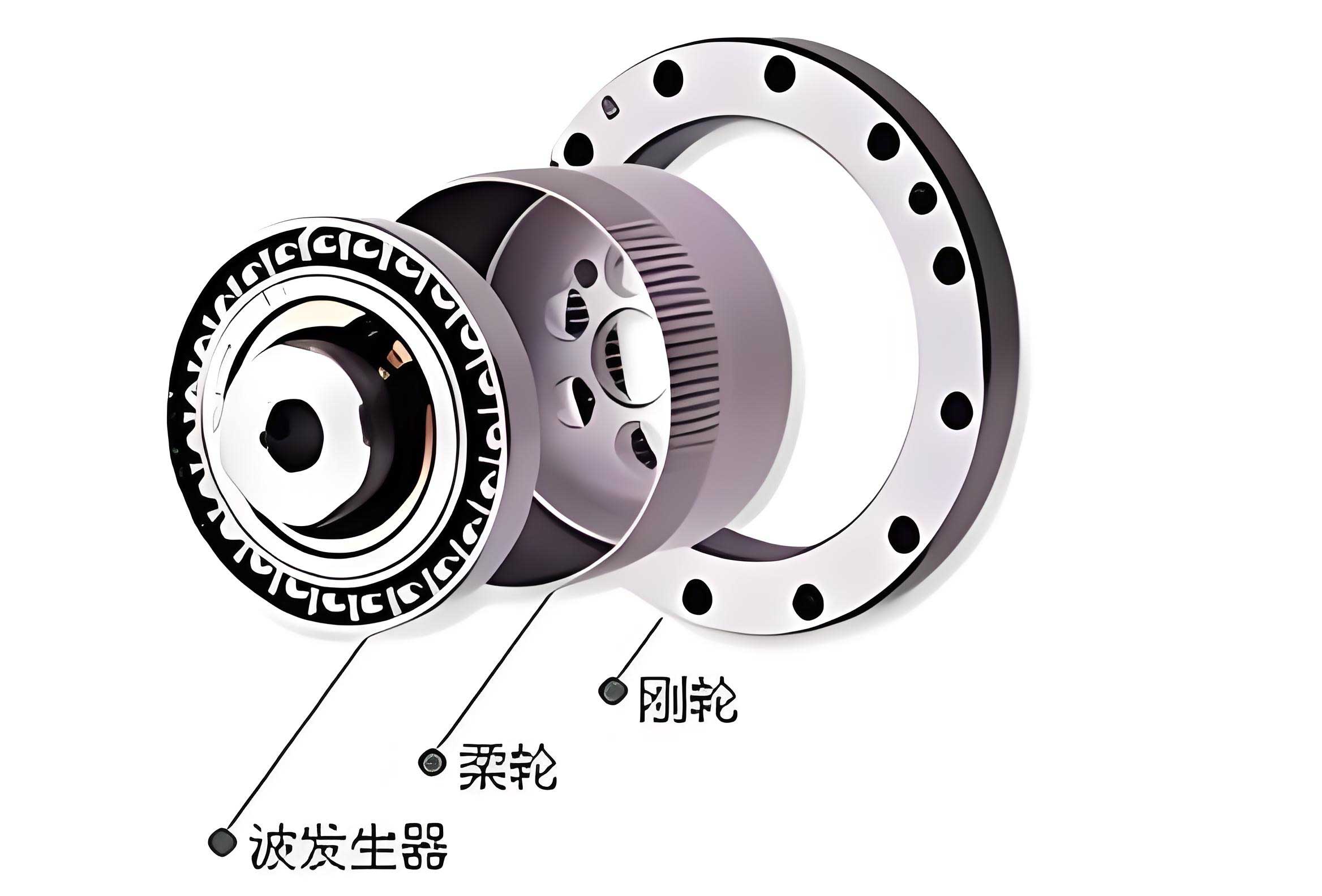
The performance of a strain wave gear is profoundly influenced by the tooth profile geometry of the mating flexspline and circular spline. While the traditional involute profile has been widely used, the quest for higher load capacity, improved torque stiffness, and enhanced transmission accuracy has driven the development of alternative profiles. Among these, the double-circular-arc (DCA) profile, specifically the common-tangent type, has emerged as a superior candidate. This profile, characterized by convex and concave circular arcs connected by a common tangent line, offers improved contact conditions and stress distribution. However, the design of this profile is complex, as its conjugate action with the rigid spline is governed by the non-linear deformation of the FS. The selection of the DCA profile’s geometric parameters (arc radii, tangent angle and length) and its positional parameters relative to the FS neutral layer (radial displacement coefficient, wall thickness) critically determines the existence, extent, and quality of conjugate engagement. An improper selection can lead to discontinuous meshing, reduced contact ratio, or even non-conjugate regions, severely degrading the performance of the strain wave gear. Therefore, a systematic investigation into how these parameters influence the conjugate characteristics is essential for optimizing the design of high-performance strain wave gear drives.
Mathematical Modeling of the Double-Circular-Arc Flexspline Tooth Profile
To analyze the meshing kinematics, a precise mathematical model of the DCA profile on the undeformed flexspline must be established. A local coordinate system \(\{X, Y, O\}\) is fixed to the FS tooth. The origin \(O\) is located at the intersection of the tooth’s symmetry axis (Y-axis) and the neutral curve of the FS cylinder. The X-axis is the tangent to this neutral curve at point \(O\). The profile is described parametrically using the arc length \(s\), measured from the tooth tip along the profile.
The DCA profile can be segmented into four distinct sections: the convex arc (AB), the common tangent line (BC), the concave arc (CD), and a transitional fillet (DE) connecting to the root circle. The fillet section DE is a passive segment determined geometrically once the primary segments are defined. Therefore, the active profile shape is governed by the parameters of the first three segments. Let us define the key profile shape parameters:
- \( \rho_a \): Radius of the convex circular arc (AB).
- \( \rho_f \): Radius of the concave circular arc (CD).
- \( \delta_L \): Angle of inclination of the common tangent line relative to the tooth symmetry line.
- \( h_l \): Length of the common tangent segment (BC).
The positional parameters linking the profile to the FS body are:
- \( w^*_0 \): Coefficient of radial displacement, scaling the nominal elliptical deformation of the FS neutral curve.
- \( \delta \): Wall thickness of the flexspline, defining the distance from the neutral layer to the root circle.
Other necessary dimensions include the addendum \(h_a\), dedendum \(h_f\), and coordinates of the arc centers \((x_a, y_a)\) and \((x_f, y_f)\) for the convex and concave arcs, respectively. These are derived from the basic module and the aforementioned parameters.
The parametric equations for the FS tooth profile vector \(\mathbf{r}(s)\) and its unit normal vector \(\mathbf{n}(s)\) (pointing outward from the tooth material) for each segment are as follows:
1. Convex Arc Segment AB (\(0 \le s \le l_1\)):
$$ \mathbf{r}_{AB}(s) = \begin{bmatrix} \rho_a \cos(\alpha_a – s/\rho_a) + x_a \\ \rho_a \sin(\alpha_a – s/\rho_a) + y_a \\ 0 \\ 1 \end{bmatrix}, \quad \mathbf{n}_{AB}(s) = \begin{bmatrix} \cos(\alpha_a – s/\rho_a) \\ \sin(\alpha_a – s/\rho_a) \\ 0 \\ 1 \end{bmatrix} $$
where \( \alpha_a = \arcsin\left( (h_a + h_f + \delta/2 – y_a) / \rho_a \right) \) and \( l_1 = \rho_a (\alpha_a – \delta_L) \).
2. Common Tangent Segment BC (\(l_1 \le s \le l_2\)):
$$ \mathbf{r}_{BC}(s) = \begin{bmatrix} \rho_a \cos \delta_L + x_a + (s – l_1) \sin \delta_L \\ \rho_a \sin \delta_L + y_a – (s – l_1) \cos \delta_L \\ 0 \\ 1 \end{bmatrix}, \quad \mathbf{n}_{BC}(s) = \begin{bmatrix} -\cos \delta_L \\ -\sin \delta_L \\ 0 \\ 1 \end{bmatrix} $$
where \( l_2 = l_1 + (\rho_a + \rho_f) \tan \delta_L \).
3. Concave Arc Segment CD (\(l_2 \le s \le l_3\)):
$$ \mathbf{r}_{CD}(s) = \begin{bmatrix} x_f – \rho_f \cos\left( \delta_L + (s – l_2)/\rho_f \right) \\ y_f – \rho_f \sin\left( \delta_L + (s – l_2)/\rho_f \right) \\ 0 \\ 1 \end{bmatrix}, \quad \mathbf{n}_{CD}(s) = \begin{bmatrix} -\cos\left( \delta_L + (s – l_2)/\rho_f \right) \\ -\sin\left( \delta_L + (s – l_2)/\rho_f \right) \\ 0 \\ 1 \end{bmatrix} $$
where \( l_3 = l_2 + \rho_f \left( \arcsin((y_f + h_f)/\rho_f) – \delta_L \right) \).
Conjugate Condition and Generation of the Circular Spline Profile
The fundamental challenge in strain wave gear design is determining the shape of the circular spline tooth profile that will maintain conjugate action with the deforming flexspline profile. The Modified Kinematic Method provides an effective framework for this analysis. This method treats the deformation of the FS as a known, prescribed geometric transformation, typically a steady-state elliptical deflection superposed on a rigid-body rotation.
The conjugate condition requires that the relative velocity vector at the contact point between the FS and CS profiles is orthogonal to the common surface normal. For a strain wave gear with a fixed CS and an FS that deforms and rotates, this condition can be expressed as finding the rotation angle \(\alpha\) of the wave generator (or equivalently, the angular position of the FS tooth relative to the WG’s major axis) for which a given point on the FS profile \(\mathbf{r}(s)\) comes into contact with the CS. The governing equation is:
$$ \mathbf{n}(s) \cdot \mathbf{v}^{(12)}(s, \alpha) = 0 $$
where \(\mathbf{v}^{(12)}\) is the relative velocity vector of the FS point relative to the CS. The deformation field of the FS, often described by a function like \(w(\phi) = w^*_0 \cos(2\phi)\) where \(\phi\) is the angular coordinate, is incorporated into the coordinate transformation used to calculate \(\mathbf{v}^{(12)}\).
For a given arc length parameter \(s\) on the FS profile, solving the above equation yields one or more specific values of the conjugate angle \(\alpha\). The set of all \(s\) for which a real solution \(\alpha\) exists defines the portions of the FS profile that can potentially contact the CS. The corresponding range(s) of \(\alpha\) values form the conjugate existent domain (CED). By solving for \(\alpha\) across the entire profile and then applying the inverse coordinate transformation for each conjugate angle, the locus of points that form the conjugate tooth profile (CTP) of the circular spline can be generated.
A critical finding for the DCA profile in a strain wave gear is that the solution of the conjugate condition typically yields two distinct conjugate angles \(\alpha_1\) and \(\alpha_2\) for a single point \(s\) on the FS profile. This implies a given FS tooth point will mesh with the CS at two different rotational positions of the wave generator—a phenomenon termed double conjugate engagement. Conversely, at a fixed conjugate angle \(\alpha\), there are often two different points \(s_1\) and \(s_2\) on the FS profile that satisfy the conjugate condition simultaneously, leading to dual-point contact. These phenomena significantly increase the total contact ratio and load-sharing capability of the strain wave gear.
The conjugate angles are typically plotted against the arc length \(s\). This plot reveals the structure of the meshing process: one or more continuous bands (CEDs) where conjugate solutions exist, separated by “blank” regions where no solution exists, indicating non-conjugate or disengaged portions of the profile. Optimizing the DCA parameters aims to maximize the width and continuity of the CEDs while promoting dual-point and double conjugate engagement.
Systematic Analysis of Parameter Influence on Conjugate Characteristics
Using the described mathematical model and conjugate theory, a comprehensive parametric study was conducted. A base strain wave gear configuration was defined: module \(m = 0.3175\) mm, FS tooth number \(Z_f = 160\), CS tooth number \(Z_c = 162\), elliptical wave generator, fixed CS, and an overall reduction ratio of 80:1. The influence of each key parameter was analyzed by varying it while holding others constant at their base values. The primary outputs analyzed were the CED plot (\(\alpha\) vs. \(s\)) and the corresponding conjugate circular spline profiles for each CED.
1. Influence of Convex Arc Radius (\(\rho_a\))
The convex arc radius \(\rho_a\) primarily affects the meshing behavior near the tooth tip. Analysis with values \(\rho_a = [0.55, 0.60, 0.65]\) mm reveals specific trends.
- Conjugate Existent Domain (CED): Two CEDs are consistently observed. The first CED (CED-1) at smaller \(\alpha\) values shows minimal change in its angular range and position with increasing \(\rho_a\). The second CED (CED-2) at larger \(\alpha\) values exhibits a noticeable decrease in both its angular range and the arc length interval of the convex profile segment that participates in it. The “blank” region between the CEDs remains largely unchanged.
- Conjugate Tooth Profile (CTP): For CED-1, the conjugate profile derived from the convex arc segment increases in radius but decreases in arc length as \(\rho_a\) grows. For CED-2, the conjugate profile from the convex arc segment decreases in both radius and arc length. A crucial design goal is to have the conjugate profile from the concave arc in CED-1 spatially coincide with the conjugate profile from the convex arc in CED-2. This overlap signifies that at certain WG angles, three distinct profile segments (convex-tangent-concave) are simultaneously in conjugate contact, maximizing load sharing and stiffness.
| Parameter Change | Effect on CED-1 (Convex Part) | Effect on CED-2 (Convex Part) | Effect on Blank Region | Implication for Meshing |
|---|---|---|---|---|
| \(\rho_a\) Increases | Angular range ~constant, interval ~constant. | Angular range decreases, interval decreases. | ~Constant. | Reduces double engagement range for convex arc in CED-2. |
2. Influence of Concave Arc Radius (\(\rho_f\))
The concave arc radius \(\rho_f\) governs the meshing near the tooth root. Analysis with \(\rho_f = [0.55, 0.65, 0.75]\) mm shows the following.
- CED: Increasing \(\rho_f\) causes a decrease in the angular range and the participating arc length interval for the concave segment in both CED-1 and CED-2. The blank region is not affected.
- CTP: For CED-1, the conjugate profile from the concave arc increases in radius but decreases in arc length. For CED-2, the conjugate profile from the concave arc remains relatively stable in radius, arc length, and position.
| Parameter Change | Effect on CED-1 (Concave Part) | Effect on CED-2 (Concave Part) | Effect on Blank Region | Implication for Meshing |
|---|---|---|---|---|
| \(\rho_f\) Increases | Angular range ~constant, arc length decreases. | Angular range decreases, interval decreases. | ~Constant. | Reduces dual-point contact potential for concave arc in both CEDs. |
3. Influence of Common Tangent Inclination Angle (\(\delta_L\))
The tangent angle \(\delta_L\) is a highly sensitive parameter. Analysis with \(\delta_L = [12^\circ, 13^\circ, 14^\circ]\) demonstrates dramatic effects.
- CED: An increase in \(\delta_L\) significantly reduces the angular range of CED-1 while increasing the participating arc length. Conversely, it increases the angular range of CED-2 while decreasing its interval. Most critically, the blank region between the two CEDs expands drastically. This expansion severely reduces the ranges for both double conjugate engagement and dual-point contact.
- CTP: The entire conjugate profile for CED-1 rotates counter-clockwise and its arc length increases. The conjugate profile for CED-2 shifts downward along its trajectory.
| Parameter Change | Effect on CED-1 | Effect on CED-2 | Effect on Blank Region | Implication for Meshing |
|---|---|---|---|---|
| \(\delta_L\) Increases | Angular range decreases, arc length increases. | Angular range increases, arc length decreases. | Dramatically increases. | Severely disrupts meshing continuity, reduces multi-point engagement. |
4. Influence of Common Tangent Length (\(h_l\))
The length of the straight tangent segment \(h_l = [0, 0.05, 0.10]\) mm also plays a significant role.
- CED: Increasing \(h_l\) increases the angular range and interval of CED-1, while decreasing those of CED-2. The blank region shrinks, improving meshing continuity. However, the total conjugate arc length from the convex and concave arcs decreases as the tangent segment’s engagement length increases.
- CTP: For CED-1, the profiles from the convex and concave arcs increase in radius but decrease in arc length. For CED-2, the profile shifts upward.
| Parameter Change | Effect on CED-1 | Effect on CED-2 | Effect on Blank Region | Implication for Meshing |
|---|---|---|---|---|
| \(h_l\) Increases | Angular range increases, interval increases. | Angular range decreases, interval decreases. | Decreases. | Improves continuity but may reduce multi-point engagement from circular arcs. |
5. Influence of Radial Displacement Coefficient (\(w^*_0\))
This parameter scales the amplitude of the FS elliptical deformation, directly affecting the depth of engagement. Analysis with \(w^*_0 = [1.0, 1.1, 1.2]\).
- CED: A larger \(w^*_0\) decreases the angular range and interval of CED-1, and increases the angular range while decreasing the interval of CED-2. The blank region experiences a rapid and substantial expansion, which is highly detrimental.
- CTP: The conjugate profile for CED-1 shifts in the positive Y-direction, while the profile for CED-2 shifts in the negative Y-direction, indicating a change in the effective operating pitch curves.
| Parameter Change | Effect on CED-1 | Effect on CED-2 | Effect on Blank Region | Implication for Meshing |
|---|---|---|---|---|
| \(w^*_0\) Increases | Angular range decreases, interval decreases. | Angular range increases, interval decreases. | Dramatically increases. | Greatly reduces meshing continuity and multi-point contact. |
6. Influence of Flexspline Wall Thickness (\(\delta\))
The wall thickness \(\delta = [0.26, 0.28, 0.30]\) mm affects the position of the neutral layer relative to the tooth profile.
- CED: Increasing \(\delta\) increases the angular range and interval for the convex and tangent parts of CED-1 (though their arc length decreases), and has a mixed effect on the concave part of CED-1. For CED-2, it decreases the engagement for convex/tangent parts but increases it for the concave part. Overall, the blank region decreases slightly.
- CTP: Both conjugate profiles shift in the positive Y-direction, with their radii and arc lengths remaining largely constant.
| Parameter Change | Effect on CED-1 | Effect on CED-2 | Effect on Blank Region | Implication for Meshing |
|---|---|---|---|---|
| \(\delta\) Increases | Complex: increases range for convex/tangent, decreases for concave arc length. | Complex: decreases for convex/tangent, increases for concave. | Slightly decreases. | Moderately improves continuity and slightly enhances multi-point contact. |
Summary of Parameter Influence and Design Guidelines
The analysis reveals complex interdependencies between the DCA profile parameters and the conjugate meshing behavior in a strain wave gear. The following table summarizes the primary effects and offers general guidance for optimization. The guideline “Smaller Preferred” is based on the observed trends within the studied parameter ranges which generally showed that smaller values promoted wider, more continuous CEDs with less blank region.
| Parameter | Primary Effect on CEDs | Primary Effect on Conjugate Profiles | General Design Guideline (for studied case) |
|---|---|---|---|
| Convex Arc Radius (\(\rho_a\)) | Reduces CED-2 range for convex arc. | Affects radius and length; influences profile overlap for multi-segment contact. | Moderate value; optimize for CED-2 concave / CED-1 convex profile coincidence. |
| Concave Arc Radius (\(\rho_f\)) | Reduces concave arc participation in both CEDs. | Increases radius but reduces length in CED-1. | Smaller preferred to maintain sufficient conjugate arc length. |
| Tangent Angle (\(\delta_L\)) | Most critical: drastically expands blank region, redistributes CED ranges. | Causes rotation and shifting of profiles. | Smaller preferred to maximize continuity and multi-point contact. |
| Tangent Length (\(h_l\)) | Increases CED-1, decreases CED-2, reduces blank region. | Changes profile radii and positions. | Balance: a small value can aid continuity but reduces circular arc engagement. |
| Radial Disp. Coeff. (\(w^*_0\)) | Drastically expands blank region, similar to \(\delta_L\). | Shifts profiles vertically. | Smaller preferred; just sufficient for tooth engagement to minimize blank region. |
| Wall Thickness (\(\delta\)) | Complex redistribution, slightly reduces blank region. | Shifts profiles positively with constant geometry. | Optimum exists; sufficient for strength but not excessive to maintain favorable kinematics. |
Conclusion
The design of a double-circular-arc tooth profile for high-performance strain wave gears is a nuanced process requiring careful balancing of multiple geometric and positional parameters. This analysis, based on the Modified Kinematic Method, conclusively demonstrates that the meshing process for a DCA profile involves two primary conjugate existent domains (CEDs), facilitating the beneficial phenomena of double conjugate engagement and dual-point contact. These phenomena are key to achieving the high torque stiffness, load capacity, and accuracy expected from advanced strain wave gear drives.
The parametric study highlights that parameters such as the common tangent inclination angle (\(\delta_L\)) and the radial displacement coefficient (\(w^*_0\)) have a disproportionately large and often detrimental impact on meshing continuity by expanding the non-conjugate “blank” region. Conversely, parameters like the tangent length (\(h_l\)) and wall thickness (\(\delta\)) can, within limits, help reduce this blank region. The arc radii (\(\rho_a, \rho_f\)) primarily influence the extent and geometric form of the conjugate circular spline profiles, affecting the potential for optimal multi-segment contact overlap.
Therefore, an optimal design strategy for a DCA strain wave gear must prioritize minimizing the blank region between CEDs to ensure continuous, smooth power transmission. This is typically achieved by selecting smaller values for \(\delta_L\) and \(w^*_0\), and balanced values for \(h_l\) and \(\delta\). The final set of parameters should then be fine-tuned to maximize the coincidence of conjugate profiles from different segments (e.g., concave arc from CED-1 with convex arc from CED-2), thereby maximizing the number of teeth and tooth segments in simultaneous contact. This systematic, model-based approach to parameter selection is essential for unlocking the full potential of the double-circular-arc profile in creating robust, precise, and high-capacity strain wave gear transmissions.