
In the manufacturing of straight bevel gears, especially for applications like automotive differentials, non-standard pressure angles and tooth heights are often required. When production batches are small, planing machines are commonly used. However, standard planing tools have a pressure angle of 20°, which leads to significant errors when machining gears with non-standard pressure angles such as 22.5° or 25°. Traditionally, specialized tools with non-standard pressure angles are ordered, or correction methods like modifying the roll ratio are employed. These approaches, while partially effective, often result in unfavorable contact patterns—narrow and elongated—that compromise gear performance. To address this, I propose a universal planing method that enables the use of standard 20° pressure angle planing tools to generate miter gears with non-standard pressure angles. This method not only corrects the pressure angle but also controls the position, shape, and size of the tooth contact area, yielding localized contact similar to crowning. Through computer simulations and planing tests, I demonstrate that gears with a 22.5° pressure angle generated using 20° tools exhibit comparable mesh quality to those machined with dedicated 22.5° tools. This paper details the theoretical foundations, adjustment parameters, and practical implementations of this universal planing method, with a focus on miter gears, which are essential in right-angle drives.
The core idea revolves around adjusting the machine settings—such as workpiece position, tool position, and relative motion—to compensate for the discrepancy between the tool’s pressure angle and the gear’s nominal pressure angle. By introducing corrections to the wheel position and bed position, along with precise control over the roll ratio, it is possible to generate tooth surfaces with localized contact. This method builds upon prior research on localized contact for straight bevel gears but extends it to handle non-standard pressure angles. Key symbols and conventions follow established literature in gear theory. In the following sections, I will elaborate on the adjustment parameters, reference point selection, mesh conditions, transmission ratio control, tooth surface curvature analysis, and contact pattern optimization. Additionally, I will present a computer-aided analysis software package, CABWPM-1, developed to simulate and validate the method, along with illustrative examples.
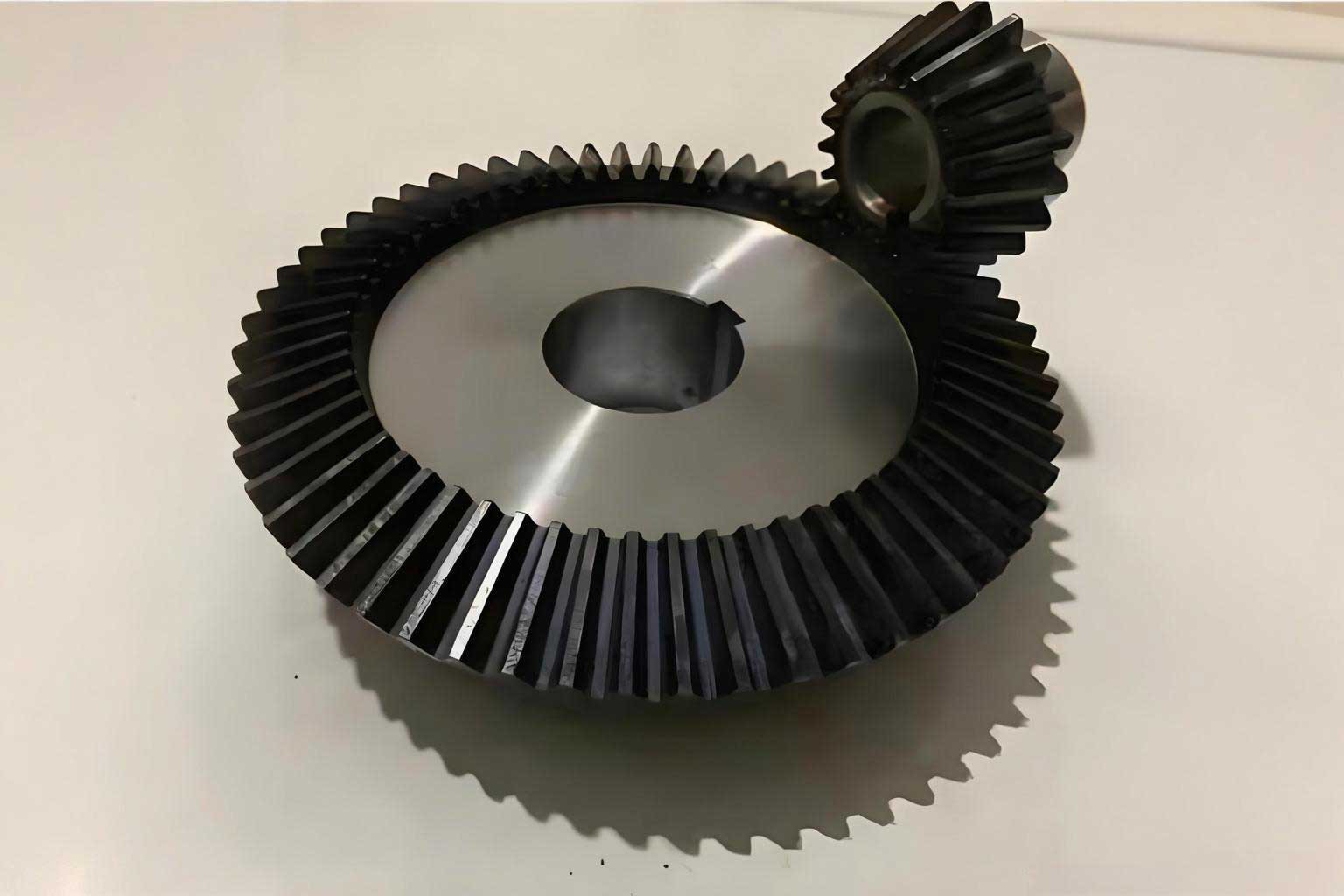
The universal planing method for miter gears involves several critical adjustment parameters on the planing machine. These parameters can be categorized into three groups: workpiece positioning parameters, tool positioning parameters, and relative motion parameters. For the workpiece, the installation angle, denoted as $\delta_a$, is set equal to the root cone angle. The horizontal displacement in the cradle plane, $\Delta E$, is achieved through corrections to the wheel position $\Delta A$ and bed position $\Delta B$. Positive values indicate the workpiece holder moving away from the cradle and the bed saddle moving away from the cradle, respectively. For the planing tool, the installation angle $\lambda$ and transverse displacement $\psi$ (often referred to as tool height) are adjusted. When $\psi$ is positive, the lower tool moves upward and the upper tool moves downward, bringing them closer together. The relative motion between the workpiece and the generating gear (cradle) is defined by the machine roll ratio $i_c$, which determines the number of teeth on the generating gear $z_c$ and the corresponding gear train ratio.
To ensure precise tooth generation, a reference point on the tooth surface is selected, typically at the center of the desired contact area. For the gear, denoted as gear 1, this point $M_1$ is located on the tooth surface $\Sigma_1$. Its position relative to the midpoint $P$ on the pitch cone generator is defined by displacements along the pitch cone: $\Delta R$ (positive towards the toe) and along the tooth height: $\Delta h$ (positive towards the root). The distance from the pitch cone apex $O_1$ to $M_1$ is $R_{m1} = \sqrt{R^2 + \Delta R^2}$, and the angle between this line and the pitch cone generator is $\theta_{m1}$, calculated using established formulas. The radial and axial positions of $M_1$ are given by $u_{m1} = R_{m1} \cos \theta_{m1}$ and $v_{m1} = R_{m1} \sin \theta_{m1}$, respectively. Assuming an approximate involute profile for the equivalent spur gear, the pressure angle $\alpha_{m1}$ at $M_1$ can be derived from the radius and unit normal vector at that point. The position vector and unit normal vector in the gear coordinate system are:
$$
\mathbf{r}_{m1}^{(O_1)} = \begin{bmatrix} u_{m1} \\ v_{m1} \\ 0 \end{bmatrix}, \quad \mathbf{n}_{m1}^{(O_1)} = \begin{bmatrix} \sin \alpha_{m1} \\ -\cos \alpha_{m1} \\ 0 \end{bmatrix}.
$$
In the planing process, a flat-topped generating gear $\Sigma_c$ is used to generate the tooth surface $\Sigma_1$ of the miter gear. A static coordinate system $S_o(O-x_o, y_o, z_o)$ is fixed to the machine frame, with $z_o$ aligned with the cradle axis. Another static system $S_1(O_1-x_1, y_1, z_1)$ is fixed to the gear, with $z_1$ along the gear axis. A moving coordinate system $S_c(O_c-x_c, y_c, z_c)$ is attached to the generating gear, where $x_c$ coincides with the trajectory of the planing tool tip. Initially, the generating gear has a rotation angle $\varphi_c^0$, and the gear has a rotation angle $\varphi_1^0$. The point $M_c$ on the generating surface $\Sigma_c$ corresponds to $M_1$ after rotations. Due to the mismatch between the tool pressure angle $\alpha_0$ (e.g., 20°) and the gear pressure angle $\alpha_{m1}$ (e.g., 22.5°), conjugate contact does not occur at the initial position. Only after the gear and generating gear rotate by angles $\Delta \varphi_1$ and $\Delta \varphi_c$, respectively, do the points satisfy the conjugate condition. Using the principle of conjugate surfaces, the following relations are obtained:
$$
\Delta \varphi_c = \frac{\Delta \varphi_1}{i_c}, \quad \Delta \varphi_1 = \frac{\alpha_{m1} – \alpha_0}{\sin \delta_1},
$$
where $\delta_1$ is the pitch cone angle of the gear. The total rotation angle of the gear is $\varphi_1 = \varphi_1^0 + \Delta \varphi_1$. The position vectors after rotation are transformed between coordinate systems to derive the machine adjustment parameters. Solving the vector equations yields the values for $\Delta A$, $\Delta B$, $\lambda$, and $\psi$. Additionally, the roll ratio $i_c$ is adjusted to ensure the transmission ratio at the reference point matches the theoretical value. This requires that the normal vector at $M_1$ passes through the relative rotation axis of the gear pair. By imposing this condition, the initial rotation angle $\varphi_1^0$ for gear 1 is determined as:
$$
\varphi_1^0 = \arctan\left( \frac{v_{m1} \cos \alpha_{m1} – u_{m1} \sin \alpha_{m1}}{u_{m1} \cos \alpha_{m1} + v_{m1} \sin \alpha_{m1}} \right).
$$
For the mating gear (gear 2), a similar process is followed to ensure conjugate action at the reference point. The tooth surface $\Sigma_2$ of gear 2 is generated using the same planing tool, but with adjustments to account for its own geometry. The reference point $M_2$ on gear 2 is chosen such that when $M_1$ and $M_2$ are in contact, the transmission ratio equals the theoretical value $i_{12} = z_2 / z_1$. The position and normal vectors for $M_2$ are derived through coordinate transformations, and the corresponding machine settings are computed. This symmetrical approach ensures that both miter gears in the pair are generated with compatible tooth surfaces.
The curvature of the generated tooth surfaces plays a crucial role in controlling the contact pattern. The generating surface $\Sigma_c$ is a plane, so its normal curvatures and geodesic torsions are zero. During planing, the contact between $\Sigma_c$ and $\Sigma_1$ is line contact. Using differential geometry, the principal curvatures and directions of $\Sigma_1$ at the reference point can be calculated. The first principal direction corresponds to the instantaneous contact line direction, and the second principal curvature is derived from the geometry of the pitch cone. For the generated surface $\Sigma_1$, the principal curvatures $\kappa_1^{(1)}$ and $\kappa_2^{(1)}$ at $M_1$ are given by:
$$
\kappa_1^{(1)} = \frac{\sin \lambda}{R_{m1} \sin \delta_1}, \quad \kappa_2^{(1)} = \frac{\cos^2 \delta_1}{R_{m1} \sin \delta_1 \cos \lambda},
$$
where $\lambda$ is the tool installation angle. Similarly, for gear 2, the principal curvatures $\kappa_1^{(2)}$ and $\kappa_2^{(2)}$ are computed. The relative curvature between the two tooth surfaces at the contact point determines the size and shape of the contact ellipse. The orientation of the contact ellipse relative to the tooth flank is controlled by the angle between the principal directions of the two surfaces. Let $\mathbf{e}_1^{(1)}$ and $\mathbf{e}_2^{(1)}$ be the unit vectors along the principal directions of $\Sigma_1$, and $\mathbf{e}_1^{(2)}$ and $\mathbf{e}_2^{(2)}$ for $\Sigma_2$. The angle $\gamma$ between $\mathbf{e}_1^{(1)}$ and $\mathbf{e}_1^{(2)}$ is calculated as:
$$
\gamma = \arccos\left( \mathbf{e}_1^{(1)} \cdot \mathbf{e}_1^{(2)} \right).
$$
To achieve a localized contact pattern with desired dimensions, the contact ellipse semi-axes $a$ and $b$ are derived from the relative curvature tensor. The length of the contact area along the tooth flank is influenced by the parameter $\xi$, defined as the ratio of the contact ellipse major axis to the tooth width $B$. Typically, $\xi$ is set between 0.3 and 0.6 for balanced performance. The angle $\beta$ between the contact ellipse major axis and the tooth midline is controlled through machine adjustments to ensure favorable contact trace direction. The following formulas summarize the control parameters:
$$
a = \sqrt{\frac{w}{2 \kappa_r}}, \quad b = \sqrt{\frac{w}{2 \tau_r}}, \quad \xi = \frac{2a}{B}, \quad \beta = \frac{1}{2} \arctan\left( \frac{2 \kappa_{12}}{\kappa_1 – \kappa_2} \right),
$$
where $w$ is the load per unit length, $\kappa_r$ is the relative normal curvature, $\tau_r$ is the relative geodesic torsion, and $\kappa_{12}$ is the mixed curvature term. By adjusting $\Delta A$, $\Delta B$, $\lambda$, $\psi$, and $i_c$, the values of $\kappa_r$, $\tau_r$, and $\beta$ can be tuned to meet specific contact pattern requirements for miter gears.
To facilitate the application of the universal planing method, I developed a computer-aided analysis software package named CABWPM-1 (Computer-Aided Bevel Gear Worm Planing Method version 1). This package performs several key functions: geometric parameter calculation for miter gears (both new design and existing drawing verification), planing adjustment computation, undercut and toe thinning checks, measurement dimension calculation after chamfering, tooth contact analysis (TCA), interference checking, and output of contact pattern graphics, motion error curves, and transmission error curves. The software is structured into two independent modules: one for planing adjustment calculation and another for TCA. This ensures that the computed machine settings accurately produce the desired tooth geometry. The table below summarizes typical adjustment parameters for a miter gear pair generated using standard 20° tools for a nominal pressure angle of 22.5°.
| Parameter | Gear 1 (Pinion) | Gear 2 (Gear) |
|---|---|---|
| Tool Pressure Angle $\alpha_0$ | 20° | 20° |
| Tool Installation Angle $\lambda$ | 3.5° | 3.2° |
| Tool Transverse Displacement $\psi$ (mm) | 0.15 | -0.10 |
| Workpiece Installation Angle $\delta_a$ | 20.5° | 67.5° |
| Wheel Position Correction $\Delta A$ (mm) | 0.05 | -0.03 |
| Bed Position Correction $\Delta B$ (mm) | 0.10 | 0.08 |
| Generating Gear Teeth $z_c$ | 24.5 | 24.5 |
| Roll Ratio $i_c$ | 1.225 | 1.225 |
| Measured Tooth Height at Heel (mm) | 5.62 | 5.58 |
| Measured Tooth Thickness at Heel (mm) | 3.45 | 3.40 |
| Toe Tooth Tip Thickness (mm) | 0.85 | 0.80 |
The software also outputs graphical results, such as contact patterns and error curves. For instance, in a case study with a miter gear pair having 10 teeth each, module 5 mm, nominal pressure angle 22.5°, and face width 20 mm, the contact pattern achieved with 20° tools is elliptical and centered, with a maximum transmission error of less than 1 arc-minute. The motion error curve shows smooth variations, indicating low vibration and noise. Compared to using dedicated 22.5° tools, the universal method yields similar contact patterns but with the advantage of tool standardization. The following equations illustrate the transmission error calculation:
$$
\Delta \varphi_2(\varphi_1) = \varphi_2(\varphi_1) – \frac{z_1}{z_2} \varphi_1, \quad \Delta i_{12}(\varphi_1) = \frac{d\varphi_2}{d\varphi_1} – \frac{z_1}{z_2},
$$
where $\varphi_1$ and $\varphi_2$ are the rotation angles of gear 1 and gear 2, respectively. The maximum values $\Delta \varphi_{2,\text{max}}$ and $\Delta i_{12,\text{max}}$ are used as quality indicators. For the example pair, $\Delta \varphi_{2,\text{max}} = 0.8$ arc-min and $\Delta i_{12,\text{max}} = 0.0015$, demonstrating high accuracy.
The universal planing method for miter gears offers several advantages over traditional approaches. First, it eliminates the need for custom-made planing tools with non-standard pressure angles, reducing tooling costs and lead times. Second, by incorporating wheel and bed corrections, it enables the generation of localized contact patterns that improve load distribution and reduce stress concentrations. Third, the method provides flexibility in controlling the contact area’s position, size, and shape, which is crucial for optimizing gear performance under specific operating conditions. Fourth, computer simulations and physical tests have validated that miter gears produced with 20° tools exhibit mesh quality comparable to those made with matched-pressure-angle tools. This is particularly beneficial for small-batch production of custom miter gears used in aerospace, automotive, and industrial machinery.
In conclusion, I have presented a comprehensive universal planing method for straight bevel gears, with a focus on miter gears. The method leverages standard 20° pressure angle planing tools to generate gears with non-standard pressure angles, while simultaneously controlling the tooth contact pattern through precise machine adjustments. Key elements include reference point selection, conjugate condition analysis, transmission ratio control, curvature matching, and contact ellipse optimization. The accompanying CABWPM-1 software package facilitates implementation and verification. This approach not only enhances manufacturing efficiency but also improves the performance and reliability of miter gear drives. Future work may extend the method to spiral bevel gears or incorporate real-time adaptive control for further refinement.