
In our study, we systematically investigate the vibration characteristics of helical gear systems under the combined effects of tooth surface friction and pitting spalling. We begin by deriving the time-varying friction excitation and the pitting‑induced stiffness variation based on the contact line evolution of helical gears. A lumped‑parameter model with eight degrees of freedom, including translation and torsion, is then developed to capture the coupled bending‑torsion‑axial dynamics. Through numerical simulations, we evaluate how tooth friction and pitting spalling influence the dynamic meshing force, transmission error, and vibration displacements of the helical gear pair.
1. Calculation of Internal Nonlinear Excitations
1.1 Tooth Surface Friction Excitation
The direction of sliding friction on the tooth flanks of helical gears reverses at the pitch line. The total friction force and friction moments acting on the driving and driven gears are obtained by integrating the contributions of all contact segments. For a single tooth pair, the friction force and moments are expressed as:
$$f(\mu) = \frac{\eta F_n}{L(\mu)}\left[l_R(\mu) – l_L(\mu)\right]$$
$$T_{fp}(\mu) = \frac{\eta F_n}{L(\mu)}\left[l_R(\mu) h_{pR}(\mu) – l_L(\mu) h_{pL}(\mu)\right]$$
$$T_{fg}(\mu) = \frac{\eta F_n}{L(\mu)}\left[l_R(\mu) h_{gR}(\mu) – l_L(\mu) h_{gL}(\mu)\right]$$
where \(\eta\) is the friction coefficient, \(F_n\) the normal load, \(L(\mu)\) the total contact line length at position \(\mu\), and \(l_R, l_L\) the lengths of contact segments on the right and left sides of the pitch line; \(h_{pR}, h_{pL}, h_{gR}, h_{gL}\) are the corresponding friction arms. For the whole meshing cycle, the total friction force and moments are:
$$F_f(\mu) = \sum_{i=0}^{N-1} f(\mu + i \cdot p_{bt}), \quad \mu \in [0, p_{bt})$$
$$T_{fp}(\mu) = \sum_{i=0}^{N-1} T_{fp}(\mu + i \cdot p_{bt})$$
$$T_{fg}(\mu) = \sum_{i=0}^{N-1} T_{fg}(\mu + i \cdot p_{bt})$$
Here \(p_{bt}\) is the base pitch in the transverse plane, and \(N\) is the number of tooth pairs in simultaneous contact. These expressions provide the time‑varying friction excitation for helical gears.
1.2 Stiffness Excitation due to Pitting Spalling
Pitting spalling reduces the effective contact area, thereby decreasing the mesh stiffness. We model a spall as a parallelogram with its long side aligned with the contact line. The reduction in single‑tooth contact line length, \(\Delta l_p\), is determined by the spall geometry. The single‑tooth mesh stiffness of a helical gear with pitting is then:
$$k(\mu) = k_{\max} \cdot k_0(\mu) \cdot \left( l(\mu) – \Delta l_p(\mu) \right)$$
where \(k_{\max}\) is the maximum single‑tooth stiffness and \(k_0(\mu)\) the normalized parabolic distribution. The overall composite mesh stiffness is the sum over the simultaneously meshing tooth pairs. The reduction of contact length directly alters the load distribution and introduces an additional periodic excitation in the system.
2. Eight‑DOF Translation‑Torsion Coupled Dynamic Model
We consider the helical gear pair as two rigid bodies connected by a time‑varying mesh element. Each gear has three translational degrees of freedom (along the line of action LOA, off line of action OLOA, and axial direction) and one rotational degree of freedom about the shaft axis. The coupling due to the helix angle and friction leads to a full eight‑DOF model. The displacement vector is:
$$\mathbf{X} = \{ x_p, y_p, z_p, \theta_p, x_g, y_g, z_g, \theta_g \}^T$$
The relative normal displacement at the mesh is:
$$\delta_n = \delta_y \cos\beta_b + \delta_z \sin\beta_b$$
$$\delta_y = y_p – y_g + r_{bp}\theta_p – r_{bg}\theta_g$$
$$\delta_z = z_p – z_g$$
The dynamic mesh force is then:
$$F_m = k_m(t) \delta_n + c_m \dot{\delta}_n$$
where \(k_m(t)\) is the time‑varying composite mesh stiffness and \(c_m\) the mesh damping. The equations of motion are:
$$\begin{aligned}
m_p \ddot{x}_p + c_{px} \dot{x}_p + k_{px} x_p &= F_f \\
m_p \ddot{y}_p + c_{py} \dot{y}_p + k_{py} y_p &= -F_m \cos\beta_b \\
m_p \ddot{z}_p + c_{pz} \dot{z}_p + k_{pz} z_p &= -F_m \sin\beta_b \\
J_p \ddot{\theta}_p &= T_p – F_m r_{bp} + T_{fp} \\
m_g \ddot{x}_g + c_{gx} \dot{x}_g + k_{gx} x_g &= -F_f \\
m_g \ddot{y}_g + c_{gy} \dot{y}_g + k_{gy} y_g &= F_m \cos\beta_b \\
m_g \ddot{z}_g + c_{gz} \dot{z}_g + k_{gz} z_g &= F_m \sin\beta_b \\
J_g \ddot{\theta}_g &= -T_g + F_m r_{bg} – T_{fg}
\end{aligned}$$
The system parameters used in our simulations are listed in the following table.
| Parameter | Driving gear | Driven gear |
|---|---|---|
| Number of teeth | 16 | 107 |
| Module (mm) | 5.5 | |
| Face width (mm) | 80 | 75 |
| Pressure angle (°) | 20 | |
| Helix angle (°) | 17 | |
| Gear mass (kg) | 5.1 | 171 |
| Mass moment of inertia (kg·m²) | 0.0067 | 8.1 |
| Bearing stiffness (N/m) | 1.2×10⁹ | |
| Bearing damping (N·s/m) | 4×10³ | |
| Input speed (r/min) | 1800 | |
| Input torque (N·m) | 1008 | |
The mesh damping is estimated using the empirical formula:
$$c_m = 2 \zeta_m \sqrt{\frac{k_m I_p I_g}{I_p r_g^2 + I_g r_p^2}}$$
with a mesh damping ratio \(\zeta_m\) taken as 0.03–0.17. The meshing frequency is \(f_m = z n / 60\). For our case, \(f_m = 480\) Hz.
3. Results and Discussion
3.1 Effect of Bearing Stiffness
We first examined the sensitivity of the LOA displacement of the driving gear to different bearing stiffness values. The results indicate that for stiffness below 0.5×10⁹ N/m, the response fluctuates significantly. As stiffness increases beyond 1.0×10⁹ N/m, the displacement stabilizes. Consequently, we selected 1.2×10⁹ N/m to avoid excessive sensitivity.
3.2 Influence of Tooth Surface Friction
When tooth friction is included, the mean dynamic meshing force decreases by about 0.6%, but its vibration amplitude increases notably. In the frequency domain, the amplitudes at the meshing frequency \(f_m\) and its second harmonic become larger. Similarly, the dynamic transmission error exhibits a larger peak‑to‑peak value and a higher amplitude at \(f_m\), confirming that friction amplifies the vibration level.
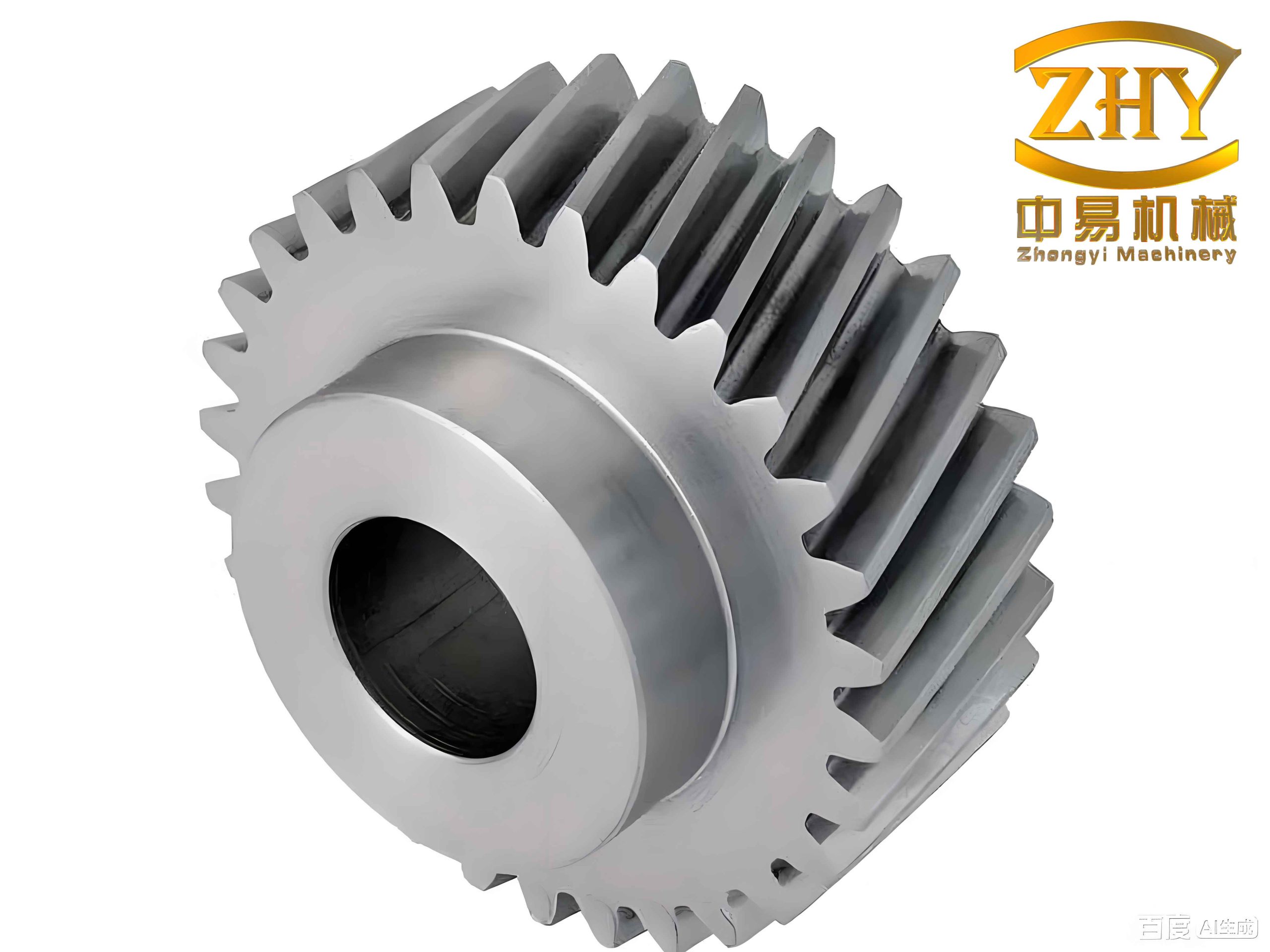
Regarding the displacement response, friction induces a periodic vibration in the OLOA direction of the driving gear, with dominant frequencies at the meshing frequency and its harmonics. In the LOA direction, the amplitude of vibration also increases when friction is considered. This coupling effect is a consequence of the helix angle: the friction force acts in the OLOA direction, but due to the spatial coupling, it also influences the LOA and axial motions. The following figure illustrates the typical excitation path in a helical gear pair.
3.3 Combined Effect of Pitting Spalling and Friction
We compared three cases: healthy gear without friction, pitted gear without friction, and pitted gear with friction. In the time domain, the dynamic transmission error of the pitted gear exhibits distinct impacts at the entry and exit of the spall zone. When friction is further included, the impact amplitude slightly decreases but the overall vibration amplitude increases. In the frequency domain, sidebands appear around the meshing frequency and its harmonics for the pitted gear. These sidebands are characteristic of local tooth faults and become more pronounced with friction.
The dynamic meshing force shows a similar trend: sharp impacts appear in the pitting region, and friction enlarges the impact magnitude. The LOA displacement of the driving gear follows the same pattern, indicating that the dynamic mesh force and displacement are closely correlated. A summary of the RMS values for different cases is given below.
| Condition | Dynamic mesh force (kN) | Transmission error (μm) | Driving gear LOA displacement (μm) |
|---|---|---|---|
| Healthy, no friction | 25.4 | 12.1 | 8.7 |
| Pitted, no friction | 26.2 | 13.5 | 9.5 |
| Pitted, with friction | 27.8 | 14.3 | 10.2 |
3.4 Influence of Spalling Size
We varied the spalling length \(l_s\) from 0 mm to 14 mm while keeping the width constant at 5 mm. The results show that the impact magnitude in both the dynamic transmission error and the meshing force increases with spalling length. In the frequency domain, the sideband amplitudes also grow with increasing spalling length. This confirms that larger spalls produce stronger fault signatures. The trend is summarized in the following table.
| Spalling length \(l_s\) (mm) | Peak impact amplitude of mesh force (kN) | Peak impact amplitude of transmission error (μm) | Sideband amplitude at \(f_m\) (kN) |
|---|---|---|---|
| 0 (healthy) | — | — | 0.12 |
| 6 | 2.1 | 1.5 | 0.35 |
| 10 | 3.8 | 2.8 | 0.61 |
| 14 | 5.6 | 4.2 | 0.93 |
4. Conclusion
Based on the analysis of helical gears, we draw the following conclusions:
- Tooth surface friction amplifies the vibration of the dynamic meshing force and increases the dynamic transmission error. Due to the bending‑torsion‑axial coupling inherent in helical gears, friction not only excites OLOA vibrations but also significantly affects the LOA displacement.
- Pitting spalling introduces distinct impacts in the time‑domain responses at the spall entry and exit. The fault signatures become stronger as the spalling length increases. Friction further intensifies the impact amplitudes.
- The proposed lumped‑parameter model effectively captures the coupled effects of friction and pitting spalling, providing a reliable tool for diagnosing early gear faults in helical gear transmissions.
Our findings offer valuable insights into the vibration characteristics of helical gears under realistic operating conditions, aiding the development of condition‑monitoring strategies.