
In the vast field of mechanical power transmission, bevel gears hold a crucial position for transmitting motion and power between intersecting shafts. Among them, straight bevel gears are often considered the most geometrically straightforward, relatively easy to manufacture, and economical. Miter gears, a specific subset where the shaft angle is 90 degrees and the gear ratio is 1:1, are a common application of this simple design. In their standard form, the theoretical line contact of a straight tooth extends across the entire face width. However, this ideal condition is rarely achieved in practice. Manufacturing inaccuracies in the gears themselves, assembly errors in the gearbox, machining tolerances of the housing, and crucially, deflections under load all conspire to disrupt this perfect contact. The result is often an undesirable edge contact, concentrating stress at either the toe or the heel of the tooth. This stress concentration is a primary culprit for premature failure through pitting, spalling, or fracture. Furthermore, such misalignment leads to less smooth transmission, increased vibration, and higher operating noise. Consequently, conventional straight bevel and miter gears have traditionally been confined to applications with lower peripheral speeds (typically below 5 m/s) and moderate power levels.
As industrial demands push towards higher speeds and heavier loads, the limitations of standard straight bevel gears become more pronounced. While spiral bevel and hypoid gears offer superior performance for these demanding conditions, they come with significant drawbacks: reliance on specialized, expensive machine tools, higher manufacturing costs, and longer lead times. Gear experts have therefore developed a highly effective solution to elevate the performance of straight bevel gears: longitudinal crowning, or barreling. The core principle is to modify the tooth trace from a straight line to a slight, controlled curve, introducing a localized area of contact. This deliberate “crowning” creates a forgiving contact pattern. Even in the presence of minor errors or deflections, the contact area remains within the central region of the tooth, safely away from the stress-raising edges. This effectively desensitizes the gear pair to common imperfections, significantly improving transmission quality, reducing noise, and extending service life. Thus, crowned straight bevel and miter gears bridge a vital performance gap, offering a more robust and economical solution where high-end spiral bevel gears are unnecessary or impractical.
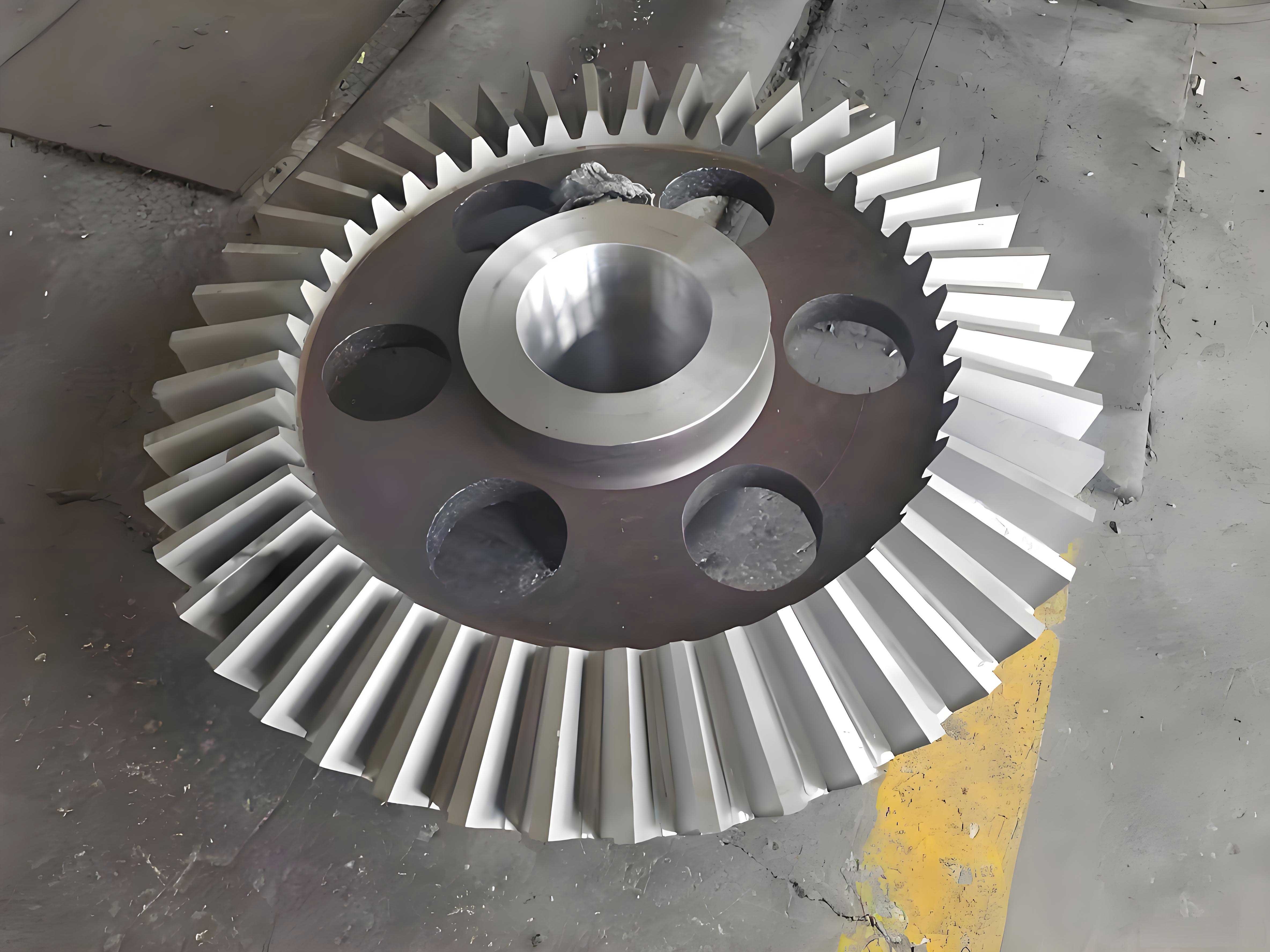
The successful implementation of crowning hinges on the precise determination of the crown amount, denoted as $\Delta S$. This is the maximum deviation of the curved tooth trace from the original straight line, measured at the center of the face width. Selecting the optimal $\Delta S$ is a balancing act. An excessive crown reduces the effective contact area, leading to elevated contact stresses ($\sigma_H$) which can paradoxically shorten gear life. The classic Hertzian contact stress formula underscores this relationship, where stress is inversely proportional to the square root of the relative radius of curvature:
$$
\sigma_H = \sqrt{ \frac{F}{2\pi b} \cdot \frac{\frac{1}{\rho_1} + \frac{1}{\rho_2}}{\frac{1-\nu_1^2}{E_1} + \frac{1-\nu_2^2}{E_2}} }
$$
Here, reducing the contact length $b$ by excessive crowning increases $\sigma_H$. Conversely, a crown amount that is too small fails to provide the necessary tolerance against misalignment, rendering the process ineffective. The determination of $\Delta S$ must therefore be a holistic decision, synthesizing several key factors. A primary consideration is the system’s precision level, encompassing the manufacturing quality of the miter gears, the gearbox housing, and the final assembly. Higher precision systems can utilize smaller crown amounts. The material properties and heat treatment of the gears dictate their core strength and resistance to deformation, influencing how much misalignment they can accommodate without permanent damage. Elastic deformations, including tooth bending, contact deflection, and shaft wind-up, must be estimated. System-level considerations like bearing clearances and the formation of an elastohydrodynamic lubrication (EHL) film also subtly affect the loaded contact pattern. Finally, the gear’s own geometry, specifically the face width $b$ and module $m$, provides the scaling context for the crown amount.
| Factor Category | Specific Considerations | Influence on Crown Amount ($\Delta S$) |
|---|---|---|
| Manufacturing & Assembly | Gear quality (AGMA/ISO grade), Housing bore alignment, Bearing seat accuracy, Assembly shimming practice. | Higher precision allows for smaller $\Delta S$. Lower precision demands a larger $\Delta S$ for robustness. |
| Material & Heat Treatment | Core hardness (e.g., 58-62 HRC for carburized steel), Yield strength, Case depth. | Stronger, harder materials can tolerate higher localized stress from a potentially smaller contact patch. |
| Elastic Deformation | Tooth bending deflection, Hertzian contact deformation, Shaft torsional wind-up, Bearing compliance. | Estimated total deflection under max load guides the minimum $\Delta S$ needed to prevent edge contact. |
| System Conditions | Operating temperature, Lubricant viscosity and film thickness, Backlash, Bearing internal clearance. | Affect the effective alignment in the operating state. Often accounted for via safety/application factors. |
| Gear Geometry | Face width ($b$), Module ($m$), Pitch angle. | Provides the dimensional basis. Crown is often expressed as a function of $m$ or a percentage of $b$. |
While a comprehensive theoretical calculation accounting for all variables is ideal, it is complex and often relies on specialized software. In practical engineering, proven empirical formulas and guidelines are indispensable. For industrial straight bevel and miter gears, the crown amount is commonly selected from the following ranges, which have shown reliable performance:
$$
\Delta S = 0.03 \text{ to } 0.05 \text{ mm}
$$
or as a function of the module:
$$
\Delta S = (0.004 \text{ to } 0.005) \times m
$$
For a miter gear with module $m = 5 \text{ mm}$, this gives $\Delta S = 0.020 \text{ to } 0.025 \text{ mm}$. The specific value within the range is chosen based on the assessment of the factors in the table above. For a high-precision, rigid system, the lower end is suitable. For more general industrial applications with expected variances, the higher end is preferred.
The machining of crowned teeth typically requires specialized equipment, such as Gleason’s Phoenix or similar bevel gear generators with built-in crowning capabilities. However, a practical and innovative method exists for retrofitting standard machines. On a conventional straight-bevel gear planer, like the Y2380 model, a custom-designed template-based attachment can be added to introduce the necessary tool oscillation. In standard operation, the tool slide moves in a straight line, constrained by a fixed guide. The crowning attachment replaces this rigid constraint with a controlled pivot. The core mechanism consists of a template (cam) with a precisely machined curve, a follower roller, a lever system, and a pre-loaded spring. As the tool slide reciprocates during the cut, the follower traces the template’s profile. This motion is transferred via the lever, causing the entire tool post to pivot minutely around a fulcrum point. This pivot superimposes a slight arcuate motion onto the tool’s primary straight-line cutting stroke. The composite path of the cutting tool edge thus becomes a shallow arc, machining the desired crowned trace onto the gear tooth. It’s important to note that this method produces crowning on both the tooth flank and, correspondingly, along the root fillet. The maximum additional displacement of the tool tip in the tooth profile direction, $\Delta H$, for a given crown amount $\Delta S$ can be derived from the lever ratio and machine kinematics. For a typical setup and $\Delta S=0.04\text{ mm}$, $\Delta H$ might be on the order of $0.15\text{ mm}$, which is compensated by a slight, uniform increase in the nominal tooth depth.
The heart of this attachment is the template curve, which defines the crowning profile. While a simple circular arc is easiest to manufacture, it positions the apex of the crown (the point of maximum tooth thickness) at the center of the face width. Empirical evidence in bevel gear operation suggests that a contact pattern biased slightly towards the toe (the inner end of the tooth) often promotes better running-in and results in quieter operation. Therefore, a two-segment parabolic curve is frequently superior to a single arc. This curve places the crown apex at a desired offset, for example, one-sixth of the face width from the center towards the toe. Let’s define the coordinate system: the x-axis runs along the face width direction, with $x=0$ at the heel (outer end) and $x=b$ at the toe (inner end). The y-axis represents the crown sagitta, with $y=R$ at the crown apex and $y=0$ being the straight line. We aim for a curve that is smooth (continuous first derivative) at the apex. Let the apex be at $x_0 = \frac{b}{2} – \frac{b}{6} = \frac{b}{3}$ from the heel, with $y(x_0)=R$, where $R$ is related to the total crown drop $\Delta S$ (the sagitta over the full width $b$). The desired crown drop from heel/toe to apex is $\Delta S/2$.
We construct two parabolas:
Segment 1 (Heel to Apex): Parabola through points $M_1(0, \Delta S/2)$, $M_2(b/3, R)$, and $M_3(2b/3, R – \Delta S/2?)$. Wait, we need a third point for a unique parabola. Actually, we define it by the apex $M_2(b/3, R)$ and the condition that it passes through the heel point $M_1(0, 0)$ if we set the straight line as y=0? Let’s clarify. The crown amount $\Delta S$ is the total deviation. If the apex is at height $R$, and the ends are at height 0, then $R = \Delta S / 2$ only if the apex is centered. For a shifted apex, the heights at the ends are not equal if we use a single parabola. To enforce a symmetric crown drop $\Delta S$ (meaning both ends deviate by the same amount from the straight line), we need a compound curve. Let’s set the straight reference line at $y=0$. We want $y(0)=y(b)=\Delta S/2$ and the apex at $x_0=b/3$ with $y(x_0)=0$. This means the crown is “up” in the middle relative to the ends. The total crown amount $\Delta S$ is the difference between end height and apex height: $\Delta S = \Delta S/2 – 0 = \Delta S/2$? That’s inconsistent. Let’s redefine properly.
Let the straight tooth trace be the reference, at $y_{ref}=0$. Crowning means we remove material, so the finished tooth surface is *below* this reference. The crown sagitta $\Delta S$ is the maximum depth. We want the deepest point (apex) at $x_0=b/3$. So $y(x_0) = -\Delta S$. At the ends, we want $y(0)=y(b)=0$. We need a smooth curve through (0,0), (b/3, $-\Delta S$), and (b, 0). A single parabola $y=ax^2+bx+c$ fits these three points perfectly. Solving:
$$ \text{At } x=0: c=0 $$
$$ \text{At } x=b: ab^2 + b\cdot b = 0 \Rightarrow b = -a b $$
$$ \text{At } x=b/3: a(b/3)^2 + (-ab)(b/3) = -\Delta S $$
$$ a\frac{b^2}{9} – a\frac{b^2}{3} = -\Delta S $$
$$ a\left( \frac{b^2}{9} – \frac{3b^2}{9} \right) = -\Delta S $$
$$ a\left( -\frac{2b^2}{9} \right) = -\Delta S \Rightarrow a = \frac{9\Delta S}{2b^2} $$
Then $b = -a b = -\frac{9\Delta S}{2b^2} \cdot b = -\frac{9\Delta S}{2b}$.
Thus, the single parabolic crown curve with offset apex is:
$$ y_1(x) = \frac{9\Delta S}{2b^2} x^2 – \frac{9\Delta S}{2b} x $$
This gives $y_1(0)=0$, $y_1(b)= \frac{9\Delta S}{2b^2}b^2 – \frac{9\Delta S}{2b}b = \frac{9\Delta S}{2} – \frac{9\Delta S}{2}=0$, and $y_1(b/3)= \frac{9\Delta S}{2b^2}\cdot\frac{b^2}{9} – \frac{9\Delta S}{2b}\cdot\frac{b}{3} = \frac{\Delta S}{2} – \frac{3\Delta S}{2} = -\Delta S$. Perfect.
However, for the template mechanism, the tool displacement is proportional to the derivative of this curve. The slope is:
$$ y_1′(x) = \frac{9\Delta S}{b^2} x – \frac{9\Delta S}{2b} $$
This is linear. To achieve a more controlled contact patch development, a two-parabola composite can be used, offering a more flexible shape. Let the composite curve consist of two parabolas $L_1$ (from heel to apex) and $L_2$ (from apex to toe), meeting smoothly at the apex $M_2(b/3, -\Delta S)$. Let $L_1$ also pass through a control point $M_1(0,0)$ and another point $M_3(2b/3, y_3)$. Let $L_2$ pass through $M_4(b,0)$ and $M_5(2b/3, y_3)$, sharing $y_3$ with $L_1$ for continuity. We enforce smoothness by matching first derivatives at $x=b/3$. Solving this system yields specific coefficients. For instance, if we set $y_3 = -3\Delta S/4$ to shape the curve, the parabolas are defined as follows:
Parabola $L_1$: $y = a_1 x^2 + b_1 x + c_1$
Conditions: $y(0)=0$, $y(b/3)=-\Delta S$, $y(2b/3)=-3\Delta S/4$.
This gives:
$$ c_1 = 0 $$
$$ a_1\left(\frac{b}{3}\right)^2 + b_1\left(\frac{b}{3}\right) = -\Delta S $$
$$ a_1\left(\frac{2b}{3}\right)^2 + b_1\left(\frac{2b}{3}\right) = -\frac{3\Delta S}{4} $$
Solving these two equations simultaneously:
(1) $a_1\frac{b^2}{9} + b_1\frac{b}{3} = -\Delta S$ => Multiply by 9: $a_1 b^2 + 3b_1 b = -9\Delta S$
(2) $a_1\frac{4b^2}{9} + b_1\frac{2b}{3} = -\frac{3\Delta S}{4}$ => Multiply by 36: $16 a_1 b^2 + 24 b_1 b = -27\Delta S$
Now, multiply equation (1) by 8: $8a_1 b^2 + 24 b_1 b = -72\Delta S$.
Subtract this from equation (2): $(16-8)a_1 b^2 = (-27+72)\Delta S$ => $8a_1 b^2 = 45\Delta S$ => $a_1 = \frac{45\Delta S}{8b^2}$.
Substitute $a_1$ into (1): $\frac{45\Delta S}{8b^2}\cdot b^2 + 3b_1 b = -9\Delta S$ => $\frac{45\Delta S}{8} + 3b_1 b = -9\Delta S$ => $3b_1 b = -9\Delta S – \frac{45\Delta S}{8} = \frac{-72\Delta S – 45\Delta S}{8} = \frac{-117\Delta S}{8}$ => $b_1 = \frac{-117\Delta S}{24b} = \frac{-39\Delta S}{8b}$.
Thus: $$ L_1: y = \frac{45\Delta S}{8b^2} x^2 – \frac{39\Delta S}{8b} x $$
Verify at $x=2b/3$: $y = \frac{45\Delta S}{8b^2}\cdot\frac{4b^2}{9} – \frac{39\Delta S}{8b}\cdot\frac{2b}{3} = \frac{45\Delta S}{8}\cdot\frac{4}{9} – \frac{39\Delta S}{8}\cdot\frac{2}{3} = \frac{180\Delta S}{72} – \frac{78\Delta S}{24} = \frac{5\Delta S}{2} – \frac{13\Delta S}{4} = \frac{10\Delta S}{4} – \frac{13\Delta S}{4} = -\frac{3\Delta S}{4}$. Correct.
Parabola $L_2$: $y = a_2 x^2 + b_2 x + c_2$
Conditions: $y(b/3)=-\Delta S$, $y(2b/3)=-3\Delta S/4$, $y(b)=0$.
We have three equations. Let’s solve:
(1) $a_2\left(\frac{b}{3}\right)^2 + b_2\left(\frac{b}{3}\right) + c_2 = -\Delta S$
(2) $a_2\left(\frac{4b^2}{9}\right) + b_2\left(\frac{2b}{3}\right) + c_2 = -\frac{3\Delta S}{4}$
(3) $a_2 b^2 + b_2 b + c_2 = 0$
Subtract (1) from (2): $a_2\left(\frac{4b^2}{9}-\frac{b^2}{9}\right) + b_2\left(\frac{2b}{3}-\frac{b}{3}\right) = -\frac{3\Delta S}{4} + \Delta S$ => $a_2\left(\frac{3b^2}{9}\right) + b_2\left(\frac{b}{3}\right) = \frac{\Delta S}{4}$ => $a_2\frac{b^2}{3} + b_2\frac{b}{3} = \frac{\Delta S}{4}$ => Multiply by 3: $a_2 b^2 + b_2 b = \frac{3\Delta S}{4}$. (A)
Subtract (2) from (3): $a_2\left(b^2-\frac{4b^2}{9}\right) + b_2\left(b-\frac{2b}{3}\right) = 0 + \frac{3\Delta S}{4}$ => $a_2\left(\frac{5b^2}{9}\right) + b_2\left(\frac{b}{3}\right) = \frac{3\Delta S}{4}$ => Multiply by 9: $5a_2 b^2 + 3b_2 b = \frac{27\Delta S}{4}$. (B)
Now we have system (A) and (B):
(A) $a_2 b^2 + b_2 b = \frac{3\Delta S}{4}$
(B) $5a_2 b^2 + 3b_2 b = \frac{27\Delta S}{4}$
Multiply (A) by 3: $3a_2 b^2 + 3b_2 b = \frac{9\Delta S}{4}$.
Subtract this from (B): $(5-3)a_2 b^2 = \frac{27\Delta S}{4} – \frac{9\Delta S}{4}$ => $2a_2 b^2 = \frac{18\Delta S}{4} = \frac{9\Delta S}{2}$ => $a_2 = \frac{9\Delta S}{4b^2}$.
Substitute into (A): $\frac{9\Delta S}{4b^2}\cdot b^2 + b_2 b = \frac{3\Delta S}{4}$ => $\frac{9\Delta S}{4} + b_2 b = \frac{3\Delta S}{4}$ => $b_2 b = \frac{3\Delta S}{4} – \frac{9\Delta S}{4} = -\frac{6\Delta S}{4} = -\frac{3\Delta S}{2}$ => $b_2 = -\frac{3\Delta S}{2b}$.
Find $c_2$ from (3): $\frac{9\Delta S}{4b^2}\cdot b^2 + \left(-\frac{3\Delta S}{2b}\right)\cdot b + c_2 = 0$ => $\frac{9\Delta S}{4} – \frac{3\Delta S}{2} + c_2 = 0$ => $\frac{9\Delta S}{4} – \frac{6\Delta S}{4} + c_2 = 0$ => $\frac{3\Delta S}{4} + c_2 = 0$ => $c_2 = -\frac{3\Delta S}{4}$.
Thus: $$ L_2: y = \frac{9\Delta S}{4b^2} x^2 – \frac{3\Delta S}{2b} x – \frac{3\Delta S}{4} $$
Check smoothness at $x=b/3$:
Derivative $L_1′ = \frac{45\Delta S}{4b^2} x – \frac{39\Delta S}{8b}$. At $x=b/3$: $L_1′ = \frac{45\Delta S}{4b^2}\cdot\frac{b}{3} – \frac{39\Delta S}{8b} = \frac{15\Delta S}{4b} – \frac{39\Delta S}{8b} = \frac{30\Delta S}{8b} – \frac{39\Delta S}{8b} = -\frac{9\Delta S}{8b}$.
Derivative $L_2′ = \frac{9\Delta S}{2b^2} x – \frac{3\Delta S}{2b}$. At $x=b/3$: $L_2′ = \frac{9\Delta S}{2b^2}\cdot\frac{b}{3} – \frac{3\Delta S}{2b} = \frac{3\Delta S}{2b} – \frac{3\Delta S}{2b} = 0$.
The derivatives do not match ($-\frac{9\Delta S}{8b}$ vs. $0$). Therefore, to enforce smoothness (equal derivatives), we must impose an additional constraint during the initial setup of the equations, which typically involves solving a system of four equations (value and derivative at join point for two parabolas) with shared parameters. This is more complex but entirely solvable, yielding a specific composite curve. The takeaway is that the template profile can be precisely calculated to produce a desired, smooth crown with a controlled apex location, optimizing the contact pattern for miter gears and other straight bevel gears.
While the template oscillation method is effective, it has a inherent kinematic limitation: the crowning is achieved by tilting the tool, which affects the entire tooth profile depth simultaneously. A more ideal form of crowning would involve a lateral shift of the tool relative to the gear blank, modifying only the tooth thickness along its length without altering the root curvature. This would more accurately mimic the crowning generated by dedicated CNC machines. Furthermore, crowned straight bevel and miter gears for high-performance applications are almost always case-hardened (e.g., carburized and ground). Heat treatment induces distortion, which can degrade the carefully machined crown and contact pattern. A promising strategy to overcome this is to perform initial roughing and semi-finishing before carburizing, leaving a small, uniform stock allowance on the tooth flanks. After hardening, the gear’s mounting and locating surfaces (e.g., bore, back face) are precision-ground to re-establish accurate datums. Finally, a hard-finishing operation, such as grinding or hard-skiving (if suitable for crowned teeth), is performed using these new datums. This process chain compensates for heat treatment distortions and yields a high-precision, crowned hard-gear with excellent life and noise characteristics.
| Aspect | Standard Straight Bevel/Miter Gear | Crowned Straight Bevel/Miter Gear | Spiral Bevel Gear |
|---|---|---|---|
| Tooth Trace | Straight Line | Curved (Barreled) | Curved (Spiral/Arc) |
| Theoretical Contact | Line (full face width) | Elliptical Patch (localized) | Elliptical Patch (localized) |
| Misalignment Sensitivity | Very High (leads to edge contact) | Low (contact stays centered) | Low |
| Noise & Vibration | Higher, especially at speed | Significantly Reduced | Low (smooth engagement) |
| Load Capacity | Moderate | Improved vs. standard | High |
| Typical Manufacturing | Conventional planer/generator | Modified planer or generator | Specialized generator (e.g., Gleason, Klingelnberg) |
| Cost & Lead Time | Low | Moderate (slightly higher than standard) | High |
| Ideal Application | Low-speed, low-power, cost-sensitive | Medium speed/power, noise-sensitive, robust design | High-speed, high-power, critical applications |
In conclusion, the application of longitudinal crowning to straight bevel and miter gears represents a powerful and pragmatic engineering upgrade. It directly addresses the principal weaknesses of the standard design by mitigating edge-loading and its detrimental consequences. The technical considerations revolve around optimizing the crown amount based on a systematic review of application factors and implementing a controlled machining process. The template-based modification of a standard planer offers a viable path for small-batch or retrofit production without capital investment in dedicated machinery. For highest quality, a post-heat-treatment hard-finishing process is recommended. This technology effectively extends the operational envelope of straight bevel and miter gears, making them a more competitive and reliable choice for a broader range of industrial drives, from conveyors and agricultural machinery to precision positioning systems, wherever intersecting shaft power transmission is required.