
In automotive, machinery, and aerospace manufacturing, gear shafts are critical components. Small-scale production facilities often face challenges like low productivity and process inefficiencies, leading to defects in gear honing. Addressing these requires innovative process improvements to enhance quality, prevent issues like pre-inspection failures or honing wheel damage, and boost overall efficiency. This article details my analysis of gear honing principles, identifies defect root causes, and introduces two effective improvement methodologies validated through practical applications.
Principles of Automotive Gear Honing
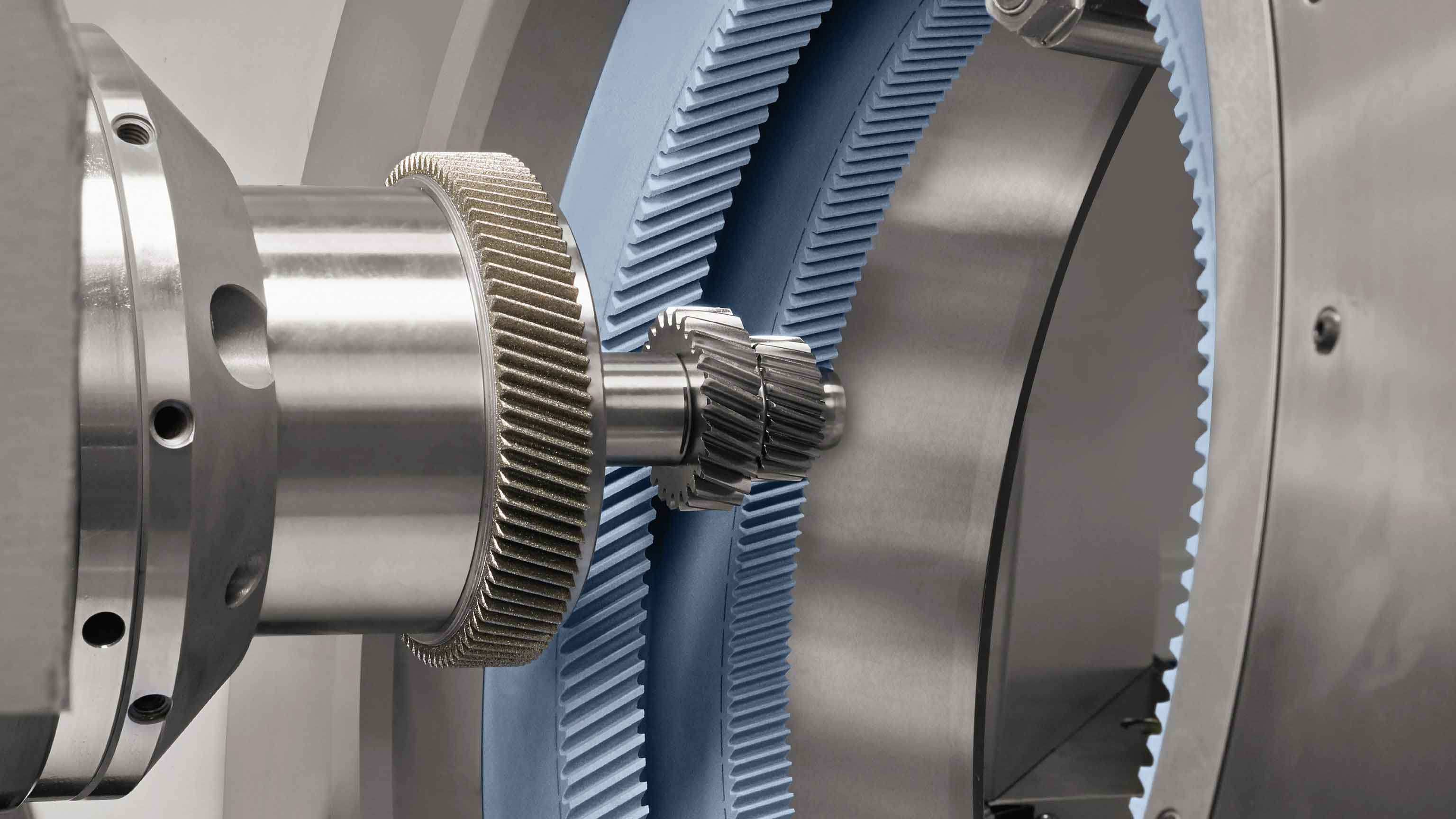
Power gear honing is widely adopted in automotive manufacturing, exemplified by its use in Volkswagen’s MQ and DQ series transmissions for high-speed gears. Transmissions directly impact vehicle dynamics, demanding high-precision gears with low noise, high load capacity, and rapid shifting. While grinding and honing are both used, gear honing is often preferred for complex geometries due to its cost-effectiveness. The core principle involves crossed-axis internal gear meshing. The honing wheel (tool) mounts externally on the machine spindle, while the workpiece gear positions internally. An axial crossing angle \(\Sigma\) is maintained between their centers, calculated as:
$$ \Sigma = \beta_1 + \beta_2 $$
where \(\beta_1\) and \(\beta_2\) represent the helix angles of the workpiece and honing wheel, respectively. During gear honing, radial cutting forces combine with the honing wheel’s reciprocating axial motion, generating a crosshatched surface pattern. This enhances meshing stability and prolongs component life. Below is a schematic of this process:
Common Defects in Gear Honing: Causes and Solutions
Pre-inspection failures and honing wheel damage (“wheel knifing”) are prevalent issues. Their origins and mitigation strategies are summarized below:
| Defect | Primary Causes | Corrective Actions |
|---|---|---|
| Pre-Inspection Failure |
|
|
| Honing Wheel Knifing |
|
|
Other defects like “black skin” (unfinished surfaces) or dimensional non-conformance often stem from inadequate machining allowance, heat treatment distortion, or equipment inaccuracy. These typically affect ≤0.1% of production but require stringent process control.
Case Study: Process Improvements for MQ Transmissions
Analyzing MQ200 and MQ250 transmissions revealed distinct gear honing challenges. MQ200 uses integrated rough hobbing-chamfering-finish hobbing, removing burrs effectively. MQ250 employs pre-heat treatment welding (gear-sleeve-ring assembly), which is cost-efficient but prone to post-heat treatment distortion due to unprocessed ring gears. Adding hard turning post-heat treatment improved MQ250 accuracy but increased costs. Key defects included:
- Pre-inspection failure rates: 0.2% (MQ200) vs. 30% (MQ250)
- Wheel knifing: Caused by excessive cutting forces or tool inaccuracies
- Black skin & dimensional errors: ~0.1% occurrence
The primary issue for MQ250 was burr-induced high points on tooth flanks (see diagram), formed during chamfering. Manual removal or relaxed pre-inspection thresholds were unsustainable solutions, often causing wheel knifing. Two novel gear honing improvement strategies were developed:
Solution 1: Pre-Heat Treatment High-Point Removal
After standard hobbing and chamfering, a shaving machine lightly processes tooth flanks to eliminate burrs. Pre- and post-shaving measurements showed:
- Before: Burr height ≈ 0.02 mm; Pre-inspection failure (“tooth flank high point” error)
- After: Burrs fully removed; Pre-inspection passed
This reduced MQ250 pre-inspection failures to 1%, resolving high points, wheel wear, and black skin without impacting gear honing cycle time. Tooling cost: +¥0.2/part.
Solution 2: Pre-Honing Shaving Roughing
Shaving performs rough machining pre-heat treatment (sequence: Hobbing → Chamfering → Shaving → Heat Treatment → Honing). Honing and shaving allowances are optimized:
$$ \Delta_{\text{honing}} = \Delta_{\text{std}} – (0.02 \text{ to } 0.04) \text{ mm (per side)} $$
$$ \Delta_{\text{shaving}} = \Delta_{\text{std}} – (0.02 \text{ to } 0.05) \text{ mm (per side)} $$
Benefits include:
- Reduced honing allowance lowers cutting forces, preventing wheel knifing.
- Cycle time reduced by 3 seconds/part.
- Annual wheel damage decreased by 5 units; downtime reduced by 1,200 minutes.
- Improved correction of heat treatment distortion (profile angle, crowning).
Cost increased by ¥2.1/part, reducible via shared shaving tool maintenance.
Comparative Analysis
The table below evaluates both solutions across key metrics:
| Criteria | Solution 1 | Solution 2 |
|---|---|---|
| Quality Improvement | Eliminates high points, wheel wear, black skin | Prevents wheel knifing, black skin; better distortion control |
| Efficiency Gain | No change in honing cycle | Cycle time ↓3s/part; Annual downtime ↓1,200 min |
| Cost Impact (per part) | +¥0.2 (tooling) | +¥2.1 (reducible via shared tool grinding) |
| Defect Reduction | Pre-inspection failure: 30% → 1% | Wheel knifing: Near-elimination; Black skin: Prevented |
Solution 2 demonstrates superior overall gains in gear honing quality, throughput, and long-term cost-efficiency despite a higher initial cost.
Conclusion
Gear honing is essential for automotive gear finishing. Defects like pre-inspection failures and wheel knifing arise from cumulative process variations, thermal distortion, and suboptimal parameters. Two solutions were implemented: Solution 1 (pre-heat treatment shaving for burr removal) significantly reduced pre-inspection failures. Solution 2 (pre-honing rough shaving with optimized allowances) comprehensively enhanced quality, reduced cycle time by 3 seconds/part, minimized downtime, and prevented critical defects. Comparative analysis confirms Solution 2’s superiority in holistically advancing gear honing performance. Manufacturers should adopt these strategies to achieve higher yields, lower costs, and superior gear quality.