
In my research on the cutting technology of miter gears, I have focused on the broaching method using a circular broach, which is recognized as one of the most efficient techniques for producing straight bevel gears, including miter gears. This method, originally developed in the United States, has been adopted worldwide due to its high productivity. However, detailed mathematical analyses of the generating principle behind circular broaching for miter gears remain limited. Inspired by the need for independent innovation, I embarked on a systematic study of this process, employing mathematical tools from gear meshing theory to derive fundamental formulas and practical adjustment methods. This article presents my findings on the generating principle, with emphasis on the application of induced curvature theory, the derivation of key equations, and the design of actual cutting surfaces for miter gears. I will use numerous formulas and tables to summarize the results, ensuring clarity for engineers and researchers working with miter gears.
The circular broaching process involves a tool called a broach disk, equipped with cutting blades arranged in a circular pattern. The disk rotates about a fixed axis while simultaneously moving linearly in a direction perpendicular to its rotation axis. This combined motion generates the tooth surfaces of miter gears. The workpiece, i.e., the miter gear blank, is held stationary during cutting. The cutting blades have circular arc profiles in the axial section of the disk, and they are symmetric with respect to a plane known as the broach plane. This setup is crucial for ensuring the correct geometry of miter gears, which are straight bevel gears with a 1:1 ratio, often used in right-angle drives. The installation requires the vertex of the miter gear and its axis to lie in the broach plane, with an installation angle typically equal to the root cone angle. In my analysis, I consider a reference point on the tooth surface of the miter gear, where the tangent plane intersects the broach plane along the feeding direction. This reference point helps simplify the kinematic and geometric relationships.
To model the process, I define coordinate systems attached to the workpiece and the broach disk. Let Σ be a coordinate system fixed to the workpiece, with origin O at the vertex of the miter gear. The feeding direction is along a line l in the broach plane. The broach disk has its own coordinate system Σ’, which rotates and translates relative to Σ. The relative motion includes a rotation with angular velocity ω and a translation with linear velocity v0. The position vector of a point P on the tooth surface of the miter gear in Σ is denoted by r, and its unit normal vector is n. Using the meshing condition from gear theory, which states that the relative velocity at the contact point must be perpendicular to the common normal, I derive the engagement equation. This leads to critical relationships between the geometric parameters of the miter gear and the broach tool.
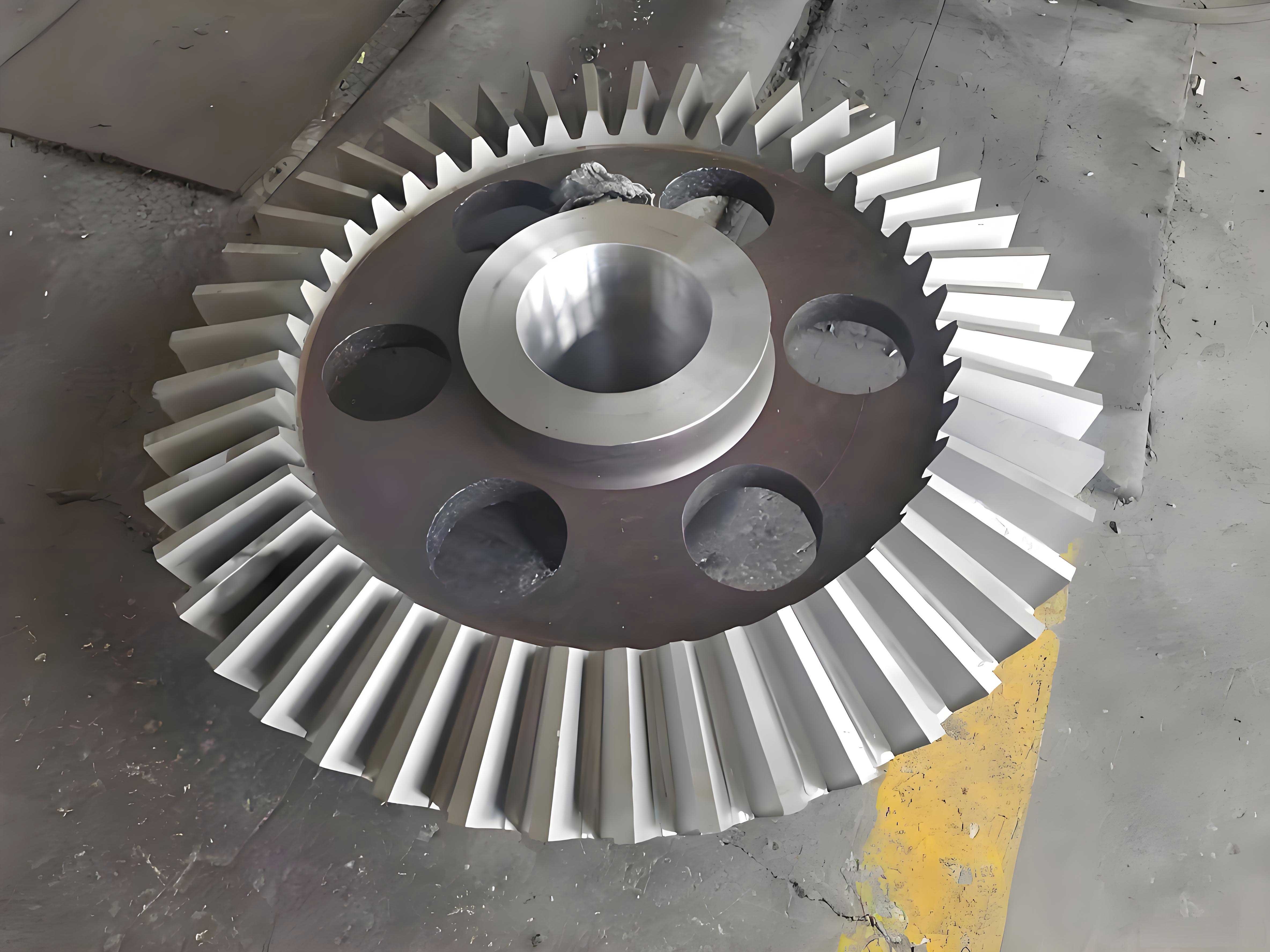
In the context of miter gears, the tooth surface is ideally a cone with vertex O. However, due to the broaching process, the actual surface deviates from a perfect cone. To analyze this, I apply the theory of induced curvature, specifically the Euler-Savary formula, to relate the curvatures of the workpiece surface and the cutting surface. For a point P on the miter gear tooth surface, let the generatrix OP be a principal direction with zero curvature. The other principal direction lies in the tangent plane perpendicular to OP. The normal curvature in the direction of relative motion, known as the longitudinal direction, and the geodesic torsion are computed. The key result is the formula for the difference in curvatures between the cutting surface and the miter gear tooth surface in a section perpendicular to the feeding direction. This formula ensures that no interference occurs during cutting, which is vital for the accuracy of miter gears.
The fundamental curvature relationship can be expressed as follows. Let ρ be the radius of curvature of the cutting blade profile (circular arc), and let ρ_s be the normal curvature radius of the miter gear tooth surface at point P in the direction perpendicular to the generatrix. Denote by Δ the angle between the generatrix OP and the feeding direction, and by R the distance from O to P along the generatrix. Then, the formula is:
$$ \frac{1}{\rho} – \frac{1}{\rho_s} = \frac{\sin \Delta}{R \sin \phi} \left( 1 + \frac{v_0}{\omega R \sin \Delta} \right) $$
Here, φ is the angle between the tangent plane and the broach plane. This equation highlights how the tool geometry and motion parameters influence the generated surface of miter gears. For practical applications, I often set v0/ω as a constant, especially in fine cutting. The formula simplifies further when specific conditions are met, ensuring efficient production of miter gears.
Next, I investigate the tool tooth line and base cone. As the broach disk moves, points along the generatrix OP of the miter gear tooth surface engage with the cutting surface at different times. The locus of these points on the cutting surface forms a curve called the tool tooth line. By applying coordinate transformations, I derive its equation and show that it lies on a cone with vertex at a fixed point relative to the broach disk. This cone, termed the tool base cone, has its axis aligned with the broach rotation axis. The tool tooth line is a helix on this base cone with a constant pitch under ideal conditions. The pitch L is given by:
$$ L = \frac{v_0}{\omega} \cdot \frac{1}{\sin \Delta} $$
This helical nature is essential for understanding the distribution of cutting edges on the broach disk for miter gears. In practice, to simplify manufacturing, the cutting blades are designed with circular arcs of the same radius ρ. This approximates the ideal cutting surface but introduces deviations in the miter gear tooth profile. Therefore, I proceed to analyze the actual cutting surface and its generated workpiece surface.
The actual cutting surface is defined by the family of circular arcs on the broach blades. For a point P on the miter gear tooth surface, the cutting surface at the engagement instant has a circular profile with center C on the common normal line. Using kinematic relations, I derive the equation of the cutting surface and the resulting workpiece surface. The workpiece surface is no longer a perfect cone but a surface that shares the same tangent plane along the generatrix. The equation of the workpiece surface can be expressed parametrically, involving the tool parameters and time. This leads to the concept of cutter marks or ψ-lines on the miter gear tooth surface, which are curves formed by points cut by the same blade at different times. These lines influence the surface finish and must be considered in tool design for high-quality miter gears.
To meet the requirement that the curvature of the miter gear tooth surface varies proportionally along the generatrix from the toe to the heel, I adjust the cutting surface. Instead of a straight generatrix, I consider a curve in the tangent plane, parameterized by coordinates (ξ, η). Let η = η(ξ) describe this curve, with reference point P0 at (ξ0, η0). The slope at P0 is tan Δ0. The desired curvature radius ρ_s along the curve should satisfy:
$$ \frac{\rho_s(\xi)}{\rho_{s0}} = \frac{\xi}{\xi_0} $$
where ρ_s0 is the curvature radius at P0. Substituting into the curvature formula yields a differential equation for η(ξ). Solving this equation approximately gives a power series expansion for η(ξ) around ξ0. The first few coefficients are crucial for tool design. For instance, the second derivative at ξ0 is approximately:
$$ \frac{d^2 \eta}{d \xi^2} \bigg|_{\xi_0} \approx – \frac{\sin \Delta_0}{R_0 \xi_0} \left( 1 + \frac{v_0}{\omega R_0 \sin \Delta_0} \right) $$
This adjustment ensures that the actual cutting surface produces miter gears with the desired taper in curvature. Consequently, the tool tooth line and blade center trajectory become helices with linearly varying pitch on the base cone. This means that the cutting blades must be installed along a helical path with a pitch that changes at a constant rate, simplifying manufacturing while achieving the required gear geometry for miter gears.
To summarize the key parameters and formulas, I present the following tables. These tables encapsulate the geometric and kinematic variables involved in the broaching of miter gears, providing a quick reference for practitioners.
| Symbol | Description | Typical Value/Range |
|---|---|---|
| O | Vertex of miter gear | Fixed point |
| P | Reference point on tooth surface | Varies along generatrix |
| Δ | Angle between OP and feeding direction | Depends on gear design |
| φ | Angle between tangent plane and broach plane | Determined by installation |
| R | Distance from O to P | Increases from toe to heel |
| ρ | Radius of cutting blade circular arc | Constant for all blades |
| ρ_s | Normal curvature radius of miter gear tooth | Varies with ξ |
| Formula | Equation | Application |
|---|---|---|
| Meshing Condition | $$ \mathbf{n} \cdot \mathbf{v}^{(r)} = 0 $$ | Determines engagement points |
| Curvature Relation | $$ \frac{1}{\rho} – \frac{1}{\rho_s} = \frac{\sin \Delta}{R \sin \phi} \left( 1 + \frac{v_0}{\omega R \sin \Delta} \right) $$ | Tool-workpiece curvature match |
| Tool Tooth Line Pitch | $$ L = \frac{v_0}{\omega \sin \Delta} $$ | Helical path on base cone |
| Adjustment Differential Equation | $$ \frac{d^2 \eta}{d \xi^2} \approx – \frac{\sin \Delta_0}{R_0 \xi_0} \left( 1 + \frac{v_0}{\omega R_0 \sin \Delta_0} \right) $$ | Curvature taper correction |
| Actual Pitch Variation | $$ L’ = L_0 + \frac{dL}{d\theta} \theta $$ where $$ \frac{dL}{d\theta} = \frac{v_0 \xi_0}{\omega R_0 \sin^2 \Delta_0} $$ | Linearly varying pitch for blades |
In my study, I have also considered the practical aspects of manufacturing miter gears using circular broaches. The design of the broach disk must account for the number of blades, their spacing, and the alignment of the blade centers along the helical trajectory. For miter gears with high precision requirements, such as those used in automotive differentials, the adjustment of local contact patterns is critical. This involves fine-tuning the installation angle and the feeding speed ratio. I have developed formulas for these adjustments based on the derived meshing equations, but they are beyond the scope of this article. However, the principles outlined here provide a foundation for further optimization.
The generating principle for miter gears in broaching is inherently linked to the conjugate surface theory. By treating the cutting surface as the envelope of the blade profiles under the given motion, I ensure that the generated miter gear tooth surface is kinematically correct. The use of circular arc blades simplifies tool grinding but necessitates the curvature adjustments described above. In practice, for miter gears with small modules, constant pitch tool tooth lines may suffice, but for larger miter gears, the variable pitch design becomes essential to maintain proper tooth contact and strength.
To illustrate the application of these formulas, consider a typical miter gear with a pitch angle of 45 degrees. The installation angle φ is set equal to the root cone angle, say 40 degrees. The reference point P0 is chosen at the midpoint of the tooth width. Using the curvature relation, I compute the required blade radius ρ for a desired tooth curvature ρ_s0. Then, from the adjustment equation, I determine the curve η(ξ) to ensure proportional curvature variation. This data guides the fabrication of the broach disk, ensuring that the produced miter gears meet design specifications.
In conclusion, my research on the generating principle of miter gears in broaching has yielded a comprehensive mathematical framework. The key contributions include the derivation of the fundamental curvature formula using induced curvature theory, the characterization of the tool tooth line as a helix on a base cone, and the development of practical methods for adjusting the cutting surface to achieve desired tooth curvature variations. These results enable the efficient and accurate manufacturing of miter gears via circular broaching. Future work could extend this analysis to spiral bevel gears or incorporate dynamic effects for high-speed cutting. Nonetheless, the principles established here underscore the importance of mathematical modeling in advancing gear technology, particularly for miter gears used in critical mechanical systems.
Throughout this article, I have emphasized the role of miter gears in various applications and how the broaching process can be optimized for their production. By integrating formulas, tables, and geometric insights, I aim to provide a valuable resource for engineers and researchers. The insertion of the miter gear image serves as a visual aid to appreciate the complexity and beauty of these components. As the demand for precision gears grows, continued exploration of generating principles will remain vital for innovation in the field of miter gears and beyond.