
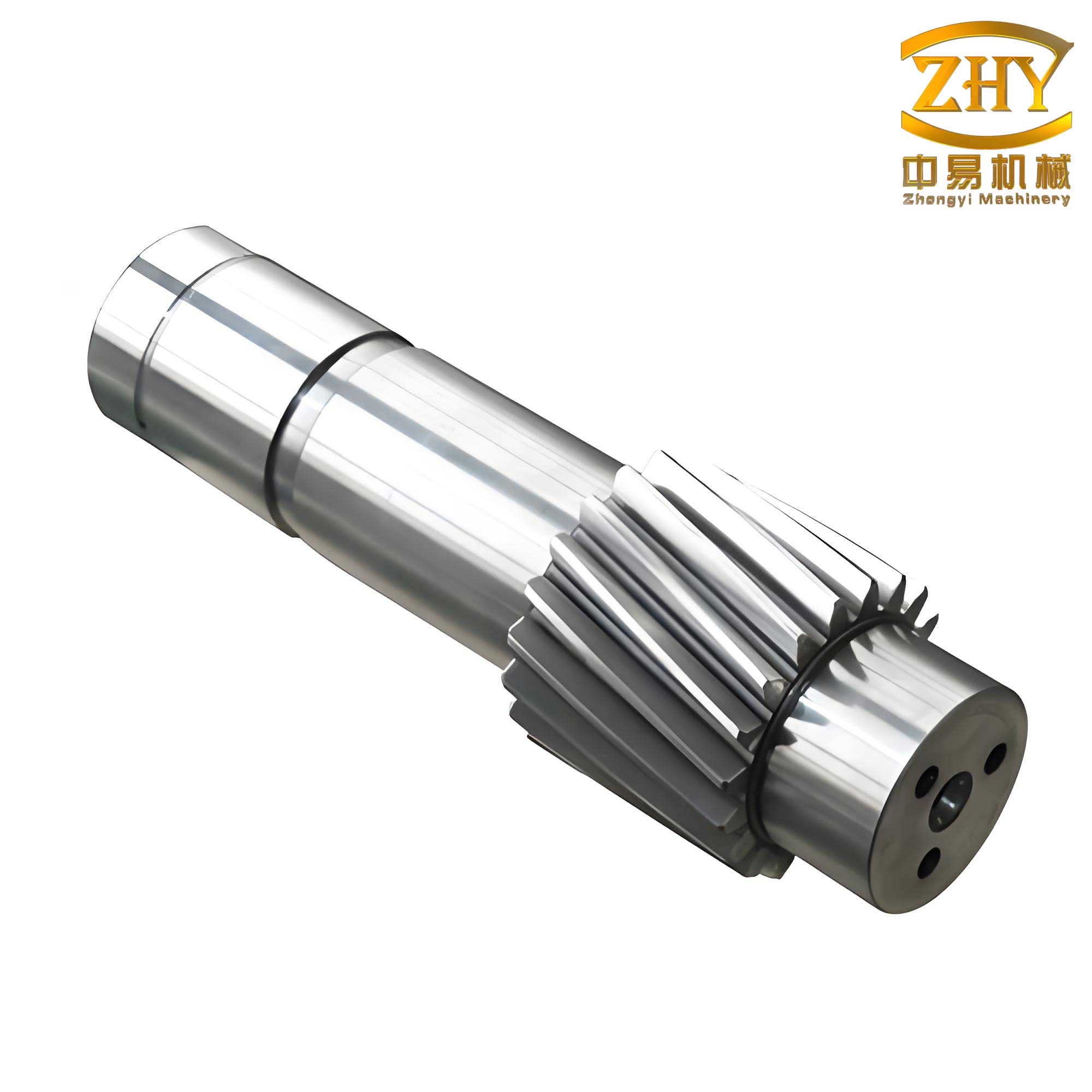
As a core component in mechanical transmission systems across sectors like wind power and rail transportation, the gear shaft operates under continuous alternating loads. These conditions make it susceptible to tooth breakage failures due to material fatigue and stress concentration. Such faults are often sudden, highly destructive, and can lead to equipment shutdowns or even safety incidents, resulting in significant economic losses. Consequently, the development of real-time monitoring and early warning systems for gear shaft tooth breakage is of paramount importance for ensuring operational safety and reducing maintenance costs.
In recent years, with advancements in IoT and artificial intelligence, research on automated monitoring for gear shaft faults has progressed. For instance, some methods separate signals and then use order-tracking techniques to extract fault-related Instantaneous Angular Speed (IAS) components, calculating entropy measures for detection. However, the weak impact energy in early-stage faults can lead to incomplete IAS extraction or insignificant entropy changes, compromising detection reliability. Other approaches combine image processing of ferrography with vibration signal denoising to capture features, feeding them into optimized Long Short-Term Memory (LSTM) models. Yet, these may struggle to adapt to the varying signal characteristics under different operational conditions. Techniques like Hilbert-Huang Transform (HHT) are employed to extract features from early fault signals by analyzing Intrinsic Mode Functions (IMF) and Hilbert spectra to identify fault periods. However, they often fail to adequately account for the complexity under alternating loads, leading to poor signal acquisition accuracy and significant localization errors. Some methods use Empirical Mode Decomposition (EMD) to select characteristic IMFs, capture fault feature vectors via the Hilbert Transform (HT), and employ improved Radial Basis Function (RBF) neural networks for detection. Nonetheless, without considering the complexities of alternating loads, the extracted features may not comprehensively reflect the characteristics of tooth breakage, resulting in suboptimal detection accuracy.
Addressing the limitations of existing methods concerning anti-interference capability, operational condition adaptability, feature extraction, and relationship mining, this study proposes an automated monitoring method for gear shaft tooth breakage under alternating loads. The method first utilizes Fiber Bragg Grating (FBG) sensors to acquire high-quality vibration signals in complex alternating load environments. Subsequently, it employs a threshold iteration loop to adaptively locate characteristic peaks on the average spectrum, constructs a dictionary using Gaussian density functions based on peak interval information, and reconstructs the signal via a matching pursuit algorithm to effectively preserve and fit peak features. Following this, time-frequency analysis is applied to extract dominant feature parameters characterizing the tooth breakage state comprehensively. Finally, a Gradient Boosting Decision Tree (GBDT) algorithm is leveraged to perform recursive and classification analysis on the extracted features, automatically mining complex inter-feature relationships to enhance monitoring accuracy and reliability.
1. Implementation of Automated Monitoring for Gear Shaft Tooth Breakage Under Alternating Loads with Gradient Boosting Decision Trees
1.1 Vibration Signal Acquisition for Gear Shafts Considering Complex Alternating Load Conditions
Alternating loads, which vary periodically in magnitude and direction over time, induce complex vibrations in the gear shaft. These vibrations exhibit different characteristics at various locations. To comprehensively understand the vibration distribution, high-precision measurement techniques are required. The FBG sensor offers high-precision strain measurement capability, enabling it to capture minute strain changes caused by vibrations. It can also perform synchronous measurements at multiple points, providing a reliable data foundation for vibration characteristic analysis. Furthermore, electromagnetic interference in industrial environments often distorts signals from traditional sensors. In contrast, FBG sensors utilize optical signal transmission, rendering them immune to electromagnetic interference and ensuring stable, reliable signal acquisition even in complex electromagnetic settings. Therefore, FBG sensors are employed to collect gear shaft vibration signals under complex alternating load conditions.
Under dynamic loads, the FBG sensor functions by measuring the shift in its center wavelength. The center wavelength of an FBG is given by:
$$\lambda_B = 2n_{eff}\Lambda$$
where $\lambda_B$ is the center wavelength of the FBG, $n_{eff}$ is the effective refractive index of the fiber, and $\Lambda$ is the grating period. External stress applied to the fiber causes coordinated changes in both its effective refractive index and grating period. This coupling effect inevitably leads to a drift in the center wavelength of the FBG’s reflection spectrum. Therefore, demodulating this drift $\Delta\lambda$ allows for the inversion of the external strain magnitude. The relationship between $\Delta\lambda$ and strain $\epsilon$ can be expressed as:
$$\Delta\lambda_B = \lambda_B (1 – p_e)\epsilon$$
where $p_e$ is the photoelastic coefficient of the fiber. Based on this principle, structural vibrations excited by the rotating gear shaft are transmitted to the FBG sensor mounted on the housing surface, inducing an internal stress response. The wavelength shift obtained from this is then demodulated to extract vibration information of the gear shaft under alternating loads. Monitoring the wavelength shift of this sensor directly yields the vibration signal of the gear shaft under alternating load conditions, completing the signal acquisition.
1.2 Gear Shaft Vibration Signal Reconstruction
Under alternating loads, gear shaft vibration signals are subject to strong interference and decreased signal-to-noise ratios (SNR), with significant feature variations across different operating conditions, making feature extraction challenging. By employing a threshold iteration loop to obtain the positions of characteristic and estimated peaks, the method can adapt to changes in signal characteristics, addressing the challenge of adaptive extraction. Since peak characteristics are crucial for reflecting the tooth breakage state, and traditional methods often fit them poorly, a Gaussian density function dictionary combined with a matching pursuit algorithm is used to reconstruct the signal. This approach effectively fits the peak features and accurately extracts key characteristics, providing reliable support for monitoring.
First, a threshold iteration method is applied to alternately identify the local maxima and minima of the gear shaft vibration signal. For detecting a minimum, the amplitude drop of the current sample point relative to the minimum value between it and the previous extremum point is evaluated. If this amplitude difference exceeds a preset threshold, the position immediately before the current point is identified as a local minimum. This condition is defined by:
$$x(k) – \min(x(p), …, x(k-1)) > \Delta$$
where $x(k)$ is the gear shaft vibration signal sequence, $x(p)$ is an extremum point, and $\Delta$ is the predefined iteration threshold. If this condition holds, $x(k)$ is identified as a local minimum.
The core condition for identifying a maximum point is that the amplitude of the current sample point must exceed the maximum value of all sample points between it and the previous extremum point, and the magnitude of this excess must satisfy the threshold requirement defined by:
$$\max(x(p), …, x(k-1)) – x(k) > \Delta$$
If this condition holds, all detected local maxima correspond to the center coordinates of the characteristic peaks. The width $y_{H_i}$ of each characteristic peak can be given by:
$$y_{H_i} = 2 \times (Z_i – A_i)$$
where $Z_i$ is the center position of the i-th peak spectrum, and $A_i$ is the coordinate of the adjacent local minimum to the left of this peak. This completes the acquisition and position estimation of the characteristic peaks.
Next, the gear shaft characteristic peak signal under alternating loads is reconstructed by combining a Gaussian density function dictionary with a matching pursuit algorithm. The detailed steps are as follows:
- Based on the peak position interval information, a dictionary $D$ is formed using Gaussian density functions. The gear shaft characteristic peak signal $y_{H_i}$ can then be represented as:
$$y_{H_i} = D\tau_0 + \alpha_0$$
where $\alpha_0$ is the residual from the iteration, and $\tau_0$ is the sparse representation of $y_{H_i}$ on the dictionary $D$. - Locate the atom within dictionary $D$ that has the maximum projection with the residual $\alpha_{t-1}$ from the $(t-1)$-th iteration. Accumulate the coefficient $d_i$ of this atom into the sparse vector $\varsigma_i^t$:
$$\varsigma_i^t = \max_{i \in q} | \langle d_i, \alpha_{t-1} \rangle |$$
where $q$ is a constant set. - Based on the updated sparse coefficient vector, solve for the sparse approximate solution at the $t$-th iteration, and then update the iteration residual $\alpha_t$:
$$\alpha_t = \alpha_{t-1} – \varsigma_i^t \times d_i$$ - Determine if the algorithm meets the set sparsity constraint condition, i.e., whether the energy of the iteration residual $\alpha_t$ is less than a residual energy threshold $\epsilon$. If yes, terminate the iteration; otherwise, return to step 2.
- Upon termination, reconstruct the characteristic peak signal from Equation related to $y_{H_i} = D\tau_0 + \alpha_0$. The sparse approximation of the real gear shaft characteristic peak signal under alternating loads is output, effectively achieving signal reconstruction $y_{H_i}$:
$$y_{H_i} = \sum_t \sum_j S_i$$ where $S_i$ contains the signal components.
To validate the effectiveness of the reconstruction, the Signal-to-Noise Ratio (SNR), Peak Signal-to-Noise Ratio (PSNR), and Root Mean Square Error (RMSE) before and after reconstruction using the proposed method are compared, as shown in Table 1.
| Test Metric | Before Reconstruction | After Reconstruction |
|---|---|---|
| SNR (dB) | 6.443 | 10.378 |
| PSNR (dB) | 7.862 | 11.345 |
| RMSE | 0.785 | 0.012 |
Analyzing the data in Table 1, before applying the proposed method for reconstruction, the SNR was 6.44 dB, indicating significant noise influence on the original signal. After reconstruction, it increased to 10.378 dB, effectively suppressing noise and enhancing signal clarity. The PSNR before reconstruction was 7.862 dB, suggesting some signal distortion, which improved to 11.345 dB after reconstruction, reducing distortion and optimizing signal quality. The RMSE decreased significantly from 0.785 before reconstruction to 0.012 afterward, indicating a substantial reduction in deviation. These results demonstrate the significant advantages of the proposed method in reconstructing gear shaft characteristic peak signals.
1.3 Automated Monitoring of Gear Shaft Tooth Breakage Anomalies via Time-Frequency Domain Analysis
Following the reconstruction of the gear shaft characteristic peak signal under alternating loads, Singular Spectrum Analysis (SSA) is introduced for time-frequency feature analysis to quantitatively characterize the feature parameters during the gear shaft tooth breakage process under alternating stress conditions. However, numerous feature parameters can be extracted from vibration signals, and complex relationships exist among them. Traditional analysis methods struggle to automatically uncover these complex relationships, leading to lower accuracy in tooth breakage anomaly monitoring. The proposed method addresses this by employing a Gradient Boosting Decision Tree (GBDT) algorithm to perform recursive and classification analysis on the extracted features. This automatically mines the complex relationships between features, solving the challenge of complex feature relationship mining and improving the accuracy and reliability of tooth breakage anomaly monitoring.
The detailed steps for time-frequency feature analysis are as follows:
- Transform the one-dimensional characteristic peak signal time series $x_n$ into a multi-dimensional vector $X_1, …, X_i, …, X_k$.
- Perform Singular Value Decomposition (SVD) on the gear shaft characteristic peak signal to obtain the trajectory matrix $X$.
- Obtain the diagonal matrix $\Lambda = diag(\lambda_1, \lambda_2, …, \lambda_L)$ from the eigenvalues of matrix $I_x = X X^T$. Obtain the orthonormal matrix $U = (U_1, U_2, …, U_L)$ from the eigenvectors of $I_x$. The trajectory matrix $X$ is composed of several elementary matrices and can be expressed as:
$$X = [X_1, X_2, …, X_k] = \sum_{j=1}^k \sqrt{\lambda_j} U_j V_j^T$$
where $T$ denotes the conjugate transpose. - Grouping: Partition the elementary matrices $X_i$ into several groups and sum the matrices within each group. Divide the indices ${1, 2, …, k}$ into $n$ disjoint subsets $R = {R_1, R_2, …, R_n}$, where $R_j = {r_{j1}, r_{j2}, …, r_{j|R_j|}}$. The composite matrix $X_{R_j}$ corresponding to $R_j$ is:
$$X_{R_j} = X_{r_{j1}} + X_{r_{j2}} + … + X_{r_{j|R_j|}}$$
Calculating the composite matrices for each subset in $R$, matrix $X$ can be decomposed as:
$$X = X_{R_1} + X_{R_2} + … + X_{R_n}$$ - Diagonal Averaging: Transform each matrix $X_{R_j}$ into a time series $g_1, g_2, …, g_n$ of length $n$:
$$g_k = \frac{1}{n} \sum_{j=1}^n X_{R_j}(k)$$ - For each matrix, applying the above method effectively enables the extraction of the dominant component feature parameters $x’_n$ for gear shaft tooth breakage under alternating loads. The corresponding calculation is:
$$x’_n = x_n \cdot \sum_{n=1}^t g_n$$
The Gradient Boosting Decision Tree (GBDT) is then introduced for automated gear shaft tooth breakage anomaly monitoring. A decision tree is a supervised learning algorithm suitable for classification and regression tasks. Its core function is to deduce rules by analyzing features to predict target variable values. A decision tree can be viewed as a tree structure containing root nodes, internal nodes, and leaf nodes. The execution flow involves recursively processing training data to generate a hierarchical branch structure, parsing the path from the start node to terminal nodes to establish decision rules, and finally applying these rules for classification or prediction on new data. To address the limitations of traditional decision trees, the Gradient Boosting Decision Tree was proposed. It integrates multiple base learners (typically decision trees), and their combined outputs form the final prediction.
The specific implementation process is described as follows: Given a training dataset ${(x_1, y_1), (x_2, y_2), …, (x_N, y_N)}$, where $x_i$ is the feature vector and $y_i$ is the label. First, initialize a constant function $F_0(x)$, typically the mean of the labels:
$$F_0(x) = \arg\min_F \sum_{i=1}^N L(y_i, F)$$
where $L(y_i, F)$ is the loss function. Then, for $m = 1$ to $M$ (where $M$ is the number of base learners), compute the negative gradient of the current function $F_{m-1}(x)$ as an approximation of the residual:
$$r_{im} = -\left[ \frac{\partial L(y_i, F(x_i))}{\partial F(x_i)} \right]_{F(x)=F_{m-1}(x)}$$
Fit a decision tree $h_m(x)$ to the data ${(x_i, r_{im})}$, resulting in leaf node regions $R_{jm}, j=1, 2, …, J_m$. For each leaf node region $R_{jm}$, calculate the output value $\gamma_{jm}$ that minimizes the loss function:
$$\gamma_{jm} = \arg\min_{\gamma} \sum_{x_i \in R_{jm}} L(y_i, F_{m-1}(x_i) + \gamma)$$
Update the model:
$$F_m(x) = F_{m-1}(x) + \nu \cdot \sum_{j=1}^{J_m} \gamma_{jm} I(x \in R_{jm})$$
where $\nu$ is the learning rate and $I(\cdot)$ is the indicator function.
After $M$ iterations, the final GBDT function is:
$$F_M(x) = F_0(x) + \nu \sum_{m=1}^M \sum_{j=1}^{J_m} \gamma_{jm} I(x \in R_{jm})$$
The extracted gear shaft tooth breakage dominant component feature parameters $x’_n$ are used as data samples. By substituting these into the final model and comparing the output against a decision threshold $\Theta$, the final monitoring result $P_{x,y}$ is obtained:
$$P_{x,y} = \begin{cases} \text{Anomaly}, & \text{if } F_M(x’_n) \geq \Theta \\ \text{Normal}, & \text{otherwise} \end{cases}$$
In this way, automated monitoring of gear shaft tooth breakage anomalies under alternating loads is achieved.
2. Experimental Validation
2.1 Experimental Platform and Parameter Settings
To effectively validate the proposed automated monitoring method for gear shaft tooth breakage anomalies under alternating loads, experimental analysis was conducted. The experimental platform primarily consists of a drive motor, a gearbox, a load simulator, sensors, and a speed controller. The load simulator applies varying loads to simulate the alternating load conditions the gear shaft endures. Vibration sensors are installed on the gearbox bearing housing to collect vibration signals during gear shaft operation, providing a comprehensive view of its working state.
Vibration signals from the gear shaft under various operating states were collected. The relevant experimental parameters are set as follows:
| Component | Parameter | Value / Setting |
|---|---|---|
| FBG Sensor | Center Wavelength | 1550 nm |
| Wavelength Sensitivity | 1.0 pm/µε | |
| Demodulator Range | 80 nm | |
| Sampling Rate | 10 kHz | |
| Wavelength Resolution | < 2 pm | |
| Gear Shaft | Rotational Speed | 300 rpm |
| Load Torque | 1000 N·m | |
| Number of Teeth | 28 | |
| Other Parameters | Iteration Count (Reconstruction) | 500 |
| Scale Parameter | 0.008 | |
| Matching Pursuit Iterations | 200 | |
| Number of Trees (GBDT) | 500 | |
| Max Tree Depth (GBDT) | 7 |
2.2 Experimental Procedure
- Baseline Data Collection: Under fault-free conditions, the gear shaft was operated under loads ranging from 5 kN to 25 kN for 1 hour each. Vibration signals were collected as baseline data.
- Fault Simulation: An early-stage tooth breakage defect was simulated by introducing a 0.2 mm wide crack at the tooth root via wire cutting. The gear shaft was run continuously for 24 hours under each load condition. Vibration data was collected for 10 minutes every hour (totaling 1440 sample sets per operating condition).
- Method Comparison: Based on the collected data, the proposed method was compared against several existing methods:
- Piecewise Mean Difference (PMD) Method from literature [5].
- PSO-optimized LSTM (PSO-LSTM) Method from literature [6].
- Self-Mixing Interference (SMI) Technique with HHT Method from literature [7].
- Radial Basis Function Neural Network (RBF-NN) Method from literature [8].
The monitoring performance was analyzed by comparing results with ground truth, calculating False Alarm Rate (FAR), F1-score, and accuracy under different operating conditions.
2.3 Experimental Analysis and Results
Under alternating loads, the proposed method’s performance for gear shaft tooth breakage anomaly monitoring was analyzed against the four comparative methods. A hydraulic servo fatigue testing machine applied alternating loads to simulate high-cycle fatigue conditions. The monitoring performance of each method is discussed below.
Qualitative Monitoring Results: The proposed method can accurately monitor changes in gear shaft vibration signals in real-time under alternating loads. It effectively captures anomalies when the signal amplitude increases significantly, correctly identifying faults. The monitoring results from the other four methods showed noticeably lower agreement with the actual fault patterns compared to the proposed method. This indicates the proposed method yields more accurate automated monitoring results for gear shaft tooth breakage anomalies.
False Alarm Rate Under Varying Loads: The variation in False Alarm Rate (FAR) for each monitoring method under increasing alternating loads is summarized in Figure 1.
| Alternating Load (kN) | Proposed Method | PMD Method | PSO-LSTM | SMI+HHT Method | RBF-NN Method |
|---|---|---|---|---|---|
| 5 | 1.1 | 1.4 | 1.5 | 1.8 | 2.0 |
| 10 | 1.3 | 1.7 | 1.9 | 2.2 | 2.5 |
| 15 | 1.8 | 2.3 | 2.8 | 3.5 | 3.9 |
| 20 | 2.4 | 3.2 | 3.8 | 4.5 | 5.0 |
| 25 | 2.9 | 4.0 | 4.5 | 5.3 | 5.8 |
Analysis shows that as alternating loads increase, the FAR for all five methods rises. This is because increased loads make gear shaft operation more complex, and interfering monitoring signals are more easily misjudged. However, compared to the other four methods, the proposed method maintains a lower and more stable FAR, making it more suitable for automated gear shaft tooth breakage anomaly monitoring and effectively reducing false alarms. In the high-load region above 15 kN, the traditional PMD and PSO-LSTM methods show a sharp exponential increase in FAR (from 1.9% to 4.0% and 2.0% to 4.5%, respectively). The SMI+HHT and RBF-NN methods exhibit significant fluctuations (increasing from 2.2% to 5.3% and 2.9% to 5.8%, respectively). In contrast, the proposed method’s FAR increases only linearly from 1.1% to 2.9%, demonstrating strong load adaptability. These results indicate the proposed method enhances monitoring reliability under complex alternating loads, providing stable technical support for industrial applications.
Long-Term Monitoring Performance (F1-Score): To further verify the monitoring performance under sustained high loads, a long-term monitoring experiment was conducted under a 25 kN alternating load. The average F1-score for each method over different runtimes is shown in Table 4.
| Runtime (hours) | Proposed Method | PMD Method | PSO-LSTM | SMI+HHT Method | RBF-NN Method |
|---|---|---|---|---|---|
| 2 | 0.96 | 0.85 | 0.84 | 0.82 | 0.81 |
| 4 | 0.94 | 0.83 | 0.82 | 0.79 | 0.80 |
| 6 | 0.92 | 0.80 | 0.78 | 0.76 | 0.77 |
| 8 | 0.91 | 0.78 | 0.74 | 0.72 | 0.73 |
| 10 | 0.90 | 0.75 | 0.70 | 0.68 | 0.69 |
| 12 | 0.89 | 0.72 | 0.67 | 0.64 | 0.66 |
According to Table 4, during prolonged operation under a 25 kN alternating load, the performance of all monitoring methods degrades, but the proposed method maintains a clear advantage. Its F1-score remains the highest throughout the 12-hour run (0.89 to 0.96) with the smallest decline (7.3%), demonstrating strong robustness and effectively resisting interference from long-term operation. The PMD method’s F1-score drops from 0.85 to 0.72 (a 15.3% decrease), with accelerated decline after 6 hours. The PSO-LSTM method’s score falls from 0.84 to 0.67 (a 20.2% decrease). The SMI+HHT method declines from 0.82 to 0.64 (22.0% decrease), possibly due to environmental factors affecting signal quality. The RBF-NN method decreases from 0.81 to 0.66 (18.5% decrease). In summary, under prolonged alternating loads, the proposed method exhibits long-term stability in complex load environments.
Accuracy Under Different Simulated Operational Conditions: To validate the practical effectiveness of the proposed method, the experimental platform simulated various long-term operating conditions for gear shafts, including variable loads and low-speed, high-torque scenarios. The conditions included Light-Medium-Heavy load cycles (5 kN to 25 kN), Random Variable Loads, and Stepwise Variable Loads. Speed was set to a low range (50-100 rpm). The drive motor’s input power was varied to simulate load fluctuations due to unstable conditions like wind speed variations. Each condition was tested for 24 hours, with 10 minutes of data collected hourly. The proposed method, PMD, PSO-LSTM, SMI+HHT, and RBF-NN methods were used to monitor for tooth breakage anomalies, with accuracy as the evaluation metric. Each method was tested 5 times per condition. The results are shown in Table 5.
| Operating Condition | Test Run | Accuracy | ||||
|---|---|---|---|---|---|---|
| Proposed Method | PMD Method | PSO-LSTM | SMI+HHT | RBF-NN | ||
| Light-Medium-Heavy Load Cycle | 1 | 0.94 | 0.92 | 0.88 | 0.85 | 0.84 |
| 2 | 0.94 | 0.91 | 0.87 | 0.83 | 0.82 | |
| 3 | 0.95 | 0.90 | 0.85 | 0.80 | 0.79 | |
| 4 | 0.96 | 0.92 | 0.88 | 0.84 | 0.83 | |
| 5 | 0.94 | 0.90 | 0.85 | 0.80 | 0.79 | |
| Random Variable Load | 1 | 0.92 | 0.85 | 0.81 | 0.78 | 0.76 |
| 2 | 0.90 | 0.84 | 0.80 | 0.77 | 0.75 | |
| 3 | 0.91 | 0.81 | 0.77 | 0.74 | 0.72 | |
| 4 | 0.91 | 0.82 | 0.78 | 0.75 | 0.73 | |
| 5 | 0.92 | 0.81 | 0.77 | 0.74 | 0.72 | |
| Stepwise Variable Load | 1 | 0.91 | 0.86 | 0.84 | 0.81 | 0.80 |
| 2 | 0.92 | 0.87 | 0.85 | 0.82 | 0.81 | |
| 3 | 0.92 | 0.85 | 0.83 | 0.80 | 0.79 | |
| 4 | 0.91 | 0.83 | 0.81 | 0.78 | 0.77 | |
| 5 | 0.90 | 0.82 | 0.80 | 0.77 | 0.76 | |
According to the results in Table 5, under the Light-Medium-Heavy load cycle condition, the proposed method’s accuracy remained stable between 0.94 and 0.96 across all five test runs, demonstrating excellent and consistent performance. In comparison, the PMD method achieved accuracy between 0.90 and 0.92, showing decent performance but lagging behind the proposed method. The PSO-LSTM method ranged from 0.85 to 0.88, with relatively small fluctuations but an overall lower level than both the proposed and PMD methods. The SMI+HHT method ranged from 0.80 to 0.85, and the RBF-NN method from 0.79 to 0.84; both exhibited lower accuracy and more noticeable fluctuations.
Under the Random Variable Load condition, the proposed method’s accuracy ranged from 0.90 to 0.92, showing slight fluctuations but maintaining a high overall level. The PMD method’s accuracy dropped to between 0.81 and 0.85, and the PSO-LSTM method to between 0.77 and 0.81; both showed decreased accuracy and increased fluctuation compared to the previous condition. The SMI+HHT method ranged from 0.74 to 0.78, and the RBF-NN method from 0.72 to 0.76; these methods exhibited further reduced accuracy and poorer stability.
Under the Stepwise Variable Load condition, the proposed method’s accuracy was between 0.90 and 0.92. The PMD method ranged from 0.82 to 0.87, and the PSO-LSTM method from 0.80 to 0.85, both showing some fluctuation. The SMI+HHT method ranged from 0.77 to 0.82, and the RBF-NN method from 0.76 to 0.81, both maintaining relatively lower accuracy with noticeable fluctuations.
Across all three simulated conditions, the proposed method significantly outperforms the other four comparative methods in terms of accuracy and maintains relatively stable performance under different scenarios. This indicates strong adaptability and robustness to complex and variable real-world operating conditions.
3. Conclusion
Considering the lag and subjective errors inherent in traditional manual monitoring, an automated monitoring method for gear shaft tooth breakage anomalies under alternating loads is proposed to achieve precise monitoring. The method acquires gear shaft vibration signals using FBG sensors, applies a threshold iteration loop to locate characteristic and estimated peak positions on the average spectrum of the vibration signal, and reconstructs the signal by combining a Gaussian density function dictionary with a matching pursuit algorithm. Subsequently, time-frequency domain analysis is used to extract dominant feature parameters of gear shaft tooth breakage under alternating loads. Finally, a Gradient Boosting Decision Tree algorithm performs recursive and classification analysis on the extracted features to obtain the tooth breakage anomaly monitoring result. Experimental research demonstrates that the proposed method not only significantly improves gear shaft vibration signal reconstruction performance but also effectively reduces false alarms. In high-load regions, the method’s false alarm rate increased to only 2.9%. During a 12-hour runtime, it consistently maintained the highest F1-score, never dropping below 0.89. Furthermore, it showed relatively stable performance across different operating conditions, with monitoring accuracy consistently at or above 0.90. This method substantially enhances the accuracy of automated gear shaft tooth breakage anomaly monitoring, holding significant importance for ensuring the normal operation of gear shafts.