
The pursuit of geometric fidelity in gear design is paramount, especially for components operating in high-precision transmission systems. Among these, miter gears—a specific type of bevel gear with a 1:1 ratio and intersecting shafts at 90 degrees—hold critical importance in applications ranging from automotive differentials to precision industrial machinery. For decades, the prevailing approach for modeling the tooth flank of a straight bevel gear, including the miter gear, has relied on an approximation: the conical or back-cone involute. This method, born from traditional cutting process logic, projects the complex three-dimensional tooth geometry onto a developable conical surface, allowing the use of standard planar involute equations. While sufficient for general manufacturing tolerance, this approximation introduces inherent geometric errors that become significant with advancements in additive manufacturing, powder metallurgy, and high-fidelity simulation, where the design model’s accuracy directly dictates the final product’s performance.
This article delves into a comprehensive error analysis between the approximate conical involute and the theoretically correct spherical involute. It establishes that for high-precision applications, particularly for custom or high-performance miter gears, the spherical involute is non-negotiable. Furthermore, we detail a robust methodology for the secondary development of a parametric modeling program within the UG/NX environment using GRIP (Graphics Interactive Programming) to generate true spherical involute tooth flanks, enabling the rapid and accurate creation of ideal straight bevel and miter gear three-dimensional solids.
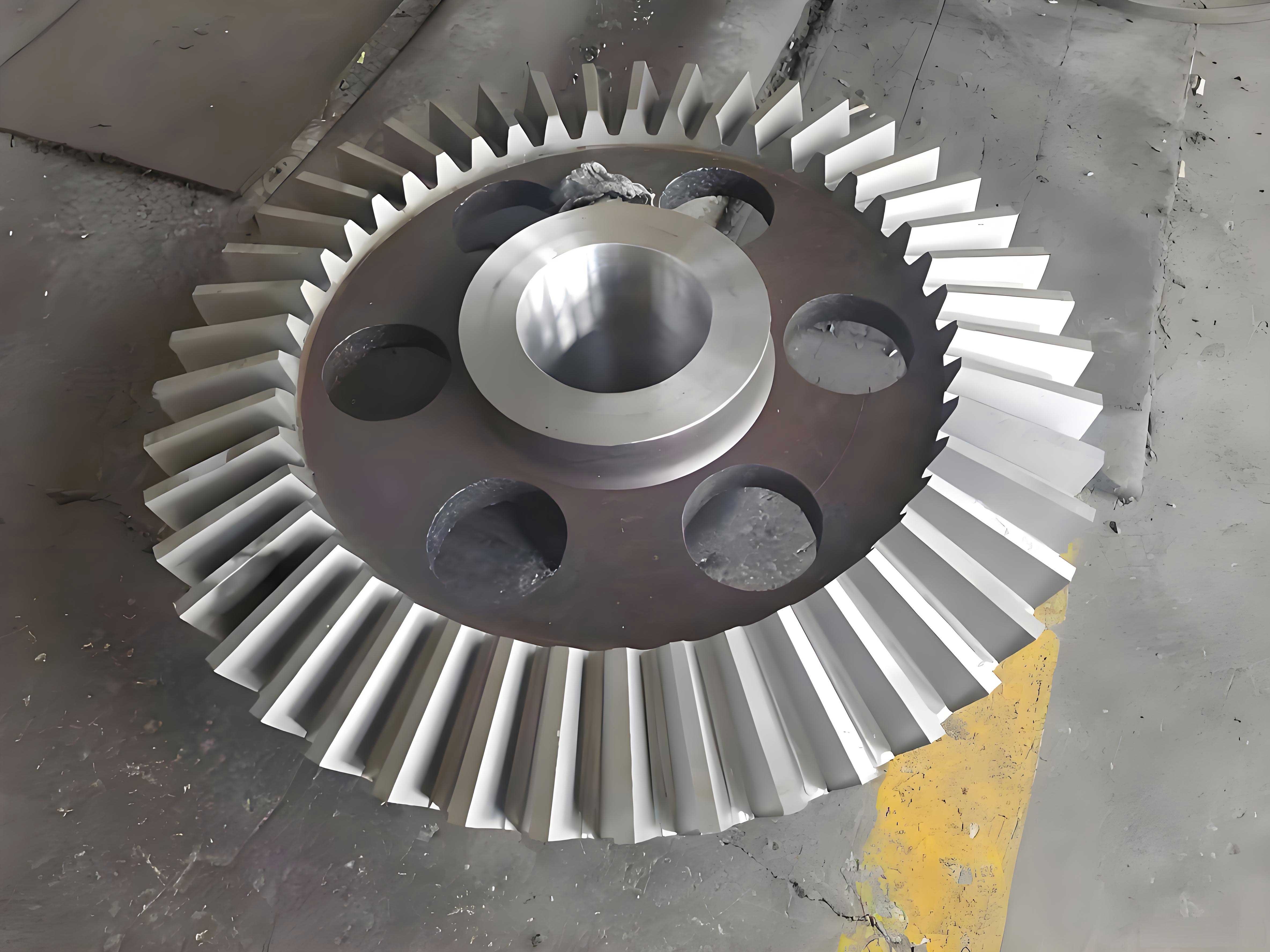
1. Foundational Error Analysis: Conical vs. Spherical Involute
The core of the discrepancy lies in the fundamental geometry of a bevel gear pair. The true pitch surface is a sphere centered at the cone apex, and the line of contact between theoretically perfect gears lies on this sphere. Consequently, the accurate tooth flank profile is a spherical involute—a three-dimensional curve traced on a spherical surface. The conventional simplification unwraps the back-cone (a tangential cone to the sphere at the mean pitch circle) onto a plane, generating a standard planar involute. The equivalence hinges on the ratio of the spherical radius (outer cone distance, R) to the gear module (m). When R/m is very large, the error is negligible. However, for gears with a low number of teeth, large modules, or high shaft angles—common scenarios in miter gear design where the pitch cone angle is 45 degrees—this error becomes substantial and critically impacts tooth contact pattern, stress distribution, and transmission error.
1.1 Mathematical Formulation and Comparative Framework
To quantify this error, we establish the parametric equations for both curves in a comparable coordinate system. For a bevel gear with module $$m$$, number of teeth $$z$$, pressure angle $$\alpha$$, and pitch cone angle $$\delta$$, we define the base cone angle $$\delta_b$$.
Conical (Planar) Involute Approximation:
The back-cone radius $$r_v$$ is calculated, and the standard planar involute equations are applied in the unfolded plane. The coordinates of a point on this involute are given by:
$$ r_k = \frac{r_b}{\cos(\alpha_k)} $$
$$ \theta_k = \tan(\alpha_k) – \alpha_k $$
$$ x_c = r_k \cos(\theta_k) $$
$$ y_c = r_k \sin(\theta_k) $$
Here, $$\alpha_k$$ is the variable pressure angle at the point of interest, $$r_b$$ is the base circle radius in the unfolded plane, and $$(x_c, y_c)$$ are coordinates in the planar development. These coordinates are then transformed back onto the 3D gear blank.
True Spherical Involute:
The generation of a spherical involute can be visualized as the trace of a point on a great circle of a sphere that rolls without slipping on the base cone. Its parametric equations in 3D space are:
$$ x_s = R (\sin \beta \cos \psi + \cos \beta \cos \psi \sin \delta_b) $$
$$ y_s = R (\cos \beta \cos \psi – \sin \beta \cos \psi \sin \delta_b) $$
$$ z_s = R \cos \psi \cos \delta_b $$
where:
– $$R$$ is the outer cone distance (spherical radius).
– $$\beta$$ is the generating angle parameter (roll angle).
– $$\psi = \frac{\beta}{\cos \delta_b}$$.
– $$\delta_b$$ is the base cone angle.
By evaluating both sets of equations for identical gear parameters and mapping them into the same 3D Cartesian space, we can compute the Euclidean error vector at corresponding points.
1.2 Quantitative Error Evaluation
The following table presents a systematic comparison of coordinate values and the resultant errors for various gear configurations. The error is defined as $$\Delta = \sqrt{(x_s – x_c)^2 + (y_s – y_c)^2 + (z_s – z_c)^2}$$. Data is sampled at points along the involute from the root towards the tip.
| Configuration | Parameter Set (m, z, δ) | Point Location | Δx (mm) | Δy (mm) | Δz (mm) | Magnitude Δ (mm) |
|---|---|---|---|---|---|---|
| Standard Bevel | m=2, z=20, δ=63.43° | Near Root | 0.1353 | 0.0000 | 0.0893 | 0.162 |
| (z2=10) | Mid-Flank | 0.1346 | 0.0000 | 0.0888 | 0.161 | |
| Near Tip | 0.1321 | -0.0001 | 0.0875 | 0.158 | ||
| Miter Gear | m=2, z=20, δ=45° | Near Root | 0.0341 | 0.0000 | 0.0384 | 0.051 |
| (z2=20) | Mid-Flank | 0.0305 | -0.0001 | 0.0413 | 0.051 | |
| Near Tip | 0.0250 | -0.0002 | 0.0435 | 0.050 | ||
| High Ratio | m=3, z=50, δ=68.20° | Near Root | 0.5250 | 0.0000 | 0.3077 | 0.608 |
| (z2=20) | Mid-Flank | 0.5250 | 0.0000 | 0.3022 | 0.605 | |
| Near Tip | 0.5248 | 0.0000 | 0.2950 | 0.602 | ||
| Large Module Miter | m=5, z=30, δ=45° | Near Root | 0.7876 | 0.0000 | 0.4616 | 0.913 |
| (z2=30) | Mid-Flank | 0.7875 | 0.0000 | 0.4533 | 0.909 | |
| Near Tip | 0.7869 | 0.0003 | 0.4401 | 0.900 |
Critical Observations from the Analysis:
- Pitch Cone Angle Dominance: For a constant module and number of teeth, the error magnitude increases dramatically with the pitch cone angle $$\delta$$. A high ratio gear ($$\delta > 60°$$) shows errors an order of magnitude larger than a miter gear ($$\delta = 45°$$) with the same module. This is because the back-cone approximation worsens as the gear becomes more “flat.”
- Module Sensitivity: The error is directly proportional to the module $$m$$. A large-module miter gear, while having a favorable 45-degree angle, can still exhibit significant absolute error (e.g., ~0.9mm for m=5), which is unacceptable for precision gearing.
- Error Vector Direction: The primary error components lie in the axial (z) and radial (x) directions relative to the gear axis. The tangential (y) error is minimal near the pitch line but can become noticeable at the flanks, especially for non-standard pressure angles or when the approximation fails to accurately represent the curved path of contact.
- Implication for Miter Gears: While the spherical vs. conical error for a standard 45-degree miter gear is smaller than for a high-ratio bevel gear, it is nonetheless systematic and non-zero. In applications demanding minimal transmission error or requiring perfect conjugate action in a bevel gear pair, such as in precision indexing or high-speed transfers, this systematic deviation must be eliminated by adopting the spherical involute model.
2. Parametric Modeling via UG/NX GRIP Secondary Development
To overcome the limitations of approximate modeling and enable the efficient design of precise gears, a parametric, program-driven approach is essential. The UG/NX GRIP language provides a powerful toolkit for this secondary development, allowing the automation of geometry creation based on fundamental equations and user inputs.
2.1 Program Architecture and Logic Flow
The development of the modeling program follows a structured workflow to ensure robustness, accuracy, and user-friendliness. The core logic is encapsulated in the following flowchart, which outlines the sequence from parameter input to final solid model generation.
Program Flowchart:
- User Input & Parameter Initialization: Interactive dialogs capture key gear parameters (m, z, α, face width, etc.), miter gear pairing condition (defining δ), tooth type (equal-depth vs. standard), and manufacturing features (chamfers, fillets).
- Geometric Constant Calculation: The program computes all dependent geometric constants: pitch diameter $$d = m \cdot z$$, pitch cone angle $$\delta$$, outer cone distance $$R$$, base cone angle $$\delta_b$$, and addendum/dedendum heights for both gear and pinion members.
- Spherical Involute Point Generation: A loop iterates over the generating angle β, calculating the corresponding $$\psi$$ and the 3D coordinates $$(x_s, y_s, z_s)$$ for both the heel and toe cross-sections using the spherical involute equations. These point sets are stored in arrays.
- 3D Curve Construction: The point arrays are used to construct non-uniform rational B-spline (NURBS) curves in UG/NX, representing the exact spherical involute at the inner and outer sections of the tooth face width.
- Tooth Profile Completion: The involute curves are mirrored about the tooth centerline plane, which is precisely calculated. The root fillet curve (typically a trochoid or specified radius) is generated and connected to the involute segments, creating closed, planar tooth profiles at the heel and toe.
- Tooth Surface Generation: The two closed profiles (heel and toe) are used as guides for a ruled or lofted surface, creating the precise 3D tooth flank solid or sheet body. This surface accurately represents the spherical involute geometry across the entire face width.
- Gear Blank Creation: A separate routine constructs the gear blank solid based on calculated back cone dimensions, apex, and face width.
- Boolean Operation & Patterning: The tooth flank solid is used as a cutting tool to subtract material from the gear blank, creating the first tooth space. This cavity is then patterned circularly around the gear axis $$z$$ times using a rotational transform matrix $$M_{rot}$$:
$$ M_{rot} = \begin{bmatrix}
\cos(2\pi/z) & -\sin(2\pi/z) & 0 & 0 \\
\sin(2\pi/z) & \cos(2\pi/z) & 0 & 0 \\
0 & 0 & 1 & 0 \\
0 & 0 & 0 & 1
\end{bmatrix} $$
Successive Boolean subtractions yield the complete geared solid. - Detailing & Output: Final features like hub bores, keyways, lightening holes, and edge breaks are added. The final 3D solid model of the ideal miter gear or bevel gear is displayed.
2.2 Key GRIP Code Modules and Implementation Details
The implementation involves several critical code modules. Below are illustrative snippets showcasing the core functionality.
A. Spherical Involute Point Calculation Loop:
This loop is the heart of the precision model. It directly implements the mathematical equations.
$$ \text{ENTITY/pp_heel(200), pp_toe(200) }$$
$$ \text{DO/loop1, beta, 0, 80, 0.5 }$$
$$ \quad \text{psi = beta / cosf(delta_b) }$$
$$ \quad \text{R_heel = R_outer }$$
$$ \quad \text{R_toe = R_outer - face_width }$$
$$ \quad \text{! Heel Coordinates }$$
$$ \quad \text{x_h = R_heel*(sinf(beta)*sinf(psi) + cosf(beta)*cosf(psi)*sinf(delta_b)) }$$
$$ \quad \text{y_h = R_heel*(-cosf(beta)*sinf(psi) + sinf(beta)*cosf(psi)*sinf(delta_b)) }$$
$$ \quad \text{z_h = R_heel*cosf(psi)*cosf(delta_b) }$$
$$ \quad \text{pp_heel(i)=POINT/x_h, y_h, z_h }$$
$$ \quad \text{! Toe Coordinates }$$
$$ \quad \text{x_t = R_toe*(sinf(beta)*sinf(psi) + cosf(beta)*cosf(psi)*sinf(delta_b)) }$$
$$ \quad \text{y_t = R_toe*(-cosf(beta)*sinf(psi) + sinf(beta)*cosf(psi)*sinf(delta_b)) }$$
$$ \quad \text{z_t = R_toe*cosf(psi)*cosf(delta_b) }$$
$$ \quad \text{pp_toe(i)=POINT/x_t, y_t, z_t }$$
$$ \text{CONTINUE/loop1 }$$
$$ \text{inv_heel = SPLINE/pp_heel(1..ALL) }$$
$$ \text{inv_toe = SPLINE/pp_toe(1..ALL) }$$
B. Coordinate System Transformation for Planar Geometry:
Creating the 2D root circle in the correct plane requires a local coordinate system (CSYS).
$$ \text{! Define points for CSYS construction }$$
$$ \text{pt_origin = POINT/0,0,0 }$$
$$ \text{pt_x_axis = POINT/root_rad_heel,0,0 }$$
$$ \text{pt_y_axis = POINT/0,root_rad_heel,0 }$$
$$ \text{csys_root = CSYS/pt_origin, pt_x_axis, pt_y_axis }$$
$$ \text{&WCS = csys_root }$$
$$ \text{root_circle = CIRCLE/CENTER, pt_origin, RADIUS, root_rad_heel }$$
$$ \text{&WCS = &SYSTEM }$$
C. Rotational Patterning and Boolean Subtraction:
This module efficiently creates all tooth spaces from the first one.
$$ \text{ENTITY/solid_blank, tooth_cutter(1..z), gear_final }$$
$$ \text{solid_blank = SOLBLK/.... }$$
$$ \text{tooth_cutter(1) = ... }$$
$$ \text{! Subtract first tooth }$$
$$ \text{gear_final = SUBTRA/solid_blank, WITH, tooth_cutter(1) }$$
$$ \text{! Pattern and subtract remaining teeth }$$
$$ \text{DO/patloop, i, 2, z }$$
$$ \quad \text{rot_ang = (i-1)*360/z }$$
$$ \quad \text{mat_rot = MATRIX/XYROT, rot_ang }$$
$$ \quad \text{tooth_cutter(i) = TRANSF/mat_rot, tooth_cutter(1) }$$
$$ \quad \text{gear_final = SUBTRA/gear_final, WITH, tooth_cutter(i) }$$
$$ \text{CONTINUE/patloop }$$
2.3 Critical Considerations for Robust Implementation
- Precision of the Mirror Plane: The plane for mirroring the involute to form the opposite flank must be calculated with high precision, based on the spherical involute’s point at the reference pitch sphere and the gear axis. An incorrect plane leads to improper tooth thickness and engagement.
- Ensuring Complete Intersection: The lofted tooth surface must fully and cleanly intersect the gear blank solid. The program should include a slight overshoot of the surface boundaries to guarantee a valid boolean cut, preventing geometric failures.
- Root Fillet Transition: The connection between the spherical involute and the root fillet must be tangent continuous (G1) to avoid stress concentrations. The fillet geometry (often a trochoid based on the generating tool) needs to be correctly derived and integrated into the 2D profile sketch.
- Parameter Validation: The input module must include checks for valid parameters (e.g., positive face width, tooth count > minimum for undercut avoidance, realistic pressure angle) to prevent geometric generation failures.
3. Conclusion and Broader Implications
The transition from conical approximation to true spherical involute modeling represents a significant advancement in the digital design of bevel gears, with particular relevance for precision miter gear applications. The error analysis conclusively demonstrates that while the conical involute may suffice for general-purpose, traditionally manufactured gears, its geometric inaccuracies become a critical liability in the context of modern direct digital manufacturing and high-performance design. The magnitude of error is a function of pitch angle, module, and number of teeth, and is non-negligible for many practical configurations.
The secondary development framework within UG/NX GRIP, as detailed herein, provides a practical and powerful solution. By directly encoding the spherical involute equations and automating the entire modeling process, it enables the rapid generation of kinematically accurate 3D solids. This parametric approach offers immense flexibility; designers can instantly explore design variants by changing basic parameters, immediately observing the impact on the model. For a miter gear pair, this ensures perfect theoretical conjugacy, leading to improved predictions of contact patterns, load distribution, and transmission error through subsequent finite element analysis (FEA) and motion simulation.
Furthermore, the precise digital model serves as an unambiguous master for downstream activities. It can drive the programming of 5-axis CNC machining centers for prototyping or mold creation, generate exact meshes for computational fluid dynamics (CFD) in lubricated gear analysis, and act as the reference geometry for coordinate measuring machine (CMM) inspection paths. In essence, adopting the spherical involute paradigm through automated parametric modeling closes the gap between theoretical gear geometry and its practical digital realization, laying a flawless foundation for the entire product development lifecycle of high-integrity bevel and miter gears.