
In the automotive industry, spiral gears are critical components, particularly in transmission systems such as gearboxes and reducers. The quality and performance of spiral gears directly influence vehicle efficiency, noise reduction, and durability. Traditional manufacturing methods for spiral gear blanks often involve processes like forging or machining, which can lead to high material waste, increased production time, and suboptimal mechanical properties. As a demand for lightweight and cost-effective vehicles grows, optimizing the forming process for spiral gears becomes paramount. In this work, I explore the use of combined forward-backward extrusion as an innovative hot forming technique for producing spiral gear blanks, leveraging Computer-Aided Engineering (CAE) simulation to analyze and optimize key parameters. The goal is to enhance material utilization, reduce energy consumption, and improve production rates, ultimately contributing to sustainable manufacturing practices.
The focus is on the active spiral gear of an automobile reducer case, which typically requires high precision and strength. Conventional methods may involve multiple steps, such as cutting, heating, and forging, resulting in a blank weight of around 8.5 kg per piece. This not only increases material costs but also imposes burdens on machining and finishing operations. By adopting a single-step hot extrusion process, we aim to streamline production and minimize waste. The forming of spiral gears involves complex metal flow due to their helical teeth geometry, which necessitates careful control of process variables to prevent defects like underfilling, cracks, or excessive die wear. Through simulation-driven design, we can predict and mitigate these issues before physical trials, saving time and resources.
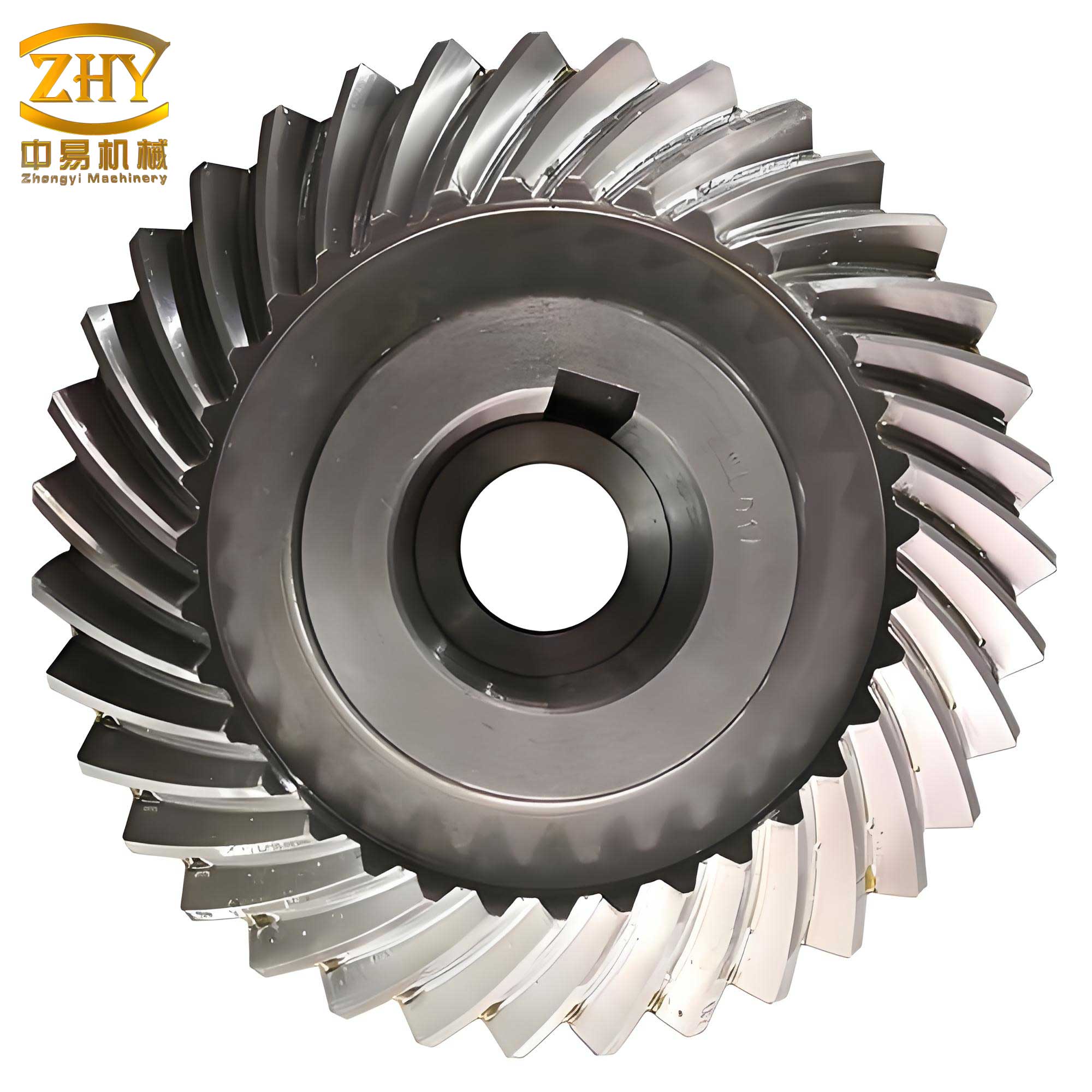
The forming process for spiral gear blanks begins with billet preparation, followed by hot extrusion. The billet is typically a cylindrical piece cut from a bar stock, heated to a suitable temperature to enhance plasticity. In the combined forward-backward extrusion, the material is forced to flow simultaneously in opposite directions by a punch and die assembly, creating the desired gear shape in one operation. This method is advantageous for producing complex geometries like spiral gears, as it allows for efficient material distribution and reduced forging loads. The key challenge lies in designing the die geometry and selecting optimal process parameters to ensure complete filling of the spiral gear teeth without overloading the equipment. To address this, I employ CAE simulation to model the extrusion process, analyzing factors such as temperature, friction, strain rate, and die design.
For the simulation, I selected DEFORM-2D, a finite element analysis (FEA) software widely used for metal forming applications. DEFORM-2D offers robust capabilities for simulating axisymmetric and plane-strain problems, making it suitable for the spiral gear extrusion, which can be approximated as an axisymmetric process in the initial blank forming stage. The software accounts for thermal-mechanical coupling, allowing us to study the interplay between temperature and deformation. The simulation setup involves defining the workpiece material, typically a medium-carbon steel like AISI 1045, commonly used for spiral gears due to its good hardenability and strength. The material properties are input as functions of temperature and strain rate, using constitutive models such as the Arrhenius-type equation for flow stress:
$$ \sigma = A \cdot \varepsilon^n \cdot \exp\left(\frac{Q}{RT}\right) $$
where $\sigma$ is the flow stress, $\varepsilon$ is the strain, $n$ is the strain-hardening exponent, $Q$ is the activation energy, $R$ is the gas constant, and $T$ is the absolute temperature. This formula helps in accurately predicting material behavior during hot extrusion of spiral gears.
The modeling process starts with creating a 2D axisymmetric geometry of the billet and die components. Since the spiral gear has helical teeth, the simulation focuses on the blank formation before gear teeth machining, assuming the extrusion shapes the basic flange and hub structure. The mesh is discretized with 2000 to 4000 quadrilateral elements, refined in regions of high deformation to capture detailed metal flow. Boundary conditions include symmetry along the central axis (Y=0), where radial displacement is constrained, and the die movement is prescribed with a velocity of 20 mm/s. The simulation runs for 200 steps with an incremental displacement of 0.63 mm per step, approximating the actual press operation on a 6300 kN hydraulic press. Contact conditions are defined with a shear friction model, where the friction factor is varied to study its effects. For thermal analysis, initial billet temperatures range from 900°C to 1200°C, and heat transfer coefficients account for conduction and convection with the environment.
Through simulation, I analyzed the influence of critical parameters on the forming of spiral gears. The primary outputs include metal flow patterns, temperature distribution, stress-strain fields, and extrusion force. To summarize the findings, I present data in tables and formulas, highlighting optimization opportunities. For instance, temperature plays a vital role in reducing flow stress and improving formability. The relationship between temperature and extrusion force for spiral gear forming can be expressed as:
$$ F_{ext} = k \cdot \sigma_y \cdot A \cdot f(T) $$
where $F_{ext}$ is the extrusion force, $k$ is a geometric factor, $\sigma_y$ is the yield stress, $A$ is the cross-sectional area, and $f(T)$ is a temperature-dependent function. Simulation results show that as temperature increases, the force decreases significantly, enabling lower press tonnage requirements.
| Temperature (°C) | Extrusion Force (kN) | Material Flow Completion |
|---|---|---|
| 900 | 7500 | Partial filling |
| 1000 | 6500 | Near complete |
| 1100 | 5500 | Complete |
| 1200 | 5000 | Complete, but risk of overheating |
From Table 1, it is evident that temperatures above 1100°C ensure full die filling for spiral gears while keeping the force within the 6300 kN press capacity. However, excessive temperature may lead to grain growth or scaling, so an optimal range of 1100°C to 1150°C is recommended. This aligns with the goal of minimizing energy input while achieving quality spiral gear blanks.
Friction is another crucial factor in spiral gear extrusion, affecting metal flow homogeneity and die life. The friction coefficient $\mu$ is varied in simulations, and its impact on extrusion force is quantified. Using the Coulomb friction model, the frictional stress $\tau_f$ is given by:
$$ \tau_f = \mu \cdot p $$
where $p$ is the contact pressure. Higher friction increases resistance to flow, potentially causing material accumulation in certain regions and increasing the load on dies. For spiral gears, which require uniform flow to form intricate features, controlling friction is essential. Simulation results are summarized in Table 2.
| Friction Coefficient ($\mu$) | Extrusion Force (kN) | Flow Uniformity (Qualitative) | Risk of Defects |
|---|---|---|---|
| 0.1 | 5200 | Excellent | Low |
| 0.2 | 5600 | Good | Low |
| 0.3 | 6000 | Moderate | Medium (e.g., folding) |
| 0.4 | 6800 | Poor | High (e.g., underfilling) |
The data indicates that a friction coefficient below 0.25 is ideal for spiral gear forming, as it balances force reduction with smooth material flow. In practice, this can be achieved using advanced lubricants like graphite-based compounds, which withstand high temperatures and reduce wear on spiral gear dies.
Die geometry optimization is also critical for spiral gear extrusion. The shape of the punch and cavity influences stress distribution and metal flow. Through iterative simulations, I adjusted fillet radii and taper angles to minimize stress concentrations. The von Mises stress $\sigma_{vm}$ in the die can be calculated as:
$$ \sigma_{vm} = \sqrt{\frac{(\sigma_1 – \sigma_2)^2 + (\sigma_2 – \sigma_3)^2 + (\sigma_3 – \sigma_1)^2}{2}} $$
where $\sigma_1, \sigma_2, \sigma_3$ are principal stresses. By ensuring $\sigma_{vm}$ remains below the die material’s yield strength, we extend tool life. For spiral gears, optimized die designs reduce extrusion force by 10-15% and improve filling of helical tooth profiles.
Microstructural evolution during hot extrusion of spiral gears is another aspect studied via simulation. DEFORM-2D allows prediction of grain size changes using models like the Avrami equation for recrystallization:
$$ X = 1 – \exp(-k t^n) $$
where $X$ is the recrystallized fraction, $k$ and $n$ are material constants, and $t$ is time. Fine-grained structures enhance the mechanical properties of spiral gears, such as fatigue resistance. Simulation results show that at 1100°C with moderate strain rates, dynamic recrystallization occurs, leading to a homogeneous microstructure suitable for subsequent heat treatment of spiral gears.
Based on the simulation insights, I optimized the process parameters for spiral gear blank production. The final setup involves a billet heated to 1120°C, a friction coefficient of 0.2, and a die geometry with optimized radii. The extrusion force is predicted to be around 5400 kN, well within the press capacity. This configuration ensures complete filling of the spiral gear blank shape, as visualized in the simulation. Compared to the traditional method, the new process reduces the billet weight from 8.5 kg to 7.0 kg per piece, representing a material saving of approximately 18%. This is calculated as:
$$ \text{Material Saving} = \frac{W_{old} – W_{new}}{W_{old}} \times 100\% = \frac{8.5 – 7.0}{8.5} \times 100\% \approx 17.6\% $$
Furthermore, the production time is drastically reduced from over 2 minutes per piece to just 30 seconds, boosting efficiency by 75%. This improvement stems from the single-step extrusion, eliminating intermediate operations often required in spiral gear manufacturing.
The economic and environmental benefits of this optimized process for spiral gears are substantial. Reduced material usage lowers raw material costs and decreases waste disposal needs. Energy consumption is minimized due to shorter heating times and lower extrusion forces. Additionally, the extended die life from reduced friction and optimized stresses reduces tooling expenses. These factors collectively enhance the sustainability of automotive component production, aligning with global trends toward green manufacturing.
In conclusion, the integration of CAE simulation in the forming process for spiral gears enables significant advancements. By systematically analyzing temperature, friction, and die design, we can achieve optimal parameters that ensure high-quality spiral gear blanks with minimal resource input. The combined forward-backward extrusion method proves effective for producing complex spiral gear geometries, offering material savings of 18% and efficiency gains of 75%. Future work could involve 3D simulations to capture the full helical teeth formation of spiral gears, or exploring advanced materials like alloys for enhanced performance. This approach underscores the value of digital twin technology in modern manufacturing, paving the way for smarter production of critical automotive components like spiral gears.
To further elaborate, the simulation methodology can be extended to other gear types, such as bevel or worm gears, using similar principles. The key formulas and tables presented here serve as a foundation for process optimization in metal forming. For instance, the general extrusion force equation for axisymmetric parts can be adapted for spiral gears by incorporating geometric complexity factors. Moreover, real-time monitoring during production could validate simulation predictions, creating a closed-loop system for continuous improvement. As automotive industries evolve toward electric vehicles, the demand for precision spiral gears in reducers and transmissions will only increase, making such optimized processes indispensable for competitive advantage.
In summary, this work demonstrates the power of CAE-driven optimization in transforming traditional manufacturing. By focusing on spiral gears, we highlight how simulation can address specific challenges in metal flow and die design, leading to tangible benefits in cost, quality, and sustainability. The insights gained here not only apply to spiral gears but also inform best practices for hot extrusion across various sectors, reinforcing the role of engineering simulation in innovation.