
Gears are fundamental components in mechanical power transmission systems. Among them, **miter gear** pairs, a specific type of bevel gear with a 1:1 ratio and typically a 90-degree shaft intersection angle, are crucial for transmitting motion and power between intersecting axes. While widely used in automotive, printing, and engineering machinery, the manufacturing of high-precision **miter gear**s has traditionally presented significant challenges, often resulting in vibration and noise due to inherent machining limitations. This article explores a transformative approach: the use of CNC Wire Electrical Discharge Machining (Wire EDM) for the direct and precise fabrication of **miter gear**s.
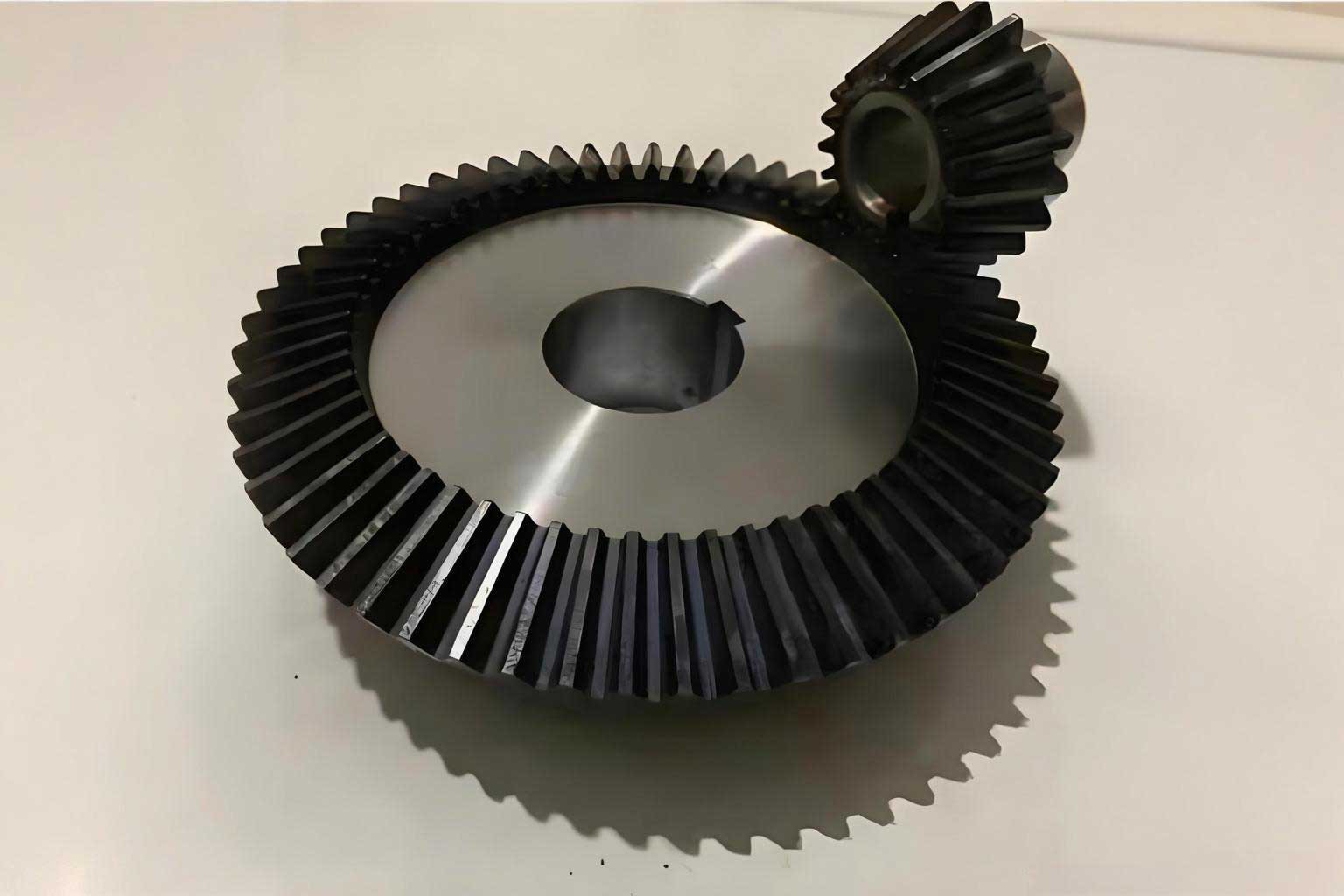
The geometry of a **miter gear** is based on its pitch cone. For a standard **miter gear** with shaft angle $\Sigma = 90^\circ$, the pitch cone angle $\delta$ is $45^\circ$. The key geometrical transformation for understanding its tooth profile is the concept of the “back cone” and the equivalent spur gear. The teeth of a bevel gear are defined on the back cone, which unwraps to form an imaginary spur gear known as the equivalent or virtual gear. The number of teeth on this equivalent gear, $z_v$, for a **miter gear** is given by:
$$ z_v = \frac{z}{\cos \delta} = \frac{z}{\cos 45^\circ} = z\sqrt{2} $$
where $z$ is the actual number of teeth on the **miter gear**. The module of this equivalent gear, $m_v$, is the outer module $m$ of the **miter gear**. Therefore, the tooth profile on the back cone (and consequently, the large end of the gear) corresponds to an involute profile of a spur gear with $z_v$ teeth and module $m$. This principle is the foundation for generating the tooth profile via Wire EDM.
Limitations of Conventional Miter Gear Manufacturing
Traditional methods for machining **miter gear**s involve mechanical cutting tools, each with distinct constraints. The table below summarizes the primary conventional techniques:
| Machine Type | Process Principle | Key Limitations | Typical Application |
|---|---|---|---|
| Bevel Gear Planer | Generating with paired planing tools. | Complex machine; limited to pre-hardened materials; high vibration affects finish. | Medium batch production of soft gears. |
| Two-Cutter Bevel Gear Milling Machine | Generating with two interlocked cutter heads. | Limited module and face width; curved tooth root. | Specific gear types. |
| Bevel Gear Broaching Machine | Form cutting with a large broaching wheel. | Extremely expensive, dedicated tooling for each gear. | Mass production only. |
| Revacycle or Coniflex Machines | Continuous generating with a tapered hob. | Complex kinematics and control; specialized tooling. | High-volume production. |
A common critical drawback across these methods is the inability to efficiently machine hardened materials. Achieving high precision and durability for a **miter gear** typically requires a secondary finishing operation like grinding after heat treatment, adding cost and complexity. Furthermore, achieving high geometric accuracy, especially for large-diameter **miter gear**s, is mechanically challenging, often relying on imported, expensive equipment.
The Wire EDM Alternative: A Non-Contact Process
Wire EDM is a non-traditional machining process that uses a continuously traveling thin wire (typically brass or coated copper) as an electrode. Material is removed through a series of rapid, controlled electrical discharges (sparks) between the wire and the conductive workpiece, submerged in a dielectric fluid. This process exerts negligible mechanical force, making it ideal for complex geometries, hard materials, and delicate features.
There are two main variants: High-Speed Wire EDM (HSWEDM), where the wire reciprocates at high speed (8-12 m/s), and Low-Speed Wire EDM (LSWEDM), where the wire moves unidirectionally at low speed (0.1-0.2 m/s). LSWEDM generally offers superior accuracy and surface finish. The fundamental material removal rate in EDM can be modeled by the discharge energy equation, but for gear profile generation, the kinematic synthesis is paramount.
CNC Wire EDM for Miter Gears: Principle and Machine Architecture
The patented method for machining a **miter gear** using Wire EDM involves a precise synchronization between the rotation of the gear blank and the radial movement of the wire electrode. The core idea is to physically simulate the “unwrapping” of the back cone to generate the involute profile on the large end of the gear tooth.
The machine setup is critical:
- The gear blank is mounted on a high-precision CNC rotary table.
- The wire guide system (upper and lower guides) is tilted so that the wire’s axis intersects the rotary axis at the **miter gear**’s pitch cone apex (the theoretical center of the back-cone sphere). The tilt angle equals the pitch cone angle $\delta$.
- The wire’s starting position is set such that its point of contact with the gear blank at the large end lies on the base circle of the equivalent spur gear.
The mathematical model governing the toolpath is derived from the geometry of the equivalent gear. As the rotary table (workpiece) turns through an angle $\theta$, the wire must move radially in the plane of the large end by an amount corresponding to the involute function. The radial distance $r(\theta)$ from the gear’s axis to the wire contact point on the large end profile is:
$$ r(\theta) = r_b \sqrt{1 + (\theta + \alpha)^2} $$
where $r_b$ is the base circle radius of the equivalent gear ($r_b = \frac{1}{2} m_v z_v \cos \phi$, with $\phi$ being the pressure angle), and $\alpha$ is a phase angle for starting position. For a standard full-depth tooth, the toolpath is segmented:
- Tooth Top Land: For rotation angle from 0 to $\theta_{top}$, the wire remains stationary at the addendum circle radius $r_a$. $$ \theta_{top} = \frac{\text{Top Land Arc Length}}{r_a} $$
- Active Flank (Involute): For $\theta_{top} < \theta < \theta_{root}$, the wire moves synchronously with rotation according to $r(\theta)$.
- Tooth Root/Fillet: For $\theta_{root} < \theta < \theta_{end}$, the wire may follow a trochoid or a defined root curve before retracing the opposite flank.
This synchronized motion—rotary axis (C-axis) and the linear axis controlling the wire’s radial position (U-axis or X-axis)—is executed under CNC command, precisely etching the tooth space. The entire **miter gear** is completed by indexing and repeating this process for each tooth. When the wire axis is set parallel to the rotary axis ($\delta = 0$), the same machine can produce high-precision spur gears or gear disks.
The machine structure comprises:
- A rigid base with a tank for dielectric fluid.
- A CNC tilting rotary table with high angular accuracy.
- A wire drive system with constant tension control.
- Precision linear axes (X, Y, Z) for positioning the wire guides and workpiece. The U-axis provides the critical radial infeed synchronized with rotation.
- A CNC system with specialized software for gear geometry calculation, toolpath generation, and multi-axis interpolation.
- A filtration and cooling unit for the dielectric fluid.
Technical Specifications and Performance Data
Wire EDM **miter gear** machines can be configured based on required precision, gear size, and production rate. The following tables outline typical specifications for High/Mid-Speed and Low-Speed Wire EDM variants.
| Model | Max. Gear OD (mm) | Max. Module | Max. Cone Distance (mm) | Best Achievable Accuracy (AGMA/DIN) | Best Surface Finish, Ra (μm) | Max. Cutting Speed (mm²/min) |
|---|---|---|---|---|---|---|
| MG-EDM200 | 200 | Unlimited* | 140 | Grade 5 | 1.0 – 1.6 | 180 |
| MG-EDM500 | 500 | Unlimited* | 350 | Grade 5 | 1.0 – 1.6 | 150 |
| MG-EDM1000 | 1000 | Unlimited* | 800 | Grade 5 | 1.0 – 1.6 | 120 |
*Practically limited by machine travel and wire stiffness.
| Model | Max. Gear OD (mm) | Max. Module | Max. Cone Distance (mm) | Best Achievable Accuracy (AGMA/DIN) | Best Surface Finish, Ra (μm) | Max. Cutting Speed (mm²/min) |
|---|---|---|---|---|---|---|
| MG-EDM200L | 200 | Unlimited* | 140 | Grade 3-4 | 0.2 – 0.4 | 80 |
| MG-EDM500L | 500 | Unlimited* | 350 | Grade 3-4 | 0.2 – 0.4 | 60 |
*Practically limited by machine travel and wire stiffness.
Advantages and Technological Impact
The adoption of Wire EDM for **miter gear** manufacturing offers profound advantages over conventional methods:
- Machining of Hardened and Exotic Materials: This is the most significant benefit. A **miter gear** can be fully hardened (e.g., HRC 60+) before the tooth cutting, eliminating post-heat-treatment distortion and the need for separate grinding. Materials notoriously difficult to cut mechanically, such as tool steels, stainless steels, and especially titanium alloys (critical for aerospace and defense), are machined with relative ease. The material removal mechanism is thermal, independent of material hardness.
- High Geometric Accuracy and Repeatability: The absence of cutting forces eliminates tool deflection and vibration. The toolpath is generated from a digital model and executed by high-resolution servo systems, enabling the production of **miter gear**s with true involute profiles, potentially exceeding AGMA Grade 5 precision. Multi-pass cutting (trimming) in Wire EDM further improves finish and accuracy.
- Simplified Tooling and Flexibility: A single spool of standard wire serves as the “tool” for any module, tooth count, or profile modification of the **miter gear**. There is no need for expensive, dedicated hobs, cutters, or broaches. Profile changes are made via software.
- Enabling Large and Micro Gearing: The process scales effectively. Very large-diameter **miter gear**s can be machined with the same precision as small ones, as long as the machine travels are sufficient. Conversely, fine-pitch **miter gear**s are also feasible.
- Reduced Environmental Impact: Wire EDM operates at lower power (typically 2-5 kW for the generator) compared to heavy gear cutting machines. Modern water-based dielectric fluids are more environmentally friendly than oil-based cutting fluids.
Challenges and Considerations
While promising, the technology is not without challenges. The material removal rate, though sufficient for high-value or hard-to-machine **miter gear**s, is lower than that of high-speed hobbing or milling for soft materials in high-volume production. A slight recast layer (white layer) is formed on the machined surface, which may require post-process polishing for ultra-high-cycle fatigue applications, though its characteristics are often superior to ground surfaces. Machine investment cost for a high-precision multi-axis Wire EDM system can be significant, though often lower than that of a large, high-end gear grinder or planer.
Conclusion
The integration of CNC Wire Electrical Discharge Machining into the realm of **miter gear** production represents a significant technological leap. It fundamentally decouples gear accuracy from material hardness and mechanical force limitations. By directly and precisely generating tooth profiles in fully hardened or exotic materials, this method simplifies the manufacturing process chain, enhances final component performance, and opens new design possibilities. For prototyping, small-to-medium batches, and manufacturing of high-performance **miter gear**s from challenging materials, Wire EDM stands as a superior and often indispensable solution. Its continued development promises to further elevate the precision and capabilities of power transmission systems across advanced industries, from aerospace and defense to high-performance automotive and precision machinery.