
In modern marine propulsion systems, the transmission mechanism plays a pivotal role in ensuring efficient power delivery and structural integrity. Among various gear types, helical gears are widely adopted due to their smooth operation, high load capacity, and reduced noise levels. This article focuses on the dynamic characteristics during mode switching in a combined drive system utilizing helical gears, which is critical for naval vessels requiring swift transitions between power sources such as gas turbines and diesel engines. I will explore the torsional dynamics, parameter sensitivities, and optimal switching conditions to enhance system performance and reliability. The analysis is grounded in a lumped-parameter model, validated through commercial software, and delves into transient behaviors during mode shifts.
The propulsion system of a ship, often termed the “heart,” integrates multiple components to drive propellers. A combined drive configuration, involving both gas turbines and diesel engines, offers flexibility and power redundancy. However, switching between these power sources—such as from gas turbine-only to combined gas turbine and diesel operation—induces transient dynamics that can impact vibration, noise, and longevity. Helical gears, with their angled teeth, are preferred in such high-power applications for their superior meshing characteristics. Yet, the complex interactions in a power-split arrangement demand thorough investigation. I aim to address this by developing a torsional dynamic model, identifying optimal switching parameters, and evaluating the influence of key factors like mesh stiffness and shaft compliance.
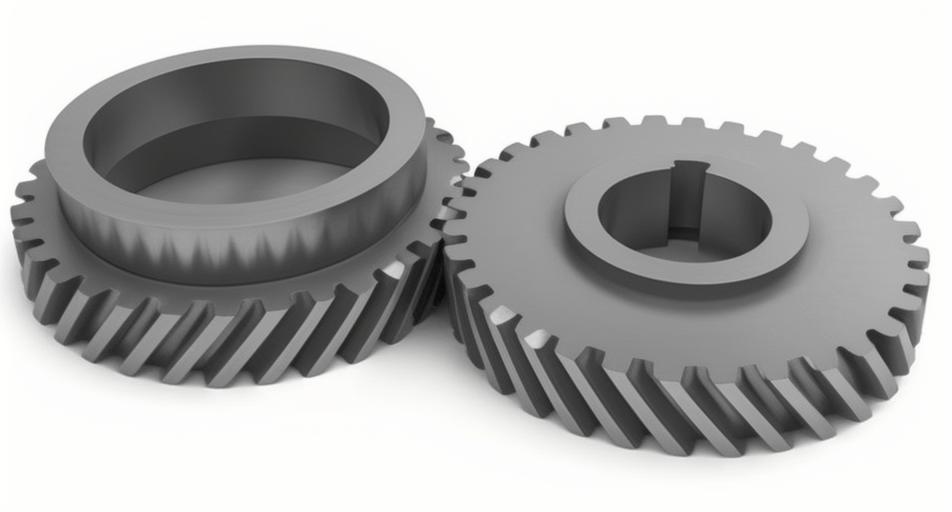
To begin, I consider a specific combined helical gear transmission system used in marine settings. This system features a power-split stage where a gas turbine input drives two parallel paths, converging at a common output stage that also incorporates a diesel engine input. The arrangement includes multiple helical gear pairs, designed to distribute torque efficiently. The geometry involves helical gears with specific helix angles, module sizes, and tooth counts, which influence dynamic behavior. For instance, the helical gears in the split stage have a helix angle of 17.1 degrees, while those in the combining stage use 15.6 degrees, affecting meshing forces and vibration patterns. The system’s three-dimensional layout shows how power flows through these helical gears, with critical junctions at the split and combine points.
I establish a pure torsional dynamic model for this system, treating each gear as a lumped inertia with rotational degrees of freedom. The model accounts for seven gears, leading to seven equations of motion based on Newton’s second law. The generalized coordinate vector is defined as:
$$ \mathbf{X} = [\theta_1, \theta_2, \theta_3, \theta_4, \theta_5, \theta_6, \theta_7] $$
where \(\theta_i\) represents the angular displacement of gear \(i\). The equations incorporate input torques from the gas turbine (\(T_1\)) and diesel engine (\(T_2\)), output torque (\(T_3\)), and dynamic meshing forces between helical gear pairs. For each gear pair \(j\), the dynamic meshing force \(F_{mj}\) is expressed as:
$$ F_{mj} = c_{mj} \dot{\lambda}_j + k_{mj} \lambda_j $$
Here, \(c_{mj}\) is the mesh damping, \(k_{mj}\) is the time-varying mesh stiffness—a key property of helical gears—and \(\lambda_j\) is the relative displacement along the line of action, given by:
$$ \lambda_1 = (r_{b1}\theta_1 – r_{b2}\theta_2)\cos\beta_1 – e_1 $$
$$ \lambda_2 = (r_{b1}\theta_1 – r_{b4}\theta_4)\cos\beta_1 – e_2 $$
$$ \lambda_3 = (r_{b3}\theta_3 – r_{b6}\theta_6)\cos\beta_2 – e_3 $$
$$ \lambda_4 = (r_{b5}\theta_5 – r_{b6}\theta_6)\cos\beta_2 – e_4 $$
$$ \lambda_5 = (r_{b7}\theta_7 – r_{b6}\theta_6)\cos\beta_2 – e_5 $$
In these equations, \(r_{bi}\) denotes base circle radii, \(\beta_1\) and \(\beta_2\) are helix angles for split and combine stages, respectively, and \(e_j\) represents static transmission errors. The equations of motion for each gear are derived considering these meshing forces and shaft torsional stiffness. For example, for gear 1 (gas turbine input):
$$ I_1 \ddot{\theta}_1 + r_{b1} F_{m1} \cos\beta_1 + r_{b1} F_{m2} \cos\beta_1 = T_1 $$
where \(I_1\) is the mass moment of inertia. Similar equations apply to other gears, with coupling terms for twin-shaft connections. The model assumes linear stiffness and damping, but captures time-varying effects through \(k_{mj}\), which is crucial for helical gears due to their gradual tooth engagement.
Key parameters, including inertias, stiffnesses, and damping, are calculated based on material properties and geometry. For helical gears, the time-varying mesh stiffness is derived using analytical or numerical methods, often via software like MASTA. I compute inertias using the formula:
$$ I_i = \frac{1}{2} \rho B_i \frac{\pi d_i^4}{16} $$
where \(\rho\) is material density (7850 kg/m³ for steel), \(B_i\) is face width, and \(d_i\) is pitch diameter. Mesh stiffness for helical gear pairs is obtained as Fourier series to represent periodic variations:
$$ k(t) = a_0 + \sum_{l=1}^{3} a_l \cos(l\omega t + \phi) + \sum_{l=1}^{3} b_l \sin(l\omega t + \phi) $$
Here, \(\omega\) is mesh frequency, and \(\phi\) is initial phase determined by gear positioning. Parameters for split and combine stage helical gears are summarized in Table 1.
| Parameter | Split Stage Gears (1, 2, 4) | Combine Stage Gears (3, 5, 6, 7) |
|---|---|---|
| Number of Teeth | 43 (gear 1), 132 (gears 2/4) | 33 (gears 3/5/7), 117 (gear 6) |
| Normal Module (mm) | 4.5 | 5.0 |
| Pressure Angle (degrees) | 20 | 20 |
| Helix Angle (degrees) | 17.1 | 15.6 |
| Face Width (mm) | 110 (gear 1), 100 (gears 2/4) | 120 (gears 3/5/7), 110 (gear 6) |
| Base Circle Radius (m) | Calculated from geometry | Calculated from geometry |
Mesh damping is estimated using:
$$ c_{mj} = 2\xi_1 \sqrt{k_{\text{mean},j} m_j} $$
with \(\xi_1 = 0.07\) as damping ratio, and \(m_j\) as equivalent mass. Twin-shaft torsional stiffness \(k_s\) is computed from material mechanics, and its damping \(c_s\) is:
$$ c_s = 2\xi_2 \sqrt{k_s \left( \frac{1}{I_2} + \frac{1}{I_3} \right)} $$
where \(\xi_2 = 0.04\). These parameters form the basis for dynamic simulations.
To validate the model, I compare results with MASTA software, a commercial tool for gear analysis. Under identical conditions—gas turbine torque of 7200 Nm, diesel torque of 0 Nm, and output torque of 78362.8 Nm—the dynamic transmission error (DTE) spectra from both methods show close agreement. For instance, at 3000 rpm, harmonic frequencies match within 3% error, confirming model accuracy. This validation step ensures that subsequent analyses on helical gear dynamics are reliable.
Next, I analyze the mode switching process from gas turbine-only to combined operation. This involves engaging the diesel engine via a clutch over 0.5 seconds, with its torque ramping linearly. The goal is to find optimal switching conditions that minimize vibration, quantified by the overall dynamic transmission error (ODTE):
$$ \text{ODTE} = \sqrt{ \frac{1}{N} \sum_{m=1}^{N} (\text{EDT}_{m+1} – \text{EDT}_m)^2 } $$
where EDT is instantaneous dynamic transmission error. I vary the gas turbine speed prior to switching and observe ODTE for each helical gear pair. Results indicate that vibration in split-stage helical gears is sensitive to speed, with peaks at sub-harmonics of mesh frequency. At 2250 rpm, vibration is minimized across both split and combine stages, making it the optimal switching speed. Similarly, for diesel engine torque, varying input torque at this speed shows that 3100 Nm yields the lowest vibration for combine-stage helical gears, particularly for the pair involving the diesel input. Table 2 summarizes these optimal values.
| Parameter | Optimal Value | Effect on Vibration |
|---|---|---|
| Gas Turbine Speed (gear 1) | 2250 rpm | Minimizes ODTE in split-stage helical gears |
| Diesel Input Torque (gear 7) | 3100 Nm | Reduces vibration in combine-stage helical gears |
With optimal conditions identified, I investigate how mesh stiffness and shaft torsional stiffness affect transient dynamics during switching. Mesh stiffness \(k_{mj}\) is varied relative to a base value \(K_m\). For helical gears, stiffness influences contact deflection and shock absorption. Simulations show that increasing mesh stiffness up to 1.2 times \(K_m\) reduces transient vibration duration and amplitude, especially for combine-stage helical gears. Beyond this range, split-stage helical gears experience secondary vibration peaks, indicating non-linear effects. The relationship can be expressed via a dimensionless stiffness factor \(\alpha = k_{mj} / K_m\), with recommended \(\alpha \in [1, 1.2]\).
To quantify, I compute ODTE for different stages under varying \(\alpha\). For example, for gear pair 3 (a combine-stage helical gear), ODTE decreases by approximately 30% when \(\alpha\) increases from 0.5 to 1.2. This is attributed to enhanced load distribution in helical gears under higher stiffness. However, excessive stiffness (\(\alpha > 1.5\)) can lead to resonant conditions. The dynamics are captured by modifying the meshing force equation:
$$ F_{mj} = c_{mj} \dot{\lambda}_j + \alpha K_m f(t) \lambda_j $$
where \(f(t)\) represents the time-varying component from Fourier series.
Shaft torsional stiffness \(k_s\) is another critical factor, affecting phase relationships between gears. Varying \(k_s\) relative to a base value \(K_n\) shows that vibration in helical gears is insensitive beyond 0.8\(K_n\). Specifically, ODTE for combine-stage helical gears drops sharply as \(k_s\) increases to 0.8\(K_n\), then plateaus. This suggests that shafts need only a minimum stiffness to ensure dynamic stability. The torsional dynamics involve equations like:
$$ I_2 \ddot{\theta}_2 + c_s (\dot{\theta}_2 – \dot{\theta}_3) + k_s (\theta_2 – \theta_3) – r_{b2} F_{m1} \cos\beta_1 = 0 $$
where \(k_s = \beta K_n\) with \(\beta \geq 0.8\). Table 3 summarizes these parametric influences.
| Parameter | Variation Range | Effect on Helical Gears | Recommendation |
|---|---|---|---|
| Mesh Stiffness (\(\alpha\)) | 0.5 to 2.0 times base | Reduces vibration up to 1.2\(\times\); beyond causes peaks | Maintain \(\alpha \in [1, 1.2]\) |
| Torsional Stiffness (\(\beta\)) | 0.5 to 2.0 times base | Vibration decreases until 0.8\(\times\), then stable | Ensure \(\beta \geq 0.8\) |
The transient response during mode switching is further analyzed through time-domain simulations. For helical gears in the split stage, dynamic transmission error shows minor fluctuations at switch initiation and completion, dampened by higher mesh stiffness. In contrast, combine-stage helical gears exhibit larger oscillations, which settle faster with optimized stiffness. The diesel-involved helical gear pair undergoes a sign change in DTE as torque builds, reflecting load transfer. These behaviors underscore the importance of helical gear design in managing transients.
In conclusion, this analysis highlights the dynamic intricacies of combined helical gear transmission systems during mode switching. I developed a validated torsional model that reveals optimal switching speeds and torques, emphasizing the role of helical gears in vibration control. Key findings include: an optimal gas turbine speed of 2250 rpm and diesel torque of 3100 Nm; mesh stiffness should be enhanced within 1 to 1.2 times base values to mitigate vibration; and shaft torsional stiffness must exceed 0.8 times base to ensure stability. These insights aid in designing robust marine propulsion systems, leveraging the advantages of helical gears for smooth power transitions. Future work could extend to non-linear effects or experimental validation, but the current framework provides a solid foundation for optimizing helical gear dynamics in complex drive scenarios.