
In mechanical engineering, gear drives are pivotal for transmitting motion and power between intersecting shafts, with miter gears—a specific type of straight bevel gear where the shaft angle is 90 degrees and the gear ratio is 1:1—being widely used in applications requiring right-angle power transmission. Traditional design methods often treat influencing factors such as load, dimensions, manufacturing processes, and testing conditions as deterministic variables. However, in reality, these factors exhibit both randomness and fuzziness, characterized by discrete values and uncertain boundaries. To address this, integrating reliability theory, fuzzy mathematics, and modern optimization techniques offers a more rational, scientific, and accurate approach. This article presents a comprehensive fuzzy reliability optimal design methodology for miter gear drives, leveraging first-person insights to detail the analytical framework, mathematical modeling, and practical implementation. By incorporating probabilistic stress distributions and fuzzy strength constraints, we aim to minimize gear volume while ensuring high reliability, with a focus on repeatedly emphasizing the relevance of miter gears in various industrial contexts.
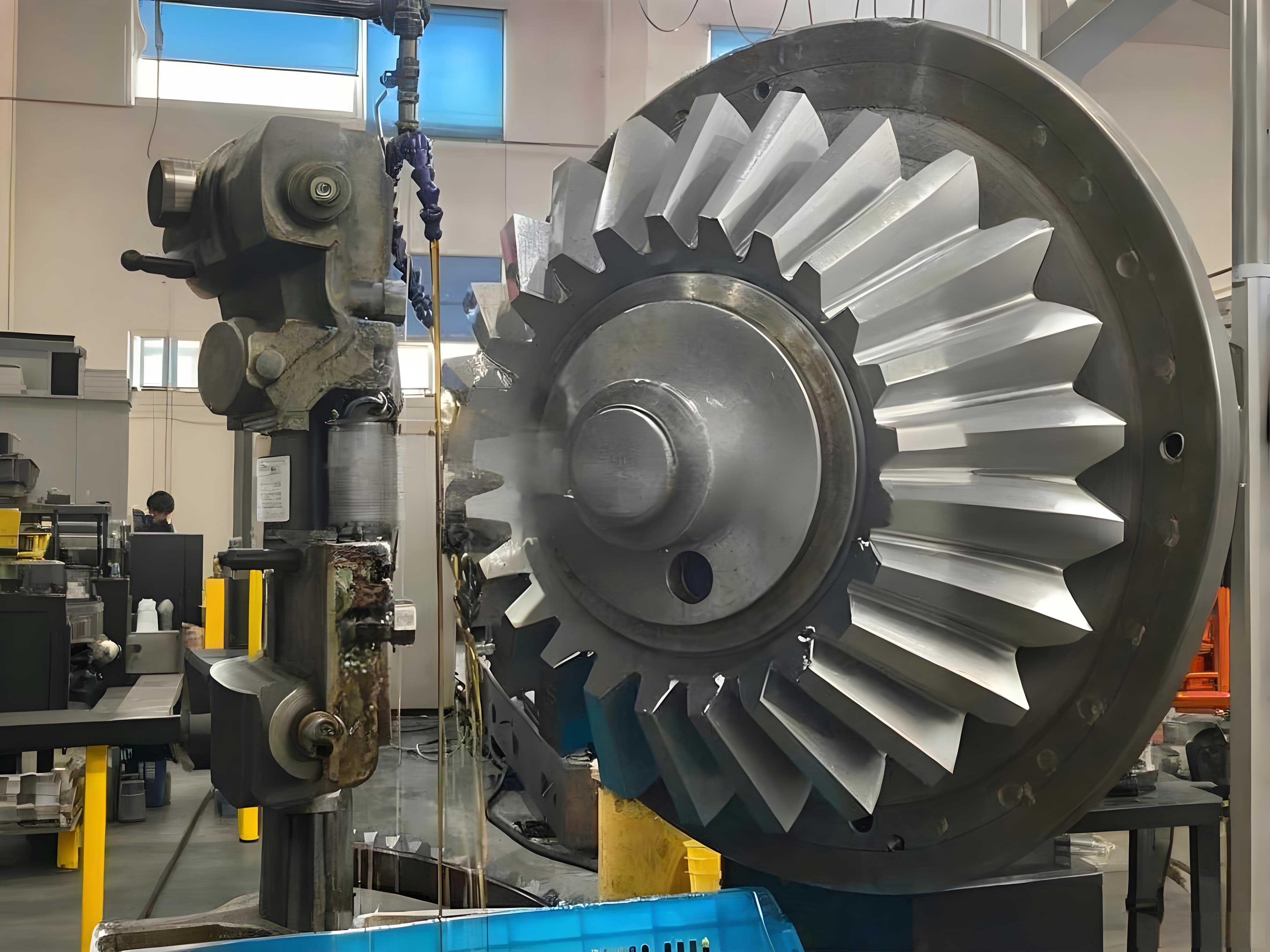
The core of fuzzy reliability design lies in modeling stress as a random variable following a specific distribution and strength as a fuzzy variable represented by a membership function. For miter gear drives, common failure modes include fatigue pitting and tooth breakage, primarily driven by contact fatigue stress and bending stress. These stresses are treated as normally distributed random variables, with their probability density functions given by:
$$ f(x) = \frac{1}{\sqrt{2\pi}S} \exp\left(-\frac{(x – \bar{\sigma})^2}{2S^2}\right) $$
where $\bar{\sigma}$ is the mean stress and $S$ is the standard deviation. The randomness arises from variations in load, material properties, and operational conditions, which are inherent in miter gear applications. Conversely, the allowable stress (strength) is considered a fuzzy variable due to uncertainties in material behavior, manufacturing tolerances, and environmental factors. A membership function $\mu(x)$ characterizes this fuzziness; for instance, a decreasing semi-trapezoidal distribution is often employed:
$$ \mu(x) =
\begin{cases}
1 & 0 \leq x \leq a_1 \\
\frac{a_2 – x}{a_2 – a_1} & a_1 < x \leq a_2 \\
0 & a_2 < x
\end{cases} $$
Here, $a_1$ represents the conventional allowable stress $[\sigma]$, and $a_2 = \beta [\sigma]$ with $\beta$ ranging from 1.05 to 1.3, determined via expansion coefficient methods to account for empirical ambiguities in miter gear performance. The fuzzy reliability $R$ is then computed by integrating the product of the membership function and stress probability density function over all possible values:
$$ R = \int_{-\infty}^{+\infty} \mu(x) f(x) \, dx $$
Substituting the expressions yields a closed-form solution:
$$ R = \frac{1}{a_2 – a_1} \left\{ (a_2 – \bar{\sigma}) \Phi\left(\frac{a_2 – \bar{\sigma}}{S}\right) – (a_1 – \bar{\sigma}) \Phi\left(\frac{a_1 – \bar{\sigma}}{S}\right) – S \cdot \frac{1}{\sqrt{2\pi}} \left[ e^{-\frac{(a_1 – \bar{\sigma})^2}{2S^2}} – e^{-\frac{(a_2 – \bar{\sigma})^2}{2S^2}} \right] \right\} $$
where $\Phi(\cdot)$ denotes the cumulative distribution function of the standard normal distribution, evaluable through numerical integration. This fuzzy reliability metric forms the basis for constraint formulation in optimizing miter gear designs, ensuring robustness against uncertainties.
To construct a fuzzy reliability optimal design model for miter gear drives, we define design variables, an objective function, and constraints. The design variables are independent parameters significantly influencing the optimization goal; for a miter gear drive with predetermined torque, speed, and transmission ratio, we select the module $m$, pinion tooth number $Z_1$, and face width coefficient $\psi_R$. Thus, the design vector is:
$$ \mathbf{X} = [x_1, x_2, x_3]^T = [m, Z_1, \psi_R]^T $$
The objective is to minimize the total volume of the miter gear pair, reducing material usage and weight—a critical consideration in compact miter gear systems. The volume is approximated as the frustum between the pitch cone’s large and small ends, leading to:
$$ f(\mathbf{X}) = \frac{\pi}{8} u (1 + u) m^3 Z_1^2 \psi_R \left(1 – \psi_R + \frac{\psi_R^2}{3}\right) $$
where $u$ is the gear ratio (often 1 for miter gears, but generalized here), and terms like cone angles are derived from geometric relations. This objective function balances efficiency and economy in miter gear production.
Constraints ensure design feasibility and reliability. First, fuzzy reliability constraints for contact and bending strengths must exceed a specified threshold $R_0$, typically above 0.995 for high-reliability miter gear applications. The contact stress mean and standard deviation are:
$$ \bar{\sigma}_H = Z_E Z_H \sqrt{\frac{4K T_1}{\psi_R u}} \cdot \frac{1}{1 – 0.5\psi_R} \cdot \frac{1}{(m Z_1)^{3/2}} $$
$$ S_H = C_H \bar{\sigma}_H $$
with $Z_E$ as the material elasticity coefficient, $Z_H$ as the zone factor, $K$ as the load factor, $T_1$ as the pinion torque, and $C_H$ as the contact stress variation coefficient (0.02–0.09). The contact fuzzy reliability $R_H$ is computed using the earlier formula. Similarly, bending stress means for pinion and gear are:
$$ \bar{\sigma}_{F1} = \frac{4K T_1 Y_{F1} Y_{S1}}{\psi_R (1 – 0.5\psi_R)^2 m^3 Z_1^2 \sqrt{u^2 + 1}} $$
$$ \bar{\sigma}_{F2} = \frac{4K T_1 Y_{F2} Y_{S2}}{\psi_R (1 – 0.5\psi_R)^2 m^3 Z_1^2 \sqrt{u^2 + 1}} $$
where $Y_F$ and $Y_S$ are tooth form and stress concentration factors, and $S_F = C_F \bar{\sigma}_F$ with $C_F$ as the bending stress variation coefficient (0.04–0.08). The bending fuzzy reliabilities $R_{F1}$ and $R_{F2}$ are derived analogously. Additional geometric and practical constraints include:
$$ g_1(\mathbf{X}) = R_H – R_0 \geq 0 $$
$$ g_2(\mathbf{X}) = R_{F1} – R_0 \geq 0 $$
$$ g_3(\mathbf{X}) = R_{F2} – R_0 \geq 0 $$
$$ g_4(\mathbf{X}) = Z_1 – 13 \geq 0 $$
$$ g_5(\mathbf{X}) = 36 – Z_1 \geq 0 $$
$$ g_6(\mathbf{X}) = \psi_R – 0.25 \geq 0 $$
$$ g_7(\mathbf{X}) = 0.333 – \psi_R \geq 0 $$
$$ g_8(\mathbf{X}) = m(1 – 0.5\psi_R) – 1.5 \geq 0 $$
These constraints cover tooth count limits, face width ratios, and minimum module requirements, tailored for miter gear durability. To solve this nonlinear constrained optimization problem, an interior penalty function method is employed, handling the fuzzy reliabilities iteratively. Discrete variables like $m$ and $Z_1$ are rounded post-optimization, and empirical coefficients are fitted using least-squares approximations from standard gear data charts.
For illustration, consider a miter gear drive design scenario with a shaft angle of 90°, pinion torque $T_1 = 19500 \, \text{N·m}$, speed $n_1 = 740 \, \text{rad/min}$, gear ratio $u = 2$ (though miter gears often have $u=1$, this example generalizes for broader applicability), and moderate shock loads. The pinion is overhung, and materials are 45# steel with hardness values as specified. The target fuzzy reliability is $R_0 \geq 0.995$. Applying the model yields optimized parameters, with results summarized in the table below, comparing fuzzy reliability optimal design against traditional deterministic methods. Note that in typical miter gear setups, the focus on right-angle transmission emphasizes compactness, making volume minimization even more critical.
| Design Parameter | Fuzzy Reliability Optimal Design | Traditional Design |
|---|---|---|
| Module, $m$ (mm) | 2.75 (rounded) | 2.75 |
| Pinion Tooth Number, $Z_1$ | 28 (rounded) | 30 |
| Face Width Coefficient, $\psi_R$ | 0.29 | 0.271 |
| Total Gear Volume (mm³) | 230227.5 | 270155.7 |
| Fuzzy Reliability, $R$ | >0.995 (ensured) | Not explicitly considered |
The volume reduction of approximately 14.8% demonstrates the efficacy of fuzzy reliability optimization for miter gear drives. This improvement stems from accurately modeling uncertainties, allowing for more aggressive design choices without compromising safety. Further sensitivity analyses can be conducted by varying fuzzy parameters, such as the membership function bounds or variation coefficients, to assess robustness in miter gear performance under fluctuating operational conditions.
Expanding on the mathematical intricacies, the optimization algorithm involves constructing a penalty function $P(\mathbf{X}, r)$ that combines the objective and constraints:
$$ P(\mathbf{X}, r) = f(\mathbf{X}) + r \sum_{i=1}^{8} \frac{1}{g_i(\mathbf{X})} $$
where $r$ is a penalty parameter reduced iteratively to steer solutions toward feasibility. The fuzzy reliability computations require efficient evaluation of $\Phi(\cdot)$; using numerical integration techniques like Simpson’s rule ensures accuracy. For miter gear applications, additional constraints might include wear resistance, thermal effects, or noise limitations, but these are omitted here for simplicity. The design process highlights how miter gears, with their unique geometry, benefit from fuzzy reliability methods by mitigating over-conservatism in traditional approaches.
To delve deeper into the fuzzy aspects, selecting an appropriate membership function is crucial. While the decreasing semi-trapezoidal form is common, alternatives like Gaussian or triangular functions could be explored for miter gear strength representations, each impacting the fuzzy reliability outcome. The parameter $\beta$ in $a_2 = \beta [\sigma]$ introduces design flexibility; for instance, a higher $\beta$ accommodates more uncertainty, potentially reducing volume further but requiring validation through experimental data on miter gear fatigue limits. Moreover, the stress variation coefficients $C_H$ and $C_F$ are derived from statistical analyses of miter gear testing, reflecting real-world dispersions in load distribution and material homogeneity.
In practice, implementing this fuzzy reliability optimal design for miter gear drives involves computational tools. Algorithms can be coded in platforms like MATLAB or Python, integrating fuzzy logic libraries for membership function handling and optimization solvers for penalty methods. The table below summarizes key coefficients and their ranges used in the model, emphasizing their relevance to miter gear design:
| Coefficient | Symbol | Typical Range | Remarks for Miter Gears |
|---|---|---|---|
| Load Factor | $K$ | 1.0–2.0 | Depends on mounting and shock levels in miter gear systems |
| Contact Stress Variation | $C_H$ | 0.02–0.09 | Lower for precision-machined miter gears |
| Bending Stress Variation | $C_F$ | 0.04–0.08 | Influenced by tooth root geometry of miter gears |
| Membership Expansion | $\beta$ | 1.05–1.30 | Higher values for less certain miter gear material data |
| Face Width Coefficient | $\psi_R$ | 0.25–0.333 | Ensures adequate strength for miter gear teeth |
Beyond the example, this methodology can be adapted for other gear types, but miter gears present distinct challenges due to their intersecting axes and equal tooth counts, making volume minimization particularly impactful. Future work could incorporate multi-objective optimization, balancing volume, cost, and efficiency, or extend fuzzy reliability to dynamic loading conditions common in miter gear applications like automotive differentials or industrial machinery.
In conclusion, fuzzy reliability optimal design offers a superior paradigm for miter gear drives by embracing the inherent randomness and fuzziness of design parameters. Through detailed mathematical modeling, including stress distributions, fuzzy strength representations, and volume minimization objectives, this approach yields significant material savings—exemplified by a 14.8% volume reduction—while maintaining high reliability standards. The use of penalty function optimization and numerical integrations ensures practical feasibility. As industries demand more efficient and compact power transmission solutions, adopting such advanced design techniques for miter gears and similar components will become increasingly vital, fostering innovation in mechanical systems.